


Berlin looks manageable on a map. The center seems compact, public transport looks dense, and travel blogs cheerfully promise you can "do" the city in a couple of days. On my most recent trip in September 2026, I believed them. I booked timed tickets back to back, chose Alexanderplatz as my base, and assumed the S-Bahn and U-Bahn would magic me between Charlottenburg, Kreuzberg, Museum Island and the East Side Gallery in no time. By the end of day three, I had seen a lot of train platforms and very little of Berlin’s actual life.
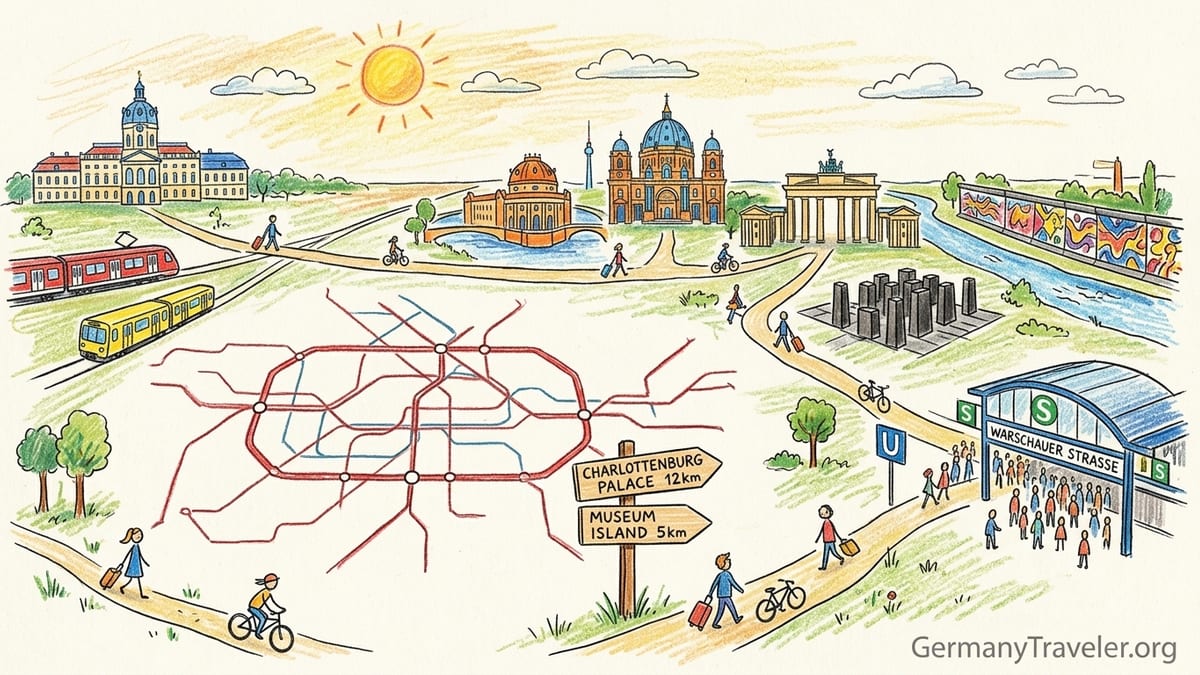
Berlin Is Wide, Not Tall: Why the Map Tricks You
What I had forgotten before landing at BER Airport is that Berlin is one of Europe’s largest cities by area, spread across zones A and B of the transport network, with suburbs stretching into zone C. The central ring where most visitors stay looks tight on a schematic transport map, but in real distance it can be over 12 kilometers from Charlottenburg Palace in the west to the East Side Gallery in Friedrichshain. On paper, a straight run on the S-Bahn across the Stadtbahn line seems simple. In practice, it means multiple walks to and from stations, packed trains at peak times, and a creeping sense that you are touring platforms rather than neighborhoods.
VisitBerlin’s own visitor material now admits that even 24 hours is not enough to explore the city properly and explicitly recommends focusing on individual neighborhoods instead of trying to “conquer” Berlin in one sweep. That guidance sounds conservative until you have crossed town a few times. On my first full day, I tried to squeeze Charlottenburg, Museum Island and Kreuzberg into a single daylight block. The result was roughly two and a half hours spent in transit and only one unhurried hour in Charlottenburg Palace’s park.
To put real numbers to it, the S-Bahn journey from Berlin-Charlottenburg station to Hackescher Markt, near Museum Island, can take around 20 to 25 minutes on the S3 or S5, not counting the 10-minute walk from Charlottenburg Palace to the station itself and time waiting on the platform. From Hackescher Markt to Warschauer Straße for the East Side Gallery is another 12 to 15 minutes by S-Bahn, plus a 10-minute walk to the murals along the Spree. On paper, these are short hops. Add security checks at museums, ticket queues, and the inevitable coffee stops, and your “quick” crossing of Berlin quietly eats an entire morning.
Day One: Criss-Crossing From Charlottenburg to Kreuzberg
My first mistake was treating Berlin like Vienna or Prague, cities where the historic core concentrates most sights within a walkable ring. I started my Monday in Charlottenburg, booking a 09:00 entry slot for Charlottenburg Palace. That seemed reasonable. The palace and gardens deserve two to three hours if you take the audio guide and wander the formal park. By 11:30, I was already power walking out of the gardens along Spandauer Damm, pushing to reach the S-Bahn at Berlin-Charlottenburg station.
From there, I took an S5 across the city to Friedrichstraße and then changed to a regional train that would drop me closer to Alexanderplatz, because my next timed entry on Museum Island was at 13:00. That combination of walking, waiting and riding came to about 40 minutes. I reached the colonnades of Museum Island just before 12:30, technically on schedule, but with barely enough time to find a snack and catch my breath before the first museum. My error was not just distance, but stacking appointments on opposite sides of the city without rounding up the travel time.
After racing through Old Masters and ancient sculptures, I then decided I “had” to see Kreuzberg in daylight and the East Side Gallery at golden hour. From Museum Island I walked to Hackescher Markt, squeezed onto an S-Bahn to Warschauer Straße, and then crossed the crowds on the pedestrian bridge, another ten minutes. I reached the start of the East Side Gallery around 16:00, already more tired than I wanted to admit. The plan had been to explore the murals, then walk through the riverside park, continue into Kreuzberg for an early dinner around Görlitzer Park, and finally head back to Alexanderplatz.
The reality: after about 40 minutes at the East Side Gallery and ten minutes trying to photograph fragments of art between tour groups, I gave up on Görlitzer Park. Instead, I walked back to Warschauer Straße, waited ten minutes for the U1, rode into Kreuzberg, and got off early, lured by an attractive side street. By the time I found a restaurant, I had spent almost three hours of the day in transit. The evening ended with a 25-minute U-Bahn journey back to Alexanderplatz and another ten-minute walk to the hotel. A day that looked like three neat points on a map had dissolved into a blur of tracks.
Museum Island: The Hidden Time Sink of Timed Tickets
My second major mistake was underestimating how draining Museum Island can be, especially with timed tickets packed too closely together. On my second day, I booked a 10:00 entry for the Pergamon’s Panorama exhibition and a 13:00 slot for the Neues Museum. Both are on Museum Island itself, so it felt efficient. What I overlooked was the mental and physical toll of back-to-back heavy history and the practical details of access and security.
Arriving from Alexanderplatz on foot takes about 15 minutes, crossing busy junctions and weaving through tour groups heading for the Berlin Cathedral. I arrived at 09:45, queued for security, and was inside just after 10:00. The Panorama exhibition and associated galleries easily fill ninety minutes if you read the panels and pause for the reconstructed scenes. Emerging just after 11:30, hungry and mentally saturated, I assumed I could grab a quick snack and rest before the 13:00 Neues Museum slot.
Instead, I spent 20 minutes queuing for a sandwich at a cafe near Lustgarten, then another 15 minutes waiting at the Neues Museum entrance while staff managed the incoming time slot. By 13:15, I was back in another multi-floor journey through ancient Egypt and prehistoric collections. By 15:00, my legs and concentration were gone, but my original plan still bizarrely included a late-afternoon visit to the DDR Museum near Alexanderplatz and a walking tour around Unter den Linden.
That afternoon is when Berlin’s geography really snapped into focus. I had technically moved very little, only bouncing between buildings on Museum Island and its edges, but I had underestimated both the internal distances within the complex and how museum fatigue accumulates. VisitBerlin and the Museum Island ticketing materials quietly warn that you should allow several hours per museum and suggest spreading visits across multiple days if you buy a combined pass. The advice is not marketing fluff. After five hours of near-continuous exhibitions and staircases, the idea of then crossing town to another district felt absurd.
Alexanderplatz Is Not the Center of Everything
I chose Alexanderplatz as my base for a simple reason: it sits at the intersection of S-Bahn and multiple U-Bahn lines, with frequent trains to almost everywhere a first-time visitor wants to go. It felt like a safe, central bet. On some level it is. From Alexanderplatz, you can reach Charlottenburg in roughly 20 to 25 minutes by S-Bahn, Kreuzberg in 15 to 20 minutes by U8 or a combination of S-Bahn and U-Bahn, and Prenzlauer Berg with a short tram ride. It is a transport hub in the strictest sense.
What Alexanderplatz is not, however, is a relaxing or particularly charming place to come back to. It is a concrete square, busy at all hours, with chain stores, underpasses, and the rotating arms of the World Clock. After long days, the idea of changing trains here, climbing multiple flights, and pushing through crowds wore thin. Because I had positioned my hotel here, every evening involved at least one more transfer across this busy node, even when I was dining in calmer neighborhood centers like Savignyplatz or Bergmannkiez.
On the third day, the distance between Brandenburg Gate, the Holocaust Memorial, and my “home base” at Alexanderplatz finally bit. I spent the morning on a themed walking tour that wove from Pariser Platz through the memorial, past surviving stretches of the Wall, and toward Potsdamer Platz. It was a dense and emotional route. By the time the tour ended after 3 hours, I knew I should have retreated to a quiet cafe in the same area or wandered Tiergarten. Instead, locked into the idea that “everything runs through Alex,” I boarded yet another S-Bahn back there for a late lunch, only to return to the same government district two hours later for an evening dome visit at the Reichstag. I had spent almost an hour shuttling back and forth between areas that are, in walking terms, neighbors.
This habit of recentering on Alexanderplatz every few hours cost me most of an afternoon over the course of the trip. In a city with such distinct, self-contained neighborhoods, a hotel near Hackescher Markt, in Charlottenburg, or in Kreuzberg would have aligned better with how I actually spent my time. The lesson was simple: central on a rail map is not the same as central to your real itinerary.
Nightlife After Heavy Museum Days: A Recipe for Frustration
Like many visitors, I arrived in Berlin with vague dreams of sampling its nightlife, particularly in Friedrichshain and Kreuzberg. I pictured an easy transition from culture by day to bars and clubs by night. What my schedule overlooked was how exhausted I would be after history-heavy days and long cross-city journeys. On my second day, after the Museum Island double-header, I had penciled in an evening in Kreuzberg, starting with dinner around Kottbusser Tor and then drinks along Weserstraße in neighboring Neukölln.
The logistics looked simple. From Alexanderplatz, the U8 runs directly to Kottbusser Tor in around 15 minutes. In reality, leaving my hotel at 19:30, I waited almost 10 minutes for a train, stood in a crowded carriage, and emerged into one of the noisiest, most hectic junctions in the city. The energy that had thrilled me on a fresh afternoon visit now felt overwhelming. My legs were heavy from stairs and cobblestones, and the idea of another late night on my feet had lost its shine.
I pushed on, walking 20 minutes into Neukölln to reach a bar friends had recommended, only to realize that my last substantial meal had been a hurried sandwich near Lustgarten. The combination of low energy, residual museum emotions, and the friction of yet another cross-town transit made me call it quits around 22:00. I turned back toward Hermannplatz and caught the U7 to connect back to Alexanderplatz, another 30 minutes including transfers. The night out had been more about moving between points than enjoying any of them.
On a later evening, I tried a different strategy: starting the day in Friedrichshain, with a leisurely brunch near Boxhagener Platz, a slow stroll down to the East Side Gallery, then a relaxed early drink near the river before heading only a short way back to my hotel. The experience was transformative. By aligning my nightlife with the area I was already in, I cut transit time to a single 15-minute hop and actually had energy left to enjoy Berlin after dark.
Too Many WWII and Cold War Sites in One Stretch
Berlin’s history is one of the main reasons people visit, and on this trip I leaned into that, booking multiple WWII and Cold War experiences. The mistake was not the content, but the clustering. On my third day, I scheduled a morning visit to the Memorial to the Murdered Jews of Europe near Brandenburg Gate, followed by the Topography of Terror documentation center along the former Gestapo headquarters site, and a late afternoon time slot at the Berlin Wall Memorial along Bernauer Straße in the north.
The morning began at 09:30 at the Holocaust Memorial. The undulating concrete stelae and underground exhibition demand emotional presence and time. I spent almost two hours there, leaving shortly after 11:30. My plan was then to walk to Potsdamer Platz and continue on to the Topography of Terror, which is about 10 to 15 minutes away on foot. The documentation center is free and comprehensive, with indoor exhibits and an outdoor excavation along a surviving section of the Wall. Two more hours slipped by as I moved through its panels and photographs.
By 14:00, I had already absorbed an enormous amount of traumatic history. Instead of giving myself a break, I jumped onto the U2 at Potsdamer Platz, changed at Alexanderplatz, and took the U8 up to Bernauer Straße. Each segment was short, but the combined effect of transit and heavy content was punishing. I arrived at the Berlin Wall Memorial shortly after 15:00, technically with plenty of time before closing, but emotionally spent. The open-air site is lengthy and encourages slow reflection as you move along the preserved border strip and illustrative panels. I walked only a fraction before acknowledging that I could not take in more.
What stands out in hindsight is not the number of museums, but the absence of light in between. VisitBerlin increasingly promotes mixing historical sites with everyday urban experiences: a park, a neighborhood market, a lakeside stroll. I had done the opposite, stitching together the most intense historical memorials in a single day and then adding long U-Bahn rides between them. The result was a blur of sorrow and concrete, with little space to process what I had learned.
Underestimating Transfers: When U-Bahn, S-Bahn, Cycling and Walking Each Win
On maps, the dense tangle of colored lines suggests that Berlin’s public transport wipes out distance. It is true that a Berlin WelcomeCard or standard AB day ticket unlocks almost every U-Bahn, S-Bahn, tram and bus you will need in the core city. In 2026, the Berlin WelcomeCard for zones AB starts around 28.50 euros for 48 hours, rising with longer durations and zone ABC supplements, and includes discounts at many sights. That sounds like an invitation to hop on and off endlessly.
In practice, each hop comes with hidden overhead. Walking from Charlottenburg Palace to the S-Bahn is about 10 to 15 minutes. Changing from S-Bahn to U-Bahn at Zoologischer Garten or Alexanderplatz means climbing or descending multiple levels, navigating corridors, and sometimes waiting 5 to 8 minutes for the next train. Over a full day, these small segments combine into large chunks of lost time. On the day I tried to fit Charlottenburg, Museum Island and Kreuzberg into one schedule, I counted later that I had boarded nine separate trains and made four platform changes.
There were also times when cycling or simply walking would have been better. The stretch from Museum Island to the Brandenburg Gate, for example, is roughly a 15-minute walk along Unter den Linden, yet on my second day I descended into the U-Bahn at Museumsinsel station and took a one-stop ride just to “save time.” Any minutes saved on the train were lost in the stairs and waiting. Similarly, moving between Kreuzberg and Friedrichshain across the river near Oberbaum Bridge can be a scenic 15- to 20-minute walk, but I reflexively took the U1 and S-Bahn to avoid what looked like a long distance on my map.
By contrast, the north–south axis from Bernauer Straße to Kreuzberg is genuinely substantial, and here public transport earned its keep. On my heavy history day, the U8 from Bernauer Straße to Moritzplatz took about 15 minutes, a distance that would have been well over an hour on foot. The trick, I realized too late, is not to avoid trains, but to use them in deliberate, longer stretches instead of stringing together tiny hops. For intermediate links under 20 minutes on foot, walking or cycling with a rental bike or app-based scheme can feel both faster and more human.
A Better Way: One Geographic Cluster per Half-Day
By the time I boarded my flight home, my notebook was full of crossed-out plans and revised ideas. The core lesson from Berlin’s spread-out geography was not to see less, but to see smarter. If I were planning the same five days again, I would structure each half-day around a single geographic cluster, limiting myself to one major “anchor” sight and building everything else within a 20-minute walking or single-line public transport radius.
One example would be a Charlottenburg half-day: start late morning at Charlottenburg Palace, allow a full two hours for the interior and at least another hour in the gardens, then walk to the nearby Kurfürstendamm area for coffee and a slow wander among side streets rather than jumping straight back into the S-Bahn. From there, an easy trip to Savignyplatz for dinner would keep the entire day inside a small west Berlin bubble. Only in the evening would I use a longer S-Bahn ride back to wherever I was staying.
Another cluster could be Museum Island and its surroundings. Instead of booking two or three museums back to back, I would choose one heavyweight museum in the morning, then leave the island for lunch at Hackescher Markt or within the streets of Scheunenviertel, exploring independent shops and courtyards. The afternoon could be spent walking to the Brandenburg Gate and Tiergarten, or taking a leisurely Spree boat trip, rather than diving into another demanding exhibition. Only in the evening would I cross the city for nightlife, if I had the energy.
For Kreuzberg and Friedrichshain, I would dedicate an entire afternoon and evening to the area: starting with a late brunch or lunch near Görlitzer Park, walking over the canal, crossing Oberbaum Bridge to the East Side Gallery, then lingering along the river before drifting into Friedrichshain’s streets for dinner and drinks. In such a plan, the S-Bahn and U-Bahn appear at the edges, not in the middle of everything. They become the bookends that bring you into a neighborhood and take you back out, rather than the threads tying every single hour together.
The Takeaway
Berlin is not difficult to navigate, but it is far larger, flatter and more dispersed than many visitors expect. My biggest mistakes on this recent trip all came from underestimating the combined effect of distance, transfers and content. Crossing from Charlottenburg to Museum Island, then on to Kreuzberg, felt logical when I drew lines on a map the night before. In lived time, it meant hours spent changing trains and walking to and from stations. Booking timed museum entries too close together turned cultural highlights into endurance tests. Choosing Alexanderplatz as an all-purpose base amplified every transfer and ensured that I passed through the same hectic hub even when my sights clustered elsewhere.
The emotional dimension mattered just as much as the geography. Stacking multiple WWII and Cold War memorials in a single day left me numb and unable to process what I had seen. Scheduling ambitious nightlife after heavy museum days resulted in early exits and long rides home. The city’s official tourism materials are increasingly clear that neighborhood-focused exploration is the way to go. Having ignored that advice once, I would now lean into it entirely.
If you are planning your own trip, think in half-days and clusters. Give each block a single anchor sight, one history-heavy element at most, and protect open time for simply sitting in a cafe, wandering a side street, or lying on the grass in Tempelhofer Feld or Tiergarten. Use Berlin’s excellent transport system to bridge morning and evening neighborhoods, not to knit every hour together. When you do, the city that once felt exhausting and scattered begins to reveal itself as a collection of distinct, walkable worlds, each deserving of your unhurried attention.
FAQ
Q1: Is 24 hours really not enough time for Berlin?
VisitBerlin itself now advises that 24 hours is not enough to explore the city properly. In a single day you can sample one or two neighborhoods and perhaps one major museum, but you will barely scratch the surface and will likely spend a disproportionate amount of time on public transport.
Q2: How much time should I allow to travel between Charlottenburg and Museum Island?
From Charlottenburg Palace, walking to Berlin-Charlottenburg station, taking an S-Bahn across the city and then walking from Hackescher Markt to Museum Island typically takes around 40 to 50 minutes door to door. It is wise to round this up to an hour in your schedule to allow for waiting times and crowds.
Q3: Is Alexanderplatz a good place to stay for first-time visitors?
Alexanderplatz is convenient in terms of S-Bahn and U-Bahn connections, but it is busy, concrete-heavy and not especially atmospheric. If you plan to spend most of your time in the west or in Kreuzberg and Friedrichshain, a base near Zoologischer Garten, Savignyplatz, Hackescher Markt or in Kreuzberg itself can reduce transfers and provide a more pleasant neighborhood feel.
Q4: How many museums on Museum Island can I realistically visit in one day?
If you are genuinely interested in the collections and not just passing through, one major museum in the morning and possibly a second lighter stop in the afternoon is usually the limit before fatigue sets in. Allow at least two to three hours for a flagship museum such as the Neues Museum or the Pergamon-related exhibitions, plus breaks.
Q5: Is the Berlin WelcomeCard worth it for getting around such a spread-out city?
The Berlin WelcomeCard combines unlimited public transport in zones AB or ABC with discounts at many attractions. For visitors who plan multiple journeys each day across the city and intend to visit paid sights, it can be good value. If you are staying mostly within one or two neighborhoods and walking a lot, a simple day ticket or 7-day ticket for the relevant zones may be more economical.
Q6: How should I group sights to avoid wasting time in transit?
Plan your days in geographic clusters. Combine Charlottenburg Palace with Kurfürstendamm and Savignyplatz, Museum Island with Unter den Linden and Tiergarten, and Kreuzberg with Friedrichshain and the East Side Gallery. Aim for one major anchor sight per half-day and keep everything else within a 20-minute walk or a single, direct public transport line.
Q7: When is walking or cycling better than taking the U-Bahn or S-Bahn?
For distances that are 15 to 20 minutes on foot, walking or cycling is usually as fast as, or faster than, taking the U-Bahn once you factor in stairs and waiting times. Good examples include the routes between Museum Island and Brandenburg Gate, Kreuzberg and the East Side Gallery via Oberbaum Bridge, or within compact neighborhoods like Prenzlauer Berg.
Q8: How many WWII or Cold War sites should I see in one day?
For most visitors, one or two major historical sites in a single day is enough, especially if they are emotionally intense memorials. A sensible combination might be the Memorial to the Murdered Jews of Europe in the morning and the Topography of Terror in the afternoon, leaving another day for the Berlin Wall Memorial or other Cold War locations.
Q9: Is it feasible to combine heavy museum visits with Berlin’s nightlife?
It is technically possible, but you will likely enjoy nightlife more if you schedule it on days that are lighter on museums and long walks. Consider spending a relaxed afternoon in the same district where you plan to go out in the evening so that you avoid crossing the city when you are already tired.
Q10: How many days do I need in Berlin to explore at a comfortable pace?
At a cluster-based, neighborhood-focused pace, four to five full days allow you to see several major museums, key historical sites and a handful of distinct neighborhoods without constant rushing. With this amount of time, you can dedicate at least a half-day to areas like Charlottenburg, Museum Island, Kreuzberg and Friedrichshain, as well as time for parks and spontaneous discoveries.