


On a grey autumn morning in Berlin, I decided to do something I had long put off. Rather than treating the Berlin Wall as a single photo stop, I set out to walk through former East Berlin and follow the German Democratic Republic across the city map. My plan was to travel roughly from Alexanderplatz to Bernauer Strasse, filling the gaps in between with the lived spaces of the GDR: monumental boulevards, prefabricated apartment blocks, surviving sections of the Wall, and the rooms where the Stasi once catalogued private lives. What I found was not a museum city frozen in 1985, but a constantly shifting urban landscape where the GDR appears and disappears from one street corner to the next.
Starting at Alexanderplatz: A Socialist Showcase Turned Shopping Hub
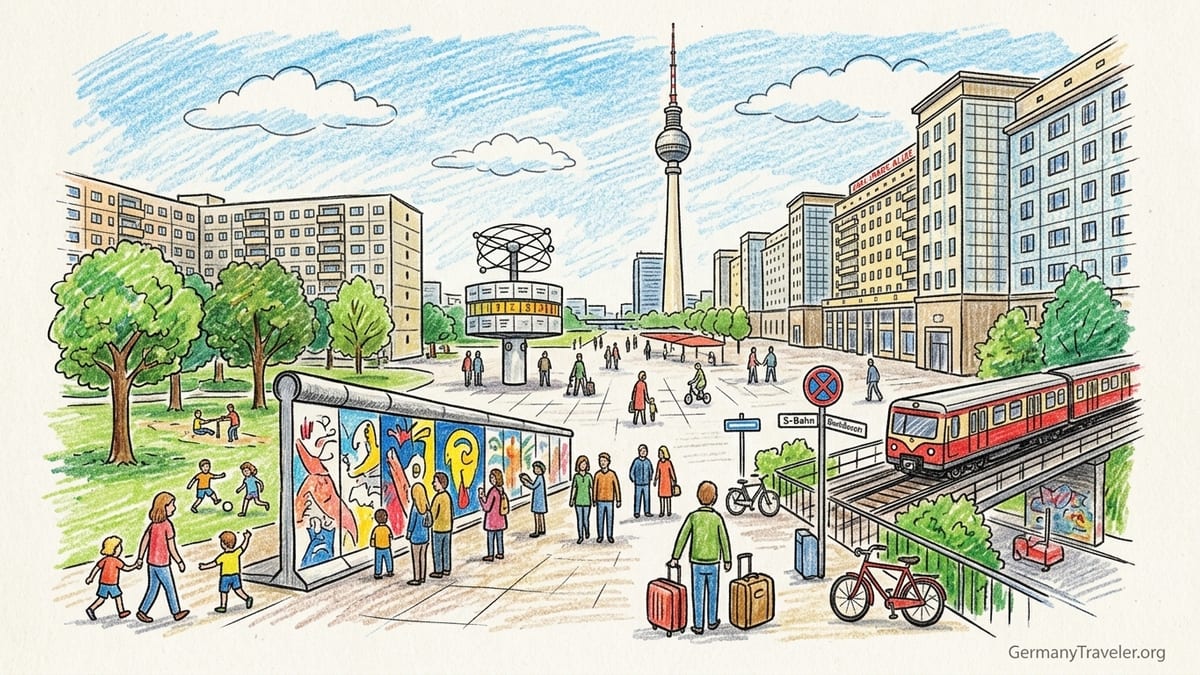
Alexanderplatz is still officially in Mitte, but it was the beating heart of East Berlin and the place where my journey into the GDR began. Standing by the S-Bahn exits, I was surrounded by chain stores, fast-food outlets and souvenir stands, yet the square’s socialist past was impossible to miss. The Fernsehturm, the East’s iconic TV Tower, still dominates the skyline, and at its base the flat, horizontal forms of the 1960s and 1970s redevelopment frame an open pedestrian expanse that feels more like a stage set than a traditional European square.
I walked directly to the Urania World Clock, the cylindrical structure that rotates through the names of world cities. VisitBerlin describes it as a true GDR relic, and in person it feels exactly that: heavy, mechanical, slightly faded, yet surprisingly loved. The metal surfaces are worn smooth where generations have leaned against them while waiting for friends or demonstrations to start. It was in Alexanderplatz that one of the largest peaceful protests in East German history took place in early November 1989, just days before the Wall opened, and it takes only a moment’s imagination to replace today’s shoppers with a crowd of East Berliners chanting for change.
Yet Alexanderplatz is also where you first see how much of the GDR has been overlaid by post-reunification commerce. The former Centrum department store is now a modernized mall with glassy entrances and familiar global brands. Many facades have been reclad, interiors gutted, and where workers once queued with ration cards, tourists now queue for bubble tea. To understand what is left of East Berlin here, you have to look at the big forms and the street grid rather than the shop signs: the broad traffic lanes, the generous forecourts, and the way pedestrian flows are channelled toward the Fernsehturm and the station. The GDR is present structurally, even if much of the surface has been replaced.
Alexanderplatz also taught me my first lesson of this walk. If you come only to photograph the TV Tower, you can miss the political charge of the place. Spend half an hour instead watching how Berliners use the square today, and then picture it in 1989 with loudspeakers, banners and people pushing against the state. Here, the GDR story requires both the visible concrete and an invisible layer of memory.
Walking Karl-Marx-Allee: Monumental Socialism in Everyday Use
From Alexanderplatz I followed Karl-Marx-Allee east, a route that reveals more about socialist ideals than almost any museum panel. The boulevard stretches roughly 2.3 kilometers between Alexanderplatz and Frankfurter Tor, up to 90 meters wide, lined with imposing residential blocks dating from the 1950s. Architectural historians describe it as a showcase of socialist classicism, and walking it confirms that description: pale facades clad with ceramic tiles, pilasters and arches, decorative friezes celebrating workers and families, and the famous corner towers that rise like bookends at Strausberger Platz and Frankfurter Tor.
Up close, the scale is daunting. Crossing from one side of the street to the other feels like traversing a small airfield. This was planned grandeur, a statement avenue intended to rival Western boulevards and to house an exemplary socialist population. Yet today the ground floors host bakeries, kebab shops, discount supermarkets and small bars. On a weekday morning, older residents pushed shopping trolleys beneath ornate cornices while parents with strollers waited at pedestrian crossings that seem slightly too long for a human scale. The boulevard is still very much lived-in architecture, not a preserved showpiece.
What struck me most here was the contrast between monumental intention and domestic details. Peering through the entrance doors of one block, I could see marble staircases and broad, light-filled lobbies that would not look out of place in a grand hotel. These apartments were designed as flagship homes and, according to contemporary accounts, cost far more to build than later prefabricated housing estates. Walk a few blocks further east, however, and the style shifts. Later sections of Karl-Marx-Allee and adjacent streets slide into the more anonymous modernism familiar from concrete Plattenbau estates, with flat facades and regular rows of balconies. In this short walk you can physically feel the shift from Stalinist classicism to the industrialized construction methods that became the GDR norm.
Commercial redevelopment has been cautious along Karl-Marx-Allee, partly because much of it is protected as a listed ensemble. There are no high-gloss malls here; instead, renovation work tends to restore original window proportions and tile patterns. Some corner cafes embrace retro GDR aesthetics inside, with orange plastic chairs or formica tables, and a few stores sell Ostalgie souvenirs. At their best, these touches highlight the period without parody. At their worst, they flatten real history into kitsch. Sitting with a coffee at a pavement table, I could look up at heroic reliefs of workers and then down at mugs printed with cartoon Trabant cars. It is a reminder that East Berlin is both a place where people still live and a destination marketed as a Cold War experience.
Traces of Everyday Socialism: Prefab Blocks and Inner Courtyards
Leaving the main boulevard, I turned into side streets running toward Friedrichshain. Here, the GDR’s more typical housing culture emerges. The grand facade of Karl-Marx-Allee gives way to less ornate, prefabricated Plattenbau blocks, especially where the postwar rebuilding continued into the 1960s and 1970s. These are not the towering estates of Marzahn or Hellersdorf, but mid-rise slabs of five to eleven storeys, built from concrete panels, with repeating window rhythms and attached balconies.
Walking the courtyards, I noticed how green the spaces are today. Trees planted decades ago have matured, creating shaded play areas and informal paths between entrances. In one courtyard, a low, original GDR sandbox sat next to a modern climbing frame, and residents had laid out vegetable beds along a sunny wall. Here, everyday socialism is visible in the layout rather than any single preserved object: large communal yards, laundry lines strung between balconies, and the sense that these were planned as complete micro-communities with schools and shops a short walk away.
At the same time, many facades in these backstreets have been thermally insulated and repainted in contemporary colors. New double-glazed windows and small satellite dishes signal that the GDR fabric has been adapted to modern needs. A visitor looking for dramatic socialist symbols might overlook this part of East Berlin, yet this is where the majority of East Berliners actually lived. If you want to understand the GDR beyond its monuments, a detour through these residential grids is essential. It teaches you that the system was experienced not only in border fences and slogans, but also in heating systems, queue lines at the Konsum stores and the sound of prefabricated walls between neighbors.
In conversations with Berliners who grew up in the area, some pointed out that these blocks, once criticized in the West as monotonous, are now appreciated for their light, their greenery and their relatively affordable rents. That complexity rarely makes it into simple east-versus-west narratives, but it is written into the cityscape if you pay attention to who still hangs laundry on fifth-floor balconies and who cycles home from work along streets that did not exist in 1945.
At the East Side Gallery: Wall as Artwork and Backdrop
From Friedrichshain I headed south to the Spree and the East Side Gallery, the longest remaining continuous section of the Berlin Wall, now covered with murals. This site is one of the city’s most photographed locations, and arriving there after the residential backstreets felt like stepping onto another stage, this time for the global tourist economy. Coaches lined Mühlenstrasse, visitors posed in front of the famous “Fraternal Kiss” painting of Brezhnev and Honecker, and influencers balanced on the curb to frame themselves against the painted concrete.
Seeing the Wall here is important, but it also raised questions. The East Side Gallery is a remnant of the outer wall, and the art was added in 1990 by international artists, then later restored. It communicates the emotion of the Wall’s fall and the desire for openness, yet it can also flatten the brutal reality of the border fortifications into a single, photogenic surface. Standing with my back to the river, it took effort to imagine the once-militarized strip between inner and outer walls, the patrols, the floodlights and the death strip that would have existed further inland.
Commercial development presses close here. On the river side, luxury apartment complexes and a glassy shopping and event structure rise where parts of the former death strip once lay. Several controversies in recent years have involved the partial removal or relocation of Wall segments to make way for private projects. Walking the length of the East Side Gallery, you can see how new buildings step closer and closer to the concrete line, narrowing the open sky that once made the site feel raw and exposed. It is an instructive place to consider how memory competes with the real estate market.
Despite the crowds, I found one moment of genuine reflection by focusing not on the murals but on the Wall’s physicality: the curved pipe atop the slabs, the texture of poured concrete, the seams between panels. Touching the surface, I tried to picture not the graffiti but the men who had once poured, erected and guarded these barriers. The East Side Gallery is strongest when you let it be a piece of stubborn infrastructure first and an art gallery second.
The Berlin Wall Memorial at Bernauer Strasse: Where Structure and Story Align
To balance the spectacle of the East Side Gallery, I rode the U-Bahn north to Bernauer Strasse, home to the Berlin Wall Memorial. If the riverside murals are the most photographed version of the Wall, Bernauer Strasse offers the most instructive. Here, an entire segment of the border system has been preserved and reconstructed along its original line, including inner and outer walls, watchtower remains and the no-man’s-land of the death strip. A documentation center and outdoor exhibition panels anchor the site and place it firmly in its historical and human context.
Walking along the memorial’s elevated viewing platform, I looked down onto the preserved strip. From this perspective you finally grasp the Wall as a system rather than a single barrier: anti-vehicle trenches, lighting masts, patrol routes and raked sand to show footprints. Apartment facades on the former East side bear scars where windows were bricked up to prevent escapes, while on the West side small crosses and photographs mark the spots where people were killed trying to cross. The memorial does not sensationalize these deaths; it simply documents them with names, dates and occasionally a short biography. It is a place where silence feels like the only appropriate response.
Compared with more interactive attractions in Berlin, the Bernauer Strasse memorial is notably restrained. Entrance to the outdoor grounds and the documentation center is free. The exhibitions rely on photographs, video testimonies, maps and original objects rather than multimedia theatrics. One section recounts the way Bernauer Strasse was literally torn in two overnight in August 1961, with residents in East-facing apartments suddenly cut off from their street and neighbors. The memorial’s power lies in aligning what you read on the panels with what lies in front of your eyes across the grass and concrete. It is here that the abstract notion of a divided city becomes uncomfortably specific.
For me, this was the single most important stop on the entire route. The East Side Gallery shows the Wall’s fall; Bernauer Strasse explains its existence and its human cost. If you only have time for one Wall site and you want to understand the GDR rather than simply collect a photograph, come here. Allow at least two hours: one to walk the length of the grounds and climb the observation tower, another to work through the documentation center’s timelines and personal stories.
Inside the Stasi Museum: An Interactive Encounter with Surveillance
To add another layer to my understanding of East Berlin, I visited the Stasi Museum in Lichtenberg, located in the former headquarters of the Ministry for State Security. The complex is several kilometers east of Alexanderplatz, but easily reached by tram or S-Bahn, and walking up to it you immediately sense a different atmosphere from the tourist-thronged central sites. The main museum building, Haus 1, is a plain, mid-century administrative block. Its seriousness becomes clear once you step inside.
The museum preserves the original offices of Erich Mielke, the long-serving head of the Stasi, complete with heavy desks, rotary telephones, and a conference room upholstered in brown tones that could not be more distinctly mid-1980s. Around these rooms, exhibitions explain how the Stasi recruited informants, opened mail, bugged apartments and compiled vast card indexes on citizens. Display cases hold cameras disguised as handbag clasps, microphones hidden in wall plugs, and sample files documenting how minutely daily life could be monitored.
What makes the Stasi Museum feel relatively interactive is the way visitors can move freely through reconstructed workspaces and examine documents at close range. Several rooms include pull-out drawers where you can browse copies of surveillance reports, or audio stations where former Stasi officers and victims describe specific cases. For English speakers, information panels and many audio materials are available in translation, although more detailed German texts often provide additional nuance. There is a suggested route, but the building’s original corridor layout encourages you to wander and imagine employees arriving each morning, hanging their coats, and proceeding to spend their day reading intercepted letters.
There are moments where the exhibition risks becoming a gallery of gadgets for visitors to marvel at rather than a sober account of repression. I overheard a few people joking about hidden cameras and spy films. Yet this is mitigated by the museum’s insistence on connecting each technology to an actual person or case. One panel describes how a simple listening device placed in a kitchen led to an arrest and prison sentence; another explains how odor samples were collected to help track individuals with dogs. It is a disturbing form of interaction, but it serves to ground the fascination with espionage in the reality of its victims.
Comparing Memorial and Museum: Depth, Emotion and Tourist Filters
Experiencing the Berlin Wall Memorial at Bernauer Strasse and the Stasi Museum on the same day highlighted the difference between a documentation site rooted in place and an institutional museum rooted in narrative. At Bernauer Strasse, the city itself is the exhibit. The preserved Wall strip, the church foundations, the former border houses and the current neighborhood all carry the story. Panels and audio guides support what you see, but the core experience is standing in the wind, looking along the former border, and realizing that every meter of this line rearranged someone’s life.
At the Stasi Museum, by contrast, the building gives you context, but most of the learning happens through designed displays. It is more obviously curated, and in that sense more traditionally “museum-like.” Visitors progress from room to room, reading explanations, watching video clips, sometimes crowding around a particularly shocking document. There are opportunities to press buttons, listen to testimonies or zoom in on digitized files, which creates a more interactive feel than the largely contemplative Bernauer Strasse memorial.
Both places have their strengths. If you want to grasp the physical division of Berlin, Bernauer Strasse is unmatched. If you want to understand how the GDR’s security apparatus infiltrated daily life, the Stasi Museum provides a chilling level of detail. Where they differ sharply is in the degree to which they lend themselves to quick, surface-level tourism. It is entirely possible to walk along the East Side Gallery and emerge with a handful of photos but no substantial knowledge of why the Wall existed. It is much harder to leave Bernauer Strasse or the Stasi Museum without at least some sense of discomfort and critical reflection.
In my own experience, what felt overly simplified or tourist-oriented were not the core exhibits at either site, but some of the packaging around them. Souvenir shops near Wall segments sell mock border guards’ caps and T-shirts with playful slogans. A Trabi safari tour passed me near the East Side Gallery, its convoy of colorful two-stroke cars accompanied by loud commentary for passengers. These can be enjoyable experiences, but they risk turning a lived dictatorship into a theme. The memorial and the museum work in the opposite direction, pulling the visitor away from pure spectacle and back toward individual stories and unglamorous facts.
What Still Stands, What Needs Imagination
By the end of my route, one question kept returning: how much of the GDR is still physically present in East Berlin, and how much now survives primarily in archives and memories. On the one hand, the city is full of authentic remnants. Karl-Marx-Allee remains one of Europe’s most striking postwar boulevards, lined with protected socialist-realist housing and original shopfronts. Large swathes of Plattenbau housing still define outer districts, providing real homes rather than functioning as open-air museums. The TV Tower anchors the skyline as a globally recognized emblem that was once purely East German.
On the other hand, entire categories of GDR life require imagination or museum context. The state-owned factories and combines that structured many people’s working days have largely disappeared or been repurposed beyond recognition. The queues at Intershops, the rhythm of weekly television broadcasts from the East, the presence of border guards at inner-city crossing points: these now live mainly in historical footage. At Bernauer Strasse, metal rods in the pavement mark the position of demolished walls and buildings, inviting visitors to mentally reconstruct facades. In the Stasi Museum, carefully staged offices stand in for thousands of similar rooms that were stripped and redecorated in the 1990s.
Commercial redevelopment plays an ambiguous role in this landscape. In areas like Alexanderplatz and along the Spree, new hotels, offices and shopping centers occupy ground that once had intense symbolic value. Their glass facades often leave little visual trace of what came before. Yet some redevelopments, particularly along Karl-Marx-Allee, scale themselves to the existing street pattern and preserve key sightlines, allowing the socialist city to remain legible even as shops change hands. For a traveler, the challenge is to read both layers at once: to enjoy a coffee in a renovated cafe while still noticing the proportion of the windows and the depth of the balcony overhang above your head.
Ultimately, the most important tool you bring to East Berlin is not a camera but a willingness to slow down and ask, at each corner, “What stood here before, and who decided what should replace it?” The city will not always answer clearly. Sometimes it responds with a preserved Wall segment and a plaque. Sometimes it responds with a shopping mall. In both cases, your own curiosity completes the picture.
The Takeaway: A Recommended Route for Understanding the GDR
After several days following the GDR across East Berlin, I would recommend a specific route for travelers who want more than a symbolic snapshot. Start mid-morning at Alexanderplatz, not just for the TV Tower but to stand by the World Clock and picture the 1989 demonstrations. Give yourself time to walk the square, notice the scale of the open plaza, and compare archival images on your phone with the present-day view. This anchors you in the former capital of the GDR rather than simply at a busy transport hub.
From there, walk east along Karl-Marx-Allee all the way to Frankfurter Tor. Take the south side one way and the north side back for a full sense of the architecture. Pause at Strausberger Platz to look back toward the TV Tower framed by socialist classicist facades. Duck into one or two courtyards to see how residents live behind the monumental frontage. A coffee or lunch in a neighborhood cafe along the boulevard gives you a chance to watch daily life unfold in a setting that was once built as a model socialist street.
In the afternoon, continue by public transport to the Berlin Wall Memorial at Bernauer Strasse. Plan at least two hours to walk the outdoor grounds and visit the documentation center. Climb the observation tower, read the panels and let the preserved border strip speak at its own pace. If you are able, include a visit to the Stasi Museum either on the same day or the next morning. Experiencing both the physical border and the interior of the surveillance institution creates a powerful, if uncomfortable, arc from public control to private intrusion.
If, after that, you still want to visit the East Side Gallery for its murals and views across the Spree, treat it as a coda rather than the main act. Arrive in the late afternoon when the light softens on the painted concrete, walk the full length instead of stopping at the most famous images, and consciously remember the more somber knowledge you gained at Bernauer Strasse. This sequence turns the Wall from a colorful backdrop back into a historical border, without denying its new life as an open-air gallery.
Followed in this order, the route reveals East Berlin not as a single story of oppression or nostalgia, but as a layered urban landscape where ideology, concrete and human memory continue to intersect. You may leave with fewer simple answers about the GDR than you arrived with, but you will have walked the streets where its promises and failures are still inscribed in stone and asphalt.
FAQ
Q1: How much time do I need to follow this East Berlin route in one day?
Plan a full day of 8 to 10 hours if you want to walk key sections, visit the Berlin Wall Memorial and spend at least 1 to 2 hours inside the Stasi Museum.
Q2: Is the Berlin Wall Memorial at Bernauer Strasse free to visit?
Yes. As of late 2026, access to the outdoor memorial grounds and the documentation center at Bernauer Strasse is free, though donations are encouraged.
Q3: Do I need to book tickets in advance for the Stasi Museum?
Individual visitors usually do not need to pre-book and can buy tickets on site, but groups and guided tours are often asked to reserve ahead, especially on weekends and holidays.
Q4: Which site is better for understanding the Wall, the East Side Gallery or Bernauer Strasse?
Both are worthwhile, but Bernauer Strasse gives a clearer sense of how the border system actually worked, while the East Side Gallery focuses more on post-1989 art and symbolism.
Q5: Is Karl-Marx-Allee safe to walk after dark?
In my experience it felt as safe as other central Berlin neighborhoods, with residential buildings, restaurants and traffic, but usual big-city precautions still apply at night.
Q6: Can I visit the former East Berlin sites with children?
Yes, though some exhibits, especially at the Stasi Museum and parts of the Wall Memorial, deal with sensitive topics like surveillance and deaths at the border that may require careful explanation.
Q7: Are English explanations available at these GDR-related sites?
Most major sites, including the Berlin Wall Memorial and the Stasi Museum, provide extensive information in both German and English on panels, audio guides or printed leaflets.
Q8: How accessible are these locations for visitors with limited mobility?
Many areas of Alexanderplatz and Karl-Marx-Allee are flat and paved, and the Wall Memorial’s paths and documentation center include step-free access; some older buildings may have more limitations.
Q9: Is there still a strong GDR atmosphere in former East Berlin?
Architecturally, yes, especially along Karl-Marx-Allee and in Plattenbau districts, but everyday life now feels like a unified, modern Berlin rather than a preserved socialist city.
Q10: What should I read or watch before doing this route?
Background books on the GDR, documentaries about the Berlin Wall and personal memoirs from East Berliners can deepen your insight, but the cityscape itself is already a powerful primary source.