


On my first extended trip to Berlin, I did what most first-time visitors do: I drew up a list of big-name sights, circled everything in Mitte, and assumed that anything crowded must be essential. After several visits over the past few years, I have a clearer picture of what felt worth my time and money and what I would quietly skip next time. Berlin is not a city that rewards box‑ticking. It rewards curiosity, slowness, and the courage to step a few streets away from the tour-bus routes. The places below are not bad because they are popular. They are the specific experiences I have paid for and later regretted, usually because the content did not live up to the marketing or the price. For each one I will share why I went, what I paid or waited, what I actually got, and what I now recommend instead.
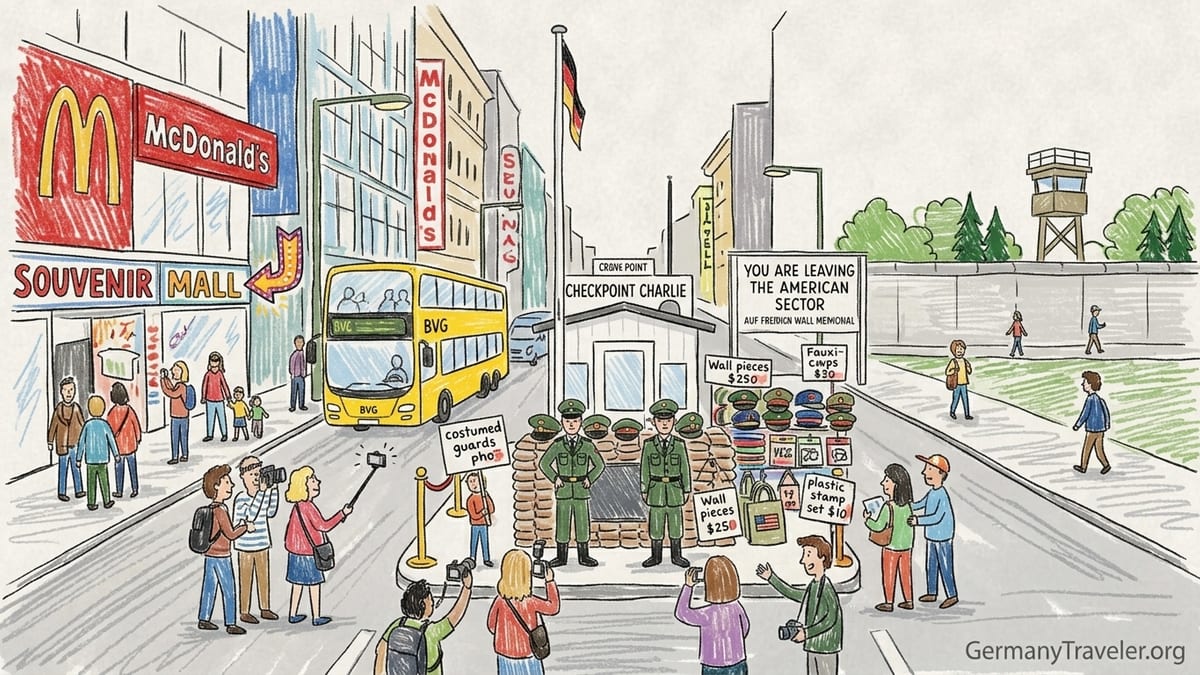
Checkpoint Charlie’s Commercial Circus
Like almost everyone who grew up with Cold War news footage, I felt I had to see Checkpoint Charlie on my first trip. I pictured a sober border crossing, maybe a small but powerful outdoor memorial. What I walked into instead felt more like a film set built on top of a souvenir mall. My first visit was in late autumn, and by then I had already spent several moving hours at the Berlin Wall Memorial on Bernauer Strasse. That might be why Checkpoint Charlie disappointed me so sharply when I finally turned the corner onto Friedrichstrasse and found the famous guardhouse wedged between fast-food outlets and souvenir stands selling faux military caps and plastic "visa stamps" for passports.
On that first visit, I paid for two things in this area. I bought a combined ticket for the well-known private museum beside the crossing point, and I bought into the street-side photo opportunity with costumed "guards" in American uniforms. The photo was only a few euros, but the price for the museum ticket was high enough that I checked it twice before paying. What bothered me more than the cost was the upselling atmosphere around the crossing itself. Many of the souvenir shops stocked mass-produced Cold War symbols without much context, and several people around me seemed confused about what was authentic and what was reconstructed for visitors.
Inside the museum, I did find interesting material, especially on escape attempts and surveillance. The exhibits are dense and historically important, but the experience is also overwhelming and somewhat chaotic, with rooms that feel like they were expanded in phases without a clear narrative route. After more than two hours inside, I left with a headache and the sense that I had paid museum-level prices for an experience that did not help me understand the actual site outside any better. Back out on the street, the famous sign reading "You are leaving the American sector" was surrounded by selfie sticks and honking traffic. It felt like a staged backdrop rather than a place where history is allowed to breathe.
I would not repeat the Checkpoint Charlie package as I did it that first time because the ratio of commercial noise to genuine reflection is simply too high. The story of divided Berlin is powerful enough without props and costumes, and I found better storytelling and quieter space for reflection elsewhere. If your time and budget are limited, I think this is one of the easiest central sights to treat as a quick walk‑by rather than a full experience.
Instead, I now steer first-time visitors to the Berlin Wall Memorial along Bernauer Strasse and the associated Documentation Center. The memorial stretches for roughly 1.4 kilometers along the former border strip and includes a preserved section of the Wall with guard tower, an open-air exhibition, and a visitor center that anchors the story of division in one specific neighborhood. Entry to the open-air memorial is free, and even a short walk from Nordbahnhof U‑Bahn to Bernauer Strasse station gives you a sense of scale and geography that no single reconstructed checkpoint can match. If you are still interested in crossing points, the former border at Bornholmer Strasse or the Glienicke Bridge out toward Potsdam both offer a calmer, more authentic feel without the heavy layer of merchandising.
Checkpoint Charlie Panorama and Gimmicky Wall Experiences
On my second Berlin trip, still convinced that I might be missing something at Checkpoint Charlie, I paid for one of the panoramic multimedia attractions advertised around the intersection. Giant banners promised a 360‑degree immersion in the divided city. The leaflet I picked up from a promoter on Friedrichstrasse showed dramatic nighttime imagery and people looking awestruck. I had already spent several hours with real photographs and original documents at Bernauer Strasse, but curiosity and rainy weather lured me inside.
The ticket price was comparable to a mid‑range museum in Berlin, and I remember pausing at the cash desk because the fee felt steep for something I knew almost nothing about. Once inside, the core experience was a circular room with a painted panorama of a Wall scene, elevated viewing platforms, and a soundscape of announcements and sirens. The craftsmanship of the painting itself was impressive, but the historical framing was thin, and the interpretation panels repeated information I had already encountered for free at outdoor exhibits around the city. After about twenty minutes, I realized I had essentially paid for a very expensive, static backdrop.
What frustrated me most was not that the panorama existed, but that it was marketed as a must‑see cornerstone of Berlin Wall history rather than as an optional add‑on. If you go in with deep prior interest in panoramas as an art form, you may appreciate it on that level. As a visitor looking for insight into the city's division, I left feeling that I had traded away time and money I could have spent in places where actual events happened. It did not help that staff were standing near the exit to push branded merchandise.
Given that experience, I now approach any "immersive" or heavily branded Cold War attraction in Berlin with more caution. I would not go back to the Checkpoint Charlie panorama, nor would I recommend it to someone with only a few days in the city. Instead, I suggest a combination of the Berlin Wall Memorial, the Topography of Terror documentation center on Niederkirchnerstrasse, and a walk along the surviving Wall section at the East Side Gallery. At Topography of Terror, the remains of the Gestapo and SS headquarters are paired with a clear, well-structured exhibition that is free to enter. At the East Side Gallery, the surviving Wall forms the canvas itself, and while it is crowded, there is no entry fee to walk the length of the paintings. Together, these experiences offer original locations, serious research, and space for your own reactions, without the feeling that the story has been packaged into a one‑hour show.
Tourist Restaurant Rows at Alexanderplatz and Brandenburg Gate
My first evening near Alexanderplatz was a classic rookie move. I arrived hungry after a long day of walking, saw a glowing strip of restaurants lining one edge of the square, and figured that anywhere with laminated multilingual menus and heaters on the terrace would at least be reliable. Over two separate trips, I ended up eating in three different places within a few minutes’ walk of the TV Tower and later in a cafe just off Pariser Platz near the Brandenburg Gate, mostly for the convenience of staying close to the central sights.
Each time, the pattern repeated itself. Prices for basic dishes like schnitzel, pasta, or burgers hovered significantly higher than what I paid in less central neighborhoods, even after the general rise in restaurant prices across Germany in 2024. A simple plate of currywurst with fries and a beer around Alexanderplatz cost me roughly what I paid for a far better meal in Kreuzberg a day later. Near Brandenburg Gate, I sat down for what I thought would be a quick midday coffee and cake and left with a bill that felt more suited to a hotel lounge than a crowded pavement café a few steps from one of Europe’s busiest monuments.
The food itself was rarely inedible, but consistently forgettable. One Italian place just off Alexanderplatz served a watery carbonara with pre‑grated cheese and a side salad that seemed to have come straight from a supermarket bag. Another restaurant in view of Brandenburg Gate presented an overcooked schnitzel with limp fries and charged extra for tap‑water‑sized portions of still water in branded bottles. Service was rushed but not rude. The problem was that everything felt calibrated to move tourists through quickly rather than to build any regular clientele.
I would not repeat these meals because Berlin’s food scene is simply too good elsewhere to justify paying central-square premiums for chain‑like cooking. In a city where you can eat excellent Turkish food in Neukölln, inventive vegetarian dishes in Prenzlauer Berg, and classic German plates in neighborhood pubs away from the landmarks, using your dining budget around Alexanderplatz or Brandenburg Gate feels like a poor trade.
Now, when I find myself in those central areas around meal times, I treat them as places to grab a quick takeaway snack at most, and then I ride the U‑Bahn or tram a few stops to eat properly. From Alexanderplatz, you can be in Mitte’s Scheunenviertel area around Auguststrasse in minutes, with more characterful bistros and wine bars along Linienstrasse and Torstrasse. From Brandenburg Gate, a short walk north takes you toward the government quarter and then across to the Moabit neighborhood, where small restaurants along Turmstrasse and Birkenstrasse offer better value and a more local mix of diners. If you are willing to plan ahead, booking a table in Kreuzberg around Bergmannstrasse or in Friedrichshain south of Boxhagener Platz will give you a more representative taste of Berlin’s kitchens without the tourist mark‑up.
Paying for Panoramas: TV Tower vs Better Views
On my first stay, I booked a timed ticket for the Berlin TV Tower at Alexanderplatz because nearly every guidebook and brochure framed it as the definitive city view. I booked online in advance to avoid the on‑site queues, paying the standard adult fee for the viewing platform. By the time I added the small surcharge for a time slot that suited my schedule, the total cost was high compared with most museums in Berlin. On another visit I joined friends who had booked a combined restaurant and viewing ticket in the revolving sphere, which pushed the total cost into the range of a full dinner in a good neighborhood restaurant.
Getting up the tower is efficient, and the first impression from the viewing deck is undeniably impressive. You stand roughly two hundred meters above the city, and Berlin’s flat, sprawling layout unfolds beneath you. But after moving slowly around the circular windows, I realized that the experience did not deepen with time. The information panels were fairly basic, and the crowds at sunset made it hard to linger in one spot. On the restaurant visit, the food was adequate but not memorable, and the combination of high ticket price and high menu prices made it hard not to keep converting each course back into the equivalent of several museum entries.
I would not say the TV Tower is a scam or a place no one should ever visit. It is an important landmark and a feat of engineering. But personally, having paid for it twice, I would not repeat the experience a third time. For me, the problem is the balance between cost and depth. You are paying primarily for height and for ticking off a bucket‑list view, not for interpretation or atmosphere. After about thirty or forty minutes, I found myself ready to come back down, feeling that my money had bought a short, crowded window of skyline photos.
Since then, I have tried several alternative viewpoints that cost less and felt more integrated into my day. The dome of the Reichstag, for example, offers a powerful combination of architecture, political symbolism, and city views. You have to register in advance and pass security checks, but entry is free, and an audio guide walks you through the landmarks visible from the spiraling ramp. Standing there at dusk, watching the city lights come on while hearing about the parliament below, felt more distinctive than my time in the tower’s anonymous viewing deck. I also enjoyed climbing the Victory Column in Tiergarten. The ticket there was modestly priced, and while the climb is physical, the panorama from the top gives you a strong sense of Berlin’s green core and radiating avenues. Between those two options and freely accessible rooftop terraces that sometimes accompany exhibitions or hotels, I now recommend that visitors think carefully before allocating a significant portion of their budget to a single, high‑priced tower ticket.
Hop‑On Hop‑Off Buses in a Highly Walkable City
On my very first Berlin trip, fresh from using sightseeing buses in more compact cities, I bought a 24‑hour hop‑on hop‑off ticket from one of the big operators whose vehicles circle between Berlin’s major sights. I purchased the ticket directly from a seller at a stand near Kurfürstendamm, lured by the promise of an easy loop past the Brandenburg Gate, Museum Island, and Checkpoint Charlie without having to navigate public transport. The ticket price for a one‑day loop was similar to, and in some cases higher than, a full‑day warm‑weather bicycle rental or several days’ worth of standard public transport tickets inside the ABC zones.
The route did cover the headline attractions, and the recorded commentary pointed out major monuments. But after a couple of loops, I realized how much time I was spending in traffic instead of in the city. Berlin’s streets can be congested, and several times we crawled along Unter den Linden or got stuck around Alexanderplatz while regular trams and buses glided by in their dedicated lanes. Because the bus stops are fixed and shared with other companies, there were points where I waited longer for my specific operator than I would have for any regular BVG bus or U‑Bahn train.
What really made me reassess the value came later in the same week, when I bought a standard day ticket for the Berlin public transport network and started combining U‑Bahn, S‑Bahn, and trams with walking. Moving at street level between stations, I discovered neighborhoods I had missed entirely from the top deck of the sightseeing bus. Places like the streets around Hackescher Markt and the canals in Kreuzberg revealed themselves only when I walked between stops. The commentary on the sightseeing bus suddenly felt like a poor trade for the freedom to get lost and to linger wherever the city caught my interest.
Since that first experiment, I have not bought another hop‑on hop‑off ticket in Berlin. The city is too well served by its regular network, and many of the most rewarding corners lie slightly off the grand boulevard routes anyway. Instead, I now recommend visitors pick up a day or multi‑day ticket for public transport and sketch out their own loops. A simple combination like starting at Hauptbahnhof, walking through the government quarter, visiting the Reichstag, crossing Tiergarten to the Victory Column, then hopping the bus to Charlottenburg Palace creates a day that is flexible and inexpensive. For a different angle, taking the S‑Bahn to Ostkreuz and walking down into Friedrichshain before catching a tram over to Prenzlauer Berg gives you a sense of lived‑in Berlin that no pre‑recorded commentary can match. If you like the idea of being above ground, the regular bus routes that traverse the city center, such as those running between Zoo and Alexanderplatz, already offer quasi‑sightseeing rides at local fares.
Souvenir Gauntlets Around Major Landmarks
One of the more subtle tourist traps I fell into on early visits was the time and money I bled in souvenir corridors around landmarks like the Brandenburg Gate, Checkpoint Charlie, and sections of the East Side Gallery. It is not that souvenirs in themselves are a problem. Many visitors want a small physical reminder of their trip, and Berlin’s history has generated powerful symbols. The trouble starts when entire streets around historic sites are lined with nearly identical shops selling the same magnets, T‑shirts, and fake "Wall" fragments at inflated prices, crowding out more thoughtful visitor experiences.
At Checkpoint Charlie, I remember being funnelled past storefronts with buckets of gray concrete chunks labeled as pieces of the Berlin Wall, all wrapped in plastic with generic certificates. The prices in central locations like this were noticeably higher than similar curios in less obvious areas, and I later learned that many of these pieces are decorative concrete rather than authenticated segments. Near Brandenburg Gate, several shops along the side streets offered the same style of printed hoodies and shot glasses I had seen three times already that day. My mistake was thinking that I needed to buy something immediately, simply because I was near a famous sight.
I would not repeat these impulse purchases or the habit of leaving extra time in my day "for souvenir shopping" in these zones. They are designed to capitalize on foot traffic and on the emotional high of seeing a world‑famous landmark moments earlier. The souvenirs themselves rarely reflect the complexity or creativity of the city. After several trips, the items that still mean something to me are not the generic coasters from a shop at Pariser Platz, but the locally designed prints and secondhand books I picked up in quieter streets.
These days, I handle souvenirs in Berlin quite differently. Instead of shopping directly at major landmarks, I look for small design stores in neighborhoods like Neukölln, Kreuzberg, or Prenzlauer Berg that stock work by Berlin artists and illustrators. Flea markets, from Mauerpark on Sundays to smaller neighborhood markets, often have stalls with handmade goods and vintage items that carry more of the city’s character. If I want something related to the Wall or Berlin’s history, the bookshops attached to serious museums and memorials, such as the Berlin Wall Memorial or the Documentation Center at Bernauer Strasse, offer carefully chosen titles and objects with clearer provenance. By shifting my souvenir budget away from the immediate orbit of the big monuments, I have ended up with fewer items but far more satisfaction.
The Takeaway
Looking back across several trips, what stands out is that Berlin did not disappoint me as a city. The disappointments came when I handed over my time and money to experiences that were built primarily for short‑stay visitors and that prioritized volume over depth. Checkpoint Charlie’s crowded intersection, the commercial panorama on its corner, the high‑priced restaurants facing Alexanderplatz or Brandenburg Gate, the paid tower views, and the hop‑on hop‑off buses all gave me moments of recognition without much lasting understanding. None of them were complete wastes, but most felt forgettable as soon as I found myself in quieter streets a few blocks away.
By contrast, the places that moved me most were often free or modestly priced and just far enough from the postcard scenes to breathe. Walking the length of the Berlin Wall Memorial, pausing at Bernauer Strasse to imagine front doors that once opened into another country, tracing the line of the former border across ordinary pavements, and sitting in small neighborhood restaurants where the menu was in German first and English second all built a layered sense of the city. Those experiences did not come with aggressive marketing, but they stayed with me long after the return flight.
Berlin rewards visitors who are willing to look past the loudest promises. If you are planning your own trip, treat the most commercial attractions as optional rather than obligatory. Ask yourself what you hope to feel and learn at each stop, not just what famous landmark you can see. Consider whether a high ticket price buys you more than a single photo, and whether a meal beneath a monument is really how you want to taste the city. Very often, the most rewarding version of Berlin is waiting just one tram stop or two side streets away from the tour-bus routes, in places where history, daily life, and curiosity still coexist in a way no souvenir stand can replicate.
FAQ
Q1. Is Checkpoint Charlie completely avoidable, or should I at least walk past it once?
It is worth walking past Checkpoint Charlie once to understand its location and see the famous sign, but you can safely skip paid photo ops and high-priced nearby attractions if your time is limited.
Q2. Are hop-on hop-off buses ever a good idea in Berlin?
They can suit visitors with very limited mobility or those who prefer not to use public transport, but in most cases a regular day ticket on the Berlin network combined with walking offers more flexibility and better value.
Q3. Is the Berlin TV Tower worth the price for first-time visitors?
If you love tall viewpoints and do not mind paying a premium for height and a famous landmark, the tower can be enjoyable once, but alternatives like the free Reichstag dome or the Victory Column offer strong city views at a lower or no ticket cost.
Q4. How can I avoid tourist-trap restaurants around major sights?
Use central squares mainly for sightseeing, then walk or ride public transport a few stops into residential neighborhoods before sitting down to eat, and look for places where menus and clientele are not aimed only at short-stay visitors.
Q5. Where should I go instead of commercial Wall attractions near Checkpoint Charlie?
Prioritize the Berlin Wall Memorial along Bernauer Strasse, including its outdoor exhibits and Documentation Center, and combine it with a walk along the East Side Gallery for authentic surviving sections of the Wall.
Q6. Is it worth buying "pieces of the Berlin Wall" from souvenir shops?
Many central shops sell small concrete fragments with generic certificates at high prices, and it can be difficult to verify authenticity, so it is wiser to focus on books, prints, or museum-shop items with clearer provenance.
Q7. How far do I need to go from Alexanderplatz to find better food?
Often just a few tram or U-Bahn stops are enough; neighborhoods around Hackescher Markt, Prenzlauer Berg, Friedrichshain, Kreuzberg, and Neukölln all have more varied and better-value dining options.
Q8. Are all popular attractions in Berlin tourist traps?
No, popularity alone does not make a place a trap; sites like the Reichstag dome, Museum Island, and the Berlin Wall Memorial are heavily visited yet still offer strong content and good value.
Q9. How can I tell if a Berlin attraction is more marketing than substance?
Be cautious with experiences that rely heavily on costumes, staged photo ops, and promises of quick "immersion" without being located at an original historic site or backed by a respected institution.
Q10. What is the single best way to get a non-touristy feel for Berlin in a short visit?
Pick one serious historical site such as the Berlin Wall Memorial, then spend the rest of the day walking or riding public transport through a couple of lived-in neighborhoods, pausing in local cafés and parks instead of sticking only to the main monuments.