


I arrived on Berlin’s Museum Island on a grey weekday morning in October 2026 with the kind of excitement that only a UNESCO-listed complex of five historic museums can inspire. By early afternoon, that excitement had thinned into sore feet, decision fatigue and the uneasy feeling that I had not done my homework about Berlin’s long-running museum renovations. Museum Island did not exactly fail me, but it did disappoint me in places. Here is what I wish I had known before I bought my tickets.
What Museum Island Really Looks Like in Late 2026
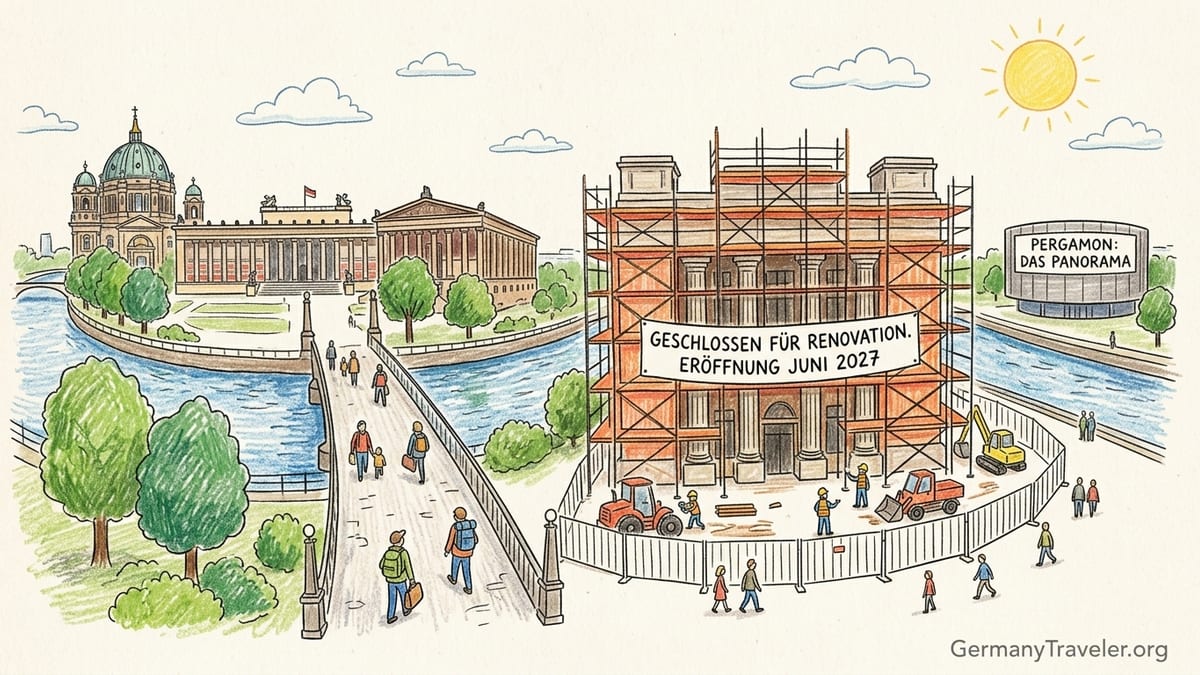
Berlin’s Museum Island is still one of Europe’s great cultural clusters: Altes Museum, Neues Museum, Alte Nationalgalerie, Bode-Museum and the Pergamonmuseum are grouped on a small island in the Spree, framed by the Lustgarten and the Berlin Cathedral. On paper, it is the kind of place where you dream of wandering all day from Greek marbles to Egyptian sculpture to nineteenth-century painting. In practice, in 2026, the picture is more fragmented, largely because the Pergamonmuseum is still closed for long-term renovation.
The Pergamonmuseum, home to the Pergamon Altar, the Ishtar Gate and the Market Gate of Miletus, shut its doors to general visitors in 2023 for a multi-year refurbishment. Official announcements now state that the museum will reopen to the public on 4 June 2027, with the Pergamon Altar and major sections of the collections accessible again at that time. That means that anyone buying tickets for Museum Island in 2026 will not see the famous altar or the original large architectural reconstructions on the island itself, despite how many older guidebooks and blog posts still imply otherwise.
Instead, the only glimpse of Pergamon as a concept currently available to visitors is “Pergamonmuseum: The Panorama,” a separate exhibition building a short walk from the island that combines original sculpture fragments with a vast 360-degree panorama of ancient Pergamon. It is striking, but it is not the same as walking around the original altar in its grand hall. The gap between what the Pergamon name evokes and what you can actually visit in 2026 is one of the main reasons my day felt deflating at times.
At the same time, the rest of the island is fully operational, and when you focus on what is open rather than what is closed, it remains an extraordinary place. The disappointment came less from the quality of the museums and more from my own attempt to squeeze too much into a single day under construction conditions, without a clear, realistic plan.
The Tickets I Bought, The Queues I Faced, And What I Would Do Differently
For this visit, I chose the official Museum Island day ticket, booked online the night before through Berlin’s tourism platform. The price at the time of my visit was just under 25 euros for an adult, giving same-day access to all the island museums that were open to the public: Altes Museum, Neues Museum, Alte Nationalgalerie and Bode-Museum, plus timed admission to the Pergamon Panorama. The idea was simple: arrive when the first museum opened, work my way through the four main buildings, and finish with the Panorama in the late afternoon.
I arrived around 9:40 a.m., aiming for the 10:00 a.m. opening of the Neues Museum. There were already two lines: one for people who still needed to buy tickets and another for those who had pre-booked a time slot. Even with a pre-booked ticket, I waited about 15 minutes in a loose queue outside as staff checked time slots and scanned codes. On busy summer weekends, other visitors I spoke to at the coat check reported waiting closer to 30 to 40 minutes without pre-booked entry, which matches recent anecdotal accounts from locals who say weekend slots on the island often sell out in advance.
The real surprise came later in the day. The Museum Island ticket itself was straightforward, but I had not fully grasped how tired I would be by the time I reached my final booking at the Pergamon Panorama. I had casually chosen a late-afternoon slot, imagining I would still be keen to “finish strong.” In reality, after six hours of galleries and miles of corridors, the extra timed entry felt like an obligation pinned to the end of an already overstuffed schedule.
If I were planning the same day again, I would strongly consider the Berlin WelcomeCard Museum Island version or the three-day Museum Pass Berlin instead of the single intense day ticket. Both options cost more overall but spread the museums across several days, pairing them with transport savings or additional attractions. Even if you keep the one-day ticket, the key is to treat it as permission to skip buildings rather than a challenge to enter all of them just because you technically can.
Walking, Standing, And When Museum Fatigue Hit Me
From a distance, Museum Island looks compact. On a map, the museums almost touch. It is easy to assume that walking between them will be negligible and that the main exertion is mental, not physical. My step counter told a different story. By the time I left in the early evening, I had clocked just over 15,000 steps, much of that indoors, and my feet hurt as if I had walked a city-wide sightseeing route.
Inside each building, there is a similar pattern: wide stone staircases, high-ceilinged galleries and long enfilades of rooms with little opportunity to sit. The Neues Museum in particular involves several flights of stairs, unless you deliberately seek out the lifts. Once I was in the flow of the exhibition route, I often followed the crowd rather than hunting for elevators or seats. In the Neues Museum and Altes Museum, I often went 30 to 40 minutes without seeing a bench, especially in the busier sections.
Museum fatigue arrived for me around 1:30 p.m., roughly three and a half hours after I walked through the first entrance. It happened on the second floor of the Altes Museum, in a quieter gallery of Roman portrait busts. I realized I had been standing continuously for nearly an hour, first in front of the Neues Museum’s Egyptian collection and then through the most celebrated Greek sculpture halls at the Altes. By the time I turned into the Roman rooms, every bust started to blur into the next. My pace slowed to a shuffle, and my ability to take in the explanatory text panels shrank considerably.
At that point, I should have left the building entirely and sat outside by the Lustgarten or the Spree for at least 45 minutes. Instead, I grabbed a quick coffee in the café under the colonnades and pressed on to the Alte Nationalgalerie. That decision reflected the sunk-cost effect at work: I had paid for the day ticket and felt compelled to “get my money’s worth,” even if it meant absorbing less of what was in front of me. In hindsight, my enjoyment of the final museums would have been higher if I had sacrificed one building entirely in exchange for a truly restorative break outdoors.
Renovation Barriers, Closed Galleries, And Subtle Disappointments
The most obvious renovation impact in 2026 is the complete closure of the Pergamonmuseum proper. You see the consequences well before you reach any entrance. Fences, scaffolding and large bilingual construction banners surround the building, explaining the multi-phase refurbishment and promoting the 2027 reopening as part of the 200th anniversary of Museum Island. It is honest and informative, but coming across the fenced-off façade after years of seeing photographs of the grand portico can be a jolt, especially if you traveled with a mental picture of standing in front of the Pergamon Altar.
Inside the other museums, the renovation impact is more subtle but still noticeable in certain places. In the Neues Museum, some smaller side galleries were roped off, with signage indicating installation work and updates to displays. In the Altes Museum, there were several rooms where objects had been removed, leaving glass cases partially empty or rearranged. Staff members confirmed that rotations and minor refurbishments are ongoing, although the headline collections remain accessible.
The most frustrating barriers, however, are often logistical rather than visual. Temporary partitions redirect visitor flow, especially in shared cloakroom or security areas. In the morning, the Neues Museum coat check felt efficient, but by midday, as people shuffled between buildings, these junction points became minor bottlenecks. In the Bode-Museum, a section of the upper-level sculpture galleries was temporarily closed, which meant doubling back down a long corridor and staircase rather than exiting in a neat loop.
Individually, none of these closures were dramatic. Together, they contributed to a sensation that Museum Island was running below its full potential, with you as a visitor constantly adjusting expectations room by room. If you arrive assuming that every masterpiece you have seen in a book will be on display and accessible, you are likely to experience small but cumulative disappointments, even in museums that are functioning well overall.
Which Collections Took My Breath Away, And Which Left Me Cold
Not every museum on the island struck me equally, and that is important to admit, because the day ticket subtly suggests parity: four or five buildings, one price, all “must see.” In reality, my emotional response varied significantly between them. Two experiences stood out as genuinely extraordinary for me: the Neues Museum and the Alte Nationalgalerie.
The Neues Museum’s Egyptian collection, anchored by the famous bust of Nefertiti, is presented with such clarity and drama that it cut through my mid-morning crowd fatigue. Timed admission meant the hall with Nefertiti never became unbearable, and the way light falls on the bust in its dedicated room gives the piece a gravitas that photographs do not fully convey. Elsewhere in the building, the combination of war-scarred walls and meticulous restoration creates a layered experience of history that goes beyond the objects themselves. This was the one museum on the island where I consistently forgot my tired feet.
The Alte Nationalgalerie, meanwhile, delivered the late nineteenth-century painting and sculpture I had been quietly craving without quite admitting it. Rooms of German Romantic landscapes, Caspar David Friedrich views and Impressionist works from Max Liebermann and others felt like stepping into a different emotional climate after the dense antiquities. The building’s neoclassical architecture, with its monumental staircase and views over the Spree, also offered visual variety that refreshed my senses late in the day. I left wanting to return here on a quiet weekday just to sit in front of a few specific canvases.
By contrast, the Altes Museum was intellectually impressive but emotionally flatter for me. Its Greek and Roman antiquities are beautifully displayed, yet after the more atmospheric Neues Museum, the Altes felt slightly more conventional as a sequence of halls of sculpture and pottery. This is a matter of personal taste, of course. For travelers with a deeper interest in classical archaeology, the Altes will be a highlight. For me, this was where fatigue and repetition started to intertwine.
The Bode-Museum, with its sculpture and Byzantine art, was my final stop and suffered most from my over-ambitious schedule. I remember a few haunting medieval sculptures and the calm of the central dome hall, but I did not have the mental space to follow the narrative of the collection. Here, the disappointment was not about the museum’s quality but about my decision to place it at the end of a long sequence of similar visual experiences.
The Gap Between The Pergamon Name And 2026 Reality
Before I dug into the details of Berlin’s renovation plans, the word “Pergamon” alone conjured a very specific scene in my mind: the monumental marble staircase of the Pergamon Altar, its frieze of gods and giants wrapping around the room, and the sensation of standing in front of a piece of ancient Greek architecture reassembled at full scale. I also expected to walk through the blue glazed bricks of the Ishtar Gate of Babylon and stand beneath the Market Gate of Miletus. These images came from guidebooks, documentaries and travel writing that often glossed over the museum’s closure timeline.
On the ground in 2026, the reality is starkly different. The Pergamonmuseum building is closed to individual visitors. The famous altar and the Ishtar Gate remain behind construction barriers, as confirmed by official updates that place the reopening of major sections, including the altar hall and the newly arranged Museum of Islamic Art, on 4 June 2027. Some materials even mention that further phases of work on other wings of the building, including the area housing the Ishtar Gate, are expected to continue for several more years after that initial reopening.
The only way to engage with “Pergamon” in 2026 is via the Pergamon Panorama attraction near Museum Island. Inside, you find a carefully staged combination of original sculptural fragments, explanatory displays and a vast 360-degree digital panorama by artist Yadegar Asisi that reconstructs ancient Pergamon as an immersive environment. The experience is powerful in its own way, with elevated viewing platforms and shifting light that simulates dawn, day and night over the city. However, you are looking at a representation, not the original altar in its familiar hall.
If you travel primarily to see the Pergamon Altar or the Ishtar Gate, then 2026 is a transitional year. You can learn about them, view smaller related objects and stand inside an ambitious digital recreation, but you cannot yet stand in front of the originals. In that sense, the greatest disappointment on Museum Island is not a bad museum, but a world-famous one that is still behind scaffolding. The danger lies in older travel content that writes about the Pergamonmuseum as if it were open as usual, without making the renovation schedule explicit.
Did Trying To See Several Museums In One Day Ruin Them A Little?
By the time I walked out of the Pergamon Panorama, early evening light on the Spree and the Berlin Cathedral looked objectively beautiful. Subjectively, I felt overstuffed. My notebook from the day backs this up. The morning entries, written in the Neues Museum and Altes Museum, are full sentences and small sketches. The afternoon notes, scribbled in the Alte Nationalgalerie and Bode-Museum, are reduced to fragments: “lovely Friedrich seascape, too tired to focus,” or “Byzantine icons serene but cannot read texts.”
Looking back, it is clear that trying to “do” four museums plus the Panorama in one day diminished each of them. Even in off-season, with relatively manageable queues, the cognitive load is high. You are not only looking at thousands of objects, but also constantly making micro-decisions: whether to read full wall texts, which side galleries to detour into, when to stop for a break, whether to rush or linger. That decision fatigue feeds directly into museum fatigue.
The island’s ticketing structure unintentionally encourages this overreach. A single day ticket that opens all doors is efficient in theory, but it pushes many visitors toward a “checklist” mindset. I met a couple from Spain in the Alte Nationalgalerie who confessed they were speed-walking through the last two floors because they still wanted to see at least part of the Bode-Museum before closing. We all laughed about it in the elevator, but there was a shared recognition that our strategy was undermining our experience.
It is worth asking yourself explicitly, before you buy any pass, how you personally respond to long museum days. If three hours in a single museum usually leaves you ready for a park or a café, the compactness of Museum Island will not change that. In fact, the density may make it more intense. In my case, spreading the same four museums over two relaxed mornings, with afternoons devoted to walking along the Spree or exploring nearby neighborhoods like Scheunenviertel, would have resulted in far stronger memories of both the art and the city.
The Museum Island Schedule I Would Use Next Time
After this slightly overcooked day in 2026, I sat down that evening and sketched the schedule I would use next time, especially once the Pergamonmuseum reopens key halls in 2027. At its core is a simple principle: one major museum per day, plus time outdoors around the Spree and the Lustgarten, with any second museum being a short, optional stop rather than an obligation.
For a future visit in, say, late 2027, when the Pergamon Altar and newly installed galleries are expected to be accessible again, I would dedicate an entire morning just to the Pergamonmuseum itself on a timed ticket. I would arrive at opening time, take advantage of the first quiet hour in the Altar Hall and the Museum of Islamic Art, and leave the building no later than early afternoon. After that, I would walk the colonnades, sit on the edge of the Lustgarten lawn facing the cathedral, or follow the Spree downstream, letting the architecture and river traffic sink in rather than more display cases.
A second day would be devoted to the Neues Museum as the main anchor, with perhaps a brief, focused visit to the Altes Museum limited to one or two specific sections I had chosen in advance, such as a particular Greek sculpture gallery. On a third day, I would return to the Alte Nationalgalerie only, perhaps for two hours in the late morning, and then spend the rest of the day exploring Hackescher Markt and its courtyards or taking a boat tour of the Spree. I would only add the Bode-Museum to the schedule if I had a fourth day in Berlin.
Alongside this slower structure, I would do more targeted advance research on closures and gallery rotations. The official websites of the Staatliche Museen zu Berlin and VisitBerlin now provide relatively clear information on renovation phases, and as the Pergamon reopening approaches, they have already published specific dates and collection details. Rather than relying on older guidebooks or blog posts, I would check those sources in the month before travel and again in the week of departure, noting any galleries temporarily closed.
Finally, I would budget my energy and money with the knowledge that not everything needs to be seen from the inside. Some of my favorite images of Museum Island from this trip were taken outside the buildings: the view of the colonnade walkway along the Spree, the dome of the cathedral at dusk, a busker’s violin echoing under the trees. Next time, I want the ratio of indoor masterpieces to outdoor Berlin to be closer to equal.
The Takeaway
Museum Island in 2026 is still an exceptional place to encounter art and archaeology, but it is not the frictionless, all-access cultural playground that older travel writing sometimes implies. The long-term renovation of the Pergamonmuseum, ongoing gallery adjustments and the sheer density of collections demand more planning, more selectivity and more self-awareness than I brought to my day.
My main disappointments were largely of my own making: expecting to feel the full impact of the Pergamon name when the building is still closed; chasing “value” by cramming four major museums into a single day; underestimating the physical and mental strain of hours of walking and standing; and trusting outdated impressions rather than current renovation schedules. None of these mistakes ruined the visit, but they did flatten parts of it that could have been profound.
If you are heading to Berlin before June 2027, go to Museum Island, but go with adjusted expectations. Choose one or two museums that match your deepest interests, reserve timed tickets, plan generous breaks outside and accept that you will leave some buildings unexplored. If you care passionately about the Pergamon Altar or the Ishtar Gate, consider waiting until after the reopening or consciously embrace the Panorama experience as a substitute, rather than a replica.
Most of all, remember that you are not in a race. The island has survived wars, division and reconstruction. It will be there when you come back. A slower, more focused encounter with one museum and an afternoon by the Spree can be far richer than a hurried glimpse of them all.
FAQ
Q1. Is the Pergamonmuseum open in 2026 and can I see the Pergamon Altar?
The Pergamonmuseum building on Museum Island remains closed in 2026 for major renovation, so you cannot see the original Pergamon Altar yet. Official information currently states that key halls, including the altar and a newly arranged Museum of Islamic Art, are scheduled to reopen to visitors on 4 June 2027, with further construction continuing on other parts of the building.
Q2. What is “Pergamonmuseum: The Panorama” and is it a good substitute?
The Pergamon Panorama is a separate exhibition near Museum Island that combines original sculpture fragments with a large 360-degree digital panorama of ancient Pergamon. It is an immersive and informative experience in its own right, but it is not a full substitute for seeing the original altar and monumental gates inside the Pergamonmuseum. Think of it as a complement or interim solution rather than the real thing.
Q3. Which ticket or pass makes the most sense for Museum Island right now?
If you only want to visit one or two island museums on a single day, a standard individual ticket with timed entry is usually enough. If you plan to visit several museums over multiple days, the three-day Museum Pass Berlin or a Berlin WelcomeCard version that includes Museum Island can offer good value and reduce the pressure to cram everything into one long day. Prices and conditions change regularly, so it is worth checking the latest details as you plan.
Q4. How much walking and standing should I expect during a Museum Island visit?
Even though the museums are close together, a full day on Museum Island can easily involve 10,000 to 15,000 steps, with long stretches of uninterrupted standing. Many galleries have limited seating, and you may spend 30 minutes or more on your feet at a time. Comfortable footwear, scheduled breaks outdoors and a realistic limit on how many buildings you will enter are essential.
Q5. Are there still renovation barriers or closed galleries inside the open museums?
Yes. While the Altes Museum, Neues Museum, Alte Nationalgalerie and Bode-Museum are open, you may encounter occasional closed rooms, roped-off side galleries or detours marked by temporary walls and signage. These usually relate to installation work, refurbishments or collection rotations. The main highlight pieces are generally accessible, but it is wise to check for any major closure notices shortly before your visit.
Q6. Which Museum Island collections feel most special if I have limited time?
If you have to choose, many visitors find the Neues Museum’s Egyptian collection, including the bust of Nefertiti, and the Alte Nationalgalerie’s nineteenth-century paintings and sculpture particularly memorable. Those more focused on classical antiquity may prefer the Altes Museum, while sculpture enthusiasts and fans of medieval and Byzantine art will appreciate the Bode-Museum. Matching your choice to your strongest interests is more important than trying to “cover” everything.
Q7. Can I realistically see all the main Museum Island museums in one day?
It is physically possible to enter four museums and the Pergamon Panorama in one day, but most visitors find that this pace leads to fatigue and diminished enjoyment. A better strategy is to plan for one major museum in the morning, an extended break outdoors around the Spree or in a nearby café, and only a short, optional second museum later, accepting that some buildings will have to wait for another trip.
Q8. How should I plan around busy periods and queues on Museum Island?
Weekends and school holidays see heavier crowds, and popular museums like the Neues Museum can book out their time slots. Whenever possible, reserve timed tickets in advance, arrive near opening time for your main museum of the day, and build in flexibility for queues at security and cloakrooms. Travellers with a pass that does not require pre-booked slots should still allow extra time at the entrance on busy days.
Q9. Is Museum Island still worth visiting before the Pergamonmuseum reopens?
Yes, Museum Island remains a highlight of Berlin, even with the Pergamonmuseum closed. The Neues Museum, Altes Museum, Alte Nationalgalerie and Bode-Museum are substantial institutions on their own, and the island’s architecture and riverside setting add to the experience. The key is to visit with clear expectations about what is and is not accessible and to avoid centering your plans solely on the Pergamon name.
Q10. What is the single most important thing to do differently from my trip?
The biggest improvement you can make over the kind of over-ambitious day I had is to slow down. Choose one headline museum per day, confirm current renovation and closure information just before you travel, and leave deliberate time to sit outside by the Lustgarten or walk along the Spree. Seeing less more deeply will give you richer memories than racing through every open doorway on your ticket.