

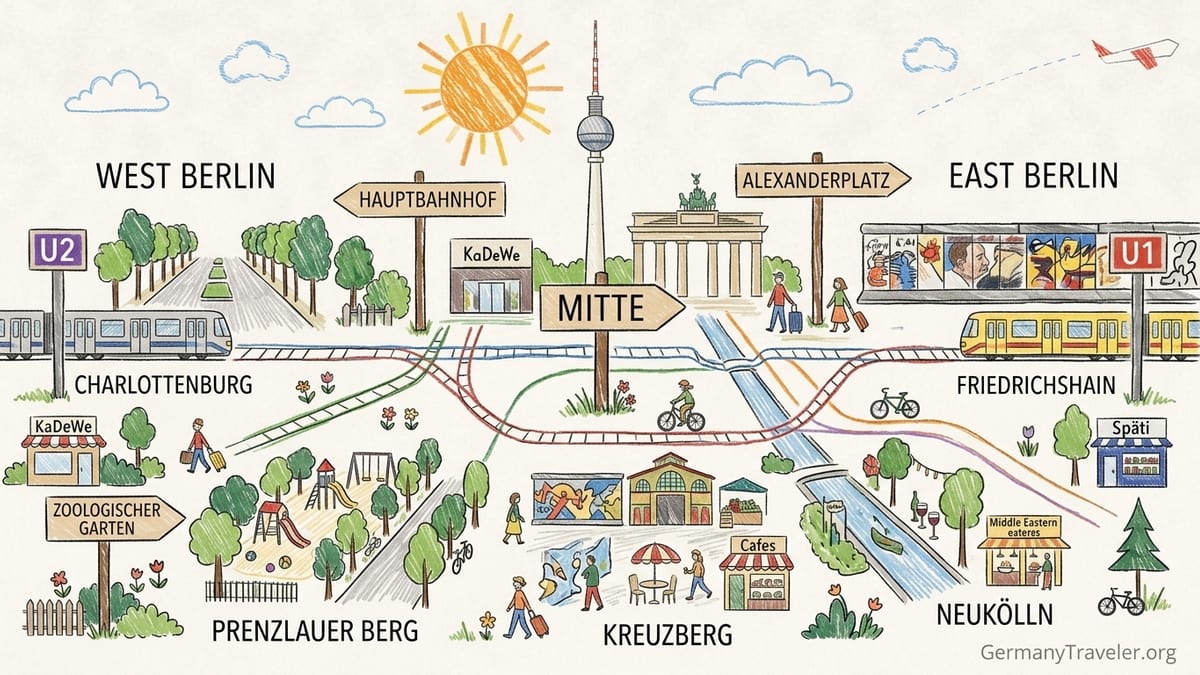
In Berlin, your hotel postcode matters as much as your room type. The city is marketed today as a patchwork of "Kieze" local neighborhoods and the 15-minute city, where daily life happens within a short walk or bike ride. Staying beside Görlitzer Park in Kreuzberg is a different Berlin than a leafy side street off Kollwitzplatz in Prenzlauer Berg, or a business hotel next to Berlin Hauptbahnhof. This guide looks past generic hotel lists to help you choose the right neighborhood and micro-location for the Berlin experience you actually want.
How Berlin’s Neighborhoods Shape Your Trip
Berlin does not have a single compact center in the way many visitors expect. Instead it is a loose ring of neighborhoods around the former East and West centers, with a dense public transport network tying them together. VisitBerlin now promotes this as a 15-minute city, encouraging travelers to explore and stay inside lived-in areas like Kreuzberg, Friedrichshain or Neukölln instead of only circling Brandenburg Gate and the TV Tower. In practice, that means your choice of neighborhood will strongly influence what you see between breakfast and bedtime, and how much time you spend on the U-Bahn.
The core trade-off is simple. Sleeping in Mitte or close to Alexanderplatz puts you within walking distance of most major sights but often in busier, more commercial streets. Moving out a couple of stops to areas like Prenzlauer Berg, Charlottenburg or Schöneberg gives you calmer, more local surroundings at the cost of a 10 to 20 minute ride into the historic core. Going further to nightlife districts along the U1, U3 or U8, such as Warschauer Straße or Reuterstraße, swaps postcard views for late-night bars and cheaper eats.
Micro-location matters just as much as the district name on a booking site. A listing that only says "Mitte" could mean a boutique hotel near Hackescher Markt surrounded by galleries and tram lines, or a quiet side street north of Naturkundemuseum with more embassies than cafés. Similarly, Kreuzberg near Mehringdamm, with its classic Turkish eateries and relaxed Bergmannkiez streets, has a very different feel from the party-heavy blocks around Görlitzer Park or the bar strip on Oranienstraße. The sections below break down both neighborhood and sub-neighborhood character so you can pick a base that fits your priorities.
Berlin’s public transport system makes almost every district workable. The S-Bahn ring and intersecting U-Bahn lines mean that, for example, a tram ride from Prenzlauer Berg’s Kollwitzplatz to Mitte’s Museum Island often takes under 15 minutes, while an S-Bahn from Charlottenburg’s Savignyplatz to Friedrichshain’s Warschauer Straße is roughly the same. The question is less “Can I get there?” and more “What do I want on my doorstep when I step out of the hotel at 9 a.m. or 1 a.m.?”
Mitte and Alexanderplatz: Central, Convenient, Not One-Size-Fits-All
Mitte is Berlin’s government-and-museums core, stretching from the Hauptbahnhof area and Brandenburg Gate across the Spree to Alexanderplatz and north toward Rosenthaler Platz. Around Alexanderplatz itself you find large chain hotels in tall blocks, big stores, and busy roads. The streets stay active late with commuters, shoppers and groups heading to and from the TV Tower. A few minutes’ walk away, near Hackescher Markt or Auguststraße, the mood shifts to courtyards, galleries and bars tucked behind pre-war facades. North again around Torstraße and Brunnenstraße, cafés, design shops and startups line the sidewalks, and side streets become quieter and residential.
Daytime in central Mitte is full of landmark sights. From many hotels between Friedrichstraße, Unter den Linden and Alexanderplatz you can walk to Museum Island, Brandenburg Gate, the Memorial to the Murdered Jews of Europe, Gendarmenmarkt or the revived Humboldt Forum. Tram lines like M4, M5 and M6 funnel people into Alexanderplatz, while S-Bahn lines from Hackescher Markt and Friedrichstraße give direct access to both airports via the Berlin Hauptbahnhof and Ostkreuz connections. The trade-off is that food and drink can be more expensive near the main axes, and some streets between the large squares feel anonymous, especially in the newer office clusters near the river.
At night, the atmosphere depends heavily on micro-location. Around Hackescher Markt, Oranienburger Straße and Torstraße, you will find small cocktail bars, jazz venues and late-opening restaurants, and the foot traffic can go well past midnight. Near Alexanderplatz, there is more transient bustle around the station and a somewhat harder urban edge after dark. By contrast, the embassy-and-ministry blocks closer to the Reichstag or north of the station are very quiet once offices empty out. Noise from trams and thoroughfares like Karl-Liebknecht-Straße means that rooms facing main roads can pick up traffic all night; travelers who are sensitive to sound should ask for a courtyard or upper-floor room where possible.
Mitte works well for first-time visitors who want to walk to major sights, business travelers with meetings in the government quarter, and museum-focused trips. It is less ideal for people who primarily want a neighborhood café scene or nightlife that feels local rather than visitor-heavy. Families might find Alexanderplatz functional but not especially charming; those with young children often prefer the quieter northern edges of Mitte near Arkonaplatz or the small playgrounds around Invalidenstraße, or shift one neighborhood north into Prenzlauer Berg for more green space. Travelers looking for a classic bohemian Berlin will be happier elsewhere.
Kreuzberg: From Bergmannkiez Calm to Görlitzer Park Chaos
Kreuzberg’s appeal lies in its mix of Turkish community life, street art, canals and bars. Yet the district is large, and the experience of staying at Mehringdamm in Bergmannkiez is nothing like booking an apartment a block from Görlitzer Park. Around Mehringdamm and Gneisenaustraße, you get easy access to the U6 and U7, streets lined with bakeries and kebab shops, and the calmer residential feel of Bergmannkiez a few minutes to the south. Marheineke Markthalle offers covered food stalls, and streets like Bergmannstraße mix independent boutiques with relaxed cafés.
Further east, between Kottbusser Tor, Görlitzer Bahnhof and the Landwehr Canal, Kreuzberg tilts heavily toward nightlife and bars. Oranienstraße and the streets around Görlitzer Park buzz late into the night, especially on weekends. Here you will find packed bars offering everything from craft beer and natural wine to smoky dive spots, plus late-night food that stretches from falafel to vegan burgers. The atmosphere can be lively to a fault, with groups drinking on the street, music from bar terraces, and the occasional police presence as the night wears on. For some travelers this is the Berlin they came for; for light sleepers, it is a reason to pick a quieter block or another district.
Public transport in Kreuzberg is strong. U1 and U3 run east-west, linking Görlitzer Bahnhof and Kottbusser Tor to Warschauer Straße and then Charlottenburg, while U7 cuts south through Hermannplatz, and U6 goes north-south via Mehringdamm into Mitte. Reaching Berlin Brandenburg Airport from Kreuzberg usually involves a short U-Bahn ride to a station such as Ostkreuz, Südkreuz or Neukölln, then a regional train or the Airport Express, with door-to-door times from around 40 to 60 minutes depending on exact location and transfers. West Kreuzberg, closer to Mehringdamm and Möckernbrücke, also has quick access to the north-south S-Bahn at Yorckstraße.
Kreuzberg is excellent for travelers who value multicultural food, bars and a dense network of small shops. Food-focused visitors can walk between Turkish breakfast cafés near Kottbusser Tor, beer gardens along the canal, and specialty coffee roasters in Graefekiez without needing a train. Families, especially with younger children, may want to avoid the noisiest blocks around Kottbusser Tor and Görlitzer Park, where nightlife and public drinking are very visible and playgrounds are more worn. Those seeking an early night or a sense of polished historic Berlin will be happier in Charlottenburg, Prenzlauer Berg or the quieter ends of Schöneberg.
Friedrichshain: Clubs, Concrete and Changing Streetscapes
Across the River Spree from Kreuzberg, Friedrichshain began as a working-class East Berlin district and has since become one of the city’s main nightlife and clubbing areas. Around Warschauer Straße station, the East Side Gallery draws daytime crowds to the longest surviving stretch of the Berlin Wall, lined with murals and riverfront bars. As evening falls, thousands of people pass through the viaduct to venues in the RAW Gelände complex, riverside clubs near Ostbahnhof and concert halls like the Mercedes-Benz Arena. Streets like Simon-Dach-Straße and Boxhagener Straße are dense with bars and casual restaurants, from ramen and Vietnamese spots to burger joints and inexpensive pizzerias.
Daytimes in Friedrichshain split between this party corridor and more residential pockets. The Samariterviertel and leafy streets north toward Volkspark Friedrichshain feel calmer, with playgrounds, small supermarkets and corner cafés. Boxhagener Platz hosts a popular weekend food and flea market, and nearby streets offer brunch places and small design shops. For many visitors, the area around Warschauer Straße and Ostkreuz is attractive because of its late-night connections: several S-Bahn lines cross here, making it easy to get home even after the U-Bahn closes, and trams run along Warschauer Straße and Karl-Marx-Allee.
Friedrichshain is convenient for airport access, since regional trains from Ostkreuz and Ostbahnhof connect to Berlin Brandenburg Airport in roughly 30 minutes. However, hotels right around Ostbahnhof sit in a somewhat in-between zone: good for trains, but with fewer cafés and neighborhood services immediately on the doorstep, which can surprise travelers expecting a more classic "Kiez" feel. Closer to Warschauer Straße and Boxhagener Platz, you are embedded in that neighborhood life but must accept more street noise at night, especially on weekends when bar terraces and club queues stay active until morning.
This district suits travelers whose Berlin to-do list includes clubs, live music and a younger nightlife scene, as well as those who want cheaper mid-range hotels with quick S-Bahn access. People looking for a village-like atmosphere, very quiet evenings, or older architectural charm will probably find Friedrichshain too intense in its central strips. Families can make it work by base-lining closer to the park or in calmer side streets near Samariterstraße, but should avoid the loudest bar clusters around Revaler Straße and Simon-Dach-Straße if bedtime before midnight matters.
Prenzlauer Berg: Leafy, Gentrified and Family-Friendly
Prenzlauer Berg sits just north of Mitte and has become shorthand for gentrified Berlin. After reunification, its grand late-19th-century buildings attracted students and artists; in the past two decades those same streets have filled with renovated apartments, playgrounds and organic supermarkets. Today, areas around Kollwitzplatz, Helmholtzplatz and the Bötzowviertel are particularly sought after by families, with tree-lined streets, traffic-calmed zones and clusters of playgrounds, kindergartens and family-oriented cafés.
During the day, the neighborhood is one of the most pleasant places in Berlin to wander. Around Kollwitzplatz, you will find weekly farmer’s markets, bakeries, and brunch spots serving everything from shakshuka to German cakes. Mauerpark, on the district’s western edge, is famous for its Sunday flea market and open-air karaoke in warmer months, which draw both locals and visitors. Trams such as the M1 and M12 run directly from Prenzlauer Berg into Mitte around Hackescher Markt and Friedrichstraße, and the U2 line through Eberswalder Straße links the area west to Zoologischer Garten and east to Alexanderplatz without changes.
Nights in Prenzlauer Berg are active but generally more subdued than in Kreuzberg or Friedrichshain. Bars and restaurants around Eberswalder Straße, Kastanienallee and Helmholtzplatz stay open late, yet the tone is more wine bar and cozy pub than thumping club. By midnight, most of the residential side streets are relatively quiet, and while you may hear courtyard conversations or the last trams, full-on street parties are rare away from a few busier corners. That said, streets close to Eberswalder Straße or along Schönhauser Allee carry traffic noise, so sensitive sleepers should again request inward-facing rooms.
Prenzlauer Berg is a strong choice for families, couples who like café culture, and travelers planning longer stays who want a settled, comfortable base. From here, Museum Island and central Mitte are often less than 15 minutes away by tram or U-Bahn, but you come home to playgrounds and local wine shops rather than tourist coach groups. Nightlife-focused visitors might find it a little too polished and may prefer to stay closer to Warschauer Straße or Kreuzberg, while budget travelers will notice that restaurant and hotel prices tend to be slightly higher than in Neukölln or parts of Friedrichshain.
Charlottenburg and City West: Classic Boulevards and Quiet Nights
Charlottenburg, in former West Berlin, centers on Kurfürstendamm and the Zoologischer Garten transport hub. The area mixes grand late-19th-century apartment buildings with post-war architecture, upscale shops, and one of Berlin’s densest clusters of hotels. Daytimes revolve around shopping and sightseeing in the western city center: the Kaiser Wilhelm Memorial Church stands beside the main square, and the side streets toward Savignyplatz are full of cafés, wine bars and long-established restaurants. The nearby Tiergarten park offers large green spaces within walking or cycling distance.
Transport here is excellent. Zoologischer Garten station combines regional trains, S-Bahn lines running east-west across the city, and U-Bahn lines U2 and U9 heading toward Mitte, Prenzlauer Berg, Schöneberg and beyond. Direct airport trains from the west are less frequent than from the east, so travelers heading to or from Berlin Brandenburg Airport usually take an S-Bahn or regional train to a hub like Ostkreuz or Berlin Hauptbahnhof, changing there for the airport services. Typical journey times from Charlottenburg to the airport by public transport are around 45 to 60 minutes, depending on exact connections and waiting times.
After dark, Charlottenburg offers a softer nightlife than Kreuzberg or Friedrichshain. Around Savignyplatz and Kantstraße you will find a concentration of well-regarded restaurants, including many Chinese and other Asian places on Kantstraße itself, plus wine bars and traditional German eateries. Bars stay open late, but street noise rarely reaches the levels seen around Kottbusser Tor or Simon-Dach-Straße. Hotels on side streets often feel very quiet after midnight, which appeals to many couples and older travelers. The trade-off is that, aside from a few late bars and cinemas, things can feel fairly calm or even sleepy once shops close.
Charlottenburg is ideal for visitors who value comfort, classic architecture and a quieter base. It works especially well for families who want to be close to Tiergarten and the zoo, and for travelers who prefer familiar international hotel brands clustered around Zoologischer Garten or Ernst-Reuter-Platz. Those whose main goal is deep nightlife immersion or constant street buzz should avoid staying too far west of the Zoo and may feel more at home in Friedrichshain, Neukölln or Kreuzberg. Travelers with only one or two days who want to be able to walk to Museum Island may also prefer Mitte or Prenzlauer Berg.
Schöneberg: Relaxed, Residential and Well Connected
Southwest of Mitte and just below Tiergarten, Schöneberg offers a balanced mix of local life and good transport. Around Nollendorfplatz and Wittenbergplatz you will find a dense grid of cafés, bars and shops. Nollendorfplatz is also a historic center of LGBTQ+ nightlife, with rainbow flags and long-running bars on and around Motzstraße. Further south, in areas like Akazienkiez near Eisenacher Straße, the mood is quieter and more residential, with independent shops, bakeries and small restaurants lining tree-shaded streets.
During the day, Schöneberg feels like a comfortable, lived-in part of the city. The large KaDeWe department store near Wittenbergplatz draws shoppers from all over Berlin, while Viktoria-Luise-Platz and nearby streets showcase late-19th-century facades and small squares. Public transport is straightforward: U1, U2, U3 and U4 all pass through or near Schöneberg, connecting you to Zoo, Potsdamer Platz, Alexanderplatz and Kreuzberg without complicated changes. Several S-Bahn stations, including Julius-Leber-Brücke and Schöneberg, plug the district into the city’s orbital and north-south rail lines.
At night, pockets of Schöneberg become lively, especially around Nollendorfplatz, where bars and clubs run late. However, most residential streets a few blocks away are relatively quiet by midnight, which makes the neighborhood attractive for travelers who want nightlife reachable on foot but not directly under their window. Families and noise-sensitive visitors might prefer to stay closer to Wittenbergplatz or Akazienkiez rather than right on Nollendorfplatz itself, where weekend crowds can be boisterous and traffic heavy.
Schöneberg is a good fit for couples, repeat visitors and travelers interested in Berlin’s LGBTQ+ history and present. It is also convenient if you want easy U-Bahn links to both the old West center around Zoologischer Garten and the attractions of Mitte without staying directly in either. Visitors seeking a distinctly edgy or alternative atmosphere might find Schöneberg too understated, while those wanting to be steps from major museums or the Reichstag may find the daily commute slightly longer than from Mitte or Prenzlauer Berg.
Neukölln: Hip, Gritty and Food-Focused
Neukölln, directly south of Kreuzberg, has become one of Berlin’s most talked-about districts in the past decade. Its northern edge, around Reuterstraße and Weserstraße, is often labeled Kreuzkölln and feels like an extension of Kreuzberg’s nightlife and café scene. Bars, natural wine spots and falafel stands sit next to Turkish supermarkets, and the streets around Maybachufer host popular canal-side markets, including a well-known Turkish market on certain weekdays. Further south, toward Hermannstraße and beyond, the district becomes more residential and working-class, with fewer international visitors but plenty of local shops and snack bars.
By day, the northern parts of Neukölln are full of coworking spaces, cafés and small designer boutiques. Tempelhofer Feld, a former airport turned public park just to the west, offers huge open-air space for cycling, skating and picnicking. In the evening, Weserstraße and adjacent blocks fill with people heading to bars and small music venues, and queues can form outside popular spots. The area’s popularity has also brought some of the same pressures seen elsewhere in Berlin, including higher rents and ongoing debates about tourism and nightlife, which visitors will sometimes see referenced in local posters and stickers.
Transport in Neukölln is anchored by U7, which runs from Rathaus Spandau across the city to Rudow, and by U8, which links Hermannplatz and central Neukölln with Kreuzberg and Mitte at Alexanderplatz. Berlin Brandenburg Airport is on the city’s southeastern edge, so from Neukölln the journey can be relatively straightforward: many travelers take U7 to the end of the line at Rudow and switch to a bus, or ride north to a Ringbahn station like Neukölln or Hermannstraße and change to a regional train to the airport. Typical times range from about 35 to 55 minutes depending on transfers and waiting times.
Neukölln is well suited to food-focused travelers, younger visitors on a budget, and people who want a nightlife scene that still feels more local than parts of Mitte or Charlottenburg. Along Sonnenallee and around Rathaus Neukölln you will find inexpensive Middle Eastern and South Asian restaurants, while the canal area mixes natural wine bars with craft coffee. Those who prefer very tidy streets and a feeling of formal order may be less comfortable with Neukölln’s graffiti, busier pavements and occasional late-night noise. Families with small children might lean instead toward Prenzlauer Berg or Charlottenburg unless they are comfortable navigating a more urban, sometimes chaotic environment.
Staying by the Stations: Hauptbahnhof vs Alexanderplatz vs Zoologischer Garten
Many travelers to Berlin consider basing themselves near a major station for easy arrivals and departures. Each of the three main hubs offers a different balance of convenience, atmosphere and access to sights. Berlin Hauptbahnhof, the central station on the River Spree, is the city’s main rail hub, with long-distance trains arriving from across Germany and beyond. Hotels clustered on both banks of the river here offer extremely easy connections to almost every part of the city, including direct or single-change links to the airport and other districts. The immediate surroundings, however, are dominated by modern offices and government buildings; outside working hours, streets can feel quiet and somewhat impersonal.
Alexanderplatz is both a transport node and a commercial center. Multiple S-Bahn, U-Bahn and tram lines converge here, so from a hotel within a short walk you can reach most corners of Berlin without changing trains more than once or twice. The benefit over Hauptbahnhof is proximity to Museum Island, Prenzlauer Berg and parts of Kreuzberg on foot or via one quick ride. The downside is that Alexanderplatz itself is a busy, fairly concrete public space with heavy foot and road traffic, chain stores, and a more hectic atmosphere that some travelers, particularly at night, find less comfortable. Micro-location helps here: a hotel two blocks away on a quieter side street can feel very different from one directly on the square.
Zoologischer Garten, in Charlottenburg’s City West, plays a similar role for the western half of Berlin. The station offers regional trains, S-Bahn and U-Bahn lines that run east-west and north-south, making it straightforward to ride to Mitte, Kreuzberg or Friedrichshain. Staying near this station puts you in the middle of a classic shopping and hotel district with restaurants on Kantstraße, the zoo and aquarium nearby, and Kurfürstendamm’s stores within walking distance. Compared with Alexanderplatz and Hauptbahnhof, the streets here feel more like a traditional city center, with plenty of people around into the evening but less of a purely transit-oriented atmosphere.
Travelers whose top priority is a smooth arrival and departure by train, or those on very short trips who plan to catch early morning departures, may appreciate the functional simplicity of hotels near Berlin Hauptbahnhof. Visitors coming primarily for sightseeing in central Berlin may find Alexanderplatz or the nearby northern parts of Mitte more pleasant once the day begins. Those who prefer a slightly more polished city feel, with extensive shopping and quieter side streets in the evening, will likely be happiest around Zoologischer Garten or Savignyplatz, trading a few extra minutes’ ride to Museum Island for a more classic neighborhood setting.
Recommendations by Traveler Type
For a first visit focused on Berlin’s major historic sights, Mitte remains the most practical base, especially within walking distance of Friedrichstraße, Gendarmenmarkt or Hackescher Markt. From here you can reach Museum Island, Brandenburg Gate, the Reichstag and the Holocaust Memorial on foot, and ride trams or U-Bahn lines to outlying neighborhoods for dinner. If you prefer a softer landing with more neighborhood character while still staying central, the border between Mitte and Prenzlauer Berg around Rosenthaler Platz and Torstraße works well, blending cafés, galleries and fast transport connections.
Nightlife seekers who prioritize bars, clubs and a late schedule are usually happiest in Friedrichshain or Kreuzberg. Staying near Warschauer Straße, Boxhagener Platz or around Revaler Straße puts you close to major clubs and concert venues, while a base near Görlitzer Bahnhof, Oranienstraße or Kottbusser Tor in Kreuzberg immerses you in streets that rarely feel empty before dawn on weekends. Neukölln’s Reuterstraße and Weserstraße area is another strong option if you want food and bars with a more local mix of guests. In all three areas, look carefully at the exact address: one block off a bar street can make the difference between a lively background hum and a sleepless night.
Families and travelers who value quieter evenings with green spaces should look to Prenzlauer Berg around Kollwitzplatz or Helmholtzplatz, Charlottenburg near Savignyplatz or the zoo, or the calmer parts of Schöneberg around Akazienkiez. These neighborhoods offer playgrounds, wide sidewalks, and plenty of family-friendly cafés and restaurants. Museum Island and central Mitte are still only a short ride away, but you return at night to residential streets rather than nightlife corridors. When checking reviews, pay attention to comments about street noise and proximity to tram lines, as even family-focused districts have a few busy corners.
Couples often enjoy Prenzlauer Berg’s wine bars and Charlottenburg’s classic streets, while history and museum enthusiasts may accept slightly busier surroundings in Mitte to shorten their walking times to major institutions. Food-focused travelers can structure their stay around areas rich in restaurants: Turkish breakfasts and street food in Kreuzberg and Neukölln, Asian dining along Kantstraße in Charlottenburg, brunch culture in Prenzlauer Berg, and a mix of everything around Rosenthaler Platz and Auguststraße in Mitte. Those who want a quieter Berlin, either for rest or remote work, are generally better off avoiding the most nightlife-heavy blocks of Kreuzberg, Friedrichshain and Neukölln, and instead basing themselves in the calmer sections of Charlottenburg, Schöneberg or northern Prenzlauer Berg.
FAQ
Q1. What is the single best neighborhood in Berlin for a first-time visitor?
There is no one-size-fits-all answer, but Mitte is usually the most convenient for a first visit focused on major sights. From a hotel near Friedrichstraße, Gendarmenmarkt or Hackescher Markt, you can walk to Museum Island, Brandenburg Gate and the Reichstag, and you have fast transport to other districts for evening explorations.
Q2. Is Kreuzberg safe to stay in, especially near Görlitzer Park?
Kreuzberg is generally busy and feels safe to many visitors, but micro-location matters. Streets immediately around Görlitzer Park and Kottbusser Tor can be intense at night, with visible public drinking, noise and occasional police activity. Travelers uncomfortable with that should consider slightly calmer pockets like Bergmannkiez near Mehringdamm or Graefekiez closer to the canal.
Q3. Which area is best for Berlin’s nightlife and clubs?
For clubs and late bars, Friedrichshain around Warschauer Straße and Revaler Straße is a strong choice, as is the stretch of Kreuzberg between Kottbusser Tor and Görlitzer Bahnhof. Northern Neukölln around Reuterstraße also offers many bars and small music venues. All three areas give you short walks home after late nights, at the cost of more street noise.
Q4. Where should families with young children stay in Berlin?
Families often prefer Prenzlauer Berg near Kollwitzplatz, Helmholtzplatz or Bötzowviertel, where there are many playgrounds, traffic-calmed streets and family-friendly cafés. Charlottenburg near the zoo and Tiergarten, or calmer parts of Schöneberg around Akazienkiez, are also good options that balance green spaces with easy public transport.
Q5. Is staying near Berlin Hauptbahnhof a good idea for tourists?
Staying near Berlin Hauptbahnhof is very practical for early or late trains and offers excellent transport connections across the city and to the airport. The trade-off is that the immediate surroundings feel modern and administrative rather than atmospheric. Visitors who prioritize neighborhood character often prefer Mitte a stop or two away, or Charlottenburg and Prenzlauer Berg.
Q6. How far is Berlin Brandenburg Airport from central neighborhoods?
Travel times vary by line and transfers, but as a guide, trips from central neighborhoods like Mitte, Kreuzberg, Neukölln or Friedrichshain to Berlin Brandenburg Airport by public transport usually take between about 35 and 60 minutes. Most routes involve an S-Bahn or regional train from a hub such as Berlin Hauptbahnhof, Ostkreuz, Südkreuz or Neukölln, plus one U-Bahn or bus ride at either end.
Q7. Which area is best for food lovers?
Food-focused travelers should look to Kreuzberg around Kottbusser Tor and the canal for Turkish and international food, Neukölln’s Sonnenallee and Weserstraße for Middle Eastern and creative kitchens, Charlottenburg’s Kantstraße for Chinese and other Asian restaurants, and Prenzlauer Berg for dense brunch and café culture. The northern part of Mitte around Torstraße and Auguststraße also offers a mix of contemporary restaurants and bars.
Q8. Are Alexanderplatz and Zoologischer Garten good bases for short stays?
Both work well for short stays with a focus on transport convenience. Alexanderplatz offers immediate access to several U-Bahn, S-Bahn and tram lines and is close to Museum Island, though the square itself is busy and concrete-heavy. Zoologischer Garten combines strong transport links with a more classic city-center feel, abundant hotels and shopping, and easier access to Tiergarten and the zoo.
Q9. What neighborhood should I avoid if I am a very light sleeper?
Light sleepers should be cautious about staying directly on busy nightlife streets such as Oranienstraße and the blocks around Görlitzer Park in Kreuzberg, Simon-Dach-Straße and Revaler Straße in Friedrichshain, or Weserstraße in Neukölln. Quieter stays are more likely on side streets in Charlottenburg, northern Prenzlauer Berg or the calmer parts of Schöneberg, especially in hotels with courtyard-facing rooms.
Q10. Is Berlin walkable, or do I need to stay very central?
Berlin’s distances between neighborhoods are larger than in many European capitals, so you will likely use public transport regardless of where you stay. The U-Bahn, S-Bahn and tram network is dense and relatively easy to navigate, which means you do not have to stay directly beside major sights. Choosing a neighborhood whose local atmosphere suits you often matters more than shaving a few minutes off the journey to Brandenburg Gate.