


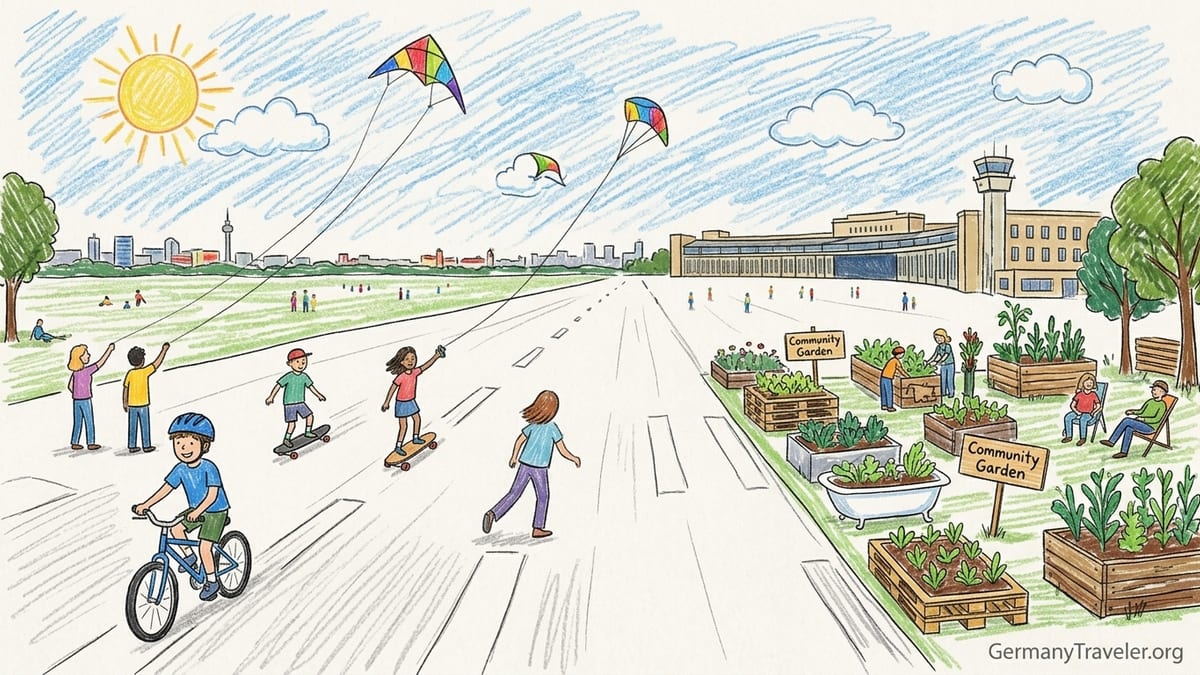
On a bright, wind-streaked afternoon in Berlin, I walked through a modest metal gate at the end of Oderstraße and stepped onto what used to be a live runway. Ahead of me, Tempelhofer Feld opened up in an almost disorienting sweep of concrete and grass, big enough to swallow whole neighborhoods. Cyclists glided along the centerline where aircraft once queued for takeoff, kids learned to ride scooters on taxiways built for propellers and jet engines, and somewhere in the distance a kite tugged at its strings in the steady crosswind that has always defined this exposed patch of Berlin.
Arriving Through Schillerkiez and My First Steps on the Runway
I started my day in Schillerkiez, the Neukölln neighborhood that backs directly onto the eastern edge of Tempelhofer Feld. Herrfurthstraße, with its mix of cafes and Turkish bakeries, led me gently away from U‑Bahn Boddinstraße toward the park. The closer I got, the more the city dropped in volume. By the time I reached the main Oderstraße entrance, Berlin’s usual traffic noise had flattened into a low murmur behind me.
The entrance itself felt almost understated for a space this legendary. A few information boards, a wide gate, groups of people squeezing past each other with bikes and longboards, and then suddenly the runway fanned out. There was no admission desk and no ticket check. Tempelhofer Feld is legally protected as free public space, and on the day I visited, I walked straight in without paying a cent. The only formality was the opening hours posted on a sign, a reminder that the park is open from early morning until sunset, after which you exit through revolving gates.
I had decided beforehand to explore from the Schillerkiez side because it drops you almost directly onto the central runway, with long views toward the terminal building and the Airlift Memorial at Platz der Luftbrücke. It also makes practical sense. If you plan to combine the park with cafe‑hopping later, this entrance gives you the easiest link between Neukölln life and the open expanse of the Feld.
Those first steps on the runway are disorienting. The surface is familiar from airports worldwide, but there are no aircraft, no security lines and no boarding announcements. Instead, there were joggers passing in headphones, a couple practicing inline skating turns, and a young family pushing a stroller right along the former centerline. The scale felt almost wrong for such everyday scenes, like ordinary Berlin life had spilled accidentally onto a film set for something much bigger.
Choosing to Walk First, Then Give In and Rent a Bike
My plan, ambitious in hindsight, was to walk the length of the runway first and rent a bike later. I wanted those slow, ground-level impressions: the sensation of the concrete changing slightly beneath my shoes, the way the wind hit with no buildings to blunt it, the gradual shift from lively edges to lonely middle distance. About fifteen minutes in, I realized I had underestimated just how large 355 hectares feels when you are moving at walking pace across bare tarmac.
From the Oderstraße side, the first stretch felt lively. People clustered near the entrance, skaters were looping lazy circles, and parents hovered at the edges of chalk drawings. But as I pushed farther down the strip, the population thinned out. The terminal building at the far northwest corner did not seem to be getting closer. The runway markings, still visible but faded, reinforced the sense of scale. Each huge painted number and line was designed to be read from the cockpit of an approaching aircraft. Up close on foot, they felt slightly absurd, as if I had shrunk.
By the time I reached roughly the midpoint, I was ready to trade romance for practicality. Near the eastern edge, back toward the neighborhood, several small rental outfits were doing brisk business. One of the most convenient options I saw was a trailer-style stand offering basic city bikes, cargo bikes and longboards at hourly rates. On my visit, standard single-speed or three-speed bikes were around 10 to 12 euros for two hours, cash or card, with a deposit or ID. Prices are always subject to change, and the selection can depend on the day, but for a typical afternoon visit, budgeting around 15 euros for a simple bike rental felt realistic.
Clipping the rental lock onto my handlebars and rolling back onto the concrete was a turning point. Suddenly the runway became proportionate. What had felt hour-long on foot turned into a ten-minute spin with the wind pushing at my back. I could trace the full length of the old takeoff stretch, detour onto the second parallel runway, and still have time and energy left to explore the quieter grass sections and community gardens.
Feeling the Wind, Weather and Sheer Scale of an Empty Airfield
Tempelhofer Feld has its own microclimate. On the day I visited, Berlin’s streets were mild and almost still, but the moment I cycled past the first open taxiway, the wind hit like an invisible wall. With no high buildings to break it, even a moderate breeze rushes across the field. VisitBerlin’s own guide talks about strong winds sweeping the runways and making them perfect for kiteboarders and power-kite riders, and that description matched what I experienced. Riders leaned hard into their kites, wheels humming, as colored fabric arced and snapped overhead.
The weather matters here more than in a typical city park. On a warm, lightly cloudy afternoon, the light felt almost Mediterranean, bleaching the concrete and turning the grasslands a muted olive. There is very little natural shade, a fact that Berlin’s tourism office now actively flags. I saw more than one visitor hugging the thin shadow of a fence post or squatting under a lone tree. The sensible ones had brought umbrellas, hats and large water bottles, which reinforced another lesson: if you come on a sunny day, pack for a beach, not an inner-city stroll.
As I cycled, the famous emptiness became the main attraction. The view from the center of the runway is essentially a 360-degree horizon of low cityscape and open sky. Apartment blocks in Neukölln, the cranes of southern Berlin and the control tower all sit at a distance that makes them feel like models set around a stage. I could understand why some locals come here purely to feel space, especially in a city whose older neighborhoods can be dense and narrow.
At the same time, that emptiness is also what some visitors find underwhelming. After the initial thrill of standing on a runway wears off, you can end up walking long straight stretches with little obvious “sight” to reward you. I met a pair of visitors from Spain who had entered from Tempelhofer Damm and were clearly surprised by how far everything was. “We thought there would be more, like, things,” one of them said, gesturing at the distance between the barbecue meadow on one side and the community gardens further down. Tempelhofer Feld rewards people who enjoy big skies and movement more than those looking for dense attractions.
Community Gardens, Picnics and the Texture of Ordinary Berlin Life
Leaving the main runway, I turned toward the community garden zones that fringe the eastern side of the field. Here the atmosphere changed completely. Instead of smooth concrete and rushing wind, there were narrow paths between improvised raised beds built from pallets, bathtubs, and reclaimed shipping crates. Hand-painted signs, herb planters and leaning deckchairs gave the impression of a rural allotment village dropped into the shell of an airport.
These gardens are collectively run spaces, many of them with names stenciled onto the fences, and they add human-scale texture to the otherwise monumental field. On my visit, gardeners were quietly tying tomato vines, repainting a shed door, or just sitting in the weak autumn sun with coffee mugs. One plot had a small solar panel propped on a post, another displayed a noticeboard with a schedule of open afternoons and seed swaps. It is still Berlin, so graffiti and political stickers sat alongside neat lines of beans.
Closer to the main picnic meadows near Columbiadamm, the vibe shifted again. Groups had claimed circles of grass with blankets and portable speakers. A few grills smoked in the designated barbecue areas, where locals had brought everything from simple disposable trays to full-sized kettle grills. Official rules about open fires and barbecues can change, and Berlin can be strict about where you are allowed to grill, so it is worth checking the current regulations on-site instead of assuming every corner is fair game.
What struck me most in this part of the field was how mundane the scene felt against such a storied backdrop. Children kicking a football, friends opening supermarket wine, someone stringing up a slackline, all within sight of the massive semi-circular airport terminal that once handled the Berlin Airlift. The contrast was most tangible when a small child cycled past humming an imitation of an aircraft engine, legs pumping on a tiny bike where real planes had once thundered down the concrete.
Cycling the Full Runway and Visiting the THF Tower
With the sun lowering, I decided it was time to do what VisitBerlin’s 2026 guide keeps urging visitors to try: cycle the full length of the main runway. Starting from near the Oderstraße entrance, I followed the broad strip toward the western end, keeping roughly to the centerline while giving way to faster road cyclists who treated the place like a training track. The ride itself was not technically challenging, but it was emotionally powerful. The runway numbers loomed larger, side taxiways branched into the middle distance, and the terminal building slowly rose from a flat shape into a distinct, imposing structure of stone and glass.
At the far northwest, I rolled off the runway and looped around toward the historic Tempelhof terminal. The building is not part of the open park; it is managed separately and can only be entered on guided tours or for specific events. I had prebooked a ticket for the THF Tower, the repurposed former air traffic control tower that now functions as a viewing point and small exhibition space. Tickets are sold for specific time slots, and when I checked online earlier in the week, standard adult admission for the tower visit alone was listed in the mid-teens of euros, with concessions a few euros less. Combined or special tours can be more.
Access to the tower involves security-style bag checks and a climb up a modern internal staircase. The historic stairwell is cordoned off to protect the monument, so you are very aware that you are inside a layered building, part original, part contemporary intervention. At the top, a compact exhibition space introduces the history of Lufthansa at Tempelhof and the broader story of the airport between the 1920s and 1940s, including its dark role under the Nazi regime and its later Cold War significance. Panels and displays are bilingual, and there is enough original photography to give a sense of how modern and glamorous the terminal once looked to early air travelers.
Stepping out onto the roof terrace delivered the real payoff. From the THF Tower viewing platform, the runways and grasslands stretched out in a symmetrical fan, and all the kites, cyclists and joggers shrank to toy-like scale. I could trace my earlier path from Schillerkiez to the midpoint of the runway and on past the gardens. The Berlin skyline rose in low layers on the horizon, punctuated by the Fernsehturm and distant high-rises, but the feeling was of standing above an enormous flat sea in the middle of the city.
Was the Terminal Tour and THF Tower Worth the Cost?
On a practical level, any visit inside the Tempelhof terminal or up the THF Tower requires planning and a willingness to spend more than you will on the field itself, which remains completely free. Guided building tours, run by the official Tempelhof development company, are typically scheduled, timed and capacity-limited. Group tours whose pricing I checked clustered around several dozen euros for a private group, with individual spots on public tours costing roughly what you might expect for a major Berlin historical site, often in the high teens. Exact prices and formats can change with new programs and exhibitions.
My combined experience of the tower and the field felt justified as an enthusiast of urban history and aviation. The cost of the tower ticket bought not only the view but also a compact historical framework that turned the abstract idea of “abandoned airport” into something more concrete. The panels on early Lufthansa, interwar architecture and the sheer logistics of the Berlin Airlift helped me understand why the building is protected so fiercely today. Seen from the terrace, the runways were no longer just convenient bike paths; they were artifacts of a century of political and technological change.
That said, travelers with a tighter budget or less interest in infrastructure might think differently. The tower visit is time-limited and controlled, and it does not grant access to the full spread of the terminal’s interior spaces, which are only accessible on longer, more specialized tours. If you simply want a high vantage point over Berlin, other city viewpoints can be cheaper or offer broader panoramas. The tower is at its most rewarding if you already feel some curiosity about how this building fit into both Nazi-era planning and Cold War logistics, and if you are willing to spend a good chunk of an afternoon combining it with time out on the field below.
For me, the strongest value lay in the juxtaposition. After leaving the tower, I walked a short distance back toward the runways and watched as a group of teenagers raced each other on shared rental e-scooters. Behind them, the vast curve of the terminal glowed in late light. Having just read about airlift flights landing here every few minutes in 1948, the ordinariness of the scene gained a poignant edge. It felt like a living, democratic reuse of what was once an authoritarian showpiece.
What Was Less Exciting: Distances, Lack of Shade and Sparse Amenities
Tempelhofer Feld is one of those places that photographs beautifully from above and from the edges, but some realities only sink in once you are in the middle of it. The most obvious is distance. Crossing even one runway on foot is the equivalent of a solid, unshaded urban walk. If you head out from one entrance expecting a conventional park, with clusters of attractions every few hundred meters, you may be disappointed by long featureless stretches of tarmac or grass.
The lack of shade is not just a minor quirk. It shapes where people choose to linger and how long they stay. On my visit, the few mature trees around the edges gathered clusters of people like magnets. Anyone caught between those oasis points looked slightly exposed, shoulders hunched against either wind or sun. It is no coincidence that both VisitBerlin and the park’s own information boards advise sun protection and sufficient water. There are toilets and a handful of snack kiosks at some of the entrances, but if you are in the middle of the field, you might have a fifteen-minute walk back to reach them.
Another slightly underwhelming aspect is how quickly the novelty of the runway surface itself can fade. After the first twenty minutes of walking or riding, the straight lines and wide concrete can blur into a repetitive backdrop. This is especially true if you are visiting outside peak times, when there are fewer kites or sports groups to watch. During my early-afternoon circuit, there were long moments when the most exciting sight was a distant cyclist slowly drawing closer, and I caught myself missing the visual complexity of Berlin’s denser parks.
Finally, the field’s very openness can make it feel less intimate than other green spaces. If you come here alone hoping to sit under a tree with a book or find a tucked-away bench, you might find the scale slightly alienating. The best moments for me involved movement or social activity: cycling beside friends, people-watching around the gardens, listening to distant music drifting over from a spontaneous gathering near the Neukölln edge. For quiet, leafy solitude, I would choose another Berlin park.
Combining Tempelhofer Feld with Neukölln and Schillerkiez
On a return visit, I would structure the day very differently from my first exploratory wander. The sweet spot, I realized, is to treat Tempelhofer Feld not as a stand-alone destination but as part of a wider Neukölln and Schillerkiez circuit, using the park as a vast breathing space between more compact urban pockets.
One practical approach would be to start late morning in Schillerkiez with coffee and breakfast at one of the independent cafes on Herrfurthstraße or Weisestraße. From there, you can walk five minutes to the Oderstraße entrance, rent bikes directly at the edge of the field, and spend two or three hours cycling the runways, detouring into the community gardens, and perhaps stopping for a simple picnic in the grass. Keeping the active part of the visit to a half-day helps avoid fatigue from the long distances and exposure.
In the mid-afternoon, you could return the bikes and exit back into Neukölln, where the streets immediately feel narrower and more animated. A stroll along Sonnenallee or through the quieter residential blocks south of Schillerkiez gives you a sense of how Berliners actually live around this space. Evening can then belong to rooftop bars or casual restaurants in the area, using the memory of the wind and space on the Feld as a mental backdrop while you tuck into falafel, Italian plates or German craft beer.
If you want to include the THF Tower on the same day, I would suggest booking a late-afternoon time slot. In that scenario, you might enter first via Platz der Luftbrücke in Tempelhof, do the tower and a shorter guided building section, then descend directly to the Feld for an early-evening walk toward Neukölln. Watching the light change on the runways as you gradually transition from Cold War monument to neighborhood park is one of the most satisfying narrative arcs you can build into a single Berlin day.
The Takeaway
Spending a full day on Tempelhofer Feld is less about ticking off attractions and more about inhabiting a set of contradictions. It is a site where one of the world’s largest inner-city open spaces sits wedged between dense Berlin neighborhoods, where the ghost of an infamous airport coexists with barbecues and bike paths, and where you can shift from solemn historical reflection to flying a kite within a few minutes’ walk.
What stayed with me longest was not any single viewpoint but the slow layering of impressions. The shock of stepping out from Schillerkiez directly onto a runway. The low roar of the wind across the concrete. The improvised beauty of pallet-built gardens. The distant outline of the terminal glowing beyond families picnicking on grass that once lay under busy flight paths. Even the small disappointments, like the endless distances and the absence of shade, became part of the story, grounding Tempelhofer Feld as a real, lived-in place rather than a glossy set piece.
If you arrive prepared, with water, sun protection and some sense of the field’s history, Tempelhofer Feld can be one of the most distinctive urban experiences Berlin has to offer. Pair it with the street life of Neukölln or the structured perspective of the THF Tower, and you get not just a day out but a vantage point on what contemporary Berlin is continually trying to become: a city that reuses its past, leaves space for its residents, and occasionally invites them to take off down an old runway under a very present sky.
FAQ
Q1. Is entry to Tempelhofer Feld really free, and do I need a ticket?
Yes, entry to Tempelhofer Feld is free and you do not need a ticket. You simply walk or cycle in through one of the main entrances during opening hours.
Q2. What are the opening hours of Tempelhofer Feld?
The field opens in the morning and closes at sunset, with exact opening times varying seasonally. After closing, you can still exit via revolving gates at the main entrances.
Q3. Which entrance is best for a first-time visitor?
For most travelers, the Oderstraße entrance at the edge of Schillerkiez in Neukölln is ideal. It puts you close to bike rentals, the main runways and neighborhood cafes for before or after your visit.
Q4. Can I rent a bike inside Tempelhofer Feld, and how much should I budget?
Yes, there are simple rental stands near the main eastern entrances offering basic city bikes and other wheels. Recent on-site prices for a standard bike were around 10 to 12 euros for a couple of hours, but you should check current rates when you arrive.
Q5. Is there much shade or shelter on the field?
Very little. Most of Tempelhofer Feld is open grassland and concrete with minimal tree cover, so bring sun protection, water and possibly an umbrella or hat, especially in summer.
Q6. Are barbecues and picnics allowed?
Picnics on the grass are common and widely accepted. Barbecues are generally restricted to designated grill areas and may be subject to changing city rules, so always check local signs and any current fire warnings before lighting a grill.
Q7. Is the THF Tower or terminal tour worth paying for?
If you are interested in aviation, architecture or Cold War history, the cost of a THF Tower ticket and a guided terminal visit can be worthwhile for the added context and elevated views. Budget-conscious travelers focused mainly on open-air relaxation may prefer to enjoy the field for free and skip the paid interior tours.
Q8. How long should I plan to spend at Tempelhofer Feld?
Plan at least two to three hours for a relaxed visit that includes walking or cycling the runways and exploring the gardens. If you add a tower visit or longer guided tour, you can easily fill half a day.
Q9. Is Tempelhofer Feld suitable for children and less-experienced cyclists?
Yes, the absence of motor traffic and the wide paved surfaces make it popular with families and beginners. Just be aware of faster cyclists and windier conditions than in regular city streets, and choose your route accordingly.
Q10. How can I best combine Tempelhofer Feld with nearby Neukölln or Schillerkiez?
A good plan is to start with breakfast or coffee in Schillerkiez, enter the field via Oderstraße for a few hours of cycling or walking, then return to Neukölln in late afternoon for dinner and drinks, using the park as the spacious centerpiece of your day.