

Berlin and Dresden sit just two hours apart by train in eastern Germany, yet they offer strikingly different experiences. Berlin is a sprawling capital of politics, street art, and all‑night techno. Dresden is a compact Baroque jewel on the Elbe River, rebuilt after wartime destruction and now prized for its museums and riverside calm. For many travelers, time is limited. The real question is not whether to visit both, but which city deserves more of your days and nights.
Big Picture: How Berlin and Dresden Feel on the Ground
Berlin feels like a collection of villages stitched together, with major sights scattered across neighborhoods such as Mitte, Kreuzberg, Friedrichshain, and Charlottenburg. You might start your morning at the Brandenburg Gate, have lunch in a Turkish eatery on Oranienstrasse in Kreuzberg, then end the evening in a courtyard bar in Prenzlauer Berg. Distances are longer, the skyline is low and flat, and the city’s history shows up in fragments: a remaining stretch of the Berlin Wall here, a Cold War watchtower there, glass-and-steel ministries next to Soviet-era apartment blocks.
Dresden, by contrast, is much more concentrated. Most visitors focus on two main areas: the Altstadt (Old Town) with its domes and palaces along the Elbe, and the Neustadt across the river with its student bars, street art, and late‑night kebab stands. You can walk from the reconstructed Frauenkirche to the Zwinger Palace to the Brühl’s Terrace lookouts in a matter of minutes. The overall vibe is slower and more intimate. Even in peak season, it rarely feels as overwhelming as Berlin.
For a first-time traveler to eastern Germany, Berlin usually rewards more time, especially if you enjoy layered history, experimental culture, and nightlife. Dresden tends to be ideal as a one‑to‑three‑night stay or a full‑day trip, particularly if you are drawn to classical architecture and concentrated museum-hopping without big‑city stress.
In practice, many visitors end up spending four to five nights in Berlin and one to two nights in Dresden. That balance gives enough time for Berlin’s major sights and a taste of its neighborhoods, with Dresden as a contrasting chapter rather than direct competition.
Attractions and Museums: Depth vs Concentration
Berlin’s list of attractions is vast. Museum Island alone, on the Spree River in Mitte, is a UNESCO World Heritage Site with five major museums and a combined day pass that typically runs a little under 25 euros. The Neues Museum, for example, holds the famous bust of Nefertiti, while the Altes Museum and Bode Museum cover classical and medieval collections. A short walk away, the Humboldt Forum in the reconstructed Berlin Palace now houses non‑European collections and large special exhibitions, giving Berlin a museum complex that some locals compare to a German answer to the British Museum.
History in Berlin goes far beyond traditional galleries. The Topography of Terror, located on the former site of the Gestapo and SS headquarters, offers a powerful free exhibition on Nazi rule. The Memorial to the Murdered Jews of Europe near the Brandenburg Gate can be visited at no cost, while its underground documentation center has modest admission. For Cold War history, travelers often pair the Berlin Wall Memorial on Bernauer Strasse with a visit to GDR‑focused exhibitions, like the “Everyday Life in the GDR” museum in Prenzlauer Berg, to understand what life was like under East German socialism. Many of these sites are either free or relatively low-cost, which helps stretch a cultural budget over several days.
Dresden’s attractions are more compact and strongly focused on art and architecture. The Zwinger complex houses the Old Masters Picture Gallery, where visitors come specifically to see works like Raphael’s “Sistine Madonna.” Nearby, the Residenzschloss (Royal Palace) hosts the Green Vault treasure chambers and other collections that showcase Saxon royal splendor. A combined palace ticket is generally under 20 euros for adults, and you can walk between the palace, Zwinger, and Elbe riverfront in under ten minutes.
Another standout in Dresden is the Frauenkirche, a Baroque church destroyed in the Second World War and painstakingly rebuilt. Entry to the main space is usually free, with a small fee if you want to climb the dome for panoramic city views. Dresden also has a surprising variety of museums given its size, including the Dresden City Museum and the Military History Museum in a strikingly redesigned arsenal building, which explores Germany’s complex relationship with war. You could tour three or four of these in two days without feeling rushed, something that is nearly impossible with Berlin’s broader museum landscape.
Architecture, Atmosphere, and Urban Scenery
Architecturally, Berlin is defined by contrast. In the city center, you will find Prussian landmarks like Unter den Linden and the Berlin Cathedral next to bold 20th‑century structures and modern governmental buildings around the Reichstag and Potsdamer Platz. Many travelers walk from the glass dome of the Reichstag, with its reserved free tours, to the stark concrete of the Holocaust memorial, then down to the revitalized Potsdamer Platz, which looks almost North American with its office towers and shopping arcades.
Neighborhoods add further texture. In Kreuzberg and Friedrichshain, former industrial spaces have become cultural centers, beer gardens, and clubs. Streets like Oranienstrasse and Warschauer Strasse mix Turkish bakeries, Vietnamese restaurants, independent bookshops, and live‑music venues. Plattenbau apartment blocks from the GDR era still dominate some outer districts, while renovated 19th‑century buildings in Prenzlauer Berg shelter chic cafes and specialty coffee roasteries.
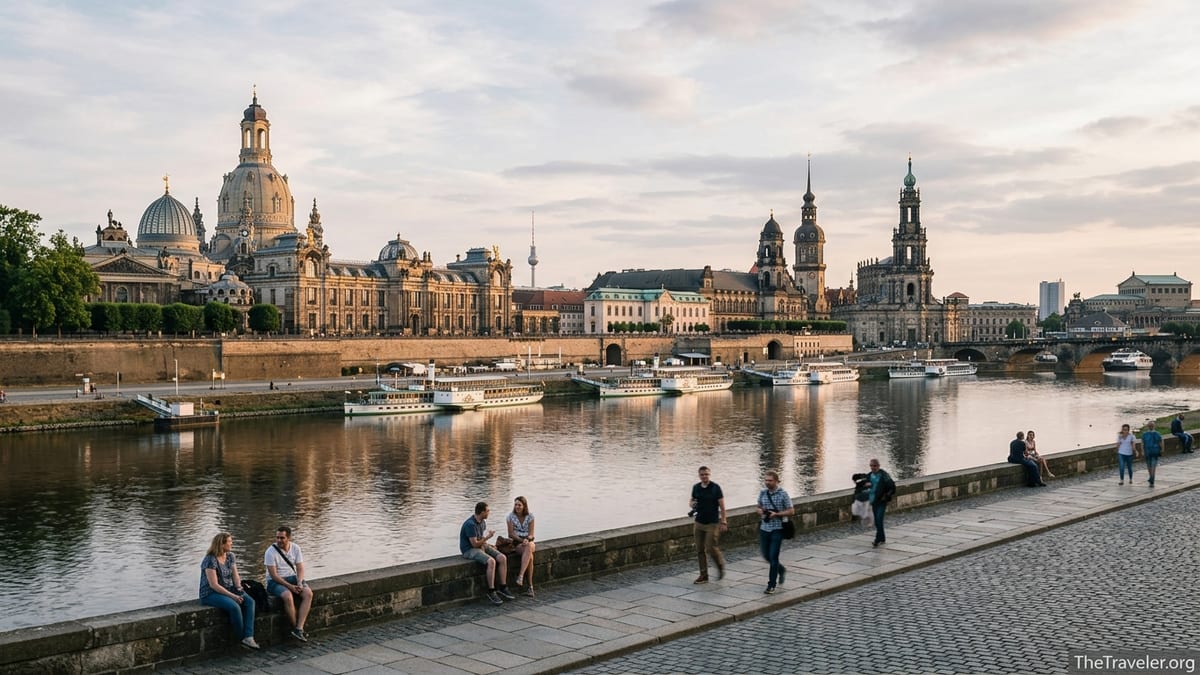
Dresden’s core, by comparison, is deliberately picturesque. Standing on the Augustus Bridge or Brühl’s Terrace, you see a skyline of domes, towers, and ornate facades that feels almost like an open‑air museum. The reconstructed Frauenkirche, Hofkirche, and Royal Palace align along the riverside, with the Elbe flowing quietly below. Many visitors take evening strolls on the promenade to watch riverboats and the fading light over the sandstone buildings.
Cross the river to the Neustadt and the look shifts quickly. Here, late 19th‑century streets house student bars, independent galleries, and small live‑music venues. Colorful facades in the Kunsthofpassage courtyard and murals along side streets give the area a bohemian feel. In scale and atmosphere, Dresden leans closer to a refined university city than a sprawling capital, which many travelers find relaxing after several intense days in Berlin.
Nightlife, Food, and Coffee Culture
Berlin’s nightlife is internationally famous, especially for electronic music. Big-name clubs are known for long lines and strict door policies, but the nightlife scene is far broader than a handful of headline venues. Along the East Side Gallery, old warehouses have been turned into bars and smaller clubs, and in Kreuzberg and Neukölln, it is common to find late‑night bars with craft beer, natural wine, or experimental cocktails for roughly 8 to 13 euros each. For travelers not interested in all‑night dancing, Berlin still offers plenty of evening options: jazz at clubs in Charlottenburg, classical concerts at the Berlin Philharmonic, comedy nights in English, and neighborhood bars that run late but feel low‑key.
Food in Berlin reflects decades of migration. Budget‑conscious visitors often rely on Turkish döner kebab stands, where a filling sandwich typically costs under 8 euros, and Vietnamese kitchens serving large bowls of pho or rice dishes in the 10 to 14 euro range. Neighborhoods like Kreuzberg, Neukölln, and Prenzlauer Berg also have vegan bakeries, specialty coffee shops, and bakeries where a quick breakfast of coffee and pastry might cost around 4 to 6 euros. At the higher end, Berlin has tasting‑menu restaurants and ambitious modern German kitchens, but reservations and prices here quickly climb.
Dresden’s nightlife is smaller but can feel more approachable. In the Neustadt, streets such as Alaunstrasse and Louisenstrasse are lined with bars and pubs, many of them student‑oriented. A beer in a typical bar often lands in the 3.50 to 4.50 euro range, and you can still pick up an inexpensive bottle from a late‑night shop for around 1 to 1.50 euros if you want to walk with friends along the Elbe. Instead of mega‑clubs, you will find small live‑music venues, jazz cellars, and seasonal outdoor beer gardens that stay busy in summer.
On the food side, Dresden offers a mix of traditional Saxon dishes and international options. In the Altstadt, many restaurants near the Frauenkirche and around historic squares cater to visitors with hearty German classics such as Sauerbraten, sausages with sauerkraut, or seasonal game. Prices in these central spots are similar to mid‑range Berlin, but you often get generous portions. Cross into the Neustadt and you will find more vegetarian and international kitchens, often slightly cheaper than equivalent places in Berlin. Coffee culture is strong in both cities, but Dresden’s smaller scale means it is easy to identify a few favorite cafes and revisit them over a short stay.
Budgets, Hotels, and Practical Costs
As a capital city, Berlin is generally more expensive overall, but it also has a larger range of price points. For accommodation, basic hostel dorm beds in central districts can often be found for roughly 25 to 40 euros per night depending on season, while mid‑range hotels and well‑rated guesthouses frequently start somewhere in the 110 to 180 euro range for a double room. At the higher end, design hotels and international chains in Mitte, around Potsdamer Platz, or near the zoo can run 250 euros and above, especially during trade fairs or major events.
Daily spending in Berlin can vary widely based on travel style. Travelers who take advantage of free or low‑cost attractions, use a day ticket or Berlin WelcomeCard for public transport, and eat at casual places often manage on something like 80 to 130 euros per day excluding accommodation. That might cover a BVG day ticket, a museum or two, a simple lunch, a decent sit‑down dinner, and a couple of drinks. Those leaning into shopping, fine dining, and club nights will spend more.
Dresden tends to be noticeably cheaper. Hostel dorms can be several euros less than comparable options in Berlin, and mid‑range hotel rooms in or near the Altstadt are often available for under 130 euros a night outside peak holidays. Budget travelers who cook occasionally or eat at inexpensive cafes and snack bars might keep daily non‑accommodation costs closer to 50 to 90 euros, especially if they focus on free attractions such as riverfront walks, church visits, and park time.
Attraction prices in both cities are fairly similar on a per‑ticket basis. A major museum or palace in either Berlin or Dresden often costs between 10 and 20 euros for adults. Where Berlin can become more expensive is public transport and nightlife. A standard public transport day ticket within Berlin is typically more than an equivalent pass in Dresden, and a multi‑course dinner or night of cocktails in the German capital often runs higher. On the other hand, Berlin has many more free, high‑quality cultural experiences, from large memorials to major parks and some museum exhibitions, which can balance out costs over longer stays.
Day Trips and Surrounding Landscapes
Berlin is a strong base for day trips, particularly for travelers interested in political or royal history. Potsdam, with its Sanssouci Palace and landscaped gardens, is an easy train ride within the local transport zone, so the standard public transit ticket often covers it. Many visitors spend a full day wandering through palaces, lakeside paths, and the Dutch Quarter before returning to Berlin in the evening. Other day‑trip options include the Sachsenhausen Memorial north of the city, focused on the former concentration camp, and lakeside escapes such as Wannsee during warmer months.
Dresden’s surroundings appeal to travelers who enjoy landscapes and smaller historic towns. Upstream along the Elbe, the sandstone formations of Saxon Switzerland National Park offer hiking trails, dramatic viewpoints such as the Bastei Bridge, and river views that feel a world away from city streets. Many people take a train from Dresden to the park in the morning and return the same evening. Downstream, the wine villages of Radebeul and Meißen make easy day trips focused on vineyard walks, wine tastings, and medieval town centers. Meissen’s hilltop cathedral and Albrechtsburg Castle give another layer of gothic and Renaissance architecture to pair with Dresden’s Baroque skyline.
In practical terms, each city can serve as a day trip from the other. Trains between Berlin and Dresden usually take about two hours, and it is entirely realistic to leave Berlin in the morning, spend a full day among Dresden’s riverfront sights and museums, and be back in Berlin by late evening. However, many travelers find it more relaxed to stay at least one night in Dresden to enjoy the evening ambiance along the Elbe and avoid rushing through key sights like the Zwinger and Frauenkirche.
If you plan a longer eastern Germany itinerary, one common pattern is to base for four or five nights in Berlin with a day trip to Potsdam and perhaps another smaller excursion, then add two nights in Dresden with one day reserved for the city itself and one day dedicated to Saxon Switzerland or the wine country.
Which City Deserves More of Your Time?
If you enjoy big‑city energy, varied neighborhoods, and a wide spectrum of cultural experiences, Berlin nearly always deserves the larger share of your trip. You could spend a week there and still feel you have only scratched the surface. History‑minded travelers will find layer upon layer of sites on the Nazi period, the Cold War, and reunification, while contemporary culture fans can explore contemporary art galleries, live music, and constantly changing food trends. Berlin is also more forgiving for travelers who like to improvise, because there is always another district to wander or another free exhibition to discover.
Dresden shines when you value compressed beauty and museum-hopping without long commutes. Its Altstadt can be absorbed in a day, but to fully appreciate the major collections, walk the riverside at different times of day, and spend evenings in the Neustadt, one and a half to two days feels ideal. Dresden also works especially well for travelers who might find Berlin’s size and intensity a bit overwhelming. Families with younger children and older travelers often appreciate Dresden’s calmer streets and easier navigation.
For many itineraries of a week to ten days in eastern Germany, a practical split would be four to six nights in Berlin and one to three nights in Dresden. If your interests skew heavily toward art history, Baroque architecture, and hiking in scenic landscapes, you might lean slightly more toward Dresden and its region. If nightlife, modern culture, and twentieth‑century history are your main draws, Berlin warrants the majority of your time with perhaps a single overnight or long day in Dresden.
Ultimately, the ideal ratio is less about a fixed formula and more about your own pace. Consider how you like to explore: wandering many different neighborhoods, staying out late, and layering different kinds of history argues for extra days in Berlin. Savoring a few great museums, river views, and cafe time in a walkable center leans toward giving Dresden a bigger slice of your schedule.
The Takeaway
Berlin and Dresden complement each other rather than compete. Berlin is the sprawling laboratory of modern Germany, where you can trace the arc from imperial capital to divided city to creative hub in a few U‑Bahn rides and museum visits. Dresden, largely destroyed and painstakingly rebuilt, compresses centuries of Saxon power and culture into a compact riverside core that feels almost theatrical in its beauty.
If you must choose, Berlin is the city that usually deserves more days, thanks to its depth of attractions, variety of neighborhoods, and unparalleled mix of history and contemporary life. It is the place to base yourself, learn how modern Germany works, and experience a 24‑hour city with global influences. Yet Dresden is the city that will likely surprise you the most: smaller, calmer, but packed with art, architecture, and easy access to vineyards and sandstone cliffs that make the region special.
In an ideal eastern Germany trip, you would not choose one over the other but give each a role: Berlin as the dynamic base and Dresden as the concentrated highlight. With a bit of planning, a two‑hour train ride is all that separates standing beneath the glass dome of the Reichstag in the morning from listening to street musicians near the Frauenkirche at sunset.
FAQ
Q1. Is Berlin or Dresden better for a first trip to Germany?
For a first trip, Berlin is usually better because it offers more major sights, diverse neighborhoods, and insight into modern German history, while Dresden works well as a side trip.
Q2. How many days should I spend in Berlin compared with Dresden?
Many travelers find four to six days in Berlin and one to three days in Dresden a good balance, depending on interests in museums, nightlife, and day trips.
Q3. Is Dresden worth visiting if I am already going to Berlin?
Yes. Dresden’s compact Baroque Altstadt, top‑tier art collections, and riverside setting provide a very different atmosphere from Berlin and make a rewarding contrast.
Q4. Can I visit Dresden as a day trip from Berlin?
Yes. Trains between Berlin and Dresden usually take about two hours each way, so an early departure and late return allow for a full day of sightseeing in Dresden.
Q5. Which city is cheaper for accommodation and daily expenses?
Dresden is generally cheaper, with slightly lower hotel and food prices, while Berlin tends to cost more overall but offers more free cultural attractions to balance a longer stay.
Q6. Where will I find better nightlife, Berlin or Dresden?
Berlin has a far larger nightlife scene with clubs, bars, and live music for almost every taste. Dresden’s nightlife is smaller and more relaxed, centered mainly in the Neustadt.
Q7. Which city is better for families or older travelers?
Dresden’s compact center, calmer streets, and easy access between sights often feel more comfortable for families and older travelers, though Berlin also has many family‑friendly museums and parks.
Q8. Do I need a car to explore the areas around Berlin and Dresden?
No. Both cities have strong train and public transport links. Potsdam, Saxon Switzerland, and nearby wine towns can all be reached comfortably without a car.
Q9. Is English widely spoken in Berlin and Dresden?
In both cities, staff at hotels, major attractions, and many restaurants speak at least some English, though Berlin generally has broader English use, especially in central and tourist areas.
Q10. If I only have five days, should I split time between both cities?
With five days, you could spend four nights in Berlin and take a long day trip to Dresden. If you prefer a slower pace, consider focusing on Berlin and saving Dresden for a future visit.