

The German North Sea coast is a very different beach experience from the Baltic: vast tidal flats, fast-changing water levels and wide, windswept sands that can feel almost wild. For travelers who plan carefully, these conditions create some of Europe’s most atmospheric coastal escapes. This guide compares the key sandy beaches on Sylt, Amrum, St. Peter-Ording, Föhr, Norderney, Borkum and Cuxhaven, with a focus on tides, swimming windows, family facilities, kitesurfing, naturist and dog sections, Strandkorb rental and practical access.
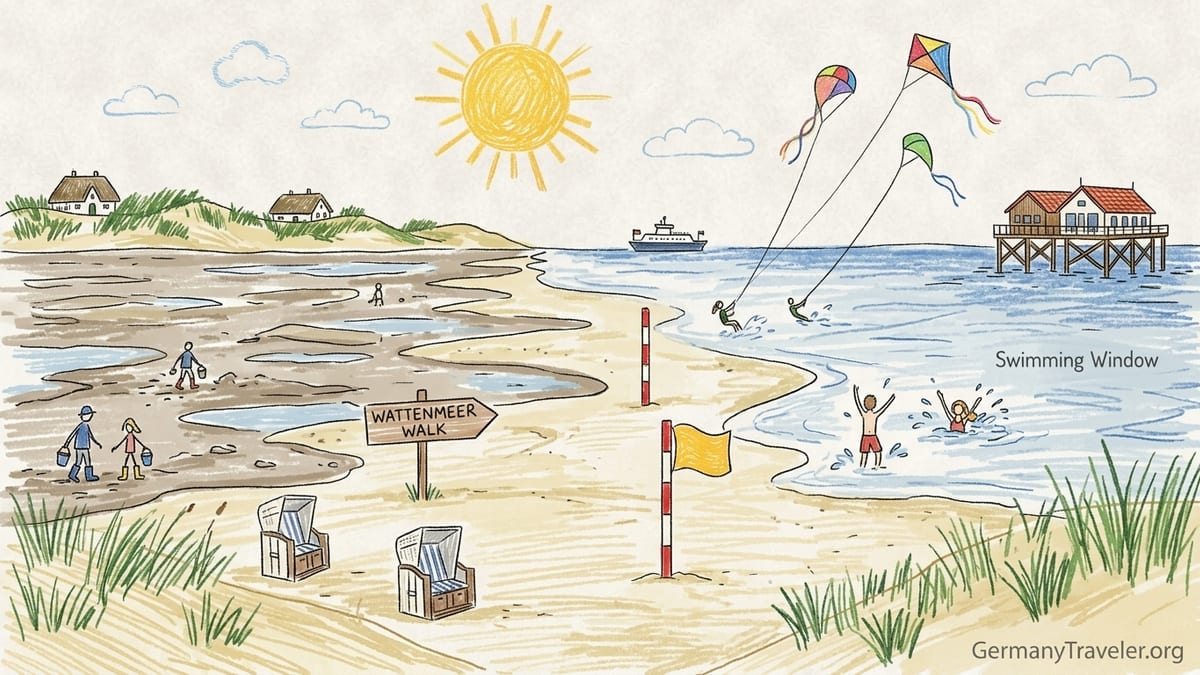
How North Sea Beaches Work: Tides, Mudflats and Swimming Windows
First-time visitors often expect the German North Sea to behave like the Baltic: gentle waves, water always close to the dunes and only a narrow strip of sand. On the North Sea it is almost the opposite. Twice a day at low tide the sea can retreat hundreds of meters from the shoreline, exposing the Wadden Sea mudflats and leaving shallow channels and sandbanks where there was swimmable water just an hour earlier. On beaches like St. Peter-Ording or Amrum’s Kniepsand, the waterline at low tide can feel like a long walk away from the nearest Strandkorb.
This means beach quality cannot be judged by the same standards used for the Baltic. You do not have continuous swimming at all times of day. Instead, you typically get two main bathing windows, each a few hours around high tide. Local tourism boards for St. Peter-Ording, Cuxhaven and the islands publish tide tables and even “bathing times” so visitors know roughly when water is high enough for proper swimming rather than just paddling in tidal pools.
The strong tidal range makes safety signage and lifeguard zones especially important. On most major beaches, the lifeguarded zones are concentrated near main access points where the seabed slopes gradually and rip currents are known and monitored. In St. Peter-Ording, for example, marked areas between the stilted beach stations are watched in summer by DLRG lifeguards, and color-coded flags indicate whether swimming is allowed. On Amrum’s Kniepsand, lifeguarded stretches sit in front of main village access points such as Nebel or Norddorf. Visitors should always check flags and obey instructions, because the pleasant, shallow water can change quickly with the turning tide.
Tides also shape your daily rhythm. A family staying a week in Cuxhaven’s Duhnen or Döse district might go for a morning mudflat walk when the water is far out, nap through the midday low tide, then head back to the same Strandkorb for late-afternoon swimming as high tide returns. On the islands, especially Sylt, Borkum and Norderney which figure prominently in current ADAC beach rankings, many regulars build their days around the tide calendar rather than the clock.
St. Peter-Ording: Endless Sand, Stilt Houses and Kitesurfing Energy
St. Peter-Ording on the Eiderstedt peninsula is one of Germany’s most iconic North Sea resorts and consistently scores highly in ADAC beach assessments. Its hallmark is a seemingly endless beach, in places up to two kilometers wide, lined with wooden stilt houses that serve as cafés, restaurants and lifeguard stations. Visitors reach the sand via long boardwalks over dunes and salt marsh, then find a landscape that feels more like a northern sand desert than a compact resort strand.
Tides matter here more than perhaps anywhere else on the German coast. Around low tide, the water may be a twenty-minute walk from the nearest Strandkorb, and large mirror-like shallow pools form between sandbanks. Families often treat this as an advantage, letting children splash in ankle-deep warm pools that heat up quickly in the sun. Serious swimming is best within the lifeguarded corridors around high tide, when the DLRG flags are green and local warnings about strong offshore currents are lifted. Safety announcements remind visitors that incoming water can surround sandbanks quickly; if you wander far out at low tide, you must be prepared to walk back as soon as the rising water is noticeable.
St. Peter-Ording is also one of Germany’s prime kitesurfing destinations. Designated kite and windsurf zones lie away from the main bathing areas, especially near Ording and at the wide beach sections favored for beach buggies and land sailing. On a windy August afternoon it is common to see dozens of kites in the sky while families read in Strandkörbe closer to the dune edge. The clear zoning means non-surfers are rarely disturbed by boards and lines, as long as everyone respects local rules about staying in marked areas.
For practicalities, St. Peter-Ording’s beach is divided into several sections such as Bad, Dorf and Ording. Each main section has rental Strandkörbe in high season, usually bookable by the day or week via the local tourism office or kiosks near the dune crossings. There are specific dog-friendly stretches as well as marked naturist areas where nudist bathing is officially allowed. Access varies: at some sections you can park directly behind the dyke for a fee, while others require a short walk or shuttle bus ride, which helps to keep the shoreline largely car-free in peak summer.
Sylt: Classic Island Glamour with Strong North Sea Character
Sylt, arguably Germany’s best-known North Sea island, combines broad sandy beaches with a level of infrastructure and style more reminiscent of upscale Mediterranean resorts. Current national rankings of beaches and seaside destinations frequently include Sylt near the top, often highlighting the kilometre-long Weststrand that runs from Hörnum in the south to List in the north. Behind the beach, dunes and thatched-roof houses give the island a distinctive, photogenic profile.
As on the mainland, tides dictate the daily routine, though the slope of the seabed off Sylt often means the water does not retreat quite as dramatically as in ultra-flat areas like Cuxhaven. Around Westerland and Wenningstedt, the main bathing zones are concentrated near stairways and promenade access, where lifeguard stations monitor swimmers during the season. Families favor these sections because the sandy bottom and clear signage make it easy to understand where it is safe to enter the water and how far out to venture as high tide approaches.
Sylt also offers a long tradition of naturist beaches. Official FKK sections exist in multiple places, for example near Kampen and on quieter stretches of the West Coast where signage marks transitions between clothed and naturist zones. Dog owners will find specific Hundestrände in towns like Westerland, where dogs can run off leash in designated areas outside the busiest bathing corridors. Strandkorb culture is strong across the island, with chairs lining promenades and quieter dunes, rented by day or season through local businesses, giving even windy days a snug, sheltered feel.
For active travelers, Sylt hosts regular kitesurfing and windsurfing events, especially in Westerland where competitions attract international riders. Surf schools cluster along the west coast, offering lessons that account for tidal timing and wave energy. Compared with St. Peter-Ording’s expansive flat sands, Sylt generally delivers more classic wave action, especially in autumn, but the same North Sea rules apply: confirm lifeguard hours, respect flag systems and always check the tide chart before committing to a long beach walk around headlands or remote sections.
Amrum’s Kniepsand and Föhr: Wide Wild Sands versus Sheltered Family Shore
Amrum’s Kniepsand is one of the most impressive sandscapes in northern Europe, a vast belt of fine white sand up to several kilometres wide and roughly fifteen kilometres long that lies in front of the island’s dune chain. Technically it is a separate sandbank rather than part of the island’s glacial core, but for visitors it simply feels like an extraordinarily wide beach. At low tide, the sea can retreat a long way, leaving firm sand perfect for long walks, beach games and photography that emphasizes the sheer scale of the landscape.
Kniepsand’s width and gently shelving seabed make it surprisingly family-friendly in the right conditions. During summer, the water warms in the shallows, and many parents with younger children prefer to stay in the calm, ankle- to knee-deep pools that form between sandbars instead of heading for deeper water. Lifeguarded zones are typically concentrated off the main access points from the villages of Wittdün, Nebel and Norddorf, where infrastructure such as Strandkorb rentals, kiosks and toilets are located. Naturist sections exist along parts of the Kniepsand, clearly marked, and dog walking is allowed in specific areas where leashes are often required to protect wildlife and other beachgoers.
Access to Kniepsand usually involves walking over the dune ridge on wooden boardwalks from each village and then continuing across the inner dry sand belt to the wet, tide-affected zone. On windy days this can be a moderate hike, so visitors with mobility concerns sometimes opt for shorter strolls that still provide panoramic views. Because Amrum has car restrictions, most guests arrive at the beach on foot, by bicycle or via local buses, which keeps the dunes and shore remarkably quiet even in peak season.
Nearby Föhr offers a different mood. Often nicknamed the “Green Island” for its sheltered position inside the Wadden Sea, Föhr’s main beaches are more compact and less exposed than Amrum’s Atlantic-style fringe. The sandy shore at Wyk is fronted by a promenade lined with cafés, Strandkorb rows and playgrounds, making it especially attractive to families with small children or older travelers who value quick access to facilities. Tides are still very noticeable and mudflats emerge at low water, but the more protected setting generally means gentler waves and a calmer overall atmosphere, ideal for first-time North Sea visitors who might be intimidated by the huge open sands of St. Peter-Ording or Kniepsand.
Norderney and Borkum: Island Resorts with Standout ADAC Ratings
Norderney and Borkum, two of the East Frisian islands off Lower Saxony, appear alongside Sylt and St. Peter-Ording in recent ADAC lists of Germany’s most attractive beaches. Both combine long sand beaches with well-developed resort infrastructure and easy access from the mainland, making them popular choices for classic German seaside holidays.
Norderney’s northern shore is lined with several distinct beach sections. Near the main town, Nordstrand provides a broad, sandy arc with lifeguard supervision in season, rows of Strandkörbe, beach cafés and short walking distances from guesthouses and hotels. Toward the western and eastern tips, the beaches become quieter and more natural, with certain segments designated as FKK zones and others marked for dog walking. As with all North Sea destinations, tides shape when real swimming is possible, but the gentle gradient off Nordstrand leaves plenty of room for paddling and sandcastle-building even when the sea is relatively far out.
Borkum, furthest offshore of the East Frisian islands, often feels wilder and more oceanic. Its main beaches, such as Nordbad and Südbad, offer wide sands and a mix of sheltered zones and more exposed wave areas that appeal to both families and watersport enthusiasts. Kitesurfing and windsurfing are popular, with local schools and rental shops timing sessions around tides and wind forecasts. The town itself sits close behind the dunes, so many visitors simply stroll from accommodation to the promenade and onto the sand without needing a car or long walk, a major convenience compared with some mainland stretches.
Both islands have embraced clear zoning to keep different types of users happy. Family bathing zones with DLRG lifeguards sit in front of the busiest access points, backed by playgrounds and snack stands. Elsewhere there are quieter nature sections, official dog beaches where pets can run more freely and naturist areas that continue Germany’s long FKK tradition. Strandkörbe can usually be rented by the day at on-site kiosks, with weekly reservations possible in high season for those staying longer. Visitors should plan ferry schedules and overnight stays with tide times in mind, especially when combining beach days with guided mudflat walks to neighboring islands or sandbanks.
Cuxhaven: Duhnen, Döse and Sahlenburg at the Edge of the Wadden Sea
Cuxhaven sits where the Elbe River meets the North Sea and serves as one of the most accessible Wadden Sea destinations for travelers arriving by car or train from Hamburg and central Germany. Its sandy beaches stretch across several districts, notably Duhnen, Döse and Sahlenburg, each with its own character but all strongly shaped by the large tidal range. At low tide the water can retreat far from the dykes, exposing a broad expanse of mudflats that locals and visitors explore on guided walks.
Duhnen is the classic family choice, with a long, gently sloping beach framed by a lively promenade. Around high tide, shallow water ideal for paddling reaches almost to the dyke, and lifeguard stations keep watch over crowded bathing zones. At low tide, children can safely explore shallow channels under parental supervision, though heavy mud in some spots makes water shoes a smart purchase from local shops. Strandkörbe line the upper beach in the main season, rented via beach offices or online booking systems, and simple cafés and fish snack bars ensure you rarely need to leave the sand for lunch.
Döse, a little further along the coast, offers similar conditions but a slightly quieter feel. It is also the area closest to the Kugelbake, a historic wooden navigation marker and popular photo subject that marks the transition point between Elbe and open North Sea. Sahlenburg, by contrast, feels more surrounded by nature, backed by forest and salt marsh and well known as a starting point for guided mudflat tours to the island of Neuwerk. It is popular with active travelers and dog owners, thanks to dedicated dog sections and the proximity of walking paths through nearby woods.
Swimming in Cuxhaven is very much tied to the tide calendar. Local tourist materials explicitly recommend bathing around high water, and lifeguard monitoring focuses on these windows when sufficient depth is available in the marked zones. At particularly low tides, you may find that “swimming” becomes more of a walk to ankle-deep pools. Many visitors embrace this by planning a mixed day: a late-morning mudflat walk from Duhnen during low tide, lunch in a promenade restaurant, then a proper swim and Strandkorb relaxation during the mid-afternoon high tide.
Strandkorbs, Dog Beaches, Naturist Sections and Access: What to Expect
Across the German North Sea coast, the Strandkorb is more than a piece of furniture; it is a symbol of the holiday culture. These hooded beach chairs shield from wind and drizzle and define the look of beaches from Sylt to Borkum. On most major beaches, you can rent one by the day from small offices near main entrances or via local tourism websites. Typical rates vary by destination and season, but travelers can expect a daily fee somewhere in the range of a modest restaurant meal, with discounts for multi-day bookings. In St. Peter-Ording, for example, entire rows stand near each stilted station and are often reserved for a full week by repeat guests who return every summer.
Dog owners are well served on the North Sea, but rules are carefully structured. Most larger resorts maintain designated Hundestrände where dogs may run off leash or at least have more freedom, while busier family sections require leashes or restrict dogs in peak hours. On Amrum’s Kniepsand and other nature-sensitive zones, dogs are often required to stay on leash everywhere to protect nesting birds and wildlife. Before your trip, it is wise to check local regulations from the tourism board and look for signage at each beach access point, as fines can be issued for ignoring posted rules.
Germany’s naturist culture is also visible on the North Sea. Officially designated FKK sections exist on many of the beaches covered in this guide, including stretches of Sylt, Amrum’s Kniepsand, Norderney, Borkum and parts of St. Peter-Ording. These areas are usually clearly signposted and often positioned slightly away from the busiest family corridors. If naturism is not your preference, simply stay in the standard zones; if it is, you can enjoy a relaxed, normalized atmosphere where nude bathing is common and integrated into the broader beach culture.
Access logistics differ by destination. Mainland locations like St. Peter-Ording and Cuxhaven generally offer large car parks behind the dykes, sometimes with beach shuttle options. Islands such as Sylt, Föhr, Norderney, Borkum and Amrum require ferry or in some cases car-train connections, which add travel time but also create a sense of escape. Once on the islands, local buses, bicycles and walking paths usually suffice to reach the main beaches. Because some access routes involve long wooden walkways over dunes or a substantial hike across wide sand, travelers with limited mobility should investigate specific access points and in some cases ask accommodations about barrier-free routes or beach wheelchairs.
Planning Your North Sea Beach Holiday
Choosing between these beaches depends largely on your priorities and how comfortable you are with the North Sea’s capricious mood. Travelers seeking a dramatic, open horizon, huge skies and endless sand will gravitate to St. Peter-Ording or Amrum’s Kniepsand. Those who prefer a compact, promenade-backed resort with cafés at arm’s length from the Strandkorb might favor Duhnen in Cuxhaven, Föhr’s Wyk promenade or Norderney’s Nordstrand. Travelers who want both beach and a sense of island glamour, shopping and dining will find Sylt compelling, while Borkum offers a hybrid of robust nature and classic Kurort comforts.
Because tidal patterns shift by roughly 50 minutes each day, a week-long holiday will include mornings, middays and evenings where high tide falls at different times. Check tide tables for your chosen destination before booking specific activities like mudflat tours, kitesurf courses or long coastal walks that might be cut off by rising water. Many kitesurf schools in places like St. Peter-Ording or Borkum plan beginner lessons for mid-tide periods when there is enough water for board starts but not so much depth that fatigue becomes dangerous.
Weather expectations should be equally realistic. Even in peak summer, the North Sea can be cool and breezy, and water temperatures are often significantly lower than in the Baltic or Mediterranean. Pack windproof layers, quick-drying clothes and sandals or water shoes suitable for both dry sand and muddy flats. At the same time, be prepared for bursts of intense sunshine that can cause rapid sunburn on reflective wet sands; sunscreen and hats are as essential here as in southern Europe, especially for children playing for hours in shallow pools.
Budget-conscious travelers will appreciate that once you arrive, many North Sea pleasures are low-cost: wandering the mudflats, watching dramatic skies roll in over St. Peter-Ording’s stilt houses, or sharing a simple portion of fries and fish on a windy dune. Costs arise mainly from ferry tickets to islands, nightly accommodation and extras like Strandkorb rentals or guided excursions. Booking early for school holiday periods is crucial on sought-after islands such as Sylt, Norderney and Borkum, which regularly appear in national rankings and thus attract both German regulars and international visitors.
The Takeaway
Germany’s North Sea beaches reward travelers who adapt to their rhythm. This is not a coast of fixed, postcard-blue waterlines and static beach days. Instead, it is a landscape that transforms hourly, as the sea advances and retreats across wide sands and the Wadden Sea reveals and conceals itself. Judged by Baltic standards, a North Sea beach at low tide may look empty or distant from the water. Judged on its own terms, it offers space, variety and a powerful sense of weather and light.
St. Peter-Ording, Sylt, Amrum’s Kniepsand, Föhr, Norderney, Borkum and the beaches of Cuxhaven all interpret this North Sea character differently. Some emphasize open wildness, others promenade comfort, but all combine tidal dynamics with German efficiency in lifeguarding, clear zoning for families, dogs and naturists, and the simple pleasure of a Strandkorb facing the sea. With a tide table in one hand and a flexible attitude in the other, travelers can enjoy these shores at their best, discovering why they increasingly appear among the country’s standout coastal destinations.
FAQ
Q1. Are North Sea beaches in Germany suitable for small children?
Yes, but families must plan around tides and stay within lifeguarded areas. Shallow pools at low tide can be very child-friendly, especially in places like Duhnen, Föhr or the inner zones of St. Peter-Ording.
Q2. When is the best time of year to visit the German North Sea for beach holidays?
The main beach season runs roughly from late June to early September, when air and water temperatures are highest and lifeguard coverage, ferries and beach services such as Strandkorb rentals operate at full capacity.
Q3. How can I find out the safe swimming times with the tides?
Local tourism websites, information offices and many hotel receptions provide daily tide tables and often highlight recommended bathing windows around high tide for popular beaches such as St. Peter-Ording, Cuxhaven, Norderney and Borkum.
Q4. Do I need special shoes for walking on the mudflats?
While many locals go barefoot, water shoes or sturdy sandals are advisable, especially for longer Wadden Sea walks around Cuxhaven, Amrum or Föhr, where shells, small stones and cooler mud can be uncomfortable.
Q5. Are kitesurfing and windsurfing spots separated from family bathing areas?
Yes, most major resorts designate specific zones for kitesurfing and windsurfing, for example on St. Peter-Ording’s outer beach or Borkum’s exposed sections, so that boards and lines stay clear of the main swimming corridors.
Q6. Is wild camping allowed on North Sea beaches like Sylt or Amrum?
No, wild camping and overnight stays on the beach or in the dunes are generally prohibited throughout the German North Sea coast, including Sylt, Amrum, Borkum and Cuxhaven, and fines can be significant.
Q7. How do I rent a Strandkorb on these beaches?
Strandkörbe are usually rented via small offices near the main beach entrances, through ticket machines at promenade points, or online through local tourism services, with daily and weekly rates depending on the destination and season.
Q8. Are there good options for travelers without a car?
Yes. Trains connect to ferry ports such as Niebüll or Norddeich for islands like Sylt, Föhr and Norderney, and to Cuxhaven and St. Peter-Ording directly. Once there, buses, bicycles and walking paths make it easy to reach most main beaches.
Q9. Can I bring my dog to the beach?
Dogs are welcome in many areas, but most resorts have clearly marked dog beaches and seasonal rules. In sensitive nature zones and on Amrum’s Kniepsand, dogs often must stay on leash, so always check local signage.
Q10. What is the main difference between North Sea and Baltic beaches in Germany?
The North Sea has a much stronger tidal range, so the waterline moves a long way and mudflats appear at low tide, while the Baltic usually offers more stable water levels, smaller tidal differences and narrower sandy strips.