


The German North Sea coast stretches from glamorous Sylt to windswept Borkum, mixing endless tidal flats, historic spa towns and islands that feel a world away from the mainland. The hotel market is broad, from understated thatched-roof hideaways to large spa resorts and family beach hotels. This guide focuses on the most interesting options around Sylt, St. Peter-Ording, Föhr and Amrum, Büsum, Cuxhaven, Norderney and Borkum, comparing not only style and atmosphere but also practical details such as distance to the beach, sea views, spa and pool facilities, breakfast quality, parking, bicycle storage, ferry access and whether staying directly on an island justifies the price premium.
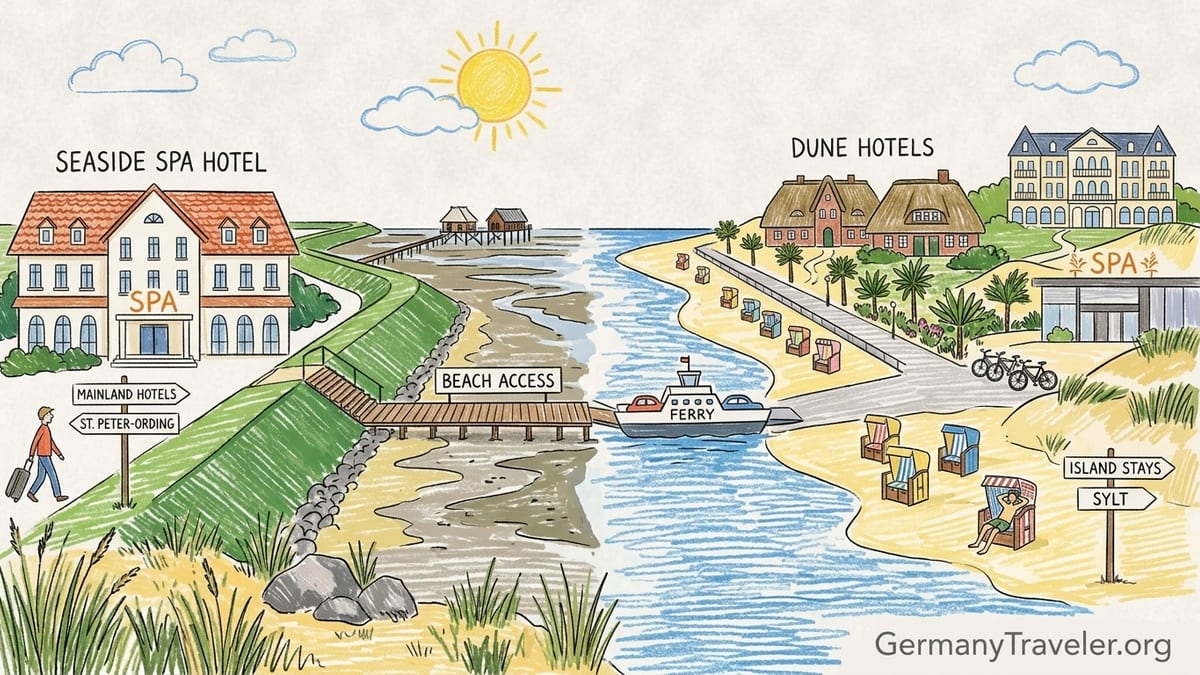
How to choose between mainland and island stays
One of the first decisions on the German North Sea is whether to base yourself on the mainland or commit to an island. Sylt, Föhr, Amrum, Norderney and Borkum all require some combination of train plus causeway, ferry or car shuttle, which adds both romance and cost. A midrange island hotel in high season can easily cost as much or more than a comfortable spa hotel on the mainland, largely because beds on the islands are limited and demand is strong in school holidays. In return, you get car-free promenades in many areas, quieter evenings once day trippers leave and the feeling of being surrounded by water and dunes rather than roads and industrial harbors.
On the mainland, hubs such as St. Peter-Ording, Büsum and Cuxhaven are accessible by regular rail services from Hamburg or Bremen, and driving is straightforward. Here you will find a wide spectrum of hotels, from classic seafront spa properties to cheaper guesthouses a few streets back from the dyke. Beachfront is a relative term: along much of the coast, a protective dyke sits between hotels and the tidal flats, so even a “seaside” address often involves a five to ten minute walk to the sand or mudflats. Prices can be more forgiving than on the islands, particularly outside peak dates, and you can often get bigger rooms, easier parking and more flexibility for short stays.
For many travelers it makes sense to combine both: start with a few nights on the mainland, then continue to an island for a more immersive coastal experience. If your budget is tight, consider choosing a mainland base with strong spa facilities and spending a day on an island by ferry. If you are seeking a once-a-year romantic escape and are comfortable paying a premium, an island hotel directly at the dunes or promenade can be worth every euro, particularly on Sylt or Norderney.
In the sections below, the focus is on concrete, real-world hotels that travelers actually book today, with attention to how far they sit from the water, whether they offer true sea views, what their spa setups look like and how they work in practice for couples, families or wellness-focused guests.
Sylt: Germany’s chic island with serious spa credentials
Sylt is often compared to the Hamptons in the United States, with long white beaches, thatched-roof houses and a well-heeled German clientele. Luxury prices reflect this atmosphere. Many visitors arrive by train directly to Westerland, where several hotels cluster close to the main beach promenade. Dorint Strandresort & Spa Sylt/Westerland is one of the most practical choices for families who still want the comfort of a spa hotel. It sits just behind the dune line, roughly a three to five minute walk from the main Westerland beach access, and offers a pool, sauna area and family-friendly suites with kitchenettes that make longer stays easier with children.
On the more upmarket end, properties such as Severin’s Resort & Spa in Keitum or the boutique-style Landhaus Stricker cater to travelers prioritizing refined wellness over immediate beach proximity. These hotels tend to be set back from the shoreline, often a ten minute or longer drive or bike ride from the main beaches, but compensate with large spa areas, indoor pools and gourmet dining. For example, a guest choosing Severin’s might accept being away from the sand in order to enjoy a full-scale, resort-style spa experience with multiple saunas, treatment rooms and quiet relaxation areas that are especially useful outside the short summer window.
When it comes to sea views, Sylt is nuanced. Only a limited number of hotels offer true, unobstructed panoramas over the North Sea from many rooms, typically where there is no dyke in front. In Westerland and Kampen, some smaller boutique hotels and apartment houses sit within a block or two of the promenade; you can expect partial sea views from upper floors rather than sweeping vistas from every balcony. The trade-off is that you are usually no more than a five minute walk from the beach, and breakfast rooms often have at least a side view of dunes or water. Bicycles are a major part of life on Sylt, and better hotels provide secure storage, sometimes with charging points for e-bikes, which is valuable if you plan to cycle between the villages.
Sylt’s island premium is clear: a smart, centrally located spa hotel in Westerland or Keitum in July or August is likely to be significantly more expensive per night than a similar-level property in St. Peter-Ording or Cuxhaven. Yet, for couples planning a special trip, the combination of high-quality restaurants, sophisticated spa culture and wild dune landscapes can make the extra outlay feel justified. Those on tighter budgets often compromise by staying a short walk back from the promenade or visiting in shoulder seasons such as May, June or September, when room rates soften but the sea air and long walks on the beach remain the main attraction.
St. Peter-Ording: mainland dunes, long beaches and modern beach hotels
St. Peter-Ording on the Eiderstedt peninsula is one of the largest seaside resorts on the German North Sea and is famous for its lifeguard stilt houses, vast sandy beach and well-developed wellness infrastructure. Here the distinction between “directly on the beach” and “near the dyke” matters. StrandGut Resort sits right on the promenade in the Bad district, with only the dunes and a stretch of boardwalk separating it from the sand. Guests can walk from the lobby to the water in roughly five to ten minutes, passing beach access points and the iconic stilted restaurant structures. Rooms facing the sea offer partial to wide-angle views over dunes and North Sea light, especially from upper floors, while landward rooms look toward the dyke and town.
For travelers who value spa access as much as the beach, StrandGut Resort has a strong advantage: it is connected to the Dünentherme, the main public spa complex, giving guests short internal access to indoor and outdoor pools, slides for children and a substantial sauna landscape. This can save both time and day-pass fees compared with staying in a simple guesthouse. Parking is typically available in a paid lot nearby, and the hotel is used to storing bicycles for guests who want to cycle the flat paths along the dyke. Breakfast is geared towards a mix of wellness and indulgence, with buffet-style spreads including fresh bread, regional cheeses and hot items.
Another notable option is the ambassador hotel & spa, a four-star superior property facing the sea in the same district. The beach is on the far side of the dyke and dunes, but most guests can reach the sand in around ten minutes on foot, depending on the tide and chosen access path. The key difference from some competitors is the in-house spa: the ambassador offers its own pool, sauna and treatment rooms on higher floors, some with broad views over the tidal flats. Many rooms have balconies angled towards the sea, though only a fraction offer completely unobstructed water views because of the dyke.
Budget-conscious families often consider Beach Motel St. Peter-Ording, where casual, surf-inspired decor and family rooms sit a short walk behind the dyke. The beach is still easily reachable, but not every room category has any kind of sea view, so it pays to check descriptions carefully. The motel’s Ocean Spa area provides saunas and relaxation spaces that help when the weather turns stormy. Across all three hotels, parking is straightforward compared with the islands, and arriving by car from Hamburg takes roughly two and a half hours, traffic permitting. For many travelers this combination of wide beach, decent spa infrastructure and accessible pricing compared with Sylt makes St. Peter-Ording a strong first North Sea base.
Föhr and Amrum: quieter island charm and village-scale hotels
Föhr and Amrum share a joint administrative district but have distinct characters. Föhr, especially around Wyk auf Föhr, feels like a classic seaside town, with a promenade facing the tidal flats and a mix of hotels and holiday apartments. The seafront here has only a few mid-sized hotels, and travelers looking for spa facilities often turn to established brands or locally run properties that offer small wellness areas rather than vast complexes. The main beach in Wyk is generally a matter of crossing the promenade and perhaps a narrow strip of grass, so many hotels marketed as “seafront” are truly within two to three minutes of the sand, and some rooms offer direct views across to the Halligen islets on clear days.
Amrum is wilder and more intimate, known for its broad Kniepsand beach on the west side of the island. Here, most hotels sit either in Nebel or Wittdün, at a distance from the dunes. For example, Inselhotel Kapitän Tadsen in Nebel positions itself as a comfortable base with a small fitness area and garden, but guests still need to cycle or walk through the village and across the island core to reach Kniepsand, which can take 20 to 30 minutes on foot or around ten minutes by bike. The trade-off is that these hotels often feel genuinely local and are priced a little below the most famous properties on Sylt, especially outside peak periods.
Spa hotels on Amrum generally focus on relaxation rather than showpiece architecture. Expect Finnish saunas, infrared cabins and quiet rooms rather than elaborate water parks. For couples, this can be ideal, as the atmosphere remains calm even at busier times. However, families with small children who need indoor pools and slides in bad weather might find the facilities limited. Some visitors solve this by booking self-catering apartments and using the public spa facilities where available, but this requires more planning and does not offer the same all-under-one-roof comfort as a full-service spa resort.
Because Föhr and Amrum are reached by ferry, parking logistics matter. Many hotels provide dedicated car parks either on the island or at mainland ferry terminals through partner services. Others encourage guests to leave cars on the mainland and travel as foot passengers, relying on bikes and buses on the islands. It is standard to find basic bicycle storage at village hotels, often in the form of covered sheds rather than high-security garages. If you are bringing expensive e-bikes, it is worth confirming in advance whether charging points are available and whether bikes can be stored indoors. For visitors seeking calm landscapes, beach walks and traditional Frisian architecture rather than nightlife, these two islands can feel like a good-value alternative to Sylt, though choice in the very top luxury category is more limited.
Büsum and Cuxhaven: practical bases with access to the Wadden Sea
Büsum on the Schleswig-Holstein coast is a fishing port turned holiday town that offers quick access from Hamburg and a substantial range of mid-scale hotels. Here, the seafront is dominated by a dyke and grassy lounging areas rather than long dry beaches, and many properties line up just behind the promenade. Even so, guests at well-located hotels are generally within a five to eight minute walk of tidal flats or the small family-friendly lagoon area. True sea-facing rooms usually look out over the dyke and water, while inland rooms face the town. Spa facilities tend to be modest: a number of hotels have saunas and small relaxation rooms, but full pools and expansive wellness zones are rarer than on the islands or in St. Peter-Ording.
Cuxhaven, further south at the mouth of the Elbe, is a larger town spread across several districts such as Döse and Duhnen. Here, beach hotels and apartment houses line the dyke, and walking distances to the sand vary by only a few minutes. Many visitors choose Cuxhaven because it combines Wadden Sea walking and beach days with practical amenities such as supermarkets, train links and a broad choice of restaurants. Families can find good-value rooms in three- and four-star hotels within a short walk of the beach without paying the premiums seen on Sylt or Norderney. Secure bicycle storage is commonly offered, although not always in a locked, monitored garage, so travelers with high-end gear may still prefer to bring simple cable locks.
Both Büsum and Cuxhaven work well for travelers who prioritize value and logistics over a postcard-perfect island feel. Staying here can cut total trip costs substantially, especially when traveling with children or extended family, because apartment hotels and guesthouses with kitchenettes are common. Ferries and boat excursions to nearby islands or sandbanks are offered regularly in season, which can give you a taste of the offshore landscapes without committing to an island stay. If you are content with shorter spa sessions and do not need sunset views directly from your room every evening, these mainland towns offer a grounded, easygoing version of the North Sea that suits many first-time visitors.
Parking in both towns is generally uncomplicated, with many hotels featuring on-site or nearby public lots. Unlike on smaller islands where car numbers are tightly controlled, you can arrive and depart at your own pace, which appeals to road trippers exploring more of northern Germany. For guests drawn to the UNESCO-listed Wadden Sea and its mudflat walks, having a mainland base can be a practical way to join guided tours that depend heavily on tides and local weather forecasts.
Norderney and Borkum: classic spa heritage and true beachfront stays
Norderney is one of the classic North Sea spa islands, with grand architecture around the historic Kurplatz and a long promenade running along the main beach. Hotels close to the spa square provide immediate access to both sand and wellness culture. Properties such as the long-established Strandhotel Georgshöhe sit very close to the water on the northwestern side of the island, with only the promenade between hotel terraces and the beach. Many rooms and suites offer full or partial sea views, and the on-site wellness area is extensive, including pools and multiple saunas. Guests can usually walk from their room to a beach chair on the sand in five to seven minutes, depending on the exact location of their chosen Strandkorb.
Breakfast culture is strong on Norderney, with many hotels offering generous buffets featuring regional dairy, freshly baked breads and a range of hot dishes. This helps justify the room rates, which are generally higher than comparable properties on the mainland but slightly lower on average than Sylt’s most famous addresses. Parking can be more cumbersome: parts of Norderney are car-restricted, and many visitors leave vehicles at the Norddeich ferry terminal, using island buses or walking to reach their hotel. Several seafront properties offer luggage transport and can arrange for rental bicycles, often with simple bike storage rooms in basement or courtyard areas.
Borkum, the westernmost East Frisian island, has a more down-to-earth feel, with a mixed clientele of families, day trippers and spa guests. Nordsee Hotel Borkum is one of the best-known central properties, positioned directly at the main beach promenade. Guests simply cross the promenade to reach the sand, typically within two to three minutes from the lobby, depending on the tide. The hotel combines its prime location with an indoor saltwater pool and additional swimming facilities, giving guests an all-weather option when strong winds or rain make the beach less appealing. Upper floor rooms with sea-facing balconies offer broad views of the North Sea and the island’s main stretch of sand.
Because Borkum lies further offshore, ferry transfer times from the mainland are longer than to Norderney, and this is reflected in somewhat lower nightly room prices relative to travel time. However, once you are on the island, costs can balance out because of fewer large-scale luxury competitors. Parking is typically managed at the mainland ports, and many visitors enjoy the absence of heavy traffic on the island itself. From a value perspective, Borkum may appeal to travelers who want a true beachfront hotel experience with indoor pool access without paying the top-tier rates of Sylt or the most exclusive Norderney properties.
On both islands, the question of whether the island premium is justified comes down to how much time you plan to spend simply sitting on your balcony or in the spa, watching the light change over the water. If your itinerary is packed with excursions and you see your hotel mainly as a place to sleep, the extra cost might feel steep compared with a comfortable mainland base. If your aim is long, slow days of walking the promenade, using the spa and enjoying sunsets from your room, then booking a seafront address like Strandhotel Georgshöhe on Norderney or Nordsee Hotel Borkum can be a central part of the experience rather than a simple accommodation choice.
Comparing key features: distance, views, spas, breakfast and bikes
Across the North Sea coast, true beachfront hotels where you step directly from the property onto sand are rare, largely because dykes and promenades run between buildings and the shore for flood protection. In practical terms, any hotel where guests can access the beach in under ten minutes on foot counts as “beachfront” for this region. StrandGut Resort and ambassador hotel & spa in St. Peter-Ording, seafront hotels in Wyk auf Föhr and many properties lining the promenades of Norderney and Borkum fall into this category. On islands like Amrum, where villages sit back from Kniepsand, walking times can lengthen to 20 minutes or more, which makes bicycle rental almost essential for daily beach visits.
Sea views are another important differentiator. On Sylt and Norderney, some luxury hotels and upper-floor apartments deliver wide panoramas, especially when there is no high dyke blocking the line of sight. However, many hotels marketed with “sea view” actually offer partial glimpses or oblique angles, particularly from lower floors. Travelers who place high value on views should consider paying for confirmed seafront or “Meerblick” room categories and checking photos beforehand. Mainland towns such as Büsum often provide grassy dyke-top lounging areas with a view, even if your room itself looks over town roofs rather than directly at the sea.
Spa and pool facilities vary widely. Larger resort-style hotels like Severin’s Resort & Spa on Sylt, Strandhotel Georgshöhe on Norderney, Nordsee Hotel Borkum and key St. Peter-Ording properties combine indoor pools with multiple saunas and treatment menus tailored to thalassotherapy and mud packs, drawing on the region’s spa tradition. Village-scale hotels on Föhr and Amrum might offer only a sauna and relaxation room, focusing on quiet rest rather than elaborate spa circuits. For families, attached water parks or neighboring public spas such as Dünentherme in St. Peter-Ording can be a major advantage, giving children space to play while adults alternate in the saunas.
Breakfast is one of the pleasures of staying in North Sea hotels and can significantly affect perceived value. Even mid-range properties tend to serve substantial buffets with local bread, cold cuts and fresh fruit, while upscale hotels add live cooking stations and special dietary options. In terms of logistics, most coastal hotels include some form of parking, though on islands this often means arranging spots at mainland terminals or using public lots on the edge of car-restricted zones. Bicycle storage ranges from simple exterior racks to dedicated locked rooms; guests who rely on cycling for daily transport should confirm details when booking. When comparing mainland and island stays, these practicalities, together with nightly rates and transfer times, are what ultimately decide whether paying the island premium will feel worth it in your own travel context.
The Takeaway
The German North Sea coast offers a surprisingly varied hotel landscape, from polished spa resorts on Sylt and Norderney to relaxed beach motels in St. Peter-Ording and small village hotels on Föhr and Amrum. The choice between mainland and island, and between luxury or more modest accommodation, hinges on how you balance atmosphere against budget and convenience. Islands bring stronger feelings of escape, quieter evenings and, in some cases, spectacular sea views directly from your balcony, but ask you to commit to ferry or train shuttles and higher room rates.
Mainland bases such as Büsum, Cuxhaven and St. Peter-Ording keep transfers simple, offer a broader range of price points and still deliver long walks by the water, decent spa facilities and family-friendly amenities. For many travelers, combining two bases in one trip offers the best of both worlds: a few practical nights on the mainland to settle in, followed by a slower, more indulgent spell in a seafront hotel on an island. By focusing on concrete factors such as walking distance to the beach, sea views, spa access, breakfast quality, parking and bicycle storage, you can match the strengths of each destination and hotel type to your own priorities and create a North Sea trip that feels both special and well thought through.
FAQ
Q1. Is it worth paying extra to stay directly on an island like Sylt or Norderney? For many travelers the premium is justified if you plan to spend most of your time walking the promenade, using the spa and enjoying sea views from your room, but if you primarily need a base for day trips and do not mind shorter views or more modest spa facilities, a well-located mainland hotel can offer better value.
Q2. How close are “beachfront” hotels on the German North Sea in reality? Because of protective dykes and promenades, even beachfront hotels usually require a five to ten minute walk to reach the sand or tidal flats, though some island properties right on promenades can be closer, while village hotels on Amrum or Föhr may be 20 minutes or more from the main beach.
Q3. Which area is best for families who want pools and easy beach access? St. Peter-Ording is a strong choice, with hotels such as StrandGut Resort and ambassador hotel & spa offering short walks to the beach and either in-house or next-door access to pools and spa facilities, while family-friendly resorts on Sylt and Borkum also combine indoor pools with nearby beaches.
Q4. Where can couples find the most romantic North Sea hotel settings? Couples often gravitate toward upscale spa hotels on Sylt and Norderney that offer sea-view rooms, refined dining and extensive wellness areas, while smaller boutique-style properties in Keitum on Sylt or village hotels on Föhr and Amrum appeal to those preferring intimate, traditional surroundings over large complexes.
Q5. Do I need a car for a North Sea coast trip focusing on these destinations? A car is convenient for reaching mainland towns such as Büsum and Cuxhaven and for carrying luggage to ferry ports, but once on islands like Sylt, Föhr, Amrum, Norderney or Borkum, many visitors rely on bikes and local buses, so it is possible to plan a largely car-free trip, especially if you choose hotels near promenades and ferry or train stops.
Q6. How do hotel prices compare between Sylt and places like St. Peter-Ording or Büsum? In peak season, Sylt generally commands the highest room rates, particularly for luxury spa hotels and sea-view suites, while St. Peter-Ording tends to be more moderate and towns like Büsum often offer the most budget-friendly options for families and long stays, especially in apartment-style hotels.
Q7. Are spa facilities in North Sea hotels suitable for bad-weather days? Yes, many larger hotels in destinations such as Sylt, St. Peter-Ording, Norderney and Borkum feature indoor pools, multiple saunas and relaxation zones specifically designed to provide a comfortable refuge when wind, rain or cool temperatures make beach time less appealing.
Q8. How important is bicycle storage when choosing a hotel on the North Sea? Bicycle storage is quite important, especially on islands where bikes are the main way to reach beaches and explore villages; most hotels provide at least basic racks or sheds, but travelers with valuable e-bikes should look for secure, covered storage and confirm whether charging facilities are available.
Q9. What should I expect from breakfast at mid-range and upscale North Sea hotels? Expect generous buffet-style breakfasts with fresh bread, regional dairy products, cold cuts, fruit and hot items at most mid-range properties, with upscale hotels adding more variety, made-to-order dishes and better accommodation of dietary needs, which can help justify higher nightly rates.
Q10. When is the best time to visit for lower hotel rates but still pleasant conditions? Shoulder months such as May, early June and September often bring milder weather, long daylight hours and significantly lower room rates than peak school-holiday periods in July and August, making them attractive times to experience both mainland and island hotels with fewer crowds.