


The German North Sea coast is one of Europe’s most unusual road trip regions. You drive along green dikes and quiet marshland, yet much of what you actually come to see lies offshore on low sandy islands where the car suddenly becomes useless. To get the best out of East Frisia, Cuxhaven, Büsum, St. Peter-Ording and Sylt, you need to think of the vehicle as a flexible shuttle between coastal bases, and treat the islands and the Wadden Sea in between as a separate, largely car-free world.
How to Structure a Realistic North Sea Coast Road Trip
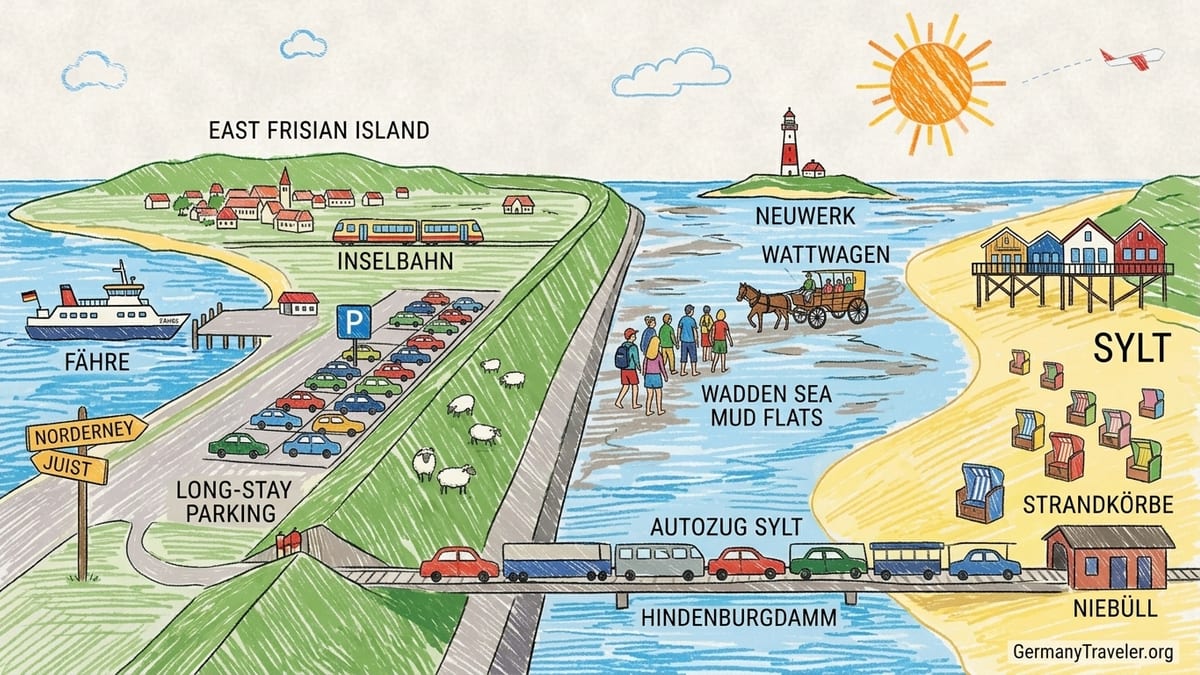
A practical way to approach the German North Sea is to treat the mainland as your spine and the islands as side trips. A workable route for a week to ten days runs from East Frisia in Lower Saxony to Cuxhaven at the mouth of the Elbe, then down to Büsum, west to St. Peter-Ording on the Eiderstedt Peninsula, and finally up through Husum and North Frisia to the jumping-off points for Sylt and the other North Frisian islands. Rather than trying to drive every kilometer of coastline, you use efficient causeways, ferries and trains to reach the islands, often leaving the car behind.
This region rewards slow travel and realistic distances. Coastal roads frequently run behind dikes, which means plenty of 70 or 80 km/h sections, tractors and sheep grids. Heavy North Sea weather can also stretch driving times. It makes sense to base for two or three nights in a mainland town such as Norddeich for the East Frisian islands, Cuxhaven for Neuwerk and the Elbe estuary, Büsum or St. Peter-Ording for the Schleswig-Holstein Wadden Sea National Park, and Husum or Niebüll for North Frisia and Sylt. From each base, you choose one or two island excursions instead of trying to tick off every sandbank on the map.
Island logistics are central. Several of the East Frisian islands are completely car-free and others restrict foreign vehicles, which means long-stay parking at the ferry piers, advance ticketing in busy school-holiday periods, and a willingness to walk, cycle or hop on small island trains. Even on car-accessible islands like Sylt, traffic and parking in high season can make it more relaxing and often faster to leave the vehicle on the mainland and arrive by train as a foot passenger.
For a first-time visitor, one or two East Frisian islands combined with one North Frisian island offers a good contrast. For example, you might spend three nights in Norddeich with a day trip to Norderney or Juist, another two nights in Cuxhaven or Büsum to experience the mudflats and a Heligoland excursion, and then three nights near Husum or Niebüll so you can reach Sylt and, if time permits, Föhr. The distances are manageable, and the rhythm of driving, parking, sailing and walking quickly becomes part of the appeal.
East Frisia: Mainland Bases and Car-Free Island Logistics
The string of East Frisian islands sits off the coast between Emden and Wilhelmshaven. From west to east, the inhabited islands are Borkum, Juist, Norderney, Baltrum, Langeoog, Spiekeroog and Wangerooge. Several are legally car-free for visitors, including Juist, Baltrum, Langeoog, Spiekeroog and Wangerooge, while Borkum and Norderney have limited car access for tourist vehicles. Offshore ferries run from harbors such as Emden and Eemshaven for Borkum, Norddeich for Norderney and Juist, Neßmersiel for Baltrum, Bensersiel for Langeoog, Neuharlingersiel for Spiekeroog and Harlesiel for Wangerooge.
On the mainland side, you should plan where to leave the car before you choose an island. Each ferry port has signed long-stay car parks behind the dike, generally on flat ground a short shuttle ride or walk from the pier. Norddeich, which serves Norderney and Juist, offers several paid car parks labeled P1, P2 and so on, with seasonal shuttle buses running every 15 minutes or so between high-season sailings to carry passengers and luggage to the terminal. At Neßmersiel for Baltrum and Bensersiel for Langeoog, private operators known locally as “Inselparker” run fenced parking areas with optional Covered spaces. You typically pay per calendar day on exit; summer day rates can be comparable to a mid-range city parking garage, while off-season prices are lower.
Because Juist, Baltrum, Langeoog, Spiekeroog and Wangerooge are car-free, leaving the vehicle on the mainland is not a matter of choice but a requirement. From the ferry pier on these islands, onward transport is on foot, by bicycle, by horse-drawn carriage or on narrow-gauge island railways where they exist. Langeoog, for example, has an island railway that meets the ferry and runs directly to the village station near the main street, while Wangerooge combines a ship and train journey so that passengers step straight from the boat to the small island train. You check luggage into marked trolleys before boarding, much as you would on a short-haul flight.
For Borkum and Norderney, which allow vehicles but have restrictions and limited spaces, many visitors still prefer to leave the car behind. The ferries from Emden or Eemshaven to Borkum and from Norddeich to Norderney can carry vehicles, but fares rise sharply for cars and especially for campervans. On Norderney, summer traffic restrictions mean that non-resident cars are often directed to edge-of-town lots. If you are staying in a central guesthouse and plan mainly beach days, renting a bicycle on arrival is usually simpler and cheaper than bringing the car. In school holidays and on summer weekends, ferry passenger reservations for popular sailings are recommended even if you travel without a vehicle, because sailings can be heavily booked.
Cuxhaven and the Elbe Estuary: Dikes, Mudflats and a Tiny Island
Cuxhaven, at the northern tip of Lower Saxony where the Elbe enters the North Sea, makes a convenient stop between East Frisia and Schleswig-Holstein. The drive from Norddeich to Cuxhaven takes roughly three hours on a mix of rural roads and autobahn. You arrive to an industrial port city that sits behind high dikes, with long sandy beaches at districts like Duhnen and Sahlenburg and a strong focus on Wadden Sea experiences rather than island life. The town is a good place to park up, walk the waterfront, and take a guided mudflat hike out into the UNESCO-listed Wadden Sea National Park.
Cuxhaven is one of the few spots on this route where you can literally walk to an island. The tiny island of Neuwerk, officially part of Hamburg, lies in the Wadden Sea offshore. In safe conditions and with licensed guides, visitors can hike across the tidal flats to Neuwerk at low tide and return by boat or horse-drawn wattwagen carriage. You leave the car in one of Cuxhaven’s public coastal car parks or at your accommodation, then join a pre-booked tour that times departure and return exactly to the tide tables. Because the route runs over soft sand and mud, guides strongly discourage unguided walks; water can return surprisingly fast, and licensed guides are trained to read the channels and weather.
Beyond Neuwerk, ferries and excursion boats run from Cuxhaven to Heligoland, Germany’s only open-sea island, which is completely car-free and known for red sandstone cliffs and low taxes on certain goods. Day trips are popular in summer: you park in a long-stay lot near the Alte Liebe pier or at Duhnen, then take a passenger ship that spends several hours offshore before returning in the evening. In rough conditions, sailings can be canceled or delayed, so it is best not to schedule your onward drive for the same evening you plan to return from Heligoland.
For overnighting, Cuxhaven works well as a one- or two-night base. Families often choose Duhnen or Sahlenburg for easier beach access, while travelers focused on the harbor atmosphere and Heligoland departures prefer to stay closer to the city center. Bicycles are an efficient way to get around, and many guesthouses provide simple rental bikes for exploring the dike-top paths that run along the Elbe and out toward the Kugelbake monument where river and sea meet.
Büsum and St. Peter-Ording: The Heart of the Schleswig-Holstein Wadden Sea
Driving west from Cuxhaven, you cross the Elbe by ferry or via the highway bridges, then follow signposted roads into Schleswig-Holstein. Büsum is a compact fishing town turned resort that makes an excellent base for Wadden Sea excursions. You typically park in municipal lots just behind the dike or at your accommodation, then explore on foot. Boats leave from the small harbor for seal-watching trips, national park tours and, in season, for day excursions to Heligoland. Like Cuxhaven, Büsum is about leaving the car and venturing out on water or mud, not driving the shoreline.
Parking in Büsum is straightforward in the shoulder seasons, with paid day lots within a short walk of the center. In July and August the main car parks can fill by late morning, which means early arrivals or choosing accommodation that includes a reserved space. Once you are checked in, the town is small enough that a bike is ideal. The coastal bike path along the dike lets you ride north and south for kilometers with constant sea views, and rental shops in the center offer standard city bikes and e-bikes suitable for day trips.
Further west, St. Peter-Ording stretches along a broad peninsula with one of Germany’s most iconic beaches. Here, logistics become more complex because of the very elements that attract visitors: vast sands, dramatic tides and long distances. The village itself has several districts, with guesthouses and hotels spread out behind the dike. Cars must usually be left in designated parking areas at the edge of the dune belt. In low tide conditions and with valid permits, parts of the beach can be used for regulated on-beach parking, but rules change and are vigorously enforced for environmental reasons, so drivers should always follow the latest local signage and ranger instructions.
For most visitors, it is easier to park once and use bicycles, the local bus or simply walk long sections of the beach on the wooden boardwalks that lead to the famous stilt-house restaurants. Distances between districts like Bad, Dorf and Böhl look small on a map but can feel long and exposed in a North Sea wind. E-bikes rented from local shops can turn what would be a tiring push into an easy glide along the dike path, and allow you to reach quiet stretches of sand that are well beyond practical walking range.
North Frisia, Husum and the Gateways to the Islands
North of St. Peter-Ording you drive toward Husum, a small harbor town that often serves as the psychological transition to North Frisia. Husum is a solid choice for a night or two, especially in shoulder seasons when Sylt’s accommodation is at its most expensive. You park in town or at your guesthouse, then wander the compact harbor, visit the castle park and sample Frisian specialties like labskaus in harbor-view restaurants. The town sits slightly inland on a tidal bay, so it feels more sheltered than the exposed island villages.
From this hub, decisions branch toward several islands. Pellworm and the Halligen islets offshore are reached by ferry from the mainland; these ships can carry vehicles, but many visitors arrive as pedestrians and rent bikes on the spot, because paved roads on these islands are short and flat. Farther north, Dagebüll serves as the main ferry port for Föhr and Amrum. Here, too, the car is optional. Long-stay pay parking sits directly behind the terminal, and the ferries are large, comfortable passenger ships that operate in almost all weather. Föhr and Amrum allow cars, but both are relatively compact and threaded with cycle paths, so bringing a vehicle works best for longer stays or family groups carrying a lot of gear.
For this road trip, you can think of Husum and Dagebüll as the last points where you decide how car-heavy you want the island section to be. If you plan to spend just a day or two on Föhr or Amrum, leaving the car in Dagebüll and relying on bikes and buses is usually gentler on both budget and nerves. For a week in a self-catering holiday house, a car onboard can make sense, but you will pay more for the ferry and need to reserve in busy periods. Either way, it is important not to schedule tight same-day connections between ferry arrival, long drives and fixed check-in times, because North Sea traffic and tides do not always respect timetables.
North Frisia also offers chances for guided mudflat walks out to small Halligen islands in safe conditions. These are highly sensitive ecosystems and routes, so travelers should only go with certified guides arranged via local tourist offices. In all cases, the pattern repeats: you leave the car handily parked on the mainland edge of the dike, step into rubber boots or onto a ferry, and enter a landscape where walking and cycling set the pace.
Sylt: Car Trains, Parking Decisions and Getting Around
Sylt is the best-known German North Sea island and the one where road trippers must think hardest about what to do with the car. There is no road bridge to Sylt. Instead, the Hindenburgdamm causeway carries railway tracks across the Wadden Sea between Niebüll on the mainland and Westerland on Sylt. To bring a vehicle, you drive onto a special car shuttle train known simply as the Autozug. Commercial operators run these services frequently, typically every hour or so during the day, and you stay seated in your car or step into a passenger coach for the roughly 35-minute crossing through the marshes and across the tidal flats.
Parking around Niebüll gives you a clear either-or choice. If you decide against taking the car over, you can park in public car parks and a multi-storey garage near Niebüll’s passenger station, where standard day rates apply and long-term tickets are available. From there you board a regular regional train to Westerland as a foot passenger, with no need for a car train ticket. Trains run several times an hour in daytime. This option is popular with couples and solo travelers staying in central Westerland or Kampen who plan to get around by bus and bicycle and wish to avoid island parking stress.
If you do choose to take the car, you follow signs in Niebüll to the car train terminal, where lanes are marked and staff check tickets as you queue. You drive slowly onto the flat wagons and remain in gear with the handbrake on for the crossing. Fares for vehicles scale with length and type, and round-trip tickets are most cost-effective if you plan to stay at least a few days. In peak summer and on holiday weekends, it is worth building in extra waiting time at the terminal because trains can be busy and weather disruptions occasionally slow the frequency.
Once on Sylt, you will quickly see why many travelers feel freer without a car. The island is long but relatively narrow, with a continuous bus service that connects the main towns of Westerland, Wenningstedt, Kampen and List, as well as smaller villages toward Hörnum in the south. A dense network of cycle paths runs behind the dunes, and e-bike rental is widely available in Westerland and the major villages. Parking near the most popular beaches can be expensive and scarce at peak times, so it is often more efficient to leave the car at your accommodation and move around by bike or bus, reserving driving for grocery runs or day trips to quieter corners.
For a short three- or four-night stay focused on beaches, restaurants and walks through the heathland, arriving as a foot passenger and treating Sylt like a car-free island works well. For longer family holidays with heavy luggage, beach toys and perhaps surfboards, the car train continues to make sense, but you should still plan days where the keys stay on the table and the island’s paths do the work instead.
Practical Tips on Reservations, Seasons and What to Pack
The success of a North Sea coast and islands road trip depends as much on timing and expectations as on routes. July and August, plus long weekends around German school holidays, bring the heaviest crowds. Ferries to Norderney, Borkum, Heligoland and Sylt car trains can be near capacity, and island accommodation prices are at their highest. If your dates are fixed in this period, pre-booking all overnight stays and any vehicle ferries or car train crossings is wise. For foot passengers, many ferry companies allow or recommend reservations on busier sailings, though they will often sell remaining tickets at the pier on the day.
Shoulder seasons from May to June and September to early October can be ideal. Temperatures are milder, the Wadden Sea mudflats are often at their most atmospheric, and parking at mainland ports like Norddeich, Neßmersiel, Büsum and Dagebüll is far less of a scramble. In winter, some island services switch to off-season timetables and frequent storms can disrupt crossings, but the upside is wide-open beaches and budget-friendly accommodation. Whenever you travel, building flex into your schedule for weather-related delays is more realistic than expecting punctuality down to the minute.
Packing for this trip should start with the assumption that wind and wet are part of the experience. Sturdy waterproof footwear, a breathable rain jacket and warm layers matter more than city-smart outfits, especially for mudflat walks and exposed dike-top bike rides. For drivers, bringing a compact windscreen sunshade and ice scraper can be surprisingly useful, since North Sea weather can swing from bright glare to chilly squalls within hours, even in late spring. A small dry bag or waterproof backpack liner keeps cameras and phones safe in ferry spray and sudden showers.
Finally, treat bicycles and public transport as core tools of the trip, not emergency fallbacks. Many mainland bases have small train stations that connect neatly with ferry timetables, and regional train tickets often allow bikes onboard outside rush hours. Checking current local rules on bike carriage and day passes at the start of the trip helps you improvise if, for example, a dike road is temporarily closed for maintenance or a storm makes driving less appealing than riding a sheltered inland cycle route.
The Takeaway
A German North Sea road trip rewards travelers who can enjoy a coastal drive and then happily lock the car and walk away from it. From East Frisia’s car-free islands and the tidal flats of Cuxhaven and Büsum to the long sands of St. Peter-Ording and the dune-backed villages of Sylt, the most memorable moments tend to happen on foot, by bike or standing on a ferry deck watching the dikes slip away.
By using the mainland as a chain of overnight bases and treating each island as an intentional detour rather than a box to tick, you keep distances sensible and stress low. Parking at the right ports, choosing ferries that match your tolerance for crowds and weather, and knowing when to leave the vehicle on the mainland all turn a potentially complicated coastline into a manageable, deeply atmospheric journey. With a bit of planning around tides, seasons and reservations, this stretch of Germany becomes one of Europe’s most distinctive road-and-sea adventures.
FAQ
Q1. Do I need a car for the East Frisian islands?
Most East Frisian islands are car-free or restrict vehicles, so you usually leave your car at the mainland ferry port and get around on foot, by bike or by island train.
Q2. Where can I safely leave my car when visiting a car-free island?
Each ferry port, such as Norddeich, Neßmersiel, Bensersiel or Harlesiel, has signed long-stay car parks behind the dike with paid day and multi-day options.
Q3. Is it worth taking my car onto Sylt?
It can be useful for long family stays or self-catering trips, but many visitors leave the car in Niebüll and use trains, buses and bikes to avoid island traffic and parking hassles.
Q4. Do I need to reserve ferries and car trains in advance?
In peak summer and school holidays it is wise to reserve vehicle spots on ferries and Sylt car trains, while foot passengers often only need reservations on the busiest sailings.
Q5. Can I drive along the beaches at St. Peter-Ording?
Only certain sections allow regulated on-beach parking when conditions and permits permit, and rules change, so you should always follow current local signs and instructions.
Q6. What is the best season for this North Sea road trip?
Late spring and early autumn usually offer mild weather, fewer crowds and easier parking, though summer brings the warmest sea temperatures and the fullest ferry schedules.
Q7. How reliable are ferry and car train services in bad weather?
Most operate in a wide range of conditions, but strong storms and very low tides can cause delays or cancellations, so you should keep some flexibility in your itinerary.
Q8. Do I need special equipment for mudflat walks?
Certified guides typically recommend sturdy old trainers or neoprene shoes, warm layers and a windproof jacket, and they provide safety briefings tailored to the day’s conditions.
Q9. Is cycling realistic for most travelers on these islands?
Yes, the terrain is generally flat, distances are modest and rental shops offer a wide range of bikes and e-bikes, making cycling accessible even for casual riders.
Q10. Can I do this route using trains and buses instead of a car?
It is possible to connect major towns like Emden, Cuxhaven, Büsum, Husum and Niebüll by rail and bus, then rely on ferries, local buses and bikes for the island sections.