


The German North Sea coast runs in a long curve from the Dutch border up to Denmark, facing one of Europe’s most dynamic and distinctive seascapes. It is a region of wide tides, green dikes, sandy islands and the UNESCO-listed Wadden Sea. For first-time visitors, the mix of tides, ferries, Halligen and Strandkörbe can be confusing. This guide introduces the main stretches of coast from East Frisia to Sylt, explains how the Wadden Sea works, and helps you choose the right base, island and season for your own North Sea trip.
Understanding the Wadden Sea and the Tides
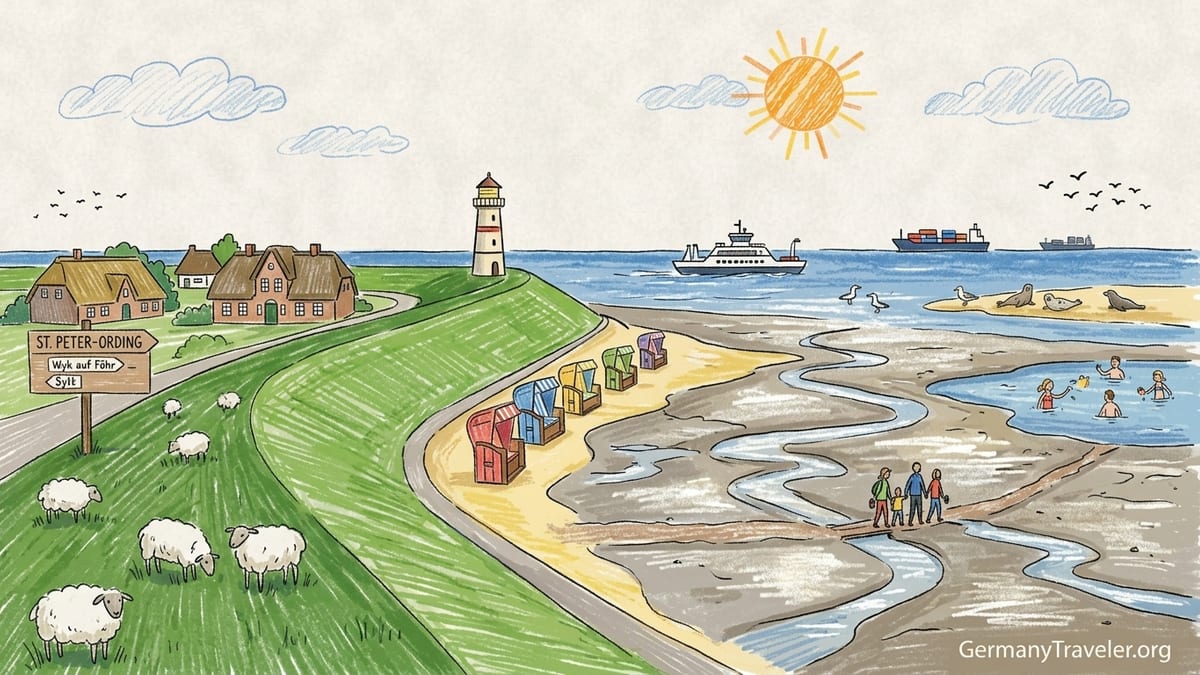
The single most important feature of the German North Sea coast is the Wadden Sea, a shallow coastal zone that falls largely dry at low tide and floods again at high tide. At low tide, what looked like open water in front of Borkum, Cuxhaven or St. Peter-Ording can turn into vast mudflats, criss-crossed by tidal creeks. The tidal range is typically between about 1.5 and 3.5 meters along the German coast, with larger differences around Cuxhaven and Dithmarschen and smaller ones near Sylt. This constant rise and fall shapes every aspect of travel here, from swimming times to ferry departures.
For visitors, the tides mean that “beach day” does not automatically equal all-day swimming. In many places on the Wadden Sea side, there is only enough water for proper swimming for a few hours around high tide. In Cuxhaven and Büsum, for example, you may see bathers in knee-deep water two hours before high tide and a horizon of shining mud two hours after. Local tourist offices and many hotels hand out tide tables, and popular destinations such as Sylt publish easy-to-read tide calendars for each day of the year. Experienced regulars check these before planning a mudflat walk, a swim or a ferry connection.
Because the seabed here is shallow and the currents strong, safety is a serious issue. It is dangerous to walk far out into the Wadden Sea on your own without checking tide times or local advice, as the incoming water can return much faster than expected and channels can fill in minutes. Lifeguards on German North Sea beaches repeatedly warn against swimming during strong outgoing tide, when currents pull seawards. As a first-time visitor, keep swimming to designated, lifeguarded beach sections, obey warning flags and avoid spontaneous long walks over the mud unless you are on an organized tour.
The Wadden Sea is also a protected national park area along most of the German coast, home to seals, migratory birds and unique salt marsh landscapes. That is why you will see long stretches of coast with little building and strict rules about staying on marked paths. In Lower Saxony and Schleswig-Holstein, guided mudflat walks, seal-watching boat trips and visitor centers such as the Multimar Wattforum in Tönning help visitors experience this ecosystem in a controlled and informative way.
Key Regions: From East Frisia to North Frisia
For trip planning, it helps to think of the German North Sea coast as a sequence of regions, each with a different character. In the far west is East Frisia, including the mainland coast and the East Frisian Islands such as Borkum and Norderney. This is a relaxed, largely flat landscape of sheep-dotted dikes, small harbors and tea culture. Towns like Emden and Norden serve as gateways to the islands, with ferries departing to the sandy barrier islands that line the Wadden Sea edge.
Further east, the Elbe estuary meets the sea at Cuxhaven. Here the Wadden Sea and the busy shipping lane to Hamburg overlap. From the promenades at Duhnen and Sahlenburg near Cuxhaven you can watch large container ships slide past just offshore on their way up the Elbe. East of Cuxhaven, the Elbe-Weser region remains relatively quiet, a mix of marshland villages and small ports. Slightly inland, cities like Bremerhaven and Bremen make practical stops for those combining coastal time with maritime museums or urban sightseeing.
North of the Elbe, in Schleswig-Holstein, Dithmarschen and the Eiderstedt peninsula form a transitional zone between marshland coast and wider sandy beaches. Büsum is one of the major seaside resorts here, while St. Peter-Ording on Eiderstedt offers some of the broadest beaches in Germany. Further north still, North Frisia stretches up to the Danish border. This area includes coastal towns such as Husum, offshore islands like Föhr and Amrum, the slightly more distant Halligen and, further out, Sylt, which is linked to the mainland by rail causeway rather than by ferry.
Distances between these regions are not huge. By train, the trip from Cuxhaven to Husum is often around three hours with changes, and Hamburg serves as the main rail and flight hub for most of the German North Sea. Many first-time visitors choose one core base such as Büsum, St. Peter-Ording or Westerland on Sylt and then add day trips by ferry or regional train to explore nearby islands and coastal towns.
Beaches, Dikes, Cycling and Strandkorb Culture
The visual hallmark of much of the German North Sea coast is the green grass dike, often topped by a paved path and flanked by grazing sheep. In many places, such as Büsum, Husum and large parts of East Frisia, the dike is the actual coast, with mudflats or tidal channels on the seaward side and villages on the landward side. Bathing areas are sometimes built as concrete steps down to the water or as tidal swimming pools, so it is common to see visitors sunbathing on lawn behind the dike rather than on natural sand.
Where the coast opens out into full sand beaches, the atmosphere changes. St. Peter-Ording is famous for its kilometer-wide sandy beach lined with wooden stilted beach restaurants and lifeguard stations, and a designated section where cars are allowed to park on the hard-packed sand during the day. Sylt’s west coast, around Westerland and Kampen, offers long sandy strands backed by dunes, while Amrum and Föhr are known for fine, shallow beaches that are especially popular with families. During the main summer season, daily beach chair rentals give you a personal base for the day with wind protection and shade.
The Strandkorb, a wicker beach chair with a hood and pull-out footrest, is a near iconic part of North Sea culture. On a typical July day in St. Peter-Ording or Norderney, entire fields of them face the water. Visitors usually rent them by the day or half-day through local beach kiosks or online in advance, with prices that can vary by resort and season. On a midsummer weekend it is not unusual to pay a moderate fee for a full day in a prime row near the water, while shoulder-season rates are lower and more flexible.
Behind the dikes and dunes, the flat landscape and signed routes make the German North Sea ideal for cycling. Many resorts promote day rides along the dikes or through the marshes, with rental bikes easy to find in places like Cuxhaven, Büsum and on the islands. A common pattern for visitors on Föhr or Norderney is to pick up rental bicycles for several days at once, then use them for everything from grocery runs to evening rides out to bird hides or lighthouses. E-bikes are increasingly common, which can be helpful when cycling into the often stiff North Sea wind.
Islands and Halligen: Choosing Your Base
The German North Sea islands fall into two main groups for visitors: the East Frisian Islands off Lower Saxony and the North Frisian Islands and Halligen off Schleswig-Holstein. All are shaped by the Wadden Sea and tides, but each has its own feel. As a rule of thumb, the larger islands with several villages and a year-round population, such as Borkum, Norderney, Föhr and Sylt, offer more services, nightlife and accommodation choice, while smaller or more remote islands and Halligen are better for quiet nature breaks.
In East Frisia, Borkum sits far out in the open sea and feels more maritime than some of its neighbors. It has long sandy beaches on the western side, a compact town with shops and restaurants and a nostalgic narrow-gauge island railway linking the port and the main village. Norderney has a slightly more upscale reputation, with a range of hotels and apartments, a modern spa complex near the main beach and a walkable town center. Both islands have ferries from the mainland that run frequently, often largely independent of tides, and accept foot passengers as well as cars, though bringing a vehicle may be restricted or expensive in peak season.
Off the Schleswig-Holstein coast, Föhr and Amrum are classic family islands. Föhr’s main town Wyk has a promenade directly at the beach, sheltered shallow water and a friendly, low-rise feel. The island interior is criss-crossed by bike paths through fields and villages. Amrum, by contrast, is best known for its very wide Kniepsand beach on the western side, which can feel surprisingly uncrowded even in school holidays because of its sheer size. Visitors usually reach Föhr and Amrum via ferry from Dagebüll, with parking lots near the harbor for those leaving their cars on the mainland.
The Halligen are a special case. These small marsh islands in North Frisia, such as Hooge and Langeneß, lack full protective dikes and are partially flooded during severe storm tides, with houses and farms built on artificial mounds. There are no classic long beaches, and life is adapted to the tides to an even greater degree than elsewhere. Visitors typically come for day trips by ferry from the mainland or from larger islands. An overnight stay on a Hallig, often in a small guesthouse or holiday apartment, is a memorable way to experience the quiet side of the Wadden Sea and is best suited to travelers who value nature and solitude over resort facilities.
Spotlight on Borkum, Norderney, Cuxhaven and Büsum
Borkum is often chosen by first-timers who want a straightforward resort feel with a clear seaside atmosphere. The main town has a pedestrian-friendly center, while the island’s beaches are divided into family, sports and dog sections to keep different activities separate. Regular ferries link Borkum to Emden and to Eemshaven in the Netherlands, and many regional train tickets can be booked through to the island pier so that the train and ferry connections align. Once on Borkum, most visitors get around on foot and by bicycle, as the island is compact and relatively flat.
Norderney mixes traditional seaside resort elements with a noticeably contemporary scene. In summer, beach bars and music events attract a younger crowd alongside families. The island offers several distinct beach sections, from child-friendly areas near town to more exposed stretches toward the east. The local spa and wellness center near the main promenade uses North Sea saltwater and thalasso treatments, which can be attractive options on cooler or windy days when long beach sessions are less comfortable. As with Borkum, it is wise to reserve accommodation and ferry spaces well ahead for July and August, especially if you plan to bring a car.
Back on the mainland, Cuxhaven is both a long-standing seaside resort and a busy shipping point at the mouth of the Elbe. Neighborhoods like Duhnen and Döse have promenades, sea-facing hotels and beach sections with lawn, sand and Strandkörbe, while Sahlenburg sits closer to woodland and offers access to the Wadden Sea national park. From Cuxhaven, popular excursions include mudflat hikes with guides, trips to the small island of Neuwerk and boat trips into the estuary to watch seal colonies on offshore sandbanks. Because of the strong tidal range and shipping traffic, swimming here is limited to marked zones and times, so it is essential to observe signage.
Further north, Büsum in Dithmarschen is one of the most accessible introductions to the Schleswig-Holstein Wadden Sea. The town lies directly behind the dike, with a modern family-friendly bathing zone, a tidal harbor and a compact center full of fish restaurants and small hotels. Many German families start their North Sea explorations here because it combines manageable size, good infrastructure and easy excursions, including boat trips out to seal sandbanks or to the offshore Heligoland archipelago. Büsum is also a gateway to longer stays along the coast, thanks to frequent rail connections to Hamburg and beyond.
Spotlight on St. Peter-Ording, Föhr, Amrum and Sylt
St. Peter-Ording, often abbreviated as SPO, sits at the outer edge of the Eiderstedt peninsula and is instantly recognizable by its endless sandy beach and long stilted piers. The beach is divided into separate sections for family bathing, kite surfing, beach sailing and other activities, and in some parts cars are allowed to drive and park directly on the sand during the day, which is unusual by German standards. The combination of spaciousness, strong wind and shallow water makes SPO one of the country’s kite-surfing hotspots as well as a family favorite. However, the sheer width of the beach means you should be alert to tide times and distances when walking out to the water.
Föhr offers a softer, more sheltered experience. Its southern coast around Wyk faces the Wadden Sea and enjoys relatively mild conditions compared with more exposed islands. Here, shallow water and fine sand make it easy for children to paddle and play, and the town’s waterfront promenade has a classic small-resort feel. Cycling routes radiate from Wyk into the island interior, where scattered thatched-roof villages and churches give Föhr a distinctly rural character. Many regular visitors rent holiday apartments or houses by the week and return every year for a combination of beach days and gentle cycling.
Amrum is sometimes described as Föhr’s wilder sibling. Its vast Kniepsand beach on the western side stretches for many kilometers and is in places so wide that the water’s edge can feel distant at low tide. This scale, combined with dune landscapes and low visitor numbers compared with larger islands, creates a strong sense of space even in the main summer weeks. The main village, Wittdün, has ferry connections, accommodation and shops, but once you head toward the island’s lighthouses or bird-rich mudflats, you quickly feel that you are in a more remote corner of the German Bight.
Sylt is the largest and most famous of Germany’s North Sea islands, known both for its natural landscapes and for a certain level of glamour in resorts like Kampen and Westerland. A causeway with rail line, the Hindenburgdamm, connects Sylt to the mainland, so visitors arrive either on regular passenger trains or by car shuttle trains that carry vehicles. On the west side, long sandy beaches back onto dramatic dune and cliff sections, while the east side borders directly onto the Wadden Sea national park. Sylt offers the widest range of accommodation on the German North Sea, from simple guesthouses to luxury hotels and design apartments, plus extensive dining, spa and shopping options. For first-time visitors, it can serve as a single-base introduction to many classic North Sea experiences, from mudflat walks and seal watching to surf lessons and fine dining.
Swimming, Ferries and Planning Around the Seasons
Because of the tides and the shallow Wadden Sea, swimming on the German North Sea requires more planning than on many ocean coasts. In places where the seabed shelves very gradually, low tide can leave only ankle-deep water for hundreds of meters, or expose mudflats where swimming is not possible at all. Resorts respond to this in different ways: some, like Büsum, have tidal pools or artificially deepened basins that maintain swimmable water even at lower tide, while others, such as St. Peter-Ording and Sylt’s west coast, rely on broader beaches that still have enough depth near high tide. In all cases, local tide tables and the flag system used by lifeguards are your best guides.
Ferry travel is almost inevitable for island visits. Most major German North Sea islands have year-round ferry connections, although timetables and capacities change with the seasons. Some routes, particularly in the Wadden Sea, are still partially tide-dependent, meaning that departure times shift slightly day by day. When planning a trip to Amrum or Föhr, for instance, you may notice that the ferry schedule for a given date clusters sailings around periods close to high water. On other routes, such as to Borkum or Norderney, modern shipping channels allow relatively tide-independent operation, providing greater flexibility for arrivals and departures.
Seasonality shapes both prices and experiences. Summer from late June through August is peak season, with school holidays in several German states and the highest likelihood of warmer, beach-friendly weather. Daytime temperatures along the North Sea coast in summer are often in the low to mid 20s Celsius, though wind and occasional storms can make it feel cooler or, during heatwaves, distinctly hot. Accommodation prices and minimum stay requirements tend to be highest in these weeks, and popular islands like Sylt and Norderney may book out well in advance.
For many travelers, the shoulder seasons of late spring and early autumn are an ideal compromise. April and May as well as September and early October often bring relatively mild temperatures, fewer crowds and lower accommodation rates, making them attractive for cycling, walking and nature-watching trips. Bird migration, in particular, is a highlight of the shoulder seasons along the Wadden Sea. Winter, from November to March, is the quietest period. Many smaller guesthouses and seasonal restaurants close, ferry timetables can be reduced and stormy weather is common. However, some visitors deliberately choose this time for bracing walks along near-empty beaches, followed by long evenings in saunas or by the fireplace in spa hotels.
The Takeaway
The German North Sea coast rewards visitors who embrace its rhythm rather than fight it. Instead of expecting a conventional all-day beach holiday with guaranteed sun and static water levels, you step into a landscape that transforms twice a day as the tide advances and retreats across the Wadden Sea. This change creates both practical constraints and special opportunities, from timed swims and guided mudflat hikes to bird-watching on newly exposed sandbanks.
For a first trip, think in terms of choosing a region and an island that fit your travel style. East Frisia and its islands suit relaxed, down-to-earth breaks, Cuxhaven and Büsum make convenient introductions with good infrastructure, St. Peter-Ording and Amrum attract those who crave big skies and very wide beaches, and Föhr and Sylt offer different blends of comfort, variety and North Sea atmosphere. Whatever you choose, plan around the tides, respect the Wadden Sea as both a fragile ecosystem and a powerful natural force, and be open to days where watching the clouds and ships from a Strandkorb is an activity in its own right.
Once you have settled on a base, delve into more detailed island and activity guides for specifics on accommodation types, recommended walking routes, family-friendly spots, wellness options and seasonal events. The German North Sea coast is not a one-visit destination. Many travelers find themselves returning in different seasons, discovering how familiar beaches and dikes look and feel entirely different under spring light, summer heat or winter storms.
FAQ
Q1: Can I swim anywhere along the German North Sea coast at any time?
Swimming is usually only recommended in designated, lifeguarded zones and mainly around high tide. At low tide, many areas turn into mudflats or become too shallow, and currents can be strong, so always follow local signs and tide tables.
Q2: What is the best time of year to visit the German North Sea for a first trip?
Late spring and summer, from about May to early September, offer the mildest weather and the widest range of services. July and August are best for classic beach days but also the busiest and most expensive, while May, June and September can be quieter yet still pleasant.
Q3: Do I need a car to explore the German North Sea coast and islands?
You can visit many key destinations by train and ferry, including Borkum, Norderney, Büsum, St. Peter-Ording, Föhr, Amrum and Sylt. On the islands, cycling, walking and local buses cover most needs. A car is helpful if you want to tour several mainland regions in a short time but is not essential for a single-base holiday.
Q4: How far in advance should I book accommodation on popular islands like Sylt or Norderney?
For peak summer weeks and school holiday periods, it is wise to book several months ahead, especially for apartments or family rooms. Outside those times, a few weeks’ advance planning usually suffices, and in shoulder seasons you may find options on shorter notice.
Q5: What is a Strandkorb and should I reserve one?
A Strandkorb is a hooded wicker beach chair that shelters you from wind and sun. Many visitors rent one for a day at resorts such as St. Peter-Ording, Büsum or Norderney. In high season at popular beaches, advance reservations are useful, while in quieter periods you can often rent one spontaneously on site.
Q6: Are guided mudflat walks necessary, or can I explore the Wadden Sea on my own?
Guided mudflat walks are strongly recommended for first-time visitors. Guides know safe routes, timing and local regulations, and they interpret the wildlife and ecosystem. Short walks close to shore are often allowed independently, but long excursions far out into the Wadden Sea without guidance and tide knowledge are dangerous.
Q7: Which island is best for families with young children?
Islands with sheltered, shallow beaches and compact towns, such as Föhr, Borkum, Norderney and parts of Sylt, tend to work well for families. Föhr’s Wyk waterfront and Borkum’s main town beach are typical examples, with nearby facilities, gentle water and plenty of family-oriented services.
Q8: How weather-dependent is a North Sea holiday?
Weather along the German North Sea can change quickly and even summer can bring cool, windy or rainy days. It is wise to plan a mix of outdoor and indoor activities, such as beaches, cycling, spas and visitor centers, and to pack layers, windproof jackets and some warmer clothing even in July or August.
Q9: Can I visit more than one island during a single trip?
Yes, island-hopping is feasible, especially among the North Frisian islands served from Dagebüll or within the East Frisian group. However, each ferry crossing takes time, so for a first visit it is usually best to choose one main island as a base and add perhaps one additional island or Hallig as a day trip.
Q10: Is the German North Sea suitable for visitors who do not speak German?
English is widely understood in major resorts, hotels and visitor centers, and many information materials are available in multiple languages. Learning a few basic German phrases is appreciated, but language alone should not prevent non-German speakers from enjoying the coast and islands.