


Germany’s North Sea coast is a patchwork of long beaches, sandy islands and low-key fishing towns, but choosing where to base yourself can feel surprisingly complex. Do you want Sylt’s upscale restaurants, St. Peter-Ording’s endless sands, Föhr’s gentle family feel, or the car-free calm of Norderney and Amrum? This guide walks through the main options that appear on today’s booking sites and regional maps and turns them into a practical decision: where should you actually stay, and what does that choice mean for your holiday in real, on-the-ground terms?
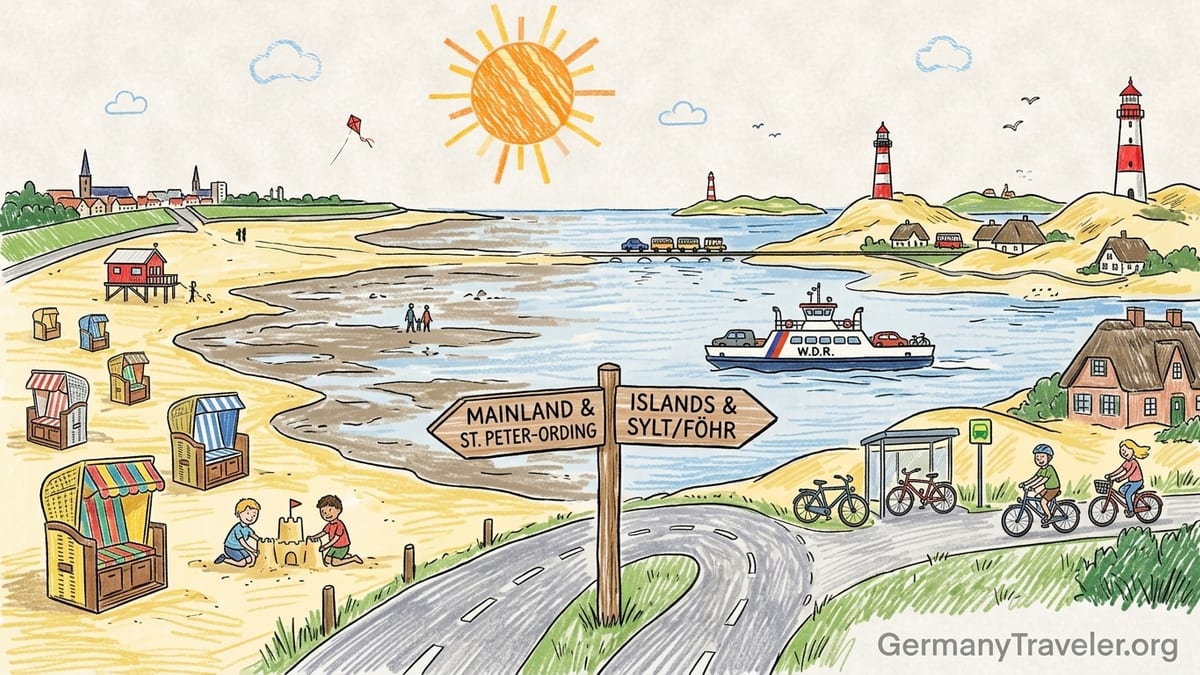
How to Choose Your Base on the German North Sea
For most travelers, the first decision is whether to stay on the mainland or on an island. Cuxhaven and Büsum offer easy rail access, no ferries and lower overall costs, which suits short trips, mixed itineraries that also include Hamburg, or anyone anxious about tight ferry schedules. The tradeoff is a less “island” feeling and more conventional seaside towns, with dikes and mudflats instead of wild dune landscapes right outside your door.
The islands of Sylt, Föhr, Amrum, Norderney and Borkum feel more remote but require more planning. You need to consider ferry times, parking on the mainland and sometimes seasonal car restrictions on the islands themselves. For example, driving your own car onto a ship to Föhr or Borkum can be convenient for families with a lot of luggage, but you may instead opt to leave the car in a long-stay car park in Dagebüll or Emden and continue on foot or by bicycle once you arrive.
Prices are another dividing line. Sylt and, to a lesser extent, Norderney often command higher nightly rates, especially in July and August and during school holidays. A centrally located hotel in Westerland on Sylt or directly behind the promenade on Norderney can easily cost two to three times as much as a mid-range guesthouse in Büsum or Cuxhaven on the same summer weekend. Föhr, Amrum and Borkum typically fall somewhere in the middle, with a strong focus on self-catering apartments and holiday homes.
Finally, think about whether you plan to stay in one place or move around. Island-hopping between Föhr, Amrum and the Halligen is realistic because ferries are relatively short, and accommodation stock includes many weekly rentals that accept mid-week arrivals outside peak season. By contrast, a week on Sylt or Norderney is usually more of a destination in itself, with rich restaurant and spa scenes that reward staying put.
St. Peter-Ording: Enormous Beaches and Easy Mainland Access
St. Peter-Ording is the place people imagine when they think of giant North Sea beaches. At low tide, the sand can seem to stretch for hundreds of meters, with iconic stilt houses and beach cafés perched above the flats. In summer, families set up day camps around rented Strandkörbe while kite surfers and land-sailors make use of the wide, hard-packed sand. The sheer scale is the attraction here, along with the fact that you can walk out toward the water for long distances without feeling crowded.
The town itself is spread over several districts, including Bad and Dorf, so it is worth checking the exact location of any hotel or apartment. A spa hotel near the Dünentherme pool complex in Bad gives you quick access to the main beach bridge and restaurants, whereas a holiday apartment in the quieter Dorf area may be several kilometers from the water. Typical mid-range hotels might start around a moderate three-figure sum per night in high season, while private apartments often require stays of several nights and can be significantly cheaper on a per-night basis for families.
Reaching St. Peter-Ording is straightforward. Regular regional trains from Hamburg connect via Husum, and the station in St. Peter-Ording sits within walking distance or a short bus ride from many guesthouses. For drivers, there is paid beach parking in certain zones when the tide allows vehicles on the sand, but conditions and access can change and are regulated, so travelers should always check current local rules upon arrival. Crucially, there is no ferry involved, which makes the town especially attractive for long weekends and short breaks.
Food and drink in St. Peter-Ording lean toward relaxed beach fare. You will find fish sandwiches, fries and cake in the stilt-house cafés, while in the village districts there are bakeries, casual bistros and a handful of more polished restaurants. The variety is not as wide as Sylt’s, but for many travelers the combination of huge beaches, modest prices and simple, family-friendly dining is exactly what they are looking for.
Sylt: Upscale Restaurants, Stylish Hotels and Direct Trains
Sylt is Germany’s most famous North Sea island and it feels like a world of its own. The main town of Westerland has a busy pedestrian zone, a long sandy beach backed by a promenade and a dense supply of hotels and apartments. Booking platforms often highlight Westerland first because of its central railway station and the concentration of mid to high-end accommodation. A standard double room in a well-located beach hotel can be expensive in peak season, while smaller pensions and apartments on quieter streets may offer better value outside school holidays.
What particularly sets Sylt apart is its restaurant scene. The island has a long-standing reputation for high quality seafood and fine dining. Around Kampen, the northern resort area, you find beach clubs and restaurants that attract a well-heeled crowd, serving local fish, oysters and inventive regional cuisine. Even casual places such as beach bistros often emphasize fresh ingredients and regional products, and there is a noticeable concentration of wine bars, cafés and bakeries compared to other islands of similar size.
Getting to Sylt does not require a passenger ferry from Germany, which surprises some visitors. If you bring a car, you drive onto a car train at Niebüll and travel across the Hindenburgdamm causeway. Passenger trains from Hamburg and beyond continue onto the island and arrive directly in Westerland, putting the town within a roughly three-hour rail journey of Hamburg central station. There is also a separate car ferry connection from the Danish island of Rømø to List on Sylt, which some travelers use when coming from Denmark.
Despite its upscale image, Sylt offers a range of experiences. Westerland can feel busy and resort-like, while List, Hörnum and the thatched villages on the eastern side of the island feel more relaxed. Bicycles are very common, and many visitors park their cars soon after arrival and rely on bikes and buses to get around. If you want a base with strong train connections, a wide selection of restaurants and a broad spectrum of accommodation from five-star spa hotels to modest apartments, Sylt is difficult to beat on the German North Sea coast.
Föhr and Amrum: Families and Nature in the North Frisian Islands
Föhr is often described as the gentle island of the North Sea, which makes it a favorite for families. The main town, Wyk auf Föhr, has a sandy beach directly along the promenade, lined with playgrounds, cafés and ice cream shops. Holiday apartments here are oriented toward longer stays; it is common to find week-long minimum bookings in summer, with many self-catering flats sleeping four or more. Nightly prices can be more moderate than Sylt, particularly if you book outside the school holiday periods, though demand is strong for seafront properties.
To reach Föhr, you take a W.D.R. ferry from the harbour of Dagebüll on the mainland. The crossing usually takes under an hour on direct services. Travellers can board on foot, with bicycles, or with vehicles. Families often choose to bring a car for convenience, but it is entirely possible to manage with bicycles and local buses, as distances on the island are short. Long-stay parking is available around Dagebüll for those who prefer to leave their car on the mainland and avoid taking a vehicle on the ferry.
Amrum, Föhr’s smaller neighbor, has a wilder feel and is best known for its broad Kniepsand beach and extensive dune landscapes. The island is also reached by W.D.R. ferries from Dagebüll, often via Föhr, with travel times of around one and a half to two hours depending on the route. Once on Amrum, visitors quickly notice that bicycles dominate, supported by a well-developed network of cycle paths. Cars are allowed on the island, but many guests find they do not need one for daily life, and some choose to leave their vehicles in mainland car parks.
Accommodation on Amrum tends toward apartments and guesthouses in villages such as Wittdün, Nebel and Norddorf. Prices vary but are generally middle of the range, with modest guest rooms and self-catering flats forming the backbone of the market. There are a few small hotels and spa properties, but nothing on the scale of Sylt. For travelers who prioritize nature, long walks in dunes and forests, birdwatching and relative quiet over nightlife and shopping, Amrum is often the most satisfying base on the German North Sea.
Norderney and Borkum: Active Island Resorts in the East Frisian Chain
Norderney, one of the East Frisian Islands, combines a compact, active resort town with broad beaches and dune landscapes. The main town has a dense grid of streets filled with hotels, apartment houses, bakeries and beachwear shops. A central promenade faces the sea, and the main bath house complex and spa give the town an almost Mediterranean resort atmosphere in summer, albeit with North Sea temperatures. Booking platforms often place Norderney high in search results thanks to its extensive accommodation stock, ranging from simple pensions to modern spa hotels.
Access to Norderney is via ferry from Norddeich Mole on the mainland. Passengers arrive by regional trains that run directly to the pier or by car, which can be driven onto the ferry with advance reservation. However, Norderney enforces restrictions on private motor traffic in parts of the island, especially in the central zone, so it is common for visitors to leave their cars in mainland parking lots and rely on local buses, taxis and bicycles once on the island. This semi-car-free environment supports a pleasant, walkable resort feel while still allowing delivery and service vehicles.
Borkum, further west near the Dutch border, is one of the larger East Frisian Islands and feels more spacious than many of its neighbors. The main town features broad streets, several beaches and a small island railway that shuttles passengers from the ferry terminal to the center. There is a mix of hotels, guesthouses and holiday apartments, again with a focus on self-catering. A family might rent a two-bedroom flat within walking distance of the main beach for a comparatively moderate sum per night outside peak weeks, while classic Kurhaus-style hotels offer more traditional half-board arrangements.
To reach Borkum, visitors typically travel via Emden or Eemshaven and then continue by ferry or fast catamaran. Vehicles can be transported on certain ferry services with a reservation, though the town itself operates seasonal restrictions on private car traffic to protect its spa atmosphere. As on Norderney, bicycles and walking are the most relaxed ways to get around, and many streets near the seafront feel almost pedestrian during the main season. Both Norderney and Borkum suit travelers who enjoy a lively town with cafés, beach bars and sports such as surfing and sailing but do not require luxury-level dining or shopping.
Cuxhaven: Mainland Hub with Big Beaches and Rail Convenience
Cuxhaven sits at the northern tip of Lower Saxony where the Elbe River meets the North Sea, and it functions as both a major port and a sea resort. For travelers, the key advantage is accessibility. Trains from Hamburg reach Cuxhaven without any transfers in many cases, making it an easy weekend destination from German cities. Once there, you can walk from the station to central hotels or take a short bus ride to the beach districts of Duhnen and Döse.
The beach experience in Cuxhaven differs slightly from the islands. Much of the seafront is protected by dikes, and the shoreline alternates between sandy sections and extensive mudflats exposed at low tide. In Duhnen, for example, you can rent a Strandkorb on the sand and watch the tidal flats extend far into the distance. Families often appreciate the playgrounds, shallow water near high tide and the variety of cafés and restaurants along the Kurpromenade. Another signature activity is the horse-drawn carriage rides out to the island of Neuwerk across the tidal flats when conditions permit, though these are highly dependent on tide and weather and must be booked and timed carefully.
Cuxhaven’s accommodation market is broad. Large apartment complexes, classic Kurhotels and small pensions dominate, with nightly rates that are usually lower than on Sylt and often competitive with Büsum. It is realistic to find a simple double room or a modest holiday flat at prices that would be difficult to match on an island in the same season. There is a strong supply of self-catering units, which suits families on longer stays who make use of supermarkets and local bakeries rather than dining out for every meal.
Because you do not have to build your holiday around ferry timetables, Cuxhaven works well for flexible, weather-dependent trips. If a forecast looks promising in June or September, you can book a few nights on short notice and simply board a regional train. For travelers considering day trips to the islands or the Wadden Sea national parks but who still want the ease of a mainland base, Cuxhaven is one of the most practical choices on the German North Sea.
Büsum: Easy, Affordable Family Base on the West Coast
Büsum, in Schleswig-Holstein, has grown from a fishing village into a popular holiday town with a strong focus on families. It sits directly on the coast behind protective dikes, with a mix of grassy and sandy beach sections along the main promenade. In summer, families spread out on the grass with picnic blankets while children play in shallow tidal pools or in the small sand areas created along the shore. When the tide goes out, the mudflats become a natural playground for guided walks with rangers and local guides.
Accommodation in Büsum clusters around mid-range hotels, pensions and a large stock of vacation rentals, many of them in apartment houses within a few minutes’ walk of the water. Booking sites prominently list Büsum thanks to this supply, and prices are attractive compared to the islands. A basic but modern one-bedroom apartment might cost far less per night than an equivalent place on Sylt at the height of summer, especially if you are willing to stay a few streets back from the dike. Many properties cater to families, offering bunk beds, small playgrounds in the garden and storage for strollers and bicycles.
Reaching Büsum is straightforward. Regional trains run from Hamburg with a change in Heide, delivering you to a small station from which you can walk into town. Drivers find ample parking around the center and in residential neighborhoods, and there are no ferry logistics to manage. From Büsum, day trips to Heligoland by high-speed boat are popular in season, giving visitors a taste of a more remote island environment while keeping their main base on the mainland.
Restaurant options in Büsum center around fish, with several places near the harbour serving North Sea shrimp, fried fish and hearty regional dishes at moderate prices. You will not find the same concentration of gourmet venues as on Sylt, but the casual atmosphere and good value make it easy to eat out with children or a larger group. For travelers who want a simple, affordable and convenient base without sacrificing the feeling of being at the sea, Büsum is an appealing alternative to both Cuxhaven and the islands.
Practical Comparisons: Beaches, Cars, Trains and Prices
When it comes to beaches, St. Peter-Ording and Amrum stand out for sheer width, with huge sandy areas that can feel almost empty even in summer once you walk a little away from the main access points. Sylt offers a long Atlantic-style west coast with dunes and surf, especially around Westerland and Kampen, while Norderney and Borkum combine broad strands with more sheltered sections closer to town. Föhr has relatively gentle, family-friendly beaches near Wyk, and Cuxhaven and Büsum present a mix of sand and mudflats where tides strongly influence the daily rhythm.
Car rules vary considerably and can influence your choice. St. Peter-Ording, Cuxhaven and Büsum are conventional mainland towns where you can arrive by car and park in or near your accommodation, although specific beach parking and dike-top access may be regulated. Sylt is reachable only by car train or via ferry from Denmark if you bring a vehicle, and parking in central Westerland can be tight and expensive, which nudges many visitors toward arriving by train and using bikes and buses. Föhr and Amrum are reachable by ferry from Dagebüll with or without a car, while Norderney and Borkum allow cars on certain ferries but apply restrictions in town, particularly in peak season.
Train access is simplest for Sylt, Cuxhaven, Büsum and St. Peter-Ording. Westerland on Sylt is a terminal for long-distance and regional trains, and Cuxhaven and Büsum are connected by regional services from Hamburg. St. Peter-Ording sits at the end of a branch line via Husum. For Föhr, Amrum, Norderney and Borkum, you usually travel by train to the ferry ports of Dagebüll, Norddeich Mole, Emden or Eemshaven and then transfer to ships. These connections are regular and well integrated into regional timetables, but they add an extra step that may not suit every traveler, especially with very young children or tight schedules.
On prices, the general pattern is clear. Sylt and Norderney tend to be the most expensive bases, especially for seafront hotels and high-summer dates. Föhr, Amrum and Borkum sit in the middle, with strong competition in the apartment market keeping many options reasonably priced if you book early and accept weekly stays. Cuxhaven, Büsum and, to a lesser extent, St. Peter-Ording often provide the most budget-friendly beds, particularly in guesthouses and older apartment blocks a short walk from the sea. In all destinations, shoulder seasons in late spring and early autumn can offer noticeably better value than July and August.
The Takeaway
If you want a classic beach resort with long sands, good rail access and a broad range of hotels and restaurants, Sylt, St. Peter-Ording and Norderney lead the pack. Sylt adds upscale dining and shopping, St. Peter-Ording offers the most dramatic expanses of beach on the mainland, and Norderney combines an active town with a semi-car-free atmosphere. These three are the obvious choices for travelers who do not want to worry about self-catering and prefer walking out of their hotel straight into a lively resort scene.
For families and nature lovers, Föhr, Amrum and Borkum shine. Föhr is family-oriented and gentle, with easy swimming beaches and many apartments. Amrum offers big nature and quiet, with dunes and forests just beyond your door, suiting those who value walking and cycling over nightlife. Borkum, with its larger size and island railway, gives a slightly more spacious, old-fashioned spa feel while remaining approachable in price. All three require ferries, which adds planning but also enhances the sense of being away from everyday life.
Cuxhaven and Büsum are the pragmatic choices that still deliver a true North Sea experience. They keep travel simple, costs moderate and services comprehensive. These mainland bases are ideal if you are combining the coast with city visits, traveling with grandparents who prefer not to deal with ferries, or aiming for a last-minute break when the forecast turns sunny. At the same time, they offer easy access to the Wadden Sea, day trips to islands and a genuine coastal atmosphere.
The German North Sea coast does not have a single “best” place to stay. Instead, it offers a spectrum: from Sylt’s polished promenades to Amrum’s barefoot dunes, from Büsum’s family-friendly dike to Norderney’s busy spa streets. Once you are clear about whether you prioritize beach size, restaurant choice, family logistics, nature, nightlife or sheer convenience, one of these destinations will stand out as the right base for your next trip.
FAQ
Q1. Which North Sea base is best for a first-time visitor to the region?
For a first trip, Sylt or St. Peter-Ording are strong choices because they combine easy train access, long beaches and a wide range of accommodation and dining. Sylt feels more upscale and island-like, while St. Peter-Ording is more relaxed and slightly easier on the budget.
Q2. Do I need a car to enjoy the German North Sea islands?
No. You can comfortably visit Sylt, Föhr, Amrum, Norderney and Borkum without a car by using trains to the ferry ports, local buses and bicycles. A car can be convenient for families with a lot of luggage or for exploring remote corners, but it is not essential for a satisfying stay.
Q3. Which destination is most budget-friendly for families?
Büsum and Cuxhaven are often the most budget-friendly bases, with many self-catering apartments and guesthouses at moderate rates. Among the islands, Föhr and Borkum usually offer better value than Sylt or Norderney, especially if you book well in advance and travel outside the peak school holiday weeks.
Q4. Where can I find the widest, most impressive beaches?
St. Peter-Ording and Amrum are known for exceptionally wide sandy beaches that can feel almost endless at low tide. Sylt’s west coast and the beaches on Norderney and Borkum are also broad and scenic, but the sheer scale of St. Peter-Ording and Amrum makes them stand out.
Q5. Which place is best if I want lots of restaurants and nightlife?
Sylt, particularly Westerland and Kampen, offers the most concentrated restaurant and bar scene along the German North Sea, followed by Norderney’s town center. St. Peter-Ording and Cuxhaven have a decent selection of eateries and a few bars but feel quieter at night, while Föhr, Amrum, Borkum and Büsum focus more on low-key evenings.
Q6. How difficult is it to reach the islands by public transport?
Reaching Sylt by train is very straightforward because long-distance and regional services run directly to Westerland. For Föhr and Amrum, you take a train to Dagebüll Mole and then a ferry. Norderney is reached via Norddeich Mole, and Borkum via Emden or Eemshaven plus a ship. Timetables are generally coordinated, but you should allow extra time for connections, especially on busy summer days.
Q7. Are there car-free or mostly car-free options on the German North Sea?
Several islands restrict car use in their central areas or apply seasonal rules, including Norderney and Borkum. Even where cars are allowed, such as on Amrum and Föhr, many visitors prefer to leave vehicles on the mainland and rely on bikes and buses. If you want a strongly car-light environment, focus on Norderney, Borkum and Amrum and check current local traffic regulations before travel.
Q8. What is the best base for a nature-focused holiday with hiking and birdwatching?
Amrum is an excellent choice, thanks to its dune landscapes, broad beaches and extensive bicycle and walking paths. Föhr’s rural interior and the Wadden Sea areas around it also suit nature lovers, as do the quieter parts of Sylt away from Westerland. Any of these islands offer good opportunities for birdwatching, especially in spring and autumn migration seasons.
Q9. If I only have a long weekend, where should I stay?
For a long weekend, destinations that do not require ferries are most efficient. St. Peter-Ording, Cuxhaven and Büsum all work well with regional trains or car travel and let you maximize time on the coast. Sylt is also realistic for a weekend if you travel by direct train to Westerland and stay near the station and promenade.
Q10. How far in advance should I book accommodation in peak season?
In July and August and during German school holidays, book as early as you can, ideally several months in advance for Sylt, Norderney, Föhr and Amrum. Cuxhaven, Büsum, St. Peter-Ording and Borkum can sometimes be booked closer to arrival, but popular seafront hotels and well-located family apartments still fill quickly in the main summer weeks.