


Germany’s North Sea islands look similar on a map, but on the ground they feel very different. Some are built up with beach clubs and designer boutiques, others are barefoot and bicycle only, and a few are so tide dependent that even the ferry timetables feel relaxed. With demand for these islands rising sharply in 2026, especially among travelers choosing just one for a week or long weekend, it has never been more important to match the right island to your travel style, budget and luggage habits.
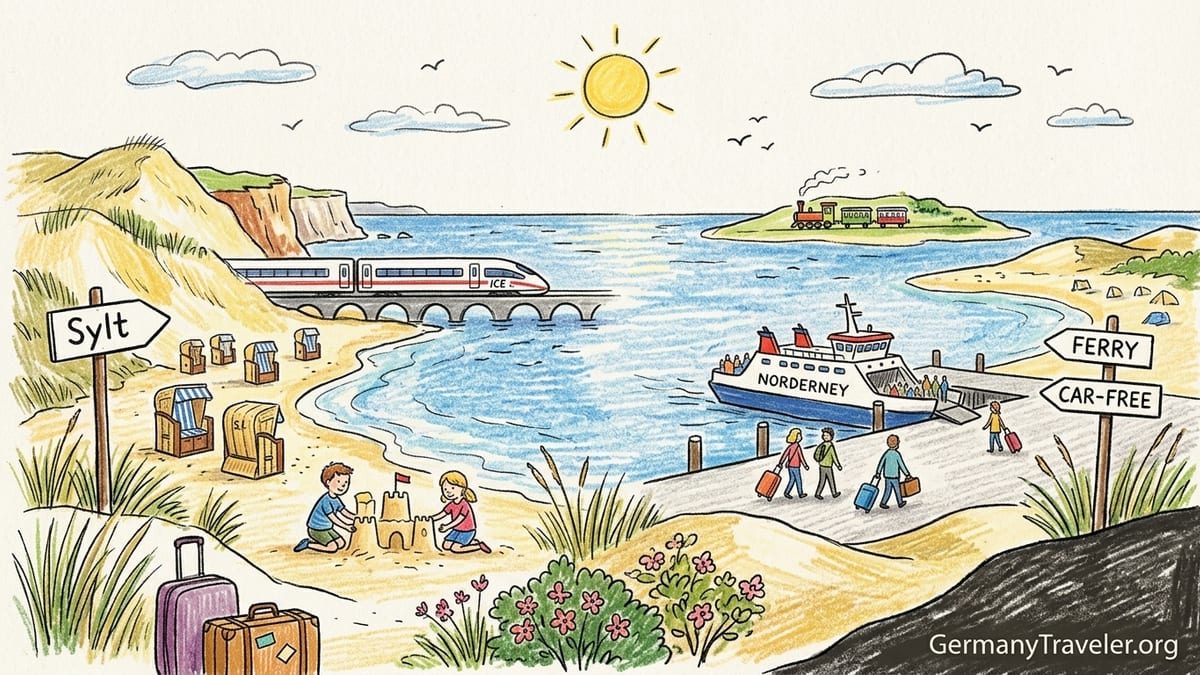
How the German North Sea Islands Compare in 2026
For most travelers, the main decision is between the fashionable North Frisian islands in Schleswig-Holstein (Sylt, Föhr, Amrum, Pellworm) and the more low key East Frisian islands in Lower Saxony (Borkum, Norderney, Juist, Langeoog, Spiekeroog, Wangerooge). Ferry networks, car rules and even luggage handling differ, so it is worth understanding the basics before you book a beach chair or an apartment.
Sylt remains the easiest island to reach without a ferry. Long distance ICE and IC trains run several times a day directly to Westerland station across the Hindenburgdamm causeway, with new ICE L services gradually added from 2026, which means you can roll your suitcase off the platform and be at the beach in about ten minutes on foot. Regional trains from Hamburg to Westerland typically run hourly via Niebüll, so even if a long distance train is disrupted you usually have a backup option.
By contrast, most East Frisian islands require a ferry from a small coastal port such as Norddeich, Bensersiel, Neuharlingersiel or Harlesiel. Services to Norderney and Langeoog tend to run to fixed timetables, often hourly or every couple of hours in high season, while ferries to Juist, Spiekeroog and Wangerooge are still strongly tide dependent and can operate only one or two times per day in shoulder seasons. That limited timetable should shape your arrival and departure days very carefully.
If you want to avoid ferries entirely, Sylt is the clear winner. If you enjoy the ritual of rolling your suitcase on to a ship and starting your holiday on deck, Föhr, Amrum, Borkum and the smaller car free islands feel much more maritime, though they do add a layer of planning and often an extra cost for parking a car on the mainland.
Beach Quality: Where the Sand Really Shines
Sylt, Amrum and Norderney usually top local rankings for sheer beach drama. Westerland and Kampen on Sylt offer long, wide strands backed by tall dunes and sometimes steep cliffs, lined with classic Strandkörbe (wicker beach chairs you can rent by the day, often around 12 to 18 euros depending on location and season). Amrum’s Kniepsand, a vast sandbank west of the island, feels almost endless on a sunny day and is seen by many regulars as the finest natural beach in Germany. Norderney’s Nordstrand and the long white stretches toward the east are similarly impressive but closer to a busy resort town.
Föhr, Langeoog and Spiekeroog offer gentler, more family friendly beaches. Föhr’s south coast near Wyk and Nieblum has soft sand and shallow water that stays warmer and calmer than the open North Sea side of Sylt, which is helpful if you travel with small children. Langeoog and Spiekeroog have wide dune backed strands but with fewer built up sections, so you can walk for half an hour and find yourself almost alone even in high season, provided you avoid the main town access points.
Borkum and Wangerooge have very solid beaches but a slightly more rugged feel, with wind and waves more apparent and some sections reserved for water sports or dog owners. Juist calls itself Töwerland, or magic land, and its beach supports that reputation: almost the entire north side of the island is one continuous strand, though it can feel windswept on grey days. Pellworm is the clear outlier. It lies mostly inside dikes and is more about green sea walls and tidal flats than sandy beach, so it is perfect if you love the Wadden Sea mudflats and birdwatching but not ideal if your priority is building sandcastles every afternoon.
If you are ranking purely on sand quality and drama, a reasonable 2026 hierarchy would be: Amrum and Sylt at the very top, followed closely by Norderney and Juist, then Föhr, Langeoog and Spiekeroog, with Borkum and Wangerooge slightly behind mainly because of their more built up front rows. Pellworm sits last for classic beach holidays but first for those who value green dikes and tidal walks.
Family Travel, Nature and Cycling: Which Islands Feel Easiest With Kids
For family holidays, car free, compact islands with flat cycling paths are usually the most relaxing. Langeoog, Spiekeroog and Wangerooge all ban private cars and rely on small island trains or tractors to move luggage and supplies from the harbor. Once you are in town you walk or cycle everywhere. Rental bikes with child seats or trailers are widely available, and prices for a day rental often sit in the 10 to 15 euro range for a standard bicycle, a bit more for e bikes. The result is a very low stress environment where you are not constantly watching out for traffic.
Föhr is another strong family option. While cars are allowed, many guests leave theirs on the mainland and rely on bikes and buses. The island is relatively flat with a network of signposted cycle routes between quiet villages like Nieblum and Utersum, and the shore is sheltered enough that even cautious swimmers feel comfortable. Amrum, slightly smaller, has more forest and dune landscapes and a wilder feel on the Kniepsand, but villages such as Wittdün and Nebel still offer playgrounds, ice cream stands and relaxed family restaurants.
Norderney also works for families who want more infrastructure. The town offers indoor pools, playgrounds and a range of self catering apartments, and the long promenade makes stroller walks easy. However, the island allows more motor traffic than the fully car free islands, and in high summer the main town can feel busy, with beach bars running into the evening. Borkum is similar, with a small island railway, several beaches and plenty of accommodation, but the harbor to town transfer and larger ferry can be a bit more complicated on arrival day with younger children.
If your children love wildlife and you prefer quiet evenings, Pellworm and Spiekeroog stand out. On Pellworm, families stay mostly on farms or small pensions and spend days cycling along the dikes or joining guided mudflat walks. Spiekeroog, reached by tide dependent ferry, has no cars at all and emphasizes calm and nature protection, which leads to earlier bedtimes and fewer noisy events but very peaceful days exploring dunes and woods.
Nightlife, Restaurants and Luxury: Where to Go When You Want More Than Sand
Sylt is still the clear leader for nightlife, dining and luxury stays. The west coast towns of Westerland, Kampen and Wenningstedt combine long beaches with beach clubs, cocktail bars and late night venues. Hotels in Kampen and the southern part of Westerland can easily reach or exceed 300 euros per night in high season, with top suites far beyond that, and you will find high end spas, gourmet restaurants and designer boutiques alongside casual fish kiosks. If you want a North Sea island that feels a little like a small resort on the French Atlantic coast, Sylt is your match.
Norderney sits next in line as the most urban of the East Frisian islands. The town has a growing set of modern beach bars, cafes with specialty coffee, and stylish restaurants that serve everything from traditional fish rolls to sophisticated tasting menus. Accommodation prices are generally lower than on Sylt but still high in July and August, with many apartments sold out months in advance for school holidays. Borkum has a similar but more low key scene, with live music on some summer evenings and a cluster of bars around the main town, but fewer high luxury hotels.
For travelers who prioritize quiet, Langeoog, Spiekeroog and Wangerooge feel very different. Even in high summer, the evenings are dominated by family dinners, slow walks along the promenade and early nights. You can still enjoy a good glass of wine on a terrace or a craft beer at a beach kiosk, but there are practically no late night clubs. Accommodation here ranges from simple pensions and holiday apartments to a few comfortable four star style hotels, and prices are generally lower than Sylt or Norderney but higher than many mainland villages.
Föhr and Amrum sit somewhere in the middle. They are more upscale and less remote than the tiny car free islands, with a handful of spa hotels, excellent seafood restaurants and stylish cafes, but they stop well short of Sylt’s intensity. On Föhr, Wyk’s waterfront promenade feels lively in the evening without being loud, and village restaurants in Nieblum or Utersum specialize in regional dishes with locally caught fish and lamb. On Amrum, the emphasis is more on nature and long days outside, with many visitors ending evenings in a thatched roof pub rather than a bar with a DJ.
Car Free Experience, Accommodation Costs and Practical Budgeting
In 2026, five of the seven classic East Frisian islands are essentially car free for visitors. Juist, Langeoog, Spiekeroog and Wangerooge fully ban private cars, and Baltrum, while not in this article’s core list, is the strictest of all. Norderney allows some island traffic but has seasonal restrictions, especially in the central town, and encourages visitors to leave their cars on the mainland. On these islands, you either walk or cycle, and larger hotels or landlords often arrange horse drawn carriages or small electric vehicles to move luggage from the quay.
Accommodation costs roughly mirror how easy each island is to reach and how famous it has become. Sylt, with its direct ICE and IC connections, has the broadest spread. In shoulder season you can still find simple guesthouses around Westerland or Tinnum for under 120 euros per night for a double room, but in late July a mid range hotel steps easily into the 200 to 260 euro range, and top addresses command much more. Norderney, Amrum and Föhr follow, with high season apartments for a family of four commonly costing from about 140 to 220 euros per night depending on standard and location.
On Juist, Langeoog, Spiekeroog and Wangerooge, you will find fewer ultra luxury options but many clean, comfortable mid range apartments and family run pensions. Because capacity is limited and ferries are tide dependent, demand is strong and prices creep up in school holiday weeks, so booking several months ahead is wise. Pellworm is usually the most affordable, especially outside peak bird migration periods and long public holiday weekends, with farm stays and simple pensions offering good value compared with Sylt or Norderney.
When comparing total trip costs, factor in mainland parking and ferry fares as well as accommodation. A day or week of parking at ports like Norddeich or Dagebüll can add 8 to 12 euros per day for an outdoor lot, and adult return ferry tickets routinely sit in the 25 to 45 euro range depending on distance and whether the ship is a high speed catamaran. Sylt visitors avoid ferry fares but may pay more for rail tickets and in resort pricing once on the island.
Getting There: Ferries, Trains and Luggage Logistics
Your arrival route shapes the kind of luggage and even stroller you should bring. Sylt is the simplest. You step directly off an ICE, IC or regional train in Westerland and walk or roll a suitcase to a nearby hotel or bus stop. Those arriving with cars use the car shuttle trains from Niebüll, driving onto the train wagons and staying in their car for the crossing, which typically takes under an hour. For pedestrians, there is no need to navigate port check in or worry about tides, which makes it ideal for shorter stays and travelers with heavy luggage.
Föhr and Amrum require a short regional train from Niebüll to Dagebüll Mole, then a ferry run by Wyker Dampfschiffs Reederei. Trains on the RB 65 line are scheduled to connect with ferries, but in peak summer a delay can still mean a missed sailing and a wait for the next one. On the positive side, these ferries are well set up for luggage and strollers, with elevators, open decks and indoor lounges. On Föhr you arrive directly in the town of Wyk, while on Amrum the main harbor is in Wittdün, both with nearby bus stops and taxi stands.
For the East Frisian islands, expect a little more complexity. Norderney and Juist use the port of Norddeich Mole, where Deutsche Bahn regional trains terminate at the pier. Ferries to Norderney usually run several times a day on fixed timetables and can carry cars, while Juist’s ferries are tied to the tides and may offer only one outbound and one inbound sailing on some days outside high summer. Borkum is reached from Emden or from Eemshaven in the Netherlands, again by ferries that allow cars but require early check in to secure a spot, especially on busy Saturdays.
Langeoog, Spiekeroog and Wangerooge add one more layer in the form of island railways. From Bensersiel, Neuharlingersiel or Harlesiel you board a ferry as a foot passenger only, leaving cars in the mainland car parks. At the island harbor, small trains wait to carry passengers and their luggage into the village. On busy days these trains can be crowded, so packing one larger rolling bag instead of several small ones makes boarding easier. Tide dependent islands in particular are at the mercy of weather. Strong winds or storms can force same day timetable changes, so building in some buffer time on arrival and departure is sensible if you have tight onward rail or flight connections.
Choosing by Travel Style: Who Should Go Where
To turn these differences into a practical decision, start by ranking what matters most to you: top tier beaches, family friendliness, nightlife, nature immersion, ease of arrival or cost. If your priority is sparkling sand and big sea views, Amrum, Sylt and Norderney should be at the top of your list, with Juist and Langeoog close behind. For young families nervous about surf and traffic, Föhr, Langeoog, Spiekeroog and Wangerooge feel safest thanks to their gentle beaches, compact villages and either car free or low traffic environments.
Travelers who want a mix of sea air and upscale creature comforts will be happiest on Sylt or Norderney, with Föhr and Amrum as quieter, slightly more affordable alternatives. If you dream of evenings with nothing but wind in the dunes and the sound of birds, Spiekeroog, Pellworm and Wangerooge are better choices, accepting that ferry schedules and limited nightlife are part of the package. Cyclists will appreciate almost every island, but the flat grids of Föhr and Pellworm and the traffic free lanes of Langeoog and Juist are especially satisfying for long, relaxed rides.
When ranking for ease of arrival, Sylt sits firmly at the top because of its year round rail connection. Next come Norderney and Borkum, whose ports have direct regional trains or motorway access. Föhr and Amrum follow thanks to coordinated train ferry links at Dagebüll. The smallest and most tide dependent islands like Juist, Spiekeroog and Wangerooge are the most charming if you enjoy the feeling of being cut off from the mainland, but they are the least suitable if you absolutely must catch a Sunday evening flight home from Hamburg or Amsterdam.
In terms of car free atmosphere, the leaders are Juist, Langeoog, Spiekeroog and Wangerooge, followed by Pellworm and Amrum where many visitors still choose not to bring a car. Norderney and Föhr offer a good compromise: you can arrive with your vehicle but easily spend a week mostly using bikes and buses. Sylt is the least car free, with a noticeable amount of traffic on main roads, but its bus network along the west coast makes it possible to experience much of the island without driving once you have settled in.
The Takeaway
If you want a quick ranking that summarizes the trade offs, Sylt comes first for ease of access, nightlife and top end dining, and shares first place on beach quality with Amrum. Föhr and Amrum are the strongest all rounders for families and for travelers who want excellent sand, good cycling and a quieter atmosphere than Sylt without feeling remote. Norderney shines for those who like a town with modern bars and restaurants wrapped around a serious beach, and Borkum offers a slightly more down to earth version of that same mix.
Juist, Langeoog, Spiekeroog and Wangerooge are ideal for travelers who value car free streets, village scale life and early nights, accepting more complicated ferry logistics and narrower timetables in return. Pellworm is the connoisseur’s choice, more about birds and dike walks than about swimming, and best for repeat visitors who already know they love the Wadden Sea landscape. If budget is decisive, consider Pellworm and some of the smaller East Frisian islands outside school holidays. If time is scarce or you are traveling with lots of luggage, Sylt, Föhr, Amrum, Norderney and Borkum will make your arrival smoother.
In the end, there is no single “best” German North Sea island, only the best island for your current trip. Clarify how important beach quality, car free calm, nightlife, nature and budget really are for you, look honestly at how much luggage you plan to bring, and then match that profile to the islands above. Plan your ferry and train connections before you reserve accommodation, build in a cushion for weather and tides, and you will arrive on whichever sandbank you choose already feeling that the holiday has begun.
FAQ
Q1. Which German North Sea island is best for a first time visit?
For most first timers, Föhr or Norderney work best. Both offer strong beaches, good infrastructure, plenty of accommodation choices and relatively straightforward access, without the premium prices and crowds of Sylt or the very quiet evenings on smaller car free islands.
Q2. If I want the very best beach, which island should I choose?
For dramatic, wide sandy beaches, Amrum and Sylt are usually considered first choices, with Norderney and Juist close behind. Amrum’s Kniepsand and Sylt’s west coast around Westerland and Kampen combine fine sand, dunes and long walking options that appeal to both swimmers and walkers.
Q3. Which island is easiest to reach by public transport with a suitcase?
Sylt is the simplest because long distance and regional trains run directly to Westerland station, so there is no need to change to a ferry. Norderney and Borkum follow, as their mainland ports have direct regional train links or motorway access with short transfers to the ferries.
Q4. Where should families with small children stay?
Föhr, Langeoog and Wangerooge are particularly good for families. They have gentle, shallow beaches, compact villages and either car free or low traffic environments. Föhr adds the bonus of easy cycling between villages and a wide choice of family friendly apartments and holiday homes.
Q5. Which islands offer the best nightlife and restaurant scene?
Sylt is number one for nightlife, beach clubs and upscale dining, especially in Westerland and Kampen. Norderney comes second with a growing set of modern bars and restaurants. Borkum offers a simpler but still lively evening scene, while the smaller car free islands focus more on quiet dinners and early nights.
Q6. Are any of the islands completely car free?
Juist, Langeoog, Spiekeroog and Wangerooge are essentially car free for visitors and rely on walking, cycling and small island trains or horse drawn carts for transport. Norderney and Föhr allow cars but strongly encourage guests to leave them on the mainland or use bikes and buses once on the island.
Q7. How should I plan for luggage when using ferries and island trains?
Pack as compactly as possible and favor one larger rolling suitcase or travel backpack per person instead of multiple small bags. On tide dependent islands and those with small island railways, you will be lifting luggage on and off ferries and trains, sometimes quickly. Soft bags with shoulder straps are easiest to manage, and booking accommodation near the village center reduces the distance you have to cover on arrival.
Q8. Which island is best if I am on a tighter budget?
Pellworm and some of the smaller East Frisian islands, especially outside school holidays, tend to be more affordable. You will find simpler pensions and farm stays and lower restaurant prices than on Sylt or Norderney. Booking shoulder season dates in May, June or September and choosing self catering apartments also helps keep costs down on almost any island.
Q9. How much time should I allow for connections with tide dependent ferries?
For tide dependent islands like Juist, Spiekeroog and Wangerooge, plan generous buffers. Aim to reach the mainland port at least an hour before departure, and avoid booking tight same day onward trains or flights. Weather or low water can occasionally change sailing times on short notice, so having flexibility on your arrival and departure days reduces stress.
Q10. Which island is best if I want mostly nature and cycling, not nightlife?
Spiekeroog, Langeoog, Pellworm and Amrum are excellent choices if you prioritize nature and cycling. They offer extensive dune and dike landscapes, long car free or low traffic cycle paths and very quiet evenings. You can spend your days riding between beaches, birdwatching points and small villages, then enjoy simple dinners and early nights without feeling you are missing a party scene.