

The German North Sea Coast is one of Europe’s most accessible long-distance cycling regions: largely flat, well signposted and threaded with coastal towns where a hot shower and plate of fish await at day’s end. At the heart of it all lies the North Sea Cycle Route, whose German section stretches around 921 kilometres from the Dutch border to the Danish frontier. For many travelers, the easiest way to experience it is on a self-guided hotel-to-hotel package that bundles accommodation, luggage transfer and rental bikes into one booking. This guide focuses on exactly those trips, comparing how they work in East Frisia, on the Cuxhaven to Hamburg stretch and in Schleswig-Holstein’s North Friesland.
Understanding the German North Sea Cycle Route
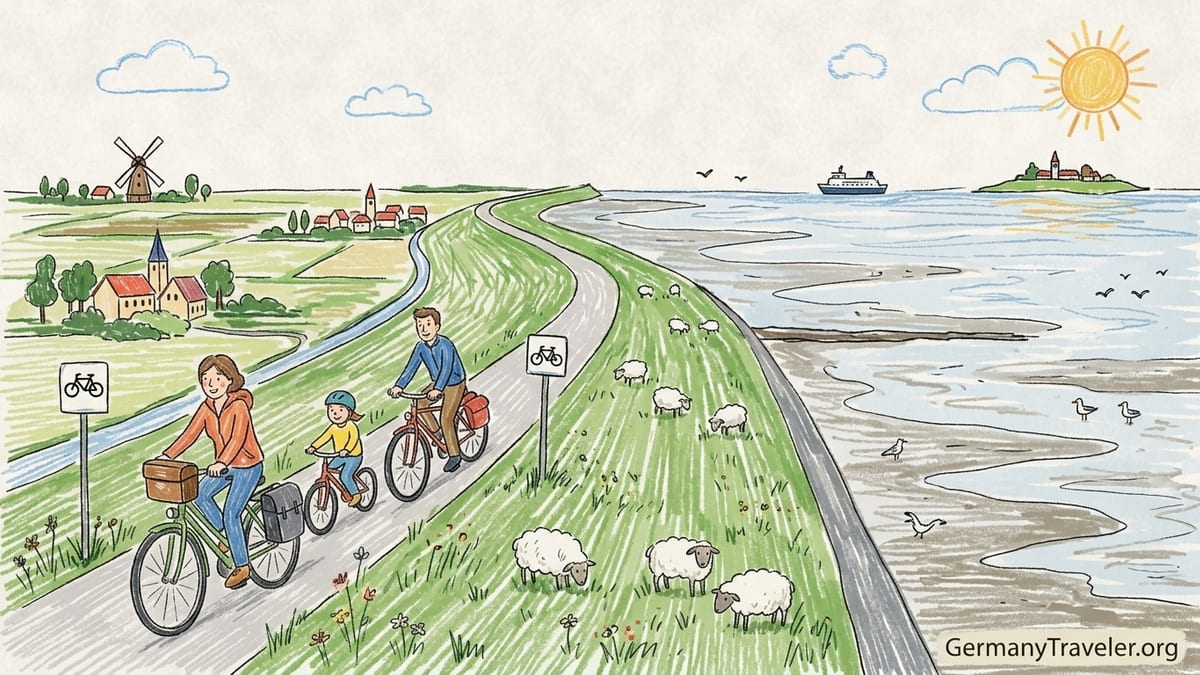
The North Sea Cycle Route is an international long-distance itinerary that loops around the North Sea through eight countries. The German section covers roughly 921 kilometres from Nieuweschans on the Dutch border along the Lower Saxon coast through Bremerhaven and Cuxhaven, then on to Hamburg and up through Schleswig-Holstein via places such as Büsum, Sankt Peter-Ording, Husum and Dagebüll to the Danish border near Ruttebüll. Much of the route runs right along the dike with sweeping sea views, salt marshes and access to the Wadden Sea mudflats.
For holiday cyclists, the attraction is not just the scenery but the practicality. The German North Sea section is largely flat or gently rolling, with gradients that are usually manageable even for families and occasional riders. Surfaces are mainly asphalt or compacted gravel suitable for touring bikes and e-bikes. The entire German stretch is signposted with the North Sea Cycle Route logo, so you can typically follow the waymarks without staring at a GPS device all day.
Commercial cycling operators take advantage of this existing backbone to create manageable one-week sections. Instead of selling the full 921-kilometre traverse, they break it into digestible segments such as East Frisian loops between Emden and the islands, a Cuxhaven to Hamburg coastal ride, or North Friesland itineraries between Husum, St Peter-Ording, the Halligen and Sylt. Each section has its own flavour, from maritime port cities to quiet marshland, but they share a similar logistical model: pre-booked hotels, daily luggage transfer and rental bikes waiting at your first hotel.
As you plan, it helps to think of the North Sea Cycle Route less as a single monolithic trail and more as a menu of coastal modules you can combine or tackle separately. A first-timer might book a six-day loop in East Frisia, while a returning cyclist extends northwards the following year with a week through Dithmarschen and North Friesland. Because trains and regional buses run parallel to the coast in many sections, it is relatively easy to start and end in different towns without needing a rental car.
How Self-Guided Hotel-to-Hotel Packages Work
Most commercial North Sea cycling holidays in Germany follow a similar template. You book a self-guided package through a specialist operator. On arrival day, you check into your first hotel, receive printed route notes or a smartphone app with GPS tracks, and are fitted with your rental bike or e-bike if you have booked one. From the next morning, you cycle independently from hotel to hotel, following the North Sea Cycle Route and signposted regional paths, while your luggage is transported for you.
An example from a German tour company in North Friesland illustrates the model. A seven-day “island hopping” holiday based in Husum and the North Frisian islands typically includes six nights in mid-range two or three star hotels or guesthouses, daily breakfast, detailed route descriptions, and luggage transfer between overnight stops with a weight limit such as two bags of up to around 15 kilograms each. Daily stages are in the 30 to 65 kilometre range, enough for several hours of riding with time left for beach walks or ferry trips to Hallig Hooge, Föhr or Amrum.
Prices as of recent seasons tend to start somewhere around the high hundreds of euros per person for a week-long trip in a double room, with surcharges for single occupancy. A Cuxhaven to Hamburg eight-day itinerary marketed on the Elbe estuary, which connects with the North Sea Cycle Route near Cuxhaven, has been priced in that range, often including luggage transfer, a service hotline and one set of printed materials per room. Rental touring bikes are usually an extra daily fee, with e-bikes costing roughly double the price of a standard trekking bike.
In practice, your daily routine is simple. You drop your suitcase at reception after breakfast, attach your handlebar bag and panniers, then set off. Your large luggage travels by van and will usually be waiting in your next hotel by late afternoon. You carry only what you need for the day: water, snacks, rain gear, a warm layer and valuables. The package operator provides emergency contacts and, in some cases, a local briefing on arrival. Meals beyond breakfast are often left flexible so you can dine in whichever beach restaurant or harbour bistro looks inviting at the end of your ride.
East Frisia: Flat Landscapes and Island Detours
The East Frisian coast is the western gateway to the German North Sea Cycle Route, sharing a border with the Netherlands and mirroring the flat polder landscapes found across the border. Self-guided packages here often combine sections of the North Sea Cycle Route with regional loops inland through canals, moorland and windmill-dotted villages. One example of a popular offering begins in Oldenburg or Emden, leads through the East Frisian countryside and coastal towns such as Aurich, Norden and Greetsiel, and sometimes includes a day trip by ferry to an island like Norderney or Borkum.
Tour operators in East Frisia typically market six to eight day trips with daily distances of 40 to 60 kilometres. An itinerary might have you riding from Oldenburg to Wiesmoor, then on to Emden and Greetsiel, before returning via different inland paths. Another variant hugs the dike between Emden and Norden, with options for a loop along Leybucht Bay to the bird-rich mudflats. Because the region is almost entirely flat, these distances feel achievable even for moderately fit riders and families with teenagers, provided the wind does not turn a short stage into an all-day effort.
Accommodation in East Frisia packages often includes family-run hotels and guesthouses categorized around two or three stars. Breakfast is standard, and some packages offer optional half-board dinners. Luggage transfer usually allows generous weight per piece, sometimes up to around 20 kilograms, and operators emphasize the lack of a strict limit on the number of bags within reason. Rental bikes range from classic seven or eight speed city and trekking models with step-through frames to e-bikes popular with older guests who want to keep up with younger family members or simply ride longer loops.
East Frisia is also well connected by rail, which makes one-way rides practical. Towns such as Oldenburg, Emden and Norden sit on regional train lines that accept bicycles with a ticket supplement. That allows you to, for instance, cycle along the coast for several days and then hop on a train back to your starting city rather than riding the same route in reverse. Package operators often provide suggested train connections in their travel documents or happily advise on timetables when you book.
Cuxhaven to Hamburg: Tidal Estuaries and Port City Finish
The stretch between Cuxhaven and Hamburg feels different from the wide open dike landscapes of East Frisia and North Friesland. Here the North Sea meets the Elbe estuary, and cycling holidays usually combine the North Sea Cycle Route with the Elbe Cycle Route, following the river inland toward Hamburg. Cuxhaven, known for the Kugelbake landmark that marks the transition from river to sea, is a common starting point for an eight day self-guided package that ends in Hamburg’s harbour district.
On such a trip, daily distances are commonly in the 40 to 70 kilometre range, with overnights in smaller towns along the Elbe such as Otterndorf, Glückstadt or Stade, depending on the operator. The terrain remains mostly flat, though some stretches run atop or alongside dikes with occasional short ramps. Surfaces range from asphalt dike paths to quiet minor roads and riverside promenades. Winds can be a factor, especially near Cuxhaven where the coast is fully exposed; many travel companies recommend riding Cuxhaven to Hamburg, rather than the reverse, to improve the odds of a prevailing westerly or northwesterly tailwind.
Operators selling Cuxhaven to Hamburg self-guided holidays tend to position them as comfortable rather than adventurous. Packages often include accommodation in three star level hotels with continental breakfast, luggage transfer between each stop and a 24 hour service hotline. Sample pricing materials from a German company show per person costs in the middle price bracket of coastal cycling holidays, with additional fees for overnight extensions in Cuxhaven or Hamburg at the start or end. Touring bike rental is sometimes offered for a modest per day fee, while e-bike rental commands a higher daily charge but significantly reduces the effort of riding into headwinds on open dikes.
Rail connections make logistics straightforward. Both Cuxhaven and Hamburg are served by trains that can carry bicycles with a separate ticket, so international travelers can arrive by rail from places like Bremen or Hanover. Once in Hamburg at the end of the trip, you can drop off your rental bike at the final hotel or at a partner shop arranged by the operator. From there it is easy to spend an extra night exploring Hamburg’s Speicherstadt, Elbphilharmonie and harbour area before heading home.
Schleswig-Holstein and North Friesland: Dikes, Halligen and Island Hopping
North of the Elbe, the North Sea Cycle Route enters Schleswig-Holstein and begins one of its most atmospheric stretches. Here the route runs from Hamburg along the Elbe to Brunsbüttel, then continues through the marshes of Dithmarschen to Büsum, on to Sankt Peter-Ording with its stilted beach restaurants, and further north to Husum, Nordstrand, Dagebüll and the Danish border. This is classic North Friesland: long dikes, sheep-grazed polders, tidal creeks and distant views of the Halligen, the low-lying islets that are periodically flooded by storm tides.
Self-guided packages in this region often use Husum or Sankt Peter-Ording as anchor points. One week-long itinerary branded as a North Friesland coastal tour might begin and end in Husum, include a loop to St Peter-Ording by train and bike, and build in ferry excursions to islands such as Föhr, Amrum or Hallig Hooge. Daily cycling distances range roughly between 30 and 60 kilometres, allowing time for strolls through harbour towns or guided mudflat walks in the Wadden Sea National Park.
Several German tour operators offer combinations of hotel nights in Husum with two or three nights on the islands, luggage transfers back to the mainland and detailed route materials. One recent example includes six nights in two and three star hotels in Husum and on the islands, buffet breakfast, luggage transport with weight limits per bag, ferry tickets between Dagebüll and Föhr or Amrum, and route descriptions. Guests are encouraged to explore the islands by bike on lightly trafficked roads and signposted circuits, returning in the evening to coastal accommodations with sea views or village settings.
Good train connections underpin these holidays. The Husum to Bad Sankt Peter-Ording railway line, for instance, provides an easy way to combine cycling and public transport across the Eiderstedt peninsula. Regional trains stop at coastal and inland towns such as Tönning and Garding, so a package might include a day where you take the train one way and cycle back along the North Sea Cycle Route or a parallel signposted itinerary. From Niebüll, another rail link carries bikes and passengers to Sylt via the Hindenburgdamm causeway, opening up additional options for day trips or pre- and post-tour extensions.
Bikes, E-Bikes, Luggage and Daily Distances
Almost all commercial packages on the German North Sea coast include the option to rent touring bikes or e-bikes. A standard setup is a comfortable trekking bike with 24 or 27 gears, fenders, a rear rack and a more upright riding position. Many operators also provide step-through frames that are popular with riders who want easy mount and dismount at traffic lights or ferry ramps. E-bikes, usually with mid-drive motors and semi-integrated batteries, have become increasingly common and are especially appreciated in the North where persistent winds can make even flat terrain demanding.
Rental prices vary, but a common pattern is that a conventional touring bike costs a modest daily fee, while an e-bike roughly doubles that amount. Helmets are sometimes available to rent but are not always included, so many international guests still prefer to bring their own. Child bikes, trailers and tag-alongs can often be booked for family groups, particularly on the gentlest sections in East Frisia and around Hamburg where there are many traffic-calmed stretches.
Luggage transfer is a key selling point of these holidays. Operators normally specify either a maximum number of bags or a weight limit per bag, for example two pieces not exceeding around 15 kilograms each in North Friesland, or multiple pieces up to about 20 kilograms per item in some East Frisian tours. You leave your main luggage at reception each morning by a certain time, labelled with tags provided by the company. The bags are collected by a local partner and delivered to your next hotel, where they are usually waiting by mid-afternoon. It is good practice to keep essential medicines and valuables in your day bag in case of unexpected delays.
Daily distances are planned to balance exercise and leisure. Along much of the North Sea Cycle Route, typical self-guided packages schedule 40 to 60 kilometres per day, which equates to three to five hours of cycling at a relaxed pace. Some days may be shorter, under 30 kilometres, when ferry crossings or sightseeing stops such as the Multimar Wattforum in Tönning are part of the program. More sportive options exist with 70 to 80 kilometre days, but these are less common on coastal holiday itineraries that aim to leave time for beaches and cafés.
Wind, Weather, Trains and Practical Route Planning
Although the German North Sea Coast is flat, it is far from effortless. Wind is the defining feature of these cycling holidays. On exposed dikes, a steady onshore breeze can feel like a constant incline. Many operators therefore design routes to be ridden with the prevailing winds wherever possible. In practice, that often means selling Cuxhaven to Hamburg rather than Hamburg to Cuxhaven, or suggesting Husum to Niebüll rather than the reverse, since westerly and northwesterly winds are frequent along the coast.
As a traveler, you can factor wind into your own planning. When booking, ask your chosen operator which direction they recommend for your preferred section of the route and why. If you are assembling a custom holiday using regional trains, consider arranging your overnight bases so that the longest open stretches are downwind if the prevailing patterns hold. Booking an e-bike can also turn a marginal headwind into a manageable day out, especially for riders who are less fit or traveling in early spring when storms are more likely.
Weather along the German North Sea is changeable. Even in July and August, you should expect a mix of sunshine, cloud, occasional showers and brisk breezes. Shoulder seasons such as May, June and September are increasingly popular for cycling packages because accommodation is more available and daytime temperatures are usually comfortable for riding. Rain gear, layers and windproof jackets are more important than high-performance cycling clothing. The combination of sea air, salt spray and occasional sand on dike paths also means regular chain cleaning is wise on longer trips, particularly if you bring your own bike.
Trains are your best friend when conditions turn against you. The coastal network in Lower Saxony and Schleswig-Holstein allows you to shorten or skip stages. For example, the Husum to Bad Sankt Peter-Ording branch line means you can cycle one way along the coast and return by train if the headwind becomes too much. On the East Frisian side, regional trains connect Oldenburg, Leer and Emden, and many local lines accept bicycles outside peak commuter hours with a small ticket surcharge. When you book a package, check whether your operator offers guidance on bike-friendly trains and potential bailout points along the route.
Choosing Between East Frisia, Cuxhaven–Hamburg and North Friesland
Each major section of the German North Sea Cycle Route offers a slightly different experience, even if the underlying concept of hotel-to-hotel self-guided packages is similar. East Frisia suits travelers seeking gentle cycling amid fields, canals and windmills with occasional island day trips. The landscapes are low and open, villages are compact, and the riding feels unhurried. Families, first-time cycle tourists and those who want to combine cultural stops in towns such as Oldenburg or Leer with quiet coastal paths often start here.
The Cuxhaven to Hamburg stretch appeals to riders who like the idea of finishing in a major city without sacrificing coastal flavour. You get a mix of sea air near Cuxhaven, riverside dikes along the Elbe and a finale among Hamburg’s docks and historic warehouses. Daily stages are slightly longer on average, and the estuary scenery has more of an industrial-maritime tone, with container ships, locks and shipyards part of the backdrop. This segment works well for travelers arriving by international rail or air who want straightforward start and end points.
Schleswig-Holstein and North Friesland require a bit more travel to reach but reward you with classic images of the German North Sea: infinitely wide beaches in Sankt Peter-Ording, pastel harbour houses in Husum, tidal flats stretching towards Hallig silhouettes and ferries bound for Föhr, Amrum and Sylt. Self-guided holidays here often weave in ferry rides and extra nights on the islands, so the experience is more about slow, atmospheric travel than ticking off kilometres. This section is especially attractive for nature lovers, birdwatchers and those intrigued by the Wadden Sea’s unique tidal ecology.
In practical terms, availability and budget also matter. East Frisian packages can sometimes price slightly lower due to shorter ferry legs and fewer high-season resort premiums, whereas North Frisian and Hamburg-focused trips may carry a mild surcharge in July and August. Booking shoulder season departures can provide better value, and many operators offer daily or near-daily start dates between April and October, provided hotels and luggage services are available.
FAQ
Q1. How difficult is cycling the German North Sea Coast for beginners?
The terrain is mostly flat and signposted, so the main challenges are wind and occasionally longer daily distances. Most self-guided packages keep stages around 40 to 60 kilometres, which many first-time cycle tourists handle comfortably with basic fitness.
Q2. Do I need to bring my own bike, or can I rent one on these trips?
You do not need to bring your own bike. Most operators offer well maintained touring bikes and e-bikes for a daily fee, supplied at your first hotel and collected at the end. If you have a favourite saddle or pedals, you can usually bring and fit them to the rental bike.
Q3. How does luggage transfer work on self-guided North Sea Cycle Route holidays?
You leave your labelled bags at reception each morning by a set time. A local partner collects them and delivers them to your next hotel, where they usually arrive by mid or late afternoon. Operators specify weight limits per bag, so pack accordingly and keep valuables in your day pack.
Q4. What is the best time of year to cycle the German North Sea Coast?
The main season runs from April to October, with May, June and September often considered ideal thanks to milder temperatures and fewer crowds. July and August offer the warmest weather and lively seaside towns but can be busy and pricier.
Q5. Should I choose an e-bike for a North Sea cycling holiday?
An e-bike is not mandatory, but it can make a big difference on windy days, especially on exposed dikes. They are popular with older riders, mixed-ability groups and anyone who prefers to focus on scenery rather than effort when riding into a headwind.
Q6. How do I get to the start and from the end of these routes without a car?
Key towns such as Oldenburg, Emden, Cuxhaven, Husum and Hamburg are connected by regional trains that accept bicycles with a supplement. Tour operators usually provide guidance on the best stations and connections for your chosen itinerary.
Q7. Are the routes suitable for children and families?
Yes, many sections are family friendly, particularly in East Frisia and around Hamburg where there are traffic-calmed paths and short stages. Some operators offer child bikes, trailers and reduced-distance itineraries, though very young children should be transported in trailers or seats rather than riding independently.
Q8. Do I need special navigation skills, or is signposting enough?
The German section of the North Sea Cycle Route is consistently signposted with dedicated logos, and most packages include maps or GPS tracks. Many riders rely mainly on waymarks and only check route notes in towns or at junctions.
Q9. What happens if the weather is too bad to cycle one day?
If conditions are poor, you can often shorten a stage or skip it entirely using regional trains or, in some cases, local buses. Your luggage will still move to the next hotel. In coastal storms, operators may suggest alternative inland routes or rest days for safety.
Q10. How far in advance should I book a self-guided German North Sea cycling holiday?
For peak summer departures and itineraries involving islands such as Föhr, Amrum or Sylt, booking several months ahead is wise. Shoulder season trips are more flexible, but reserving at least a few weeks in advance helps ensure hotel and luggage transfer availability.