


The German North Sea Wadden Sea is one of Europe’s most distinctive landscapes: a vast tidal world of sandbanks, creeks and salt marshes that appears and disappears twice a day. Walking on the seabed itself is unforgettable, but it is also potentially dangerous if you misjudge tides or weather. This guide explains how to experience the Wadden Sea around Sylt, St. Peter-Ording and Cuxhaven safely on guided mudflat walks, wildlife excursions and nature tours, and why you should never attempt unfamiliar tidal crossings on your own.
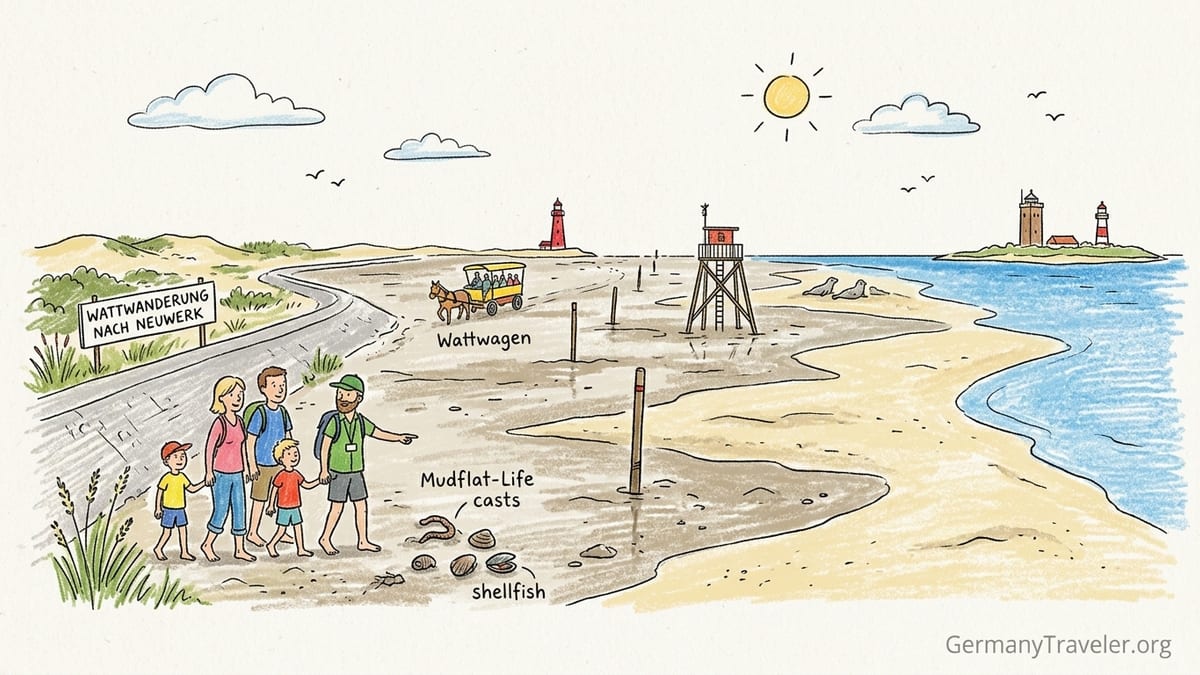
Understanding the German Wadden Sea and Its Tides
The Wadden Sea stretches along the coasts of the Netherlands, Germany and Denmark and is protected as a UNESCO World Heritage Site and national park. Along the German shore, tidal flats fringe the North Sea from the Danish border down past Cuxhaven. Twice a day, the water retreats to reveal mudflats and sandbanks, then rushes back in with surprising speed. For many visitors, the chance to walk across the exposed seabed is a highlight of any North Sea trip.
The same forces that create this remarkable landscape also make it risky. The tidal range can be around 2 to 3 meters in many areas, and the incoming water often returns not as a gentle lapping tide but as fast-rising creeks that cut off your route back. Local rescue services in the Wadden Sea region regularly warn that every year people have to be rescued from the mudflats after misjudging tide tables or fog. This is why the national park authorities license specialist mudflat guides and recommend that travelers join guided tours instead of venturing out alone.
On a typical guided mudflat walk, you meet at a marked point on the dike or beach about 30 to 45 minutes before low tide. The guide explains the route, checks conditions and leads the group out over firm areas of sand and mud, avoiding deep creeks and soft mud patches. Tours are carefully timed so you are safely back on shore or on an island well before the water returns, often leaving a generous buffer of at least an hour.
Because conditions change daily, even within the same week, there is no such thing as a “standard” safe time for a crossing without expert knowledge. Wind, air pressure and storm systems can all shift the water level and speed of the tide. What was safe at a certain time on one day can be dangerous at the same nominal tide time just a few days later. This is why relying on a printed tide table alone is not enough for visitors unfamiliar with the area.
Sylt: Year-Round Mudflat Walks and Family-Friendly Tours
Sylt is one of Germany’s best-known North Sea islands and sits within the Schleswig-Holstein Wadden Sea National Park. The island runs regular guided Wadden Sea walks throughout the year, typically lasting around 1.5 to 2 hours. Local organizers and the island’s tourism office promote a mix of family-focused walks, ecology-themed excursions and special-interest tours such as birdwatching or walks that allow you to bring your dog along. These short outings are ideal if you want an accessible introduction to mudflat walking without committing to a long crossing.
A typical family tour on Sylt might start near the eastern shore at low tide, with a certified guide explaining the basics of tides as you step off the sand and onto the firm mud. Over roughly two hours, the group pauses frequently to look at lugworm casts, small crabs and shellfish. Children are often invited to gently dig into the mud to see the animals that live just beneath the surface, while adults learn about the national park rules and the role of the Wadden Sea as a bird migration stopover. Prices are usually moderate per adult with discounted rates for children, and many tours are available in German with some dates in English.
These Sylt tours focus more on nature discovery than distance. You walk out onto the tidal flats and then back along a similar route, staying within a clearly defined area near the island. This keeps the duration manageable and reduces risk, as the group is never far from the safety of the dike or beach. For visitors who are unsure about their fitness or have young children, these year-round 1.5 to 2 hour walks are often the best way to experience the mudflats.
For more active travelers, some operators on Sylt also offer slightly longer nature hikes along the tidal edge or themed walks that concentrate on birdlife in spring and autumn. These might run closer to three hours and cover more ground but are still very different from full inter-island crossings. In all cases, certified guides adjust itineraries based on the day’s weather, wind, and water conditions, and they will cancel or shorten tours if visibility deteriorates or a storm front is expected.
St. Peter-Ording and the Eiderstedt Peninsula: Ranger-Guided Mudflat Experiences
On the mainland side of the Schleswig-Holstein Wadden Sea, St. Peter-Ording is famous for its long sandy beach, stilt-house restaurants and wide tidal flats. The area is integrated into the national park, and ranger-guided mudflat experiences are a key way to explore the environment responsibly. These official walks are often led by uniformed rangers or licensed guides who work closely with the national park authority.
A ranger-guided walk from St. Peter-Ording typically lasts around two hours and focuses strongly on education. Participants meet at a signposted meeting point near one of the beach access points on the Eiderstedt peninsula. The ranger explains the national park zoning system, points out protected bird feeding areas and talks about the sensitivity of salt marsh plants. Children might hear how a lugworm filters sand or why seals haul out on distant sandbanks at low tide, while adults learn why even seemingly harmless behaviors, such as leaving footprints in certain salt marsh areas, can damage nesting habitat.
These tours are deliberately shorter and less demanding than the long intertidal routes between islands. Rather than attempting a full crossing, the group stays close to the mainland, moving out and back on a loop that keeps clear of fast-flowing creeks. For families staying in St. Peter-Ording, this makes it possible to join a morning mudflat outing and still have most of the day left for the beach, cycle paths or spa facilities in town.
Because St. Peter-Ording experiences strong winds and sometimes fast changes in weather, rangers put particular emphasis on safety and on sticking together as a group. If a fog bank is forecast or thunder is expected, walks may be postponed, even if tide tables would suggest there is enough time. When you book, you are usually advised to provide a mobile phone number so the organizer can reach you in case of last-minute changes.
Cuxhaven and the Neuwerk Crossing: Classic Long-Distance Tidal Routes
Cuxhaven, at the mouth of the Elbe River, is the main gateway for one of Germany’s classic long-distance Wadden Sea crossings: the route across the tidal flats to the island of Neuwerk, which belongs administratively to Hamburg. At low tide, experienced guides lead walkers from the Cuxhaven districts of Duhnen or Sahlenburg across around 10 to 13 kilometers of tidal flats to Neuwerk. The walk itself typically takes about 2.5 to 3.5 hours, depending on the route, conditions and pace of the group.
Unlike the shorter family-focused walks on Sylt or St. Peter-Ording, the Neuwerk crossing is a point-to-point journey that requires strict timing. Participants usually start well before low tide, so they can reach the island and higher ground before the incoming water floods the creeks and channels behind them. The route is marked by wooden stakes and, crucially, by rescue beacons on stilts where people can climb up if caught by the tide. Local information boards in Cuxhaven explicitly warn that every year overconfident walkers underestimate the tide and need to be rescued from the mudflats, which can be costly and dangerous for both walkers and rescuers.
Licensed operators in the Cuxhaven region offer several variants of the experience. One common option is to walk to Neuwerk on a guided tour and return later by small passenger boat once the tide has risen again. Another is to combine a walk in one direction with a ride on a traditional horse-drawn “Wattwagen,” a high-wheeled carriage that travels between Sahlenburg and the island when the flats are exposed. These combinations allow visitors to experience the tidal landscape in different ways while giving guides more flexibility to avoid walking at less favorable tide times.
Because the Neuwerk route is longer and more exposed, guides are stricter about fitness and equipment requirements. You are usually asked to be able to walk several hours at a steady pace, sometimes through knee-deep mud or water-filled channels. Children must be old enough and strong enough to manage the distance. Organizers might also set a minimum age or ask that younger children ride in special carriers rather than walking. Departure times change daily based on tide forecasts, and group sizes are often capped, so advance booking is essential during the main season.
Other Island Destinations and Wildlife-Focused Wadden Sea Tours
Beyond Sylt, St. Peter-Ording and Cuxhaven, many other German North Sea islands and Halligen offer guided mudflat and nature tours. Smaller islands like Föhr, Amrum or some of the Halligen in the Schleswig-Holstein Wadden Sea, as well as destinations in the Lower Saxony Wadden Sea, frequently feature short guided walks that emphasize birdlife, salt marsh vegetation or seal watching rather than long-distance crossings. For example, some tours are timed to coincide with pupping season on distant sandbanks or with the spring and autumn bird migration periods, when thousands of waders and geese rest and feed on the flats.
Wildlife-focused trips often combine short walking sections on the mudflats with boat travel. A common format is a half-day excursion where you sail out from a mainland port or island harbor, then disembark on a sandbank or firm mudflat area under the supervision of a guide. Here, you might walk a short loop, inspect shells and worms, observe seals resting on nearby banks at a respectful distance and then reboard the vessel before the tide rises. This format provides much of the sensory experience of walking on the seabed while reducing exposure to the fast-moving tidal channels closer to shore.
The duration of these wildlife tours can vary from about two to five hours door to door, depending on boat travel time. Operators generally stress that animals must not be disturbed, particularly breeding birds and seals. Guides keep groups at set distances and may ask participants to speak quietly, move slowly and avoid sudden movements. Binoculars are a worthwhile addition to your packing list if you are joining one of these trips, especially during migration season when large flocks and rare species may be present.
On many islands, you will also find specialized offers such as photography workshops on the mudflats, evening tours focusing on sunset light across the tidal landscape, or winter excursions where the emphasis is on the stark, quiet atmosphere of the Wadden Sea outside the main holiday season. These tend to be smaller-group, higher-priced experiences that require prior booking and flexibility in case of weather-related cancellations.
Tour Types Compared: Family Walks, Longer Crossings and Wildlife Excursions
When choosing a Wadden Sea experience, it helps to think in terms of three main categories: short family walks, longer tidal crossings and wildlife-focused tours. Each comes with different expectations for duration, fitness, gear and booking requirements. Understanding these differences will help you select a tour that matches your group’s abilities and interests.
Short family walks, like many of the 1.5 to 2 hour tours on Sylt and ranger-led outings around St. Peter-Ording, prioritize accessibility and education. These are suitable for most reasonably mobile visitors, including school-age children and older adults who can manage an easy walk on uneven ground. You stay relatively close to shore, and guides regularly pause to explain wildlife and demonstrate how tides work. Booking can sometimes be done on short notice, especially outside peak holidays, and prices are typically modest per person.
Longer tidal crossings, exemplified by the Cuxhaven to Neuwerk route, are more demanding. Expect walking times of 2.5 to 3.5 hours each way, sometimes longer in strong wind or softer mud. These tours require solid fitness, and many operators recommend or require advance reservations, particularly for weekend and holiday departures when group sizes are limited. Because scheduling depends strictly on tide predictions, departure times may be very early in the morning or later in the evening. If you plan to walk one way and return by boat or wagon, you will need to reserve both legs in advance and allow for possible weather-related changes.
Wildlife-focused tours, whether walking-based or combining boats and short mudflat segments, sit somewhere in between. They may be physically easier than a full crossing but can still last several hours overall. The emphasis is on observation rather than distance: watching seals hauled out on sandbanks, scanning for birds with binoculars, or learning how plants survive in salty soils. These trips often have slightly higher prices, reflecting the cost of boats and specialized guides, and they almost always require advance booking because they operate less frequently and depend heavily on seasonal wildlife patterns and favorable weather.
Whichever category you choose, ask operators specific questions before booking: How long is the walking time, not just the total excursion time? How deep might the water be in the channels? Is the tour suitable for children of a particular age or for travelers with knee or balance issues? Clarifying these points in advance reduces the risk of surprises once you are already on the mudflats.
Footwear, Clothing and Practical Gear for Mudflat Walks
Choosing the right footwear is crucial for enjoying a Wadden Sea mudflat walk. For short family tours on firmer sand near Sylt or St. Peter-Ording, many guides encourage participants to go barefoot, as long as they are comfortable doing so and the temperature is mild. Bare feet allow you to feel the texture of the mud and make it easier to rinse off afterward. However, if you have sensitive feet or are concerned about shells, small stones or colder water, lightweight neoprene shoes or snug-fitting water shoes are a good compromise.
On longer and more demanding crossings such as Cuxhaven to Neuwerk, guides often recommend or require sturdier footwear: either old trainers that you do not mind getting thoroughly soaked and muddy or closed neoprene booties with a decent sole. Flip-flops and loose sandals are a poor choice because they tend to get sucked into soft mud and can be lost in creeks. Rubber boots can work in some shallow areas but may quickly fill with water and become heavy when you have to cross deeper channels.
Clothing should be layered, windproof and quick-drying. Even in midsummer, the North Sea can feel cool and windy, and temperatures on the exposed flats are often several degrees lower than in sheltered inland areas. A breathable base layer, fleece or light sweater and a windproof jacket are usually recommended. In warmer weather, many people wear shorts to avoid having trouser legs soaked by shallow water, while in cooler seasons, thin synthetic hiking trousers that dry quickly are preferable. Cotton jeans can become cold and uncomfortable once wet.
Additional practical items include a small backpack with water, a snack, a lightweight towel, sun protection, and, for family tours and wildlife trips, binoculars and a camera with a strap. Guides will ask you to carry your phone in a waterproof pouch if you bring it. For long crossings, you may also be advised to carry a change of socks and a warm top sealed in a dry bag, especially if the weather forecast is uncertain. In every case, travel light: anything you bring must be carried across the mudflats and may get splashed or muddy.
Tides, Booking and Why You Must Not Attempt Unfamiliar Crossings Alone
Tides are the single most important factor in every Wadden Sea excursion. Operators schedule tours based on detailed tide tables and local knowledge of how wind and air pressure can alter water levels. For example, strong onshore winds can push water in faster and higher than predicted, while prolonged offshore winds can delay the incoming tide. Experienced guides interpret these variables and adjust or cancel tours when needed. As a visitor, you will see only the departure time printed on your ticket, but behind that time sit years of local experience and safety planning.
This is why travelers should not independently attempt unfamiliar tidal crossings, especially routes like Cuxhaven to Neuwerk or onto isolated sandbanks. The mudflats can look deceptively harmless when the tide is low, but channels fill rapidly and often from behind, cutting off your retreat. Fog can roll in without warning, making it impossible to see landmarks or stakes, and even GPS apps are not a reliable safeguard when you are wading through water and mud. In some parts of the Wadden Sea, there are rescue beacons where stranded walkers can climb to await help, but reaching them may involve wading through deep, fast-flowing water where hypothermia and exhaustion become real risks.
Rescue organizations and national park authorities repeatedly report incidents in which visitors attempted crossings on their own after glancing at a tide table or following footprints left by a previous group. In many of these cases, the walkers underestimated their speed, the softness of the mud or the strength of the currents in the creeks. Even if they ultimately reach safety, they may face substantial rescue costs and put emergency services at unnecessary risk. In the worst cases, people drown after being swept off their feet in a flooding channel or trapped by cold and rising water.
By booking a licensed guided tour, you shift the burden of planning, timing and hazard assessment to professionals who know the terrain. Guides carry communication devices, know where the firm ground is, and can read subtle signs such as ripples on the surface of shallow channels or changes in wind direction that indicate the tide is turning faster than expected. They also know when to turn back early or change the route. For visitors, this means you can concentrate on the experience itself rather than constantly worrying about whether the water is already rising.
If you are tempted to go alone, consider this practical rule: if you do not know exactly how deep every channel on your intended route can become within 30 minutes of the predicted tide change, and you have not walked the same route multiple times with a local guide in different conditions, you should not attempt it independently. The safest and most rewarding way to discover the Wadden Sea is in the company of specialists who walk these routes week after week, year after year.
The Takeaway
The German North Sea Wadden Sea offers some of Europe’s most memorable coastal experiences, from gentle family mudflat walks on Sylt and St. Peter-Ording to classic long crossings from Cuxhaven to Neuwerk and wildlife-focused excursions to seal sandbanks and bird-rich salt marshes. Each type of tour showcases a different aspect of this shifting seascape, whether it is the intricate life beneath the mud, the spectacle of migrating birds or the physical challenge of covering many kilometers between mainland and island.
Yet the same tidal forces that create this landscape demand respect. Rapidly rising water, hidden channels and sudden fog make unguided crossings a serious risk, especially for visitors unfamiliar with local tides and weather. Choosing a licensed mudflat guide or ranger-led tour is not just a safety precaution, it is also the best way to deepen your understanding of the Wadden Sea’s ecology and culture. Expert guides turn what might otherwise be a simple walk on wet sand into a rich nature experience filled with stories, observations and context.
When planning your trip, think carefully about what kind of outing suits your fitness level and interests: a short, family-friendly nature walk, a demanding long-distance crossing with a boat or horse-drawn wagon return, or a wildlife-focused excursion that balances boat travel and short walks. Pack appropriate footwear and clothing, book ahead, remain flexible about weather-related changes and always follow your guide’s instructions. Do that, and your time on the German Wadden Sea will be not only safe, but unforgettable.
FAQ
Q1. Do I really need a guide for a mudflat walk in the German Wadden Sea?
Yes. Local authorities and rescue organizations strongly advise joining licensed guided tours, especially for any route that goes beyond the immediate shoreline or involves crossing to an island. Guides plan around tides, weather and channels, which change constantly and can be dangerous for visitors who only rely on printed tide tables or smartphone maps.
Q2. How long do typical guided mudflat walks on Sylt and St. Peter-Ording last?
On Sylt and around St. Peter-Ording, most introductory and family-oriented mudflat walks last about 1.5 to 2 hours. This includes time for explanations, short stops to look at wildlife and a comfortable walking pace suitable for a wide range of ages.
Q3. How long does the Cuxhaven to Neuwerk mudflat crossing take?
The guided crossing between the Cuxhaven area and the island of Neuwerk usually takes around 2.5 to 3.5 hours on foot in one direction, depending on the exact starting point, route, conditions and group pace. Some visitors choose to walk one way and return by boat or horse-drawn wagon, which increases overall trip time to a half or full day.
Q4. What kind of footwear is best for a mudflat walk?
For short, easy walks on firmer sand, many people go barefoot or wear lightweight water shoes. For longer or rougher routes like the Neuwerk crossing, old trainers or sturdy neoprene booties with a decent sole are often recommended. Flip-flops and loose sandals are not suitable, as they can be sucked off in soft mud and creeks.
Q5. Are mudflat walks suitable for children and older travelers?
Short guided walks of 1.5 to 2 hours on Sylt or St. Peter-Ording can be very suitable for school-age children and many older travelers who are steady on their feet. Longer crossings such as Cuxhaven to Neuwerk require better fitness and balance. If in doubt, discuss ages, fitness and any mobility issues with the tour operator before booking to ensure the route is appropriate.
Q6. What should I wear for a Wadden Sea mudflat excursion?
Wear layered, quick-drying clothing, including a windproof jacket, as the North Sea coast can feel cool and breezy even in summer. In warmer weather, shorts are practical because your legs may get wet in shallow channels. Avoid heavy cotton garments like jeans that stay cold and wet. Bring sun protection, a small towel and a light backpack for water and snacks.
Q7. How far in advance should I book a mudflat walk or Wadden Sea tour?
For popular routes and peak holiday periods, it is wise to book at least several days in advance, and sometimes longer for weekend Cuxhaven to Neuwerk crossings or specialized wildlife tours that operate on limited dates. Short family walks on Sylt or St. Peter-Ording may be available on shorter notice outside school holidays, but spaces can still fill quickly in good weather.
Q8. Can mudflat tours be cancelled because of weather or tides?
Yes. Even if tide tables look favorable, guides may cancel or shorten tours because of strong winds, storms, fog, lightning risk or unusually high water levels. Safety always takes priority. Operators usually offer rebooking or refunds in such cases, so it is important to provide contact details and check messages on the day of your tour.
Q9. Will I see seals or special bird species on a standard mudflat walk?
It depends on the route and season. Some short walks focus more on invertebrate life and general landscape, while wildlife-specific trips are timed to give better chances of seeing seals on sandbanks or large flocks of migratory birds. If spotting wildlife is a priority, choose a tour that explicitly advertises seals or birdwatching and, ideally, operates during migration periods in spring and autumn.
Q10. Is it safe to follow footprints or other people’s tracks on the mudflats if I miss my group?
No. Footprints can be misleading because they may belong to a group that left much earlier under different tidal conditions or followed a route unsuitable for your pace. Channels and mud conditions also change over time. If you miss your booked tour, do not attempt to catch up on your own. Stay on shore, contact the operator and arrange to join a later departure.