


The Moselle Valley between Koblenz and Trier is one of Germany’s most romantic river landscapes, and its castles are a major reason why. Reichsburg Cochem and Burg Eltz dominate online searches, yet they are only the start of what castle lovers can see here. This guide focuses on four of the most accessible fortifications for travelers using trains, cars or the Moselsteig long distance trail, with concrete advice on uphill walking, opening seasons, viewpoints and how to weave each stop into a realistic itinerary.
How Moselle castles fit into real itineraries
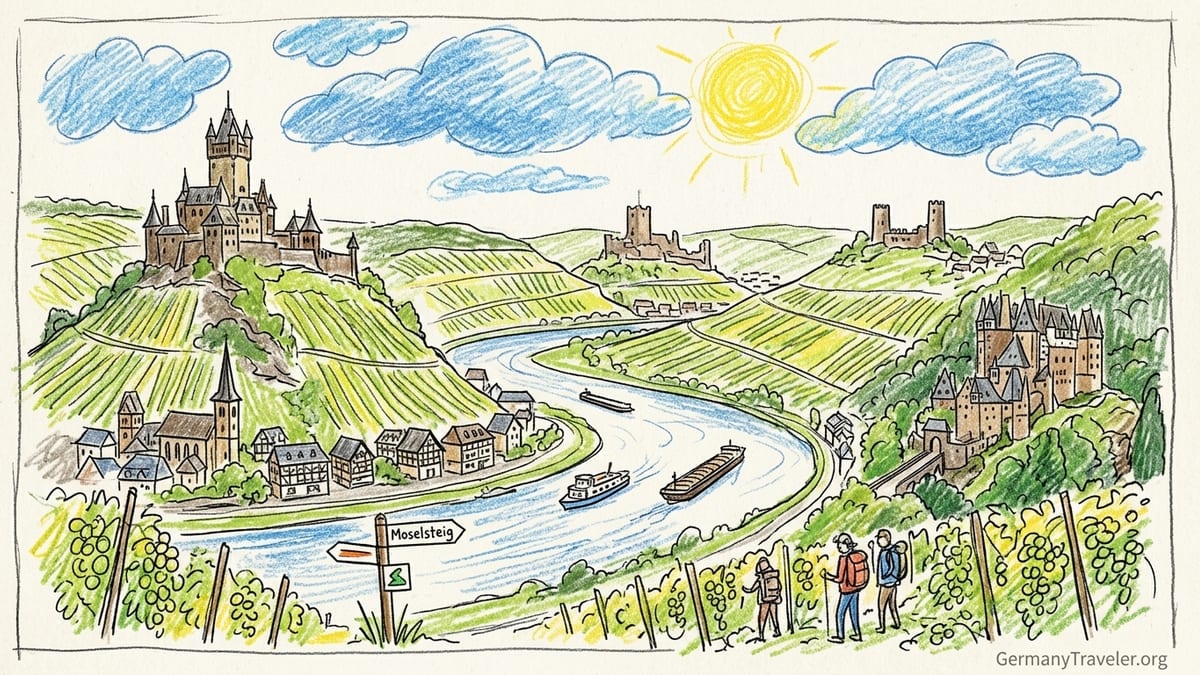
If you look at a map, the classic Moselle castle cluster runs roughly from Koblenz to Traben Trarbach, with Cochem and Bernkastel Kues as natural overnight bases. Reichsburg Cochem overlooks Cochem itself, Burg Eltz sits slightly inland in a wooded side valley, Burg Landshut crowns Bernkastel Kues and Burg Thurant commands the slopes above the village of Alken. All four can be seen on a three to five day trip that combines river towns, vineyard hikes and boat or train travel.
Reichsburg Cochem and Burg Eltz are full interior tours with furnished rooms, armories and guided visits. Burg Landshut and Burg Thurant offer a more relaxed “explore at your own pace” feel, with ramparts, courtyards and terraces that double as panoramic viewpoints over the Moselle. Travelers who mainly rely on public transport usually pair Cochem plus Burg Eltz in one or two days, then add Bernkastel and Burg Landshut. Visitors with a rental car can easily add Burg Thurant as a half day stop between Koblenz and Cochem.
For hikers, the Moselsteig trail and its side loops make the castles feel almost built into the landscape. Stages around Cochem and Bernkastel include spur paths or circular routes that climb directly to the castle hills. That means you may not need a separate “castle day” at all: you walk up through the vineyards in the morning, visit the ruin or fortress at midday, then drop back down into a wine village for the evening.
Seasonality matters. Most Moselle castles are fully open from roughly late March to early November, with shorter hours or closures in winter. Interior tours at Reichsburg Cochem and Burg Eltz run on a fixed daily schedule in the main season, so check times locally and allow enough margin if you are connecting to trains or boats later the same day.
Reichsburg Cochem: iconic hilltop above the river
Reichsburg Cochem is possibly the most photographed sight in the Moselle Valley, a turreted Gothic Revival castle perched around 100 meters above the town. Inside, the rooms are decorated in historicist style with tapestries, carved wooden ceilings and views framed by pointed arch windows. Entry is by guided tour only, typically offered many times a day in the main season, which keeps the crowds moving even at peak times.
Reaching the castle involves at least some uphill walking. From Cochem railway station, it is about 45 minutes on foot through the old town and up the Schlossstrasse, or a little longer if you choose a quieter vineyard path that passes the small St Rochus chapel. The gradient is steady rather than extreme, but travelers with limited mobility will notice it. For part of the year a shuttle bus runs from Endertplatz in the town center up to a stop called “Reichsburg Alte Linde”, leaving around 150 meters of steep footpath to walk. Direct access by private car or motorbike is not possible, so you must park in town, for example in the Endertstrasse parking garage or riverside lots, and continue on foot or by shuttle.
Once on the castle terrace, the payoff is immediate. You look straight down on the tight curves of the Moselle, the town’s half timbered streets and the chairlift that climbs to the Pinnerkreuz viewpoint on the opposite slope. Many visitors time their tour for late afternoon, then linger with a drink at the small castle restaurant terrace to watch the light soften over the vineyards. In good weather, it is easy to spend two to three hours between the tour, photos and a snack.
Reichsburg Cochem works naturally with several itineraries. Day trippers coming by regional train from Koblenz or Trier can visit the castle in the morning, have lunch by the river, then add a short Moselle boat cruise or ride the chairlift. Multi day visitors on the Moselsteig often integrate the castle into a loop: for example, walking a stage section, dropping into Cochem for the night, and climbing up to Reichsburg Cochem either in the early evening when many coaches have left or first thing the next morning when it is quieter.
Burg Eltz: fairy tale stronghold in a side valley
Burg Eltz is the other giant of Moselle castle travel, although it actually sits in a wooded tributary valley rather than directly above the river. The castle remained in the hands of the same family for centuries and was never destroyed, which gives the interior a rare sense of continuity. Visitors walk through furnished rooms, kitchens, armory displays and a treasury of historical objects, all reached by guided tour.
Getting to Burg Eltz involves more logistics but rewards the effort. With a car, most travelers follow signs from Münstermaifeld or Wierschem to a large forest parking area. From there it is about 800 meters on foot along a paved or gravel track that descends gently to the castle. A seasonal shuttle minibus usually operates up and down the steepest section for a small fee, which is helpful for anyone with knee issues or those returning uphill in hot weather. Without a car, the most flexible option is to take a regional train along the Moselle to Moselkern or Hatzenport and either hike for roughly an hour through the forest or connect with a local taxi or seasonal bus.
The uphill or downhill component at Burg Eltz depends entirely on the route. Arriving from the upper car park, you walk downhill first and then face the climb back at the end of your visit. Hiking from Moselkern, you start nearly at river level and gradually ascend through a wooded gorge, crossing small bridges and passing a few rustic benches. In practice, most reasonably fit walkers manage it comfortably, but it is not ideal for heavy luggage. As a rule of thumb, plan on 30 to 45 minutes of steady walking each way from Moselkern and at least 15 minutes from the official parking area if you do not use the shuttle.
Many visitors combine Burg Eltz with Cochem as a long day trip. One realistic pattern is to take a morning train to Moselkern, hike to the castle, join a mid day tour and have a snack at the courtyard café, then hike back and continue by train to Cochem for the evening. Another is to base yourself in Koblenz, visit Burg Eltz one day and then move along the Moselle to Cochem and Bernkastel on subsequent days. Because Burg Eltz closes for several months in winter and can occasionally reduce hours in shoulder seasons, it is wise to treat opening times as approximate and double check shortly before you travel.
Burg Landshut above Bernkastel Kues: ruin with a restaurant and views
Burg Landshut sits directly above the old town of Bernkastel, its ruined walls and one surviving tower visible from almost every corner of the riverside promenade. Unlike Reichsburg Cochem and Burg Eltz, it is a ruin rather than a complete interior castle, yet it has become one of the best casual viewpoints in the middle Moselle thanks to its terrace restaurant and easy access from town.
From Bernkastel’s market square, expect around 25 to 30 minutes of uphill walking on a serpentine path that winds through the vineyards. The climb is “pithy” in places, with short steep sections, but the path is wide and well maintained, and there are multiple spots where you can step aside to photograph the half timbered roofs below. Another option follows the castle access road, which has a gentler gradient and is sometimes favored by families with strollers. There is also parking closer to the castle on the hill if you are driving, although most visitors still need to walk a short distance from the nearest spaces.
At the top, low walls and a viewing platform open onto one of the most classic panoramas of the Moselle: a near circular bend of the river, Bernkastel’s lattice of medieval streets and the bridge to Kues on the opposite bank, all backed by vineyards on three sides. You can wander the courtyard, climb up to viewpoints integrated into the ruin and then sit down for a drink or meal at the modern glass fronted restaurant that occupies part of the site. Because the ruin is open air, many travelers head up in late afternoon or early evening during the long days of late spring and summer to watch the light change over the valley.
Burg Landshut is easy to weave into a Moselsteig based itinerary. Several short circular walks from Bernkastel use the castle as their high point before returning through forest or vineyard paths. Those staying two nights in Bernkastel often dedicate one morning to a more ambitious hike, perhaps combining Burg Landshut with a loop along the ridge, and then drop back into town for wine tasting. Given the accessible location, it is also an ideal castle stop for travelers who do not want long transfers or rigid tour schedules but still want that elevated “castle above the river” feeling.
Burg Thurant above Alken: quieter stronghold on the lower Moselle
Burg Thurant rises above the village of Alken on the lower Moselle, roughly between Koblenz and Cochem. It is less internationally famous than Reichsburg Cochem or Burg Eltz, yet many castle enthusiasts rate it highly because you can explore substantial parts of the complex on your own. Inside, the two towers, inner courtyards and terraced gardens reveal different angles over the river and vineyards, and there are occasional small displays in historic rooms.
For drivers, Burg Thurant is very straightforward. You follow signs uphill from Alken’s riverside through residential streets to a parking area close to the entrance. From there, it is a short but definite uphill walk to the gate, usually only a few minutes on foot. Arriving by public transport, you step off the bus or boat in Alken and then climb through the village lanes, gaining around 100 meters of elevation. Depending on pace, that takes 20 to 30 minutes and can feel quite steep in hot weather, though you are never far from shade.
The castle is particularly pleasant in the shoulder seasons, when flowers and vines in the terraced gardens are in bloom but the Moselle is not yet at peak summer visitor numbers. Entry typically involves a modest fee, and you are then free to choose your own route between towers, ramparts and viewpoints rather than join a fixed guided tour. That makes Burg Thurant a good contrast to the more controlled visitor flows at Reichsburg Cochem and Burg Eltz.
In itinerary terms, Burg Thurant is a natural stop when traveling by car from Koblenz toward Cochem or as a quieter day trip from either base. Some visitors take a late morning regional bus or boat down the Moselle from Koblenz, explore the castle in the warmest part of the day, then return to the riverfront for an early dinner and an evening connection back to the city. Hikers who like steep, shorter climbs can also link Alken and Burg Thurant into their own mini loop, then continue by train or boat to other Moselle stops.
Trains, parking and the Moselsteig: getting around without stress
The Moselle Valley is well served by regional trains and buses that follow the river, which makes car free castle trips realistic if you plan carefully. Cochem and Moselkern lie on the main Koblenz Trier railway line, so you can travel directly from larger cities such as Koblenz or Trier to reach Reichsburg Cochem and Burg Eltz. Bernkastel Kues no longer has a railway but is linked to Wittlich and Traben Trarbach by buses that tie into long distance train services, giving access to Burg Landshut with only one or two changes for most travelers.
Parking is generally uncomplicated, although height restrictions and narrow streets in medieval centers can surprise visitors with large vehicles. In Cochem, multi storey garages and marked riverside parking areas allow you to leave the car at town level before climbing to Reichsburg Cochem on foot or by shuttle. Near Burg Eltz, a dedicated car park in the forest handles the bulk of visitors, with staff often on site in high season to manage busy days. Bernkastel offers extensive parking along the Moselle embankments, from which you can walk into the old town and start the climb to Burg Landshut. At Burg Thurant, the final approach is a narrow, winding road, so it is sensible to drive slowly and be ready to pull in for oncoming traffic.
The Moselsteig long distance trail and its side paths are an excellent backbone for a slow travel castle trip. One practical pattern is to base in Cochem for two nights, walk a Moselsteig stage section that passes above the town one day, visiting Reichsburg Cochem en route, then move to Bernkastel and repeat the idea with Burg Landshut. Hikers comfortable with more strenuous days can add a separate outing to Burg Eltz by combining trains and forest trails. Because signage is generally good but not uniform across regions, using a recent hiking map or an offline app is helpful, especially in wooded sections near Burg Eltz.
Remember that Moselle summers can be hot, especially on open vineyard slopes. When planning castle approaches that involve steady ascent, such as Cochem, Bernkastel and Alken, it often makes sense to walk up early in the morning or later in the afternoon, then spend the warmest hours inside town museums, on river cruises or in shaded courtyards. Carrying water and wearing shoes with decent grip is more important than specialist hiking gear, but flip flops and very smooth soles are uncomfortable on cobbled inclines and vineyard paths.
Which castles to pick for different kinds of travelers
Because time is finite, most visitors need to prioritize. If you want a single “showpiece” castle with extensive interiors and dramatic architecture, choose either Reichsburg Cochem or Burg Eltz. Cochem is simpler for travelers who prefer minimal transfers and short walks from a rail connected base town. Burg Eltz is better if you enjoy a sense of seclusion and do not mind a moderate forest hike or a combination of train and shuttle.
Families with younger children often respond strongly to Reichsburg Cochem’s fairy tale silhouette visible directly from town, as well as to the relatively short total visit time. You can walk up, take a guided tour of about 40 minutes, let children explore the terrace and cannon displays, and be back at the riverside playgrounds without committing to a full day. Burg Landshut, with its ruinous walls and open spaces, also works well as a casual outing where children can move more freely than in furnished interiors.
Travelers interested in quieter, less commercial sites might lean toward Burg Thurant and Burg Landshut. At both, there is more opportunity to pause in corners of the ruin, study the stonework or simply sit on a bench watching boats glide below. Photography minded visitors often appreciate these slower paced castles, where waiting for clear shots of walls, towers and river curves without large groups in frame is easier compared to the busiest hours at Cochem or Burg Eltz.
For hikers and independent travelers on multi day routes, the best strategy is often to view the castles less as separate excursions and more as highlights along the way. Staying two nights in Cochem and Bernkastel Kues, using trains to reach Moselkern for Burg Eltz and perhaps adding Burg Thurant from Koblenz, creates a compact but varied itinerary that showcases both the big names and the more intimate fortifications of the Moselle.
The Takeaway
The Moselle Valley rewards visitors who look beyond a single famous castle and think practically about access, walking time and how each fortification fits into their style of travel. Reichsburg Cochem and Burg Eltz deliver the classic interior tour experience, complete with guided visits, historic furnishings and postcard views. Burg Landshut and Burg Thurant, by contrast, offer open air exploration, panoramic terraces and a slower, more reflective atmosphere above the vineyards and villages.
Whether you arrive by regional train hugging the river, park your car in a vineyard lined side valley or follow the yellow waymarks of the Moselsteig, the key is to allow enough time on the hillsides themselves. The most memorable moments are often not inside the castle walls but on the paths leading up and the viewpoints looking down, where you can see how the fortresses, river bends, steep slopes and wine villages all interlock. With realistic expectations about uphill walking, rough opening seasons and transport options, it is possible to shape a Moselle journey where each castle naturally anchors a different chapter of the trip.
FAQ
Q1. Can I visit Reichsburg Cochem and Burg Eltz in one day using public transport?
It is possible but makes for a long day. You would typically take an early regional train from Cochem to Moselkern, hike or transfer to Burg Eltz, visit around midday, then return by train to Cochem for a late afternoon or evening visit to Reichsburg Cochem, keeping in mind uphill walking and tour schedules at both sites.
Q2. Which Moselle castle involves the least uphill walking from parking?
If you arrive by car, Burg Eltz has a large parking area from which a shuttle often runs most of the way to the castle, reducing the walk to a short stretch. Burg Thurant also has parking relatively close to the entrance, though the final approach is still noticeably uphill.
Q3. Are any of the castles suitable for travelers with limited mobility?
All four castles sit on hills, so completely step free access is limited. However, using the shuttle at Burg Eltz and the seasonal shuttle toward Reichsburg Cochem can shorten the steeper sections, and Burg Landshut’s access road offers a more gradual gradient than the vineyard footpath. Checking current accessibility information shortly before traveling is recommended.
Q4. When are Moselle castles generally open to visitors?
Most castles along the Moselle have their main season roughly from late March or early April through early November, with extended daily hours in summer. In winter, some sites close entirely while others operate on reduced schedules or only open parts of the complex, so it is important to verify times for your specific travel dates.
Q5. Do I need to join a guided tour at every castle?
No. Reichsburg Cochem and Burg Eltz typically require guided tours to see the furnished interiors, while Burg Landshut and Burg Thurant can generally be explored independently. Even at the guided tour castles, you are normally free to spend additional time on terraces and in courtyards before or after your tour.
Q6. Which base town is better for castle visits, Cochem or Bernkastel Kues?
Cochem is better connected by rail and works well if your focus is Reichsburg Cochem and a day trip to Burg Eltz. Bernkastel Kues, which is reached by bus, offers an atmospheric old town, direct access to Burg Landshut and good connections to hiking routes, making it ideal for walkers and travelers who prefer a smaller, slightly quieter base.
Q7. Is it necessary to rent a car to see these castles?
A car is convenient, especially for combining several sites in one day and for reaching Burg Thurant, but it is not essential. With careful planning around regional train and bus timetables, you can visit Reichsburg Cochem, Burg Eltz and Burg Landshut without driving, though travel days will be longer and more structured.
Q8. How much time should I allow at each castle?
Plan around two to three hours for Reichsburg Cochem and Burg Eltz, including walking to and from the sites and joining a guided tour. Burg Landshut and Burg Thurant often fit comfortably into one and a half to two hours each, especially if you include time for photos, a drink or a simple meal overlooking the valley.
Q9. Can I combine castle visits with Moselle wine tasting?
Yes. Many villages at the foot of the castle hills, such as Cochem, Bernkastel Kues and Alken, have wine taverns and tasting rooms where local producers serve Rieslings and other regional wines. A common pattern is to do the uphill walking and castle visiting earlier in the day, then enjoy a tasting or leisurely dinner by the river afterward.
Q10. What should I wear for castle visits and uphill walks?
Comfortable shoes with good grip are important, as approaches often involve cobbles, vineyard paths or forest tracks. In summer, lightweight clothing, sun protection and a refillable water bottle help with exposed hillside sections, while a light jacket is useful in shoulder seasons when winds on the ridges and castle terraces can feel cooler than in the valley.