


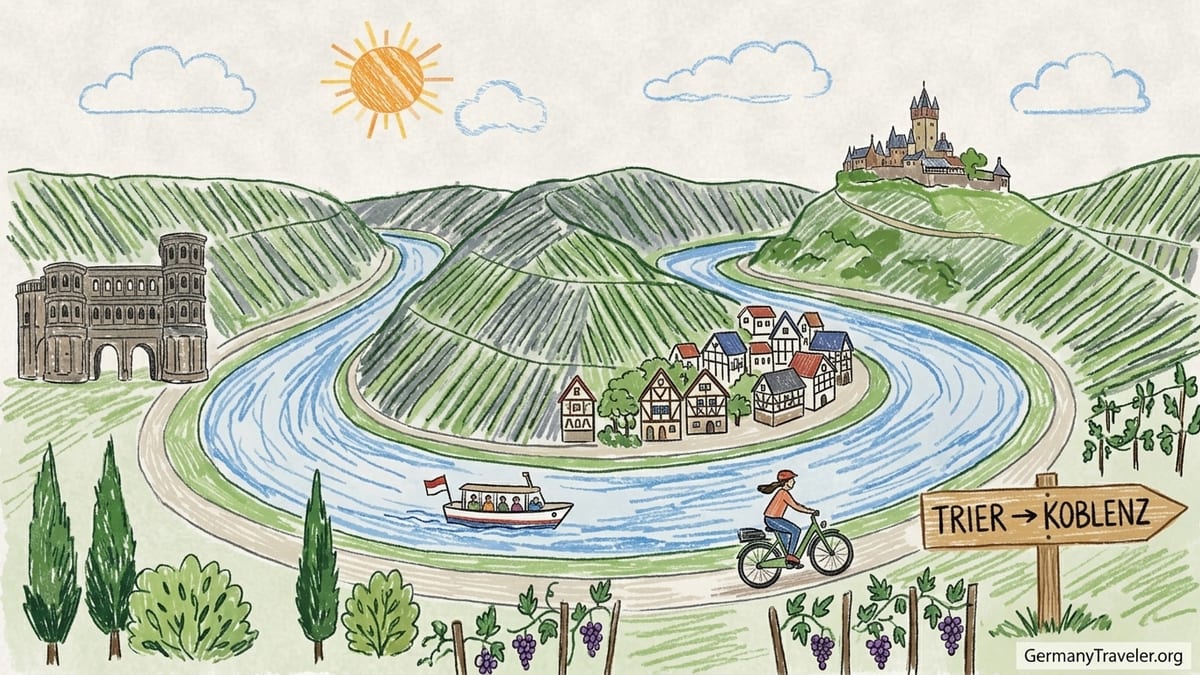
The Moselle Valley in western Germany is one of Europe’s classic river landscapes: a slow, looping river lined with slate vineyards, half-timbered wine villages and hilltop castles. For first-time visitors, the 200 kilometer stretch between Trier and Koblenz can feel overwhelming to plan. This guide focuses on the most rewarding section for a first trip, explains the differences between Upper, Middle and Lower Moselle, and shows how to experience the region’s signature Riesling, river cruises, cycling and Moselsteig hiking without feeling you must cover the entire river from source to mouth.
Understanding the Upper, Middle and Lower Moselle
The Moselle River runs roughly 545 kilometers from the Vosges mountains in France to its confluence with the Rhine at Koblenz in Germany. Within Germany, the river is commonly divided into three main tourism sections: Upper Moselle, Middle Moselle and Lower Moselle. For most first-time visitors interested in classic riverside scenery and wine villages, the focus will be between Trier and Koblenz, which spans all of the Middle Moselle and the Lower Moselle valley.
The Upper Moselle in Germany runs from the French and Luxembourg borders around Perl to Konz, just before Trier. Here the valley is wider and less steep, the vineyards are often on gentler slopes and there is a noticeable influence from Luxembourg’s wine culture. White Burgundy and Pinot varieties are more common in this southern section, and the scenery feels more open and agricultural than the dramatic gorge-like stretches further downstream.
The Middle Moselle stretches from the Trier area past Bernkastel-Kues to around Pünderich and Reil. This is where the river begins to twist through tight loops and where many of the most famous Moselle vineyards and wine villages sit directly on the water’s edge. Steep slate slopes covered in vines rise straight above towns like Bernkastel-Kues, Traben-Trarbach and Zeltingen-Rachtig, giving this section a storybook feel that many travelers associate with the Moselle.
The Lower Moselle, sometimes called the Terraced Moselle, runs from roughly Pünderich or Moselkern to Koblenz, where the river meets the Rhine at the Deutsches Eck. Here the valley is often narrower, the slopes even steeper and heavily terraced, and castles such as Reichsburg Cochem and nearby Burg Eltz watch over the river. Villages like Beilstein, Bremm and Cochem feel slightly quieter and more rural than the busier Middle Moselle hubs, but the scenery is just as impressive. For a first visit, the continuous stretch from Bernkastel-Kues to Cochem offers a concentrated taste of the region’s classic landscapes.
The Classic First-Timer Route: Trier to Koblenz
For a first trip, you do not need to explore the full river from France to Koblenz. Many travelers choose a 3 to 5 day itinerary running from Trier to Koblenz, stopping at a handful of key towns such as Bernkastel-Kues, Traben-Trarbach, Zell, Beilstein and Cochem along the way. This corridor is well served by regional trains and buses, and by the Moselle Cycle Route and Moselsteig long-distance hiking trail, making it easy to combine slow travel with practical connections.
Regional trains between Trier and Koblenz usually take around 1 hour 30 minutes to 2 hours, stopping at main Moselle towns such as Cochem along the way. Typical second-class fares, bought in advance or using regional day tickets, are often in the range of 20 to 35 euros per person for the whole stretch, depending on the ticket type and any rail pass you may hold. This “Moselstrecke” line runs right along the river for long stretches, so the train itself can double as a scenic ride, particularly between Cochem and Koblenz.
Many visitors begin in Trier, Germany’s oldest city and a former Roman imperial capital. After a night or two exploring the Porta Nigra gate, the Roman amphitheater and the riverside district, it is easy to move downstream by train, bus or bicycle. Some travelers book a luggage-transfer cycling holiday between Trier and Koblenz, where a company moves bags each day while you ride 30 to 50 kilometers along the river, staying in small hotels or guesthouses in towns like Bernkastel-Kues, Zell and Cochem.
Others choose a “hub and spoke” model, basing themselves in one or two central locations. A common pattern is to spend two nights in Bernkastel-Kues to explore the Middle Moselle, followed by two nights in Cochem for the Lower Moselle and nearby Burg Eltz, using regional trains, buses and riverboats for day trips. This approach is efficient for first-time visitors who prefer fewer hotel changes but still want to see several different village atmospheres.
Riesling, Vineyards and Wine Experiences
The Moselle is one of the world’s classic Riesling regions. On the steep slate hillsides between Trier and Koblenz, vines cling to slopes that can exceed 60 degrees, capturing sunlight and heat that help ripen grapes in this relatively cool climate. While you will find other varieties such as Müller-Thurgau, Pinot Blanc and Pinot Noir, Riesling is the star, especially in the Middle and Lower Moselle where it often makes up the majority of plantings on the best south-facing slopes.
For a first-time visitor, the easiest way to experience Moselle wine culture is to visit a village wine bar or a family-run winery tasting room. In Bernkastel-Kues, for example, you might step into a traditional Weinstube on the market square in the evening and order a 0.2 liter glass of off-dry Riesling for around 5 to 7 euros. Tasting flights of three or four wines are common and often cost between 10 and 18 euros, providing a quick introduction to how Riesling can range from bone-dry to lusciously sweet while staying refreshingly low in alcohol compared with many warm-climate wines.
Many estates along the route welcome drop-in visitors for simple tastings, especially in the late afternoon. In smaller villages such as Zell or Beilstein, you may find a sign outside a family home or courtyard advertising “Weinprobe” or “Straußwirtschaft,” indicating that the family is serving their own wines alongside simple local food. It is usual to pay a small tasting fee, sometimes 5 to 10 euros, which is often waived if you purchase a bottle or two. When in doubt, ask politely if they have time for a short tasting and be prepared for generous pours and friendly conversation.
Harvest season, generally late September into October depending on the year, is especially atmospheric. Local wine festivals in Bernkastel-Kues, Traben-Trarbach and Cochem may include fireworks, parades and open-air music, with food stalls selling Flammkuchen, bratwurst and Federweißer, a partially fermented new wine. Accommodation during these weekends can book out months in advance and nightly rates for guesthouses may increase from, for example, 90 euros to 130 euros or more for double rooms, so advance planning is useful if you want to be there during the busiest festivities.
Key Towns from Trier to Koblenz
Trier is both a gateway city and a destination in its own right. You can arrive by train from major hubs such as Frankfurt or Cologne and spend a day exploring major Roman remains along with the cathedral and lively pedestrian streets. The city has a wide range of accommodation, from inexpensive pensions and chain hotels near the station to more atmospheric historic hotels in the old town. Expect midrange rooms to cost roughly 100 to 150 euros per night for a double, varying with season and demand.
Bernkastel-Kues sits in the heart of the Middle Moselle and is one of the region’s most photographed towns, with half-timbered houses clustered around a cobbled market square and the ruins of Landshut Castle on the hill above. From Bernkastel, short bus or boat trips reach nearby wine villages such as Piesport or Traben-Trarbach. Many visitors enjoy walking up to Landshut Castle in the late afternoon for views over the river loop, or taking a one-hour sightseeing cruise that passes through nearby vineyard bends before returning to town.
Traben-Trarbach, further downstream, spans both banks of the Moselle and is linked by an elegant bridge. It has an Art Nouveau heritage, several notable wine houses and underground cellars that are sometimes open for tours or Christmas markets in winter. Zell, slightly smaller, is known for the “Zeller Schwarze Katz” vineyard and offers a quieter base with riverfront promenades and easy access to cycling paths in both directions. Accommodation here is often a little more economical than in Bernkastel-Kues, with riverside guesthouses sometimes offering doubles under 100 euros per night outside peak festival periods.
Beilstein and Cochem anchor the classic Lower Moselle section. Tiny Beilstein is sometimes called the “Sleeping Beauty of the Moselle” and has a compact old town climbing up to Burg Metternich castle ruins, which offer wide views of the river’s sharp bends. Nearby Cochem is considerably larger and busier, with a riverside promenade, many restaurants, and the dramatic Reichsburg castle on a hill above town. From Cochem, day trips to Burg Eltz, one of Germany’s most famous castles hidden in a forested side valley, are straightforward by train and bus or with organized excursions.
Cruising, Cycling and Hiking the Moselle
River cruises are a defining feature of the Moselle experience. On any summer day between April and October, small excursion boats shuttle passengers between towns such as Bernkastel-Kues and Traben-Trarbach or between Cochem and nearby villages. Typical one-way fares for short hops in 2024 and 2025 are often in the range of 12 to 20 euros per adult, with discounts for round trips or family tickets. Longer day cruises that include onboard commentary and several hours of sailing may cost from 25 to 40 euros per person, depending on distance and operator.
Cycling is perhaps the most accessible way to explore the valley at your own pace. The Moselle Cycle Route runs for roughly 248 kilometers between Perl near the French border and Koblenz, almost entirely on paved, signposted paths that follow the riverbank. Terrain is largely flat and suitable for casual riders, with typical day distances between 20 and 50 kilometers. In towns like Bernkastel-Kues, Traben-Trarbach, Zell and Cochem, bike rental shops commonly offer city bikes or e-bikes for around 20 to 35 euros per day, with helmets and panniers available for a modest extra fee.
For hikers, the Moselsteig is a 365 kilometer long-distance trail that closely follows the river from Perl to Koblenz but gains elevation to cross vine-clad slopes and forested ridges. It is divided into 24 signed stages, many between 10 and 20 kilometers, making it easy to choose a single day section suitable for a first visit. Popular highlights for beginners include stages near Bernkastel-Kues with panoramic views over the town and river bend, and the Calmont area near Bremm, where side paths lead to one of Europe’s steepest vineyards, complete with fixed ladders and railings for confident hikers.
You do not need to commit to multi-day adventures to enjoy these routes. A typical first-time visitor might rent a bike in Bernkastel-Kues for a relaxed ride to Traben-Trarbach and return by river boat in the afternoon, or take a morning Moselsteig stage above Cochem before descending to the town for lunch and a castle visit. Many accommodation providers welcome walkers and cyclists with secure bike storage and early breakfast times, reflecting how tightly integrated these active options are with everyday tourism along the river.
Getting Around: Trains, Buses and Driving
The Moselle Valley between Trier and Koblenz is well connected by public transport, making it feasible to visit without a car. The regional railway line runs along the river, and most major towns, including Trier, Wittlich (for buses to Bernkastel-Kues), Bullay (for Zell), Cochem and Koblenz, have frequent services. In many cases there is at least one train per hour during the day, though smaller stations may see less frequent service in the evening, so it is wise to check the schedule before late dinners or long hikes.
Regional day tickets sold by German Rail and local transport associations often offer good value. For instance, a full day ticket for two adults covering local trains and many buses within Rhineland-Palatinate typically costs somewhere between 35 and 50 euros, and can be used for hops between Moselle towns as well as for the final journey to larger cities like Mainz or Cologne. When traveling in a small group, these group tickets can be notably cheaper than buying separate point-to-point tickets for each leg of the journey.
Buses fill the gaps where the rail line sits on the opposite bank or higher on the hillside. For example, Bernkastel-Kues does not sit directly on the main Trier to Koblenz railway, so passengers often take a short bus ride from the nearest rail station at Wittlich to reach the town. Bus fares on these local routes are usually a few euros per ride, and buses are geared to connect with school times and commuter needs, which means they can be busy at certain hours but are generally reliable.
Driving can be convenient for those who prefer maximum flexibility, especially if you plan to visit smaller side valleys or remote vineyards. Car rental is available in Trier and Koblenz and sometimes in mid-sized towns nearby. The main Moselle road is relatively narrow and follows the river’s curves, with frequent roundabouts and local traffic, so driving speeds tend to be modest even on straight stretches. Parking in popular towns like Cochem and Bernkastel-Kues often costs a few euros per hour near the center, with cheaper long-stay lots slightly outside the old town cores, reachable with a short walk along the promenade.
Where to Base Yourself and Trip Length
For a first visit of three or four nights, it is realistic and enjoyable to focus on just one or two bases rather than trying to sleep in every famous town. Bernkastel-Kues and Cochem are especially strong choices, as both offer plenty of accommodation, dining and excursion options and sit in the heart of the most scenic river loops. A typical pattern is to spend two nights in Bernkastel-Kues to experience the Middle Moselle, then two nights in Cochem for the Lower Moselle and a side trip to Burg Eltz, before continuing by train to Koblenz or back to a major airport.
Bernkastel-Kues works well for travelers who prioritize atmospheric streets and wine tasting. The old town is compact, and a short walk or taxi ride across the bridge leads to quieter neighborhoods with guesthouses and apartments. From here, you can spend a day wandering the town and castle, another day cycling or cruising towards Traben-Trarbach, and possibly take a half-day bus or boat trip to nearby villages like Piesport. Many first-time visitors find that even one full day here gives them the classic Moselle feel they had imagined, without needing to see every loop of the river.
Cochem, on the other hand, is ideal for travelers who want a combination of classic river scenery and easy access to castles. You can tour Reichsburg Cochem in the morning, stroll the promenade in the afternoon, and join a short boat cruise early evening when the light softens and the hillsides glow green and gold. A day trip to Burg Eltz from Cochem typically involves a 30 to 40 minute train ride to Moselkern followed by a forest hike or shuttle ride to the castle, turning it into a full but manageable day out without needing a car.
If you have more time, adding stops in Trier at the beginning and Koblenz at the end rounds out the experience. In Trier you see the Roman roots of the region, while Koblenz offers the striking confluence of Rhine and Moselle at the Deutsches Eck, views from the Ehrenbreitstein Fortress reached by cable car, and restaurants and wine bars that showcase both Moselle and Rhine wines. Even with a full week, most travelers find that concentrating on the stretch between Bernkastel-Kues and Cochem delivers the essence of the Moselle, with its steep vineyards, small ferries, riverside cycle paths and proudly local wine culture.
The Takeaway
The Moselle Valley rewards travelers who slow down, choose a few well-placed bases and embrace the rhythm of a river that has shaped wine and trade for centuries. You do not need to trace every one of the Moselle’s bends to experience its character. A compact route from Trier through Bernkastel-Kues, Traben-Trarbach, Zell, Beilstein and Cochem to Koblenz offers a concentrated slice of vineyards, castles and wine village life that feels both relaxed and rich in detail.
Riesling, slate slopes and terraced vineyards provide the backdrop, but it is the everyday experiences that make a first trip memorable: a glass of chilled wine on a riverside terrace after a bike ride, a quiet moment on the deck of a small excursion boat, a conversation with a winemaker pouring from family bottles in a simple cellar. With good public transport, clearly marked cycle routes and the Moselsteig trail, it is easy to tailor your days to your interests without worrying about complex logistics.
Whether you are drawn by the Roman history of Trier, the half-timbered facades of Bernkastel-Kues, the hilltop silhouette of Cochem’s Reichsburg or the cable car views in Koblenz, the Moselle’s compact geography makes it possible to link these experiences in a single, coherent journey. By focusing on the Middle and Lower Moselle, particularly the stretch between Bernkastel-Kues and Cochem, first-time visitors can immerse themselves in the classic landscapes they have seen in photos and postcards while leaving plenty of reasons to return for deeper exploration.
FAQ
Q1. How many days do I need for a first trip to the Moselle Valley? For a first visit, three to five days is usually enough to see Trier, one or two wine villages such as Bernkastel-Kues or Traben-Trarbach, and Cochem, with time for at least one river cruise or bike ride. With a full week you can add more hiking stages, extra tastings and overnight stops in smaller towns like Zell or Beilstein.
Q2. Do I need a car to explore the Moselle between Trier and Koblenz? A car is not essential. The regional train line follows the river for much of the way and connects Trier, Cochem and Koblenz, while buses link in towns like Bernkastel-Kues and Zell. Many visitors travel entirely by train, bus, bicycle and boat, using regional day tickets to keep costs manageable.
Q3. Which section of the Moselle is best for first-time visitors? The stretch between Bernkastel-Kues and Cochem is often considered the most rewarding for a first trip, as it combines steep slate vineyards, classic wine villages, castles and easy access to river cruises and cycling. You can visit this section even on a short break without needing to follow the river all the way from the French border.
Q4. When is the best time of year to visit the Moselle?Late spring and early autumn are especially appealing. From May to June the vineyards are bright green and temperatures are usually mild, while September and early October bring grape harvest, wine festivals and golden foliage. July and August can be busier and warmer, especially on weekends, but are ideal if you want long days for cycling and river cruises.
Q5. How expensive is wine tasting in the Moselle Valley?Wine tasting is generally good value compared with many other European regions. A glass of local Riesling in a village wine bar often costs around 5 to 7 euros, and tasting flights of several wines are commonly 10 to 18 euros. At family-run wineries, a small tasting fee is sometimes waived if you buy bottles to take home.
Q6. Can beginners handle cycling or hiking in the Moselle region?Yes. The Moselle Cycle Route largely follows flat riverside paths that are suitable for casual cyclists and families, and e-bikes are widely available to help with longer distances. While some Moselsteig hiking stages include steeper climbs, it is easy to choose shorter, moderate sections with good viewpoints and to return to the valley floor by local bus or train.
Q7. Is it better to stay in one base or move along the river each night?For a first trip, staying in one or two bases usually feels more relaxed than changing hotels every night. Many travelers choose Bernkastel-Kues as a base for the Middle Moselle and Cochem for the Lower Moselle, using trains, buses or boats for day trips. This approach keeps packing to a minimum while still letting you experience several different towns.
Q8. How crowded does the Moselle Valley get in peak season?Popular towns such as Bernkastel-Kues and Cochem can be busy on summer weekends and during wine festivals, with full restaurant terraces and many day-trippers. However, quieter side streets and nearby villages often remain peaceful, especially in the early morning and later evening. Booking accommodation several months ahead for September and main festival weekends is wise, but outside those times you can usually find rooms with less advance planning.
Q9. Can I visit the Moselle on a day trip from a bigger city?Yes, although an overnight stay is more rewarding. From cities such as Cologne, Frankfurt or Luxembourg, you can reach Cochem, Koblenz or Trier by train in roughly two to three hours, depending on connections. Many travelers do a single-day visit to Cochem or Bernkastel-Kues, combining a town walk with a short river cruise, then return to their city base in the evening.
Q10. Is English widely spoken in Moselle Valley towns?In most tourist-focused areas, especially hotels, major attractions and many restaurants, staff speak at least basic English, and menus often include English translations. In smaller villages and traditional wine taverns, German will be more common, but a few polite phrases and a friendly attitude usually go a long way, and many locals are used to international visitors interested in wine and hiking.