


The Moselle between Trier and Koblenz is one of Germany’s most rewarding self-drive routes: a looping river corridor lined with slate vineyards, half-timbered wine towns and hilltop castles. Rather than racing through on a rigid multi-stop itinerary, the best trips build around the river itself, choosing a handful of bases and adding short drives, ferry hops and side trips by bike, train or boat. This guide follows the classic 2026 route from Trier via Piesport, Bernkastel-Kues, Traben-Trarbach, Zell, Bremm, Beilstein and Cochem to Koblenz, focusing on realistic daily drives, which bank to follow, where to park in compact villages and when the car becomes more burden than bonus.
Understanding the Trier to Koblenz Moselle Corridor
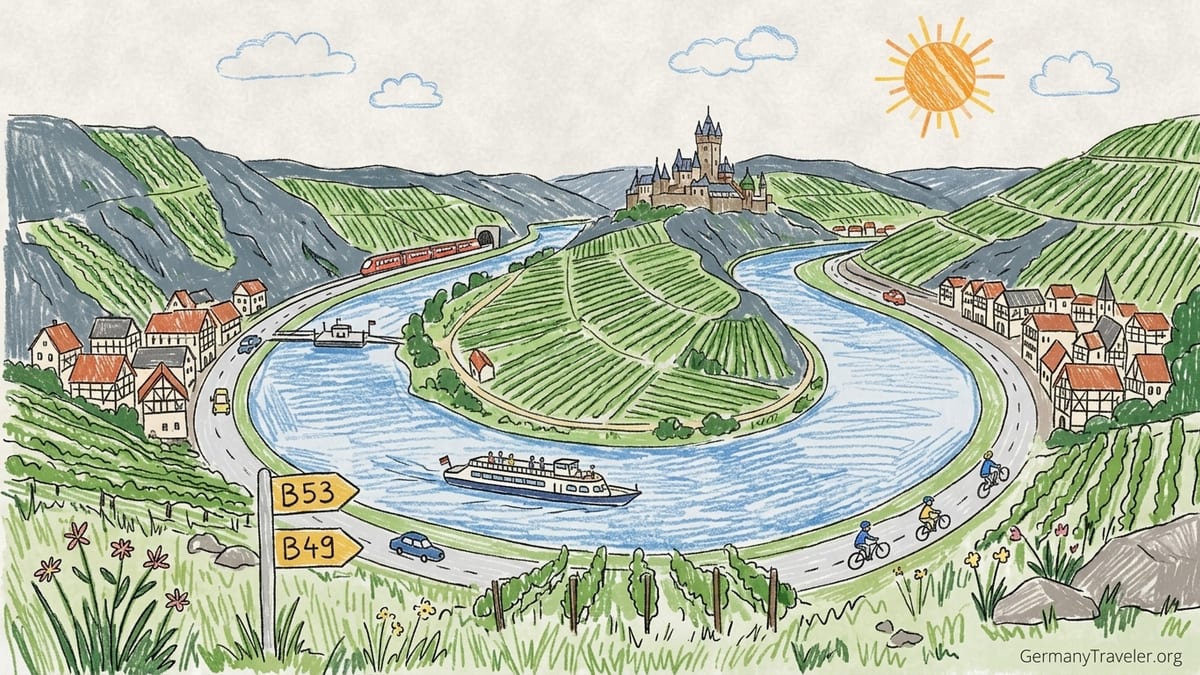
The Moselle between Trier and Koblenz curves through deep meanders that constantly swap the most scenic stretches from one bank to the other. On German road signs you will see the right-bank route signed mostly as B53 and the left-bank route as B49 or local L-roads. Both follow the water closely but weave in and away from the river as they pass through small wine villages and around steep vineyard spurs. Because there are no tolls on this corridor and villages are close together, you can comfortably design a trip around short hops of 20 to 40 minutes rather than long driving days.
The character of the river changes as you go. Between Trier and Bernkastel-Kues, the valley is wider and more agricultural, with big vineyard plateaus above Piesport and Trittenheim. From Bernkastel-Kues to Zell and Bremm, the Middle Moselle cuts into slate hills, creating tight bends and steeper slopes such as Calmont between Bremm and Ediger-Eller, often described as one of the steepest vineyard hillsides in Europe. Beyond Cochem, the valley gradually opens again as you approach Koblenz and the confluence with the Rhine, with more frequent trains and larger towns like Treis-Karden and Winningen along the way.
This geography matters when you are planning how to move. The tightest meanders are the most photogenic to drive, but they can also be slow in peak season, especially around Bernkastel-Kues and Cochem where tour buses and campervans share narrow river roads. Many travelers now treat the car simply as a flexible link between bases: for example, driving Trier to Bernkastel-Kues one day, then using boats or bikes for local exploring before relocating to Cochem or Zell for a couple of nights. That approach keeps you on the river while avoiding the stress of daily packing and congestion at busy chokepoints.
Rail lines and the Mosel-Radweg cycle route shadow the water almost the entire way between Trier and Koblenz, while boats connect many of the wine towns in season. That means you can always swap from road to rail, saddle or riverboat for particular stretches that might be less enjoyable to drive, such as the busier approaches to Cochem or the suburban belt around Koblenz. Thinking of the corridor as a flexible spine rather than a single fixed road itinerary is the key to an enjoyable 2026 Moselle trip.
Choosing the Best Bank and Using Bridges and Ferries
One of the most common questions on the Moselle is which riverbank offers the best views. The honest answer is that it changes bend by bend. For example, the drive from Trier through Schweich toward Piesport is pleasant on both banks, but many drivers prefer the right bank closer to the vineyards above Leiwen and Trittenheim, where small pull-outs let you stop and photograph broad river loops with rows of vines rising behind them. A little farther downstream, however, the left bank gives better perspectives of Piesport’s amphitheater-like vineyards and the wide curve of the river in front of the village.
Between Piesport and Bernkastel-Kues, the left bank via Neumagen-Dhron and Wintrich offers a classic village-to-village feel, passing roadside tasting rooms and allowing short detours up into the vineyards. The right bank, by contrast, tends to feel slightly more open and agricultural in this stretch. Around Bernkastel-Kues itself, both banks are appealing; the right-bank side gives you the fairy-tale old town of Bernkastel, while the left bank in Kues offers easier access to larger car parks and the old-town parking garage beneath the Forum Alter Bahnhof, which many visitors use as a base to walk across the bridge into Bernkastel’s lanes.
Farther downstream, between Traben-Trarbach and Zell, you can mix and match banks using bridges at Traben-Trarbach, Enkirch and Zell. Many drivers start on the right bank to enjoy views of Trarbach’s Jugendstil architecture across the water, then cross at Traben-Trarbach to continue on the left bank via Kröv and the wine villages leading into Zell. Where there is no bridge, small ferries fill the gaps. Around Piesport and Minheim, for example, seasonal car ferries allow quick hops without detouring to the nearest bridge, which is useful if you have booked accommodation on one bank but want to dine or taste wine on the other.
The tight Cochemer Krampen section between Bremm and Cochem is where bridge and ferry choices matter most. Many travelers drive the right bank through Ediger-Eller and Neef to Bremm to see the Calmont vineyards, then cross at the bridge near Neef or take one of the small ferries if running, switching banks to vary the views on the way to Beilstein and Cochem. In practice, a simple strategy works well: choose one bank for the outbound drive in the morning, cross via bridge or ferry near your lunch stop, and return along the opposite bank in the afternoon or the following day, treating each side as a different route rather than duplicating scenery.
Driving Village to Village: Parking, Viewpoints and Short Detours
Self-driving in the Moselle valley is straightforward, but parking can be tight in the most popular wine towns. In Bernkastel-Kues, for instance, free curbside spots on the riverfront fill early on summer weekends and during autumn wine festivals. Most visitors now head directly for signed parking zones on the Kues side, including the multi-storey or underground facilities near the former station building, and then walk across the bridge into the old town. It is realistic to budget around 5 to 10 euros for several hours of parking in these structured lots, while village riverfront spaces are often pay-and-display during the day.
Smaller villages such as Piesport, Neumagen-Dhron or Wintrich tend to have simple riverside parking near the embankment, sometimes with a designated area for campervans. In Piesport you can usually leave the car near the central riverside green and then walk up quiet lanes to tasting rooms like family-run wineries dotted along the lower slopes. From there, signed vineyard paths lead to viewpoints above the village, where you look down on the broad river loop and see barges moving slowly beneath you. Expect gentle but sustained gradients; wearing walking shoes rather than city sneakers makes these detours more pleasant.
Traben-Trarbach and Zell require a little more planning. In Traben-Trarbach, many drivers park on the Traben (right-bank) side where there are larger lots near the bridge, then cross on foot to explore Trarbach’s art nouveau riverfront and cellar doors. In Zell, long narrow car parks line both sides of the river; arriving before late morning gives you more choice, especially if a river cruise ship is in port. These towns reward spontaneous stops: a short detour up to the Marienburg viewpoint near Zell, for example, offers a sweeping panorama over several Moselle loops and the vineyards that surround them.
Bremm and Beilstein are small but enormously popular. In Bremm, dedicated parking at the foot of the village and at signed Calmont trailheads keeps cars largely out of the historic core. In busy months you may find attendants guiding vehicles into overflow fields on weekends. Beilstein, often called one of the prettiest Moselle villages, has limited streetside parking, so most visitors use designated lots slightly outside the center and walk in under ten minutes. Here, renting a room in a riverfront guesthouse or wine hotel can be worthwhile, since it guarantees a space and lets you enjoy the evening atmosphere after the day-trippers leave.
Key Stops: From Piesport and Bernkastel-Kues to Traben-Trarbach and Zell
The classic drive from Trier begins gently, with a first stop around Piesport. Here the Moselle swings in a wide curve, framed by tiered vineyards that have produced Riesling for centuries. A typical traveler day might involve parking near the river, visiting a local winery for a tasting flight that could cost a little over 10 euros for several small pours, then walking up to a vineyard chapel or viewpoint for picnic-level views. Nearby Neumagen-Dhron promotes itself as one of Germany’s oldest wine villages, where you can occasionally see a replica Roman wine ship cruising the river in season, adding a sense of history to the landscape.
Bernkastel-Kues is often the first real base. Its half-timbered Marktplatz, steep lanes and hilltop Landshut Castle make it feel like a Moselle postcard. Many travelers now book two nights here to slow down. A practical pattern is to arrive by midday, park in Kues, check into a hotel or guesthouse, then spend the afternoon exploring the old town and perhaps hiking up to the castle in about 30 to 45 minutes. The next day you might drive just a short distance to nearby villages such as Wehlen, Graach or Zeltingen-Rachtig for tastings, or leave the car and join a short river cruise from Bernkastel’s quay to see the town from the water.
Traben-Trarbach provides a contrast to half-timbered Bernkastel. Trarbach’s riverfront architecture has notable art nouveau and Jugendstil elements, a legacy of the town’s role as a major wine trading hub in the late nineteenth and early twentieth centuries. Beneath the streets you can tour expansive underground wine cellars that stay cool year-round. A realistic visit includes a cellar tour, a coffee and cake pause at a riverside café, and perhaps a short ride on the small funicular or shuttle to a hilltop viewpoint. Staying one night in Traben-Trarbach makes sense if you enjoy this mix of architecture, spa hotels and wine culture, although many travelers simply stop for a half day on the way between Bernkastel-Kues and Zell.
Zell, straddling both banks beneath the “Zeller Schwarze Katz” vineyard, works well as another possible base or a leisurely lunch stop. Its riverside promenade hosts seasonal markets and wine stands, especially during late summer and early autumn. From Zell you can make short drives to quieter villages like Briedel or Merl, or cross the bridge and follow narrow lanes up to viewpoints that look down on multiple river loops. Compared with Bernkastel-Kues and Cochem, Zell feels a little less hurried while still offering enough restaurants, supermarkets and river cruises to function as a comfortable overnight stop.
Calmont, Bremm, Beilstein and Cochem: Vineyards and Castles
The stretch between Zell and Cochem is the visual highlight for many Moselle drivers. Around Bremm, the Calmont hillside rises steeply above the river, with vines climbing at angles that look almost implausible from the road. Well-marked hiking routes here range from a demanding via ferrata-style trail across the steep slopes to a more moderate ascent to the Calmont Gipfelkreuz summit cross and other viewpoints where you can sit at a simple wine hut and look down on the river bending nearly back on itself. Parking is provided in Bremm and at nearby trailheads, and local businesses often serve simple breakfasts and tastings to walkers who make the climb.
From Bremm it is a short, scenic drive to Beilstein, where a cluster of slate-roofed houses gathers around a tiny riverfront square beneath the ruins of Burg Metternich. This is a place where the time of your arrival matters. Tour buses and river cruise groups tend to fill the small lanes from late morning through mid-afternoon. If you are driving, arriving before 10:00 in peak season or later in the early evening gives a quieter experience. Some travelers choose to spend a night or two here in small guesthouses or historic wine hotels and use Beilstein as a peaceful base, taking day trips by boat to Cochem or by car to nearby viewpoints.
Cochem itself is a key anchor on the lower Moselle. The town spreads along both banks, with Reichsburg Cochem perched on a hill directly above, dominating many classic views of the valley. By car you often approach on the left bank, park in one of the signposted lots slightly outside the densest part of the old town, and then walk in along the riverside promenade. Crowds and traffic can be heavy on weekends and in school holidays, so it is wise to reserve accommodation well ahead in 2026 if you want to stay within walking distance of the old center and riverfront.
From Cochem you can easily combine driving with other modes. Boat companies typically operate day cruises upstream toward Beilstein and downstream toward Treis-Karden and Koblenz in season, letting you leave the car parked for a day. Local buses and regional trains run along the valley, making it possible to hike in one direction along vineyard trails or the Moselsteig long-distance path and then return by public transport. Many visitors also use Cochem as the jumping-off point for a side trip to Burg Eltz, one of Germany’s best-known castles, reached by a short onward drive followed by a walk or shuttle bus from designated car parks above the Eltzbach stream.
Where It Makes Sense to Change Bases or Drop the Car
On a compact trip of four to seven days, it rarely makes sense to change hotels every night along the Moselle. Instead, most travelers do well with two or three bases. A common pattern is to start with one or two nights in Trier, then move to Bernkastel-Kues or nearby for two or three nights, followed by two or three nights in Cochem or Zell before finishing in Koblenz. This structure keeps drive times low, reduces the number of times you have to park in busy centers and gives you enough time in each base to use non-driving options like boat rides or bike rentals.
Bernkastel-Kues is a natural first base after Trier because it sits roughly a third of the way to Koblenz and offers a dense cluster of services: multiple hotels and guesthouses in both Bernkastel and Kues, several supermarkets, riverside bike rental shops and frequent cruise departures in season. It also has direct access to the Mosel-Radweg bike path on both banks, which lets you cycle short sections to Piesport, Zeltingen or Traben-Trarbach while leaving your car parked for the day. If you strongly prefer quieter evenings, a smaller village such as Zeltingen-Rachtig or Kröv can serve the same role with a more local feel.
A second base around Zell, Bremm or Beilstein makes sense if you want easy access to the valley’s most dramatic scenery without the constant bustle of Cochem. From Zell you can drive in either direction to reach Bremm, Beilstein or Traben-Trarbach within about 30 to 40 minutes, while small guesthouses offer rooms that are often slightly cheaper than in Bernkastel-Kues or Cochem. Beilstein, by contrast, gives the most atmospheric riverfront setting but has a limited number of properties and books out early; it suits those who value charm over choice of restaurants and shops.
Cochem or the outskirts of Koblenz work best as a final base. Cochem keeps you in the core of the wine valley and within easy reach of Burg Eltz, while Koblenz offers better rail links if you are continuing to Cologne, Frankfurt or beyond. Some road trippers choose to return their rental car in Koblenz and continue by train along the Rhine, especially if their onward route is city-focused. Doing this can save on multi-day car hire costs and parking fees in larger cities, while still giving you the freedom of a self-drive for the most scenic Moselle stretches.
When to Leave the Car: Train, Bike and Boat Alternatives
Although a car offers freedom between villages, there are points in the Moselle valley where other modes are more enjoyable. The most obvious is cycling. The Mosel-Radweg cycle route follows the river from Trier to Koblenz on a mix of dedicated bike paths and quiet frontage roads, often separated from car traffic. Casual cyclists regularly cover manageable sections such as Bernkastel-Kues to Traben-Trarbach or Cochem to Zell in a half day, stopping for coffee and cake or a light lunch in villages along the way. Renting basic trekking bikes or e-bikes from local shops is straightforward, with day rates that are usually less than the fuel and parking you would otherwise spend driving and stopping multiple times.
Trains are particularly useful when driving becomes more chore than sightseeing. The Moselle railway line connects Trier, Wittlich, Bullay, Cochem, Treis-Karden, Kobern-Gondorf and Koblenz, with local stops that often sit right beside the river. If you stay in Cochem, for instance, you can take a short train ride to Bullay and then hike or cycle back along the river without having to loop the car around to your start point. Rail is also the more relaxing choice if the weather turns wet or foggy, when driving narrow river roads in poor visibility becomes tiring.
Boats add a slower, more contemplative dimension. In season, several companies run scheduled services between Trier’s surroundings and towns like Bernkastel-Kues, Traben-Trarbach, Zell, Beilstein, Cochem and occasionally all the way toward Koblenz. A realistic example might be to drive from your base in Bernkastel-Kues to Traben-Trarbach in the morning, leave the car parked, then take a lunchtime boat downstream to Zell and return by train or bike in the late afternoon. Tickets for shorter segments are typically priced at a level that makes them easy half-day outings rather than major investments, and you see the vineyards and castles from water level rather than constantly turning your head while driving.
There are also situations where you may wish to avoid driving entirely, such as wine festivals in Bernkastel-Kues or Zell, when riverside car parks fill even faster and traffic restrictions may be in place. In these cases, basing yourself in one town and using festival shuttles, local trains or simply walking between tasting stands keeps the focus on enjoyment rather than parking. Similarly, if you plan a day focused on multiple winery visits, switching to bikes, walking or public transport is the safer choice, since drink-driving rules are strictly enforced and roadside checks around popular wine regions are not uncommon.
The Takeaway
A Moselle Valley road trip from Trier to Koblenz in 2026 is less about ticking off a long list of stops and more about learning to move with the river’s pace. The loop between Piesport, Bernkastel-Kues, Traben-Trarbach, Zell, Bremm, Beilstein and Cochem offers enough villages, viewpoints and castles to fill a week without ever driving more than an hour at a stretch. By paying attention to which bank carries the more scenic views, using bridges and ferries to vary your route and accepting that you will not see every bend, you turn what could be a rushed checklist into a relaxed journey.
Choosing two or three bases along the valley, rather than changing hotels every night, lets you settle into the rhythm of wine country. In Bernkastel-Kues you can spend slow evenings by the river after daytime drives to nearby villages. Around Zell or Beilstein you have easy reach to Calmont’s slopes and quieter stretches of the river, while Cochem and Koblenz connect you onward by train and highway. Interspersing driving days with boat trips, train hops and cycling excursions keeps the landscape fresh and reduces the strain of parking in small towns.
Most importantly, the Moselle corridor invites flexibility. If traffic builds near Cochem, you can switch banks at the next bridge. If the sun breaks through after a cloudy morning, you can abandon plans and drive up into the vineyards above Piesport or Zell for an impromptu picnic. With realistic expectations about distances, parking and the advantages of alternative transport, a Trier to Koblenz journey becomes less a linear route and more a gentle weave between water, vines and slate, shaped by your own pace and interests.
FAQ
Q1. How many days do I need for a Trier to Koblenz Moselle road trip?
Most travelers are comfortable with four to seven days between Trier and Koblenz, which allows time for at least two bases and a mix of driving, boat and bike days.
Q2. Which Moselle riverbank is better to drive on?
Neither side is always best. The left bank often gives good views around Piesport and Bernkastel-Kues, while many drivers prefer mixing banks between Zell, Bremm, Beilstein and Cochem using bridges and ferries.
Q3. Is parking difficult in popular Moselle towns?
Parking can be tight in Bernkastel-Kues, Beilstein and Cochem at midday in high season, but signed car parks and garages on the edge of town usually have space if you arrive earlier in the day.
Q4. Should I book accommodation ahead of time?
Booking ahead is strongly recommended for July, August, public holidays and wine festival weekends, especially in small villages like Beilstein or riverfront hotels in Bernkastel-Kues and Cochem.
Q5. Do I need a car, or can I rely on trains and boats?
You can travel the Moselle entirely by train, bus and boat, but a car gives more flexibility for small villages and viewpoints. Many visitors combine a rental car for a few days with public transport.
Q6. When is the best time of year to drive the Moselle Valley?
Late spring and early autumn are ideal, with mild weather, vineyard activity and fewer crowds than peak summer. Autumn harvest weeks are atmospheric but busier and require more planning.
Q7. Is cycling the Mosel-Radweg suitable for casual riders?
Yes, many sections are flat and well paved, making them accessible for casual cyclists. Renting an e-bike makes longer distances between Bernkastel-Kues, Traben-Trarbach, Zell and Cochem manageable.
Q8. Can I visit Burg Eltz easily from the Moselle route?
Yes, Burg Eltz is a popular detour from Cochem or Treis-Karden. You typically drive to signed car parks in the hills and then walk or take a shuttle bus down to the castle.
Q9. Are Moselle wine tastings expensive?
Wine tastings are generally affordable compared with many other wine regions, with small flights often priced at a modest level, especially in family-run wineries in villages like Piesport or Kröv.
Q10. Is it safe to drive the Moselle roads in poor weather?
The roads are well maintained, but in heavy rain or fog visibility can drop and driving becomes tiring. In such conditions, many travelers switch to the parallel train line for a safer, more relaxed day.