


The Moselle Valley has quietly become one of Europe’s most enjoyable river cycling destinations: easy gradients, vineyard views, wine villages every few kilometres and a fully packaged tourism infrastructure that makes planning remarkably straightforward. At the heart of it all lies the Mosel Cycle Path, a 248 kilometre, largely flat route between Perl and Koblenz that can be ridden independently or booked as a hotel-to-hotel holiday with luggage transfers, bike or e-bike rental and built-in train support. This guide explains how the route works in practice, compares popular itineraries and shows how to turn the Mosel into a stress-free cycling holiday, even if you have never done a bike tour before.
Understanding the Mosel Cycle Path: Perl to Koblenz
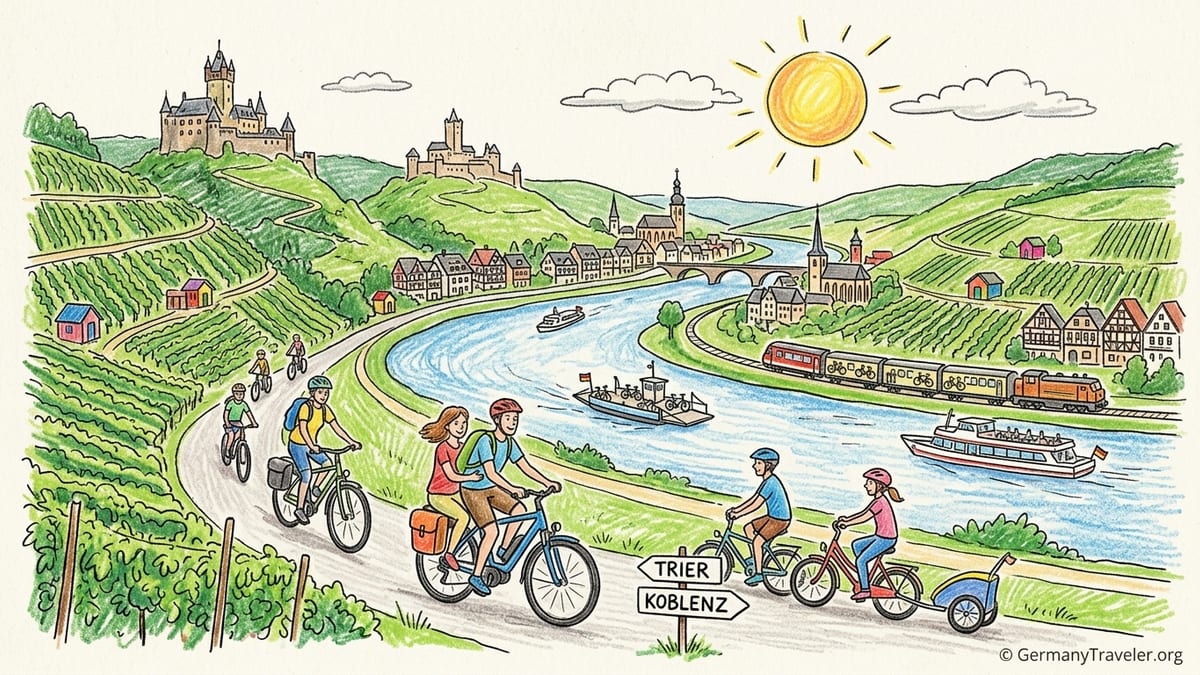
The German Mosel Cycle Path runs roughly 248 kilometres from Perl on the German–French–Luxembourg border to Koblenz, where the Mosel meets the Rhine at the Deutsches Eck. The official tourism board promotes the route in 10 stages, each typically 20 to 35 kilometres, designed for relaxed riding rather than endurance. The path is mostly asphalt, almost entirely traffic free or on very quiet roads and follows the river closely, which keeps gradients gentle enough for families and first-time touring cyclists.
For planning purposes, it helps to think of the Mosel in three parts. The Upper Mosel covers Perl to Trier, a quieter stretch through open valleys and smaller wine villages. The so-called Middle Mosel runs from around Trier to Zell and Bernkastel-Kues, dense with classic wine towns, steep terraced vineyards and more tourist infrastructure. The Lower Mosel continues from Zell and Cochem down to Koblenz, with more dramatic river bends, castles perched above the water and slightly narrower valley sections that feel wilder in places.
Most international visitors encounter the Mosel Cycle Path through official tourism offers or specialist bike tour operators. The regional tourism organisation sells ready-made packages such as a “From Perl to Koblenz: the big tour”, while private companies market variations on the theme, from six-day Trier–Koblenz routes to longer seven or eight-day Perl–Koblenz itineraries. These packages bundle accommodation, route notes, luggage transfers and optional bike hire into one booking, which is a major reason the Mosel has become known as an “easy-entry” destination for river cycling holidays.
Because the route is so flat and well signposted, confident cyclists can also ride it without a package by booking their own hotels and using local luggage transfer services where needed. Regional trains run along almost the entire valley, which makes it simple to shorten stages, skip bad-weather days or return to your starting point after a linear ride.
Perl–Koblenz vs Trier–Koblenz vs Middle Mosel: Which Trip Suits You?
The clearest decision for most travellers is whether to ride the entire German Mosel from Perl to Koblenz or to focus on the more famous central section from Trier. Complete Perl–Koblenz trips typically last seven to eight days with five or six cycling days. One common Perl–Koblenz package spreads the ride across roughly five stages, for example Perl to Trier, Trier to Piesport, Piesport to Traben-Trarbach, Traben-Trarbach to Cochem and Cochem to Koblenz. Daily distances in these itineraries often range from about 40 to 60 kilometres, which suits reasonably active riders who like to be in the saddle for much of the day but still have time for a few tastings or sightseeing stops.
By contrast, the classic Trier–Koblenz trip is marketed as the “Mosel Cycle Path classic” and usually runs over four to six days with three to five cycling days. A typical four-stage version might go from Trier to Leiwen or Trittenheim, then to Bernkastel-Kues, on to Cochem and finally to Koblenz, with daily distances in the 35 to 55 kilometre range. That makes it ideal for first-time touring cyclists, couples who want long lunches and unhurried wine tastings, or travellers adding the Mosel onto a broader Germany itinerary with limited time.
Then there are the shorter Middle Mosel breaks that concentrate on the scenic heart between about Piesport and Cochem. These might involve three or four nights based in one town such as Bernkastel-Kues or Traben-Trarbach with out-and-back day rides. For example, you could stay in Bernkastel-Kues, ride upstream to Trier one day and downstream to Traben-Trarbach or Zell the next, using trains if needed to shorten the return. Such Middle Mosel stays are particularly popular with wine lovers who want to spend evenings in local taverns rather than changing hotels every night.
In practice, the choice comes down to time and priorities. If you want the satisfaction of “completing” the route and do not mind 50 to 60 kilometre days, Perl–Koblenz over a week is attractive. If you prefer a more relaxed pace, the Trier–Koblenz classic is easier to combine with city breaks in Trier or Koblenz and can be slotted into a longer European rail itinerary. If wine towns and slow travel are the priority, basing yourself on the Middle Mosel and riding circular or one-way day trips is often the most enjoyable option.
Hotel-to-Hotel Packages and What They Include
Most organised Mosel cycling holidays follow a similar structure, whether booked directly via the regional tourism board or through private operators. You choose a start date within the cycling season, typically from early April to late October, and select a comfort level, such as standard three-star hotels and guesthouses or an upgraded mix including four-star properties. The operator then reserves all overnight stays along the route and provides a detailed itinerary with stage descriptions, recommended lunch stops and points of interest.
A common seven-day Perl–Koblenz itinerary might include one night each in Perl, Trier, Piesport, Traben-Trarbach, Cochem and two nights in Koblenz to allow time to explore the Rhine as well. Prices vary widely depending on hotel category and travel dates, but as a broad example, mid-range packages for a week-long trip with breakfast and luggage transfer often fall somewhere in the ballpark of several hundred euros per person in a double room. Shorter four or five-night Trier–Koblenz trips, again with breakfast and luggage transfer, typically come in somewhat cheaper overall, though the per-night cost can be similar.
What most packages have in common is that they are designed for independent, self-guided cycling rather than guided group tours. You ride at your own pace using route notes, GPS tracks or simply following Mosel Cycle Path signposts. At the end of each day, you arrive at your pre-booked hotel, where your luggage already awaits in reception or in your room. Breakfast is included almost everywhere; dinners are usually left open so you can explore wine taverns and local restaurants in each town.
Several operators also bundle extras such as entry to specific attractions or boat trips. Some Trier–Koblenz packages include a cable car ride over the Rhine to Ehrenbreitstein Fortress in Koblenz, for example, or discounted tickets for boat excursions between Cochem and Beilstein. A few Perl–Koblenz tours add optional detours to Roman sites such as the reconstructed Villa Borg near Perl or extra nights in Trier to visit its UNESCO-listed Roman monuments.
Luggage Transfers, Daily Distances and Train Support
Luggage transfer is one of the key services that makes the Mosel Cycle Path feel accessible to non-cyclists. Many hotel-to-hotel packages include baggage transport as standard, with the operator collecting your suitcase each morning and delivering it to your next hotel by late afternoon. Some providers specifically advertise that they do not limit the number of bags per person, only the weight per piece, often in the region of around 20 kilograms, which is usually more than enough for a week’s touring wardrobe.
Independent travellers can book luggage transfer separately through local companies that specialise in the Mosel valley. As an example, a dedicated service between Trier and Koblenz charges a set fee per person and per stage, with a minimum charge per delivery. For a couple riding from Trier to Koblenz over four or five days, this kind of service keeps the daily cost manageable while allowing you to travel with a normal suitcase rather than bikepacking bags. There are usually modest surcharges if your accommodation lies higher up the slope away from the river.
Daily distances are flexible because the towns and villages along the Mosel lie relatively close together. On a standard Trier–Koblenz itinerary, many riders cover around 40 to 50 kilometres per day, perhaps leaving Trier around mid-morning, stopping for coffee in Schweich or Leiwen, wine tasting around Neumagen-Dhron or Piesport, and arriving in Bernkastel-Kues by late afternoon. Stronger cyclists or e-bike users often stretch stages to 60 or even 70 kilometres, for example riding from Trier directly to Bernkastel-Kues, especially when days are long in late spring and summer.
Train support runs like a safety net in the background. The regional rail line more or less parallels the Mosel Cycle Path, with frequent stops in major towns such as Trier, Bullay (near Zell), Cochem and Koblenz. Most local trains carry bikes, though space can be limited at peak times or on holiday weekends, so advance planning is wise. Many commercial packages build in a rail transfer at the end of the tour, with guests returning from Koblenz to Trier or Perl by train or, in some cases, by organised bus, rather than cycling back the same way.
Bike and E-Bike Rental Along the Mosel
Cyclists who do not want to bring their own bikes will find a dense network of rental options along the Mosel. In the Middle Mosel especially, towns like Bernkastel-Kues, Traben-Trarbach and Cochem have multiple rental outlets offering touring bikes, step-through city bikes, children’s bikes, trailers and a growing range of e-bikes. In the Bernkastel-Kues holiday region alone there are more than ten rental stations, including small family-run hotels and guesthouses that maintain their own fleets of pedelecs for guests.
Many bike tour operators collaborate with rental partners along the route. When you book a package, you can typically add a touring bike or e-bike for a daily fee, often including basic panniers and a repair kit. You collect the bike at your starting point, ride it along the agreed route and leave it in Koblenz or another end-point hotel, where the local partner retrieves it. This one-way rental structure is particularly convenient for linear trips such as Perl–Koblenz or Trier–Koblenz because it avoids the need to return to the starting town.
E-bikes are especially popular on the Mosel because they allow riders of differing fitness levels to share the same holiday. Grandparents can comfortably join adult children and teenagers on 50 kilometre stages, for example, or couples can choose different bike types according to fitness. Most rental providers supply standard pedelecs with mid-mounted motors and at least one spare battery charger; many hotels now offer secure bike storage and charging points, reflecting how common e-bikes have become on German river routes.
When renting, it is worth checking details such as whether helmets are included, what happens in the event of a mechanical issue and whether the bike is equipped with panniers, handlebar bags or only a rear rack. Some Middle Mosel outlets cater to day-trippers with more basic city bikes and baskets, while long-distance tour specialists along the route focus on multi-day touring setups. Booking ahead for high summer and public holiday weekends is wise, especially for e-bikes and smaller frame sizes.
Wine Towns, Highlights and Shorter Middle Mosel Stays
The Mosel Cycle Path is as much about places to stop as it is about the riding itself. On a full Perl–Koblenz trip, the Roman influence is strongest near the start, with sights such as Villa Borg close to Perl and Trier’s city centre with the Porta Nigra and Roman bath complexes. Downstream from Trier, the cycling becomes a continuous string of wine villages and riverside towns: Trittenheim with its bridge and hillside vineyards, Neumagen-Dhron with its Roman wine ship, Piesport’s amphitheatre of vines and Bernkastel-Kues with its half-timbered market square.
Further along the Middle Mosel, Traben-Trarbach stands out for its art nouveau villas, Jugendstil architecture and old wine warehouses lining both banks of the river. Zell is surrounded by steep vineyards, including the well-known Zeller Schwarze Katz site that you will see advertised in local wine shops. Between Bullay and Cochem, the valley narrows and the path runs close to the water beneath terraces that seem to rise almost vertically, particularly around Bremm and the Calmont, often cited as one of the steepest vineyard slopes in Europe.
Cochem itself is one of the most visited towns on the Mosel, dominated by Reichsburg Castle above the river and a compact old town filled with cafes, wine bars and boat piers. From here, many cyclists take a short detour by boat or bike to Beilstein, a small village sometimes nicknamed a “Sleeping Beauty of the Mosel” for its preserved historic core. Approaching Koblenz, the valley gradually opens out again, with riverside villages such as Hatzenport, Kobern-Gondorf and Winningen providing quieter overnight alternatives to larger centres.
Travellers interested mainly in wine, scenery and relaxed cycling often choose to focus their time around the Middle Mosel between about Piesport, Bernkastel-Kues, Traben-Trarbach, Zell and Cochem. A typical four-night stay might involve basing yourself in Bernkastel-Kues or Traben-Trarbach, renting bikes locally and riding day trips up or downriver. For example, one day could be a leisurely ride from Bernkastel-Kues to Piesport and back, stopping in wineries along the way, while another day covers the route to Traben-Trarbach with a boat return in the late afternoon.
Practical Planning Tips for Mosel Cycling Holidays
The main cycling season along the Mosel runs from roughly April to late October. Spring and autumn offer cooler temperatures, fewer crowds and colourful vineyards, while July and August bring warmer weather, busy riverside promenades and lively wine festivals in many towns. Because the path is paved and close to the river, it is rideable in almost all weather conditions, though strong headwinds and heavy rain can still make stages feel longer than the map suggests.
When booking a Perl–Koblenz or Trier–Koblenz package, pay close attention to the daily distances and overnight stops. Itineraries designed for “enjoyment” often keep riding days below 50 kilometres and allow at least one two-night stay, often in Trier or Koblenz, so you are not packing and unpacking every day. If you are travelling with children or less experienced riders, look for packages that highlight especially family-friendly stages, such as the early sections between Perl and Nittel or the more open stretches near Mehring and Piesport.
For independent travellers arranging hotels themselves, consider booking “Bett+Bike” certified accommodation where possible. These cycle-friendly properties typically offer secure bike storage, basic tools, drying rooms for wet gear and early breakfast times. In many Mosel towns, standard guesthouses and small hotels have adapted to cyclists’ needs in similar ways, but the certification gives added reassurance if you are travelling with expensive bikes or e-bike batteries that need safe overnight charging.
Finally, build some flexibility into your schedule. One of the advantages of the Mosel Cycle Path is that distances between train stations are short and there are frequent services along much of the valley. If a storm rolls in or you discover a village wine festival you would rather linger at, it is usually straightforward to adjust your plans by riding fewer kilometres and using the train to reach your next overnight stop. That flexibility, combined with luggage transfer services and abundant rental options, is what turns the Mosel from a simple river route into a genuinely accessible cycling holiday destination.
The Takeaway
The Mosel Cycle Path offers a rare combination of ease, infrastructure and atmosphere. The complete Perl–Koblenz route gives you the satisfaction of tracing the entire German Mosel, from its borderland beginnings through Roman Trier and the classic wine terraces of the Middle Mosel to the river’s grand finale at Koblenz. Shorter itineraries such as the Trier–Koblenz classic or Middle Mosel stays deliver concentrated doses of the valley’s highlights for travellers with less time or a preference for slower travel.
Hotel-to-hotel packages with luggage transfer mean you can ride with a light day bag, while the dense network of bike and e-bike rental outlets makes it easy to arrive by train and still enjoy a full cycling holiday without bringing your own bike. Daily distances are flexible, the path is almost entirely flat and paved, and train support provides a constant safety net for bad-weather days or early finishes.
Whether you are a first-time cycle tourist looking for an uncomplicated introduction to multi-day riding, a wine lover dreaming of vineyard views and riverside evenings, or a family seeking a mostly traffic-free adventure, the Mosel Cycle Path has the ingredients for a rewarding holiday. With thoughtful planning and realistic daily stages, it can be as leisurely or as active as you choose, all against the backdrop of one of Germany’s most atmospheric river valleys.
FAQ
Q1. How many days do I need to cycle the Mosel Cycle Path from Perl to Koblenz?
Most travellers allow between six and eight days for the full Perl to Koblenz route, with five or six cycling days and at least one extra night in Trier or Koblenz for sightseeing.
Q2. Is the Mosel Cycle Path suitable for beginners and families with children?
Yes. The route is largely flat, mostly asphalted and often separated from road traffic, which makes it very suitable for beginners and families, especially if you keep stages to around 30 to 40 kilometres.
Q3. What is the difference between a Perl–Koblenz tour and the classic Trier–Koblenz trip?
A Perl–Koblenz tour covers the entire German section of the river and usually involves slightly longer daily distances. The Trier–Koblenz classic starts in Trier, skips the very first Upper Mosel segment and focuses on the more famous wine towns further downstream.
Q4. Can I book luggage transfer without a full package tour?
Yes. Several local companies offer luggage transfer services between towns such as Trier and Koblenz that you can book independently, paying a per-person, per-stage fee while arranging your own accommodation.
Q5. Do I need to bring my own bike, or can I rent one locally?
You can rent bikes and e-bikes in many Mosel towns, particularly in the Middle Mosel around Bernkastel-Kues, Traben-Trarbach and Cochem. Many tour packages also include rental bikes or e-bikes as an optional extra.
Q6. How far will I ride each day on a typical Mosel cycling holiday?
On most hotel-to-hotel itineraries, daily distances range from about 35 to 60 kilometres. Shorter, family-focused or enjoyment-oriented packages tend to stay at the lower end of that range.
Q7. What is the best time of year to cycle along the Mosel?
The main season runs from April to October. May, June, September and early October are often ideal, with mild temperatures, open wine taverns and generally less crowding than in peak summer.
Q8. How do I get back to my starting point after a one-way trip?
Most travellers use regional trains that run along the Mosel between Koblenz, Cochem, Bullay and Trier, usually with bike spaces. Some organised tours include a dedicated bus or pre-booked rail ticket for the return journey.
Q9. Is it necessary to book a package, or can I organise everything myself?
It is perfectly possible to organise your own Mosel cycling trip by booking hotels, arranging luggage transfer if desired and renting bikes locally. Package tours are most useful if you prefer a single point of contact and pre-arranged services.
Q10. Are there plenty of places to eat and taste wine along the route?
Yes. Almost every town and many small villages along the Mosel have at least one restaurant, cafe or wine tavern, particularly in the Middle Mosel, so it is easy to plan regular meal and tasting stops during your ride.