


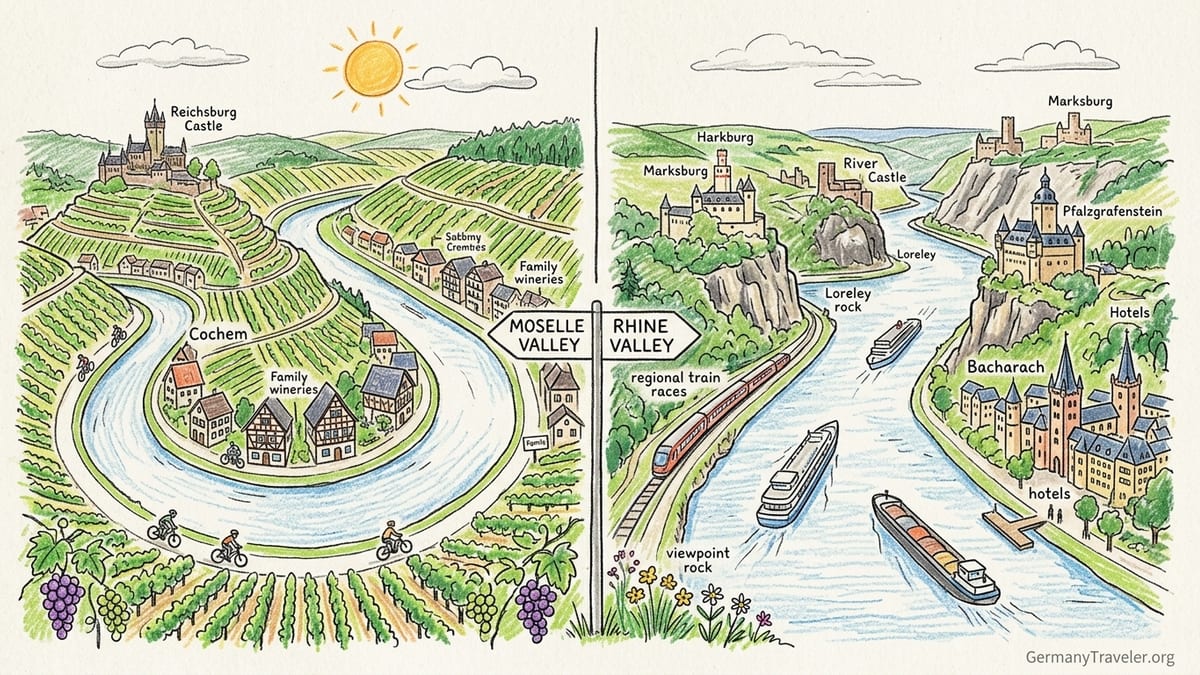
Two of Germany’s most iconic river landscapes sit almost back to back in the country’s west: the Moselle Valley and the Rhine Valley. On a map they look close enough to visit in a weekend, yet on the ground they feel surprisingly different. One is quieter and more intimate, with lazy bends, tight vineyard slopes and half-timbered wine villages. The other is a grand corridor of castles and river traffic, where trains, barges and cruise ships pass steep cliffs and legendary rocks. If you are planning a trip and have time for only one, or you are wondering how to combine both, this guide will help you make a clear, practical choice.
Moselle vs Rhine at a Glance: What Type of Traveler Are You?
When travelers compare the Moselle Valley with the Rhine Valley, they are rarely choosing between better and worse. Instead they are choosing between two different moods. The Moselle from Cochem through Beilstein, Traben Trarbach and Bernkastel Kues offers a slower, village based experience. You cycle from one cluster of half-timbered houses to the next, linger in small family wineries and watch the river curve around improbable hillsides thick with Riesling vines. Overnights often mean guesthouses above a wine cellar rather than big hotels.
The Rhine between Koblenz and Rüdesheim, the UNESCO listed Upper Middle Rhine Valley, feels more dramatic and more crowded in every sense. On this 65 to 70 kilometre stretch you see dozens of castles packed onto steep cliffs, with famous viewpoints like the Loreley rock near St Goarshausen and big riverboats sliding past almost constantly. Regional trains race along both banks, and towns such as Boppard, Bacharach, St Goar and Rüdesheim welcome heavy day trip and cruise traffic in summer.
A simple rule of thumb is that the Moselle suits travelers who want to slow down, sip wine and spend evenings in quiet villages, while the Rhine suits those who want maximum castles and classic German river scenery in the shortest time. Many visitors who rush through on a one day Rhine cruise later say they wish they had added two slower Moselle days for contrast. Fortunately, rail lines and roads converge at Koblenz, so you do not actually have to choose if you can spare three or four nights.
Pricewise, both valleys sit in a similar range, but how you spend is different. On the Moselle your budget may go more toward wine tastings and countryside guesthouses, while on the Rhine it often flows into castle entry fees, cable cars, short river cruises and central hotels in larger towns. If you are planning a first Germany itinerary of 7 to 10 days, many travelers now allocate 2 nights Rhine, 2 nights Moselle and then move on to cities such as Cologne or Frankfurt.
Landscape and Atmosphere: Tight Bends vs Grand Gorge
The Moselle’s signature look is the tight river bend wrapped in vineyards. Around Cochem and further up toward Bernkastel Kues the river loops through steep slopes cut into terraces. From viewpoints above towns like Beilstein or the ruins of Grevenburg above Traben Trarbach you see the water curve almost back on itself, with narrow roads and a single rail line hugging the banks. It feels contained and human scaled. Even in peak season, noise is mostly from bicycles whirring past and the occasional regional train, not long freight convoys.
The Rhine in its Middle Valley offers a wider, deeper river with a cliff like profile. South of Koblenz the river carves down between Braubach, Boppard, Oberwesel and St Goar, passing the Loreley narrows where the river tightens to around 170 metres across and currents run faster. Here you feel small under the scale of the gorge and the number of castles that line the ridges and mid river rocks. Barges, container ships, long distance river cruise vessels and frequent trains give the corridor a constant background hum and a more industrial undercurrent beneath the romance.
For many travelers the key atmospheric difference is pace. On the Moselle, you can sit at a riverside wine garden in Zell or Piesport for an hour and see only a handful of cars pass. Locals cycle to work along the river path and older visitors stroll back to their pension after early dinners. The Rhine’s main towns, especially Boppard and Rüdesheim, feel livelier after dark, with riverside promenades full of people, bars facing the docks and tour groups arriving on coaches and cruise ships.
If you are sensitive to noise at night, this distinction matters. Train lines run on at least one bank of both rivers, but on the Rhine heavy freight traffic can mean frequent train noise through the night, especially in smaller villages set tight to the tracks. On the Moselle there is still train traffic yet it is lighter and some villages sit slightly above or back from the line, so choosing your accommodation carefully can give you quieter nights.
Wine, Villages and Cycling: The Moselle’s Strong Suit
Both valleys are classic Riesling territory, but the Moselle is the more immersive wine landscape. In villages such as Bernkastel Kues, Ürzig, Wehlen and Graach you can walk from your guesthouse to multiple family run wine estates in minutes. Many offer relaxed tastings in vaulted cellars or simple modern tasting rooms, often charging only a modest fee that is waived if you buy a bottle. It is common to find decent local Riesling by the glass for around 4 to 6 euros in village wine taverns, and village festivals in late summer add brass bands and food stalls to the mix.
Cochem, one of the most popular Moselle bases, pairs a fairytale castle above town with a compact old centre of half timbered houses and wine bars. Quieter options such as Beilstein, sometimes called the Sleeping Beauty of the Moselle, appeal to travelers who want a few restaurants, a riverfront promenade and not much else. Further upriver, Traben Trarbach has an Art Nouveau townscape and riverside hotels, while Bernkastel Kues is a hotspot with cobbled squares, overhanging upper stories and a ruined castle on the hill above. Local tourism boards promote wine themed walks and even light and music wine tastings in towns like Zell.
For cyclists, the Moselle is one of Germany’s most forgiving and scenic river routes. The dedicated riverside path often runs separate from traffic, mostly flat, and you can easily ride between villages such as Cochem, Ediger Eller, Zell and Traben Trarbach in half day stages. E bike rentals are common at Cochem and Bernkastel Kues, and multi day riders sometimes continue all the way to Trier or even Luxembourg. Compared with long distance Rhine cycling, the Moselle route feels more intimate, with vineyards almost always within arm’s reach and frequent opportunities to stop for cake and coffee or a mid afternoon glass of wine.
The Rhine has its own excellent wine culture, especially around Bacharach, Oberwesel and Rüdesheim, but villages are more linear and sit closer to busy rail lines and main roads. That makes casual cycling less relaxing for some visitors, although there are good stretches of car free riverside path. For a focused wine trip, especially if you love exploring individual producers and old cellars on foot, the Moselle is usually the better primary base.
Castles, Cruising and Iconic Sights: Where the Rhine Shines
If your mental image of Germany involves a river lined with medieval castles, the Rhine Valley delivers in a way few other landscapes can match. Between Koblenz and Rüdesheim there are more than 40 significant castles, palaces and fortifications within a compact corridor, including riverside highlights such as Marksburg above Braubach, Rheinfels towering over St Goar and the island stronghold of Pfalzgrafenstein near Kaub. This concentration has helped the Upper Middle Rhine Valley earn UNESCO World Heritage status and produces a near continuous slideshow of towers and ruins from any passing boat.
River cruising is easier to sample on the Rhine than on the Moselle. Several companies operate hop on, hop off style day boats between Koblenz and Rüdesheim in the main season, so you can, for example, board a mid morning boat in Boppard, glide past castles and the Loreley cliffs for two or three hours, then disembark in St Goar, visit Rheinfels Castle and return by train in the evening. Prices vary by operator and season but a one way stretch such as Boppard to Bacharach typically costs a few tens of euros per person and is widely regarded as one of Europe’s best value classic river cruises.
The Moselle has castles too, most famously Reichsburg Castle above Cochem and the fairy tale Burg Eltz set in a side valley between Moselkern and Münstermaifeld. Burg Eltz in particular is a favourite day trip for Moselle based visitors, with a signposted forest path from the parking area and shuttle options for those who prefer not to walk. However, castles along the Moselle are more sporadic and often ruined, and the river scenery is less about fortresses and more about terraces and village church spires.
Short cruises are available on the Moselle around Cochem, Traben Trarbach and Bernkastel Kues yet there is typically less choice and traffic than on the Rhine. Boats are smaller, and departures may be limited to a few scheduled sailings per day outside high summer. That can make the experience feel more relaxed and local but if your priority is to sit on a sun deck watching one castle after another slide by, the Rhine is the stronger candidate.
Hotels, Guesthouses and Where to Stay
Accommodation character is another way these valleys diverge. On the Moselle, traditional guesthouses and winegrower run pensions dominate many villages. In places such as Bernkastel Kues and Traben Trarbach you find historic hotels in half timbered buildings or Art Nouveau townhouses, often with only a few dozen rooms. It is common for riverside hotels to offer balconies directly over the water and on site wine bars. Rates for simple double rooms in shoulder season often begin in the low to mid 100 euro range, with breakfast included and parking either on site or nearby.
The Rhine corridor, with its heavier tourist flow, offers a broader range of midscale hotels and apartment style accommodation. Boppard and Rüdesheim in particular have waterfront hotels that cater to river cruise passengers and coach tours, with larger dining rooms and bus parking. Smaller towns like Bacharach and St Goar mix cosy half timbered guesthouses with a few standout properties such as castle hostels in fortresses like Stahleck above Bacharach, where you can sleep in restored medieval walls overlooking the river.
Noise management should play into your booking decisions, especially on the Rhine. In many villages the main road, railway and riverfront are squeezed into a narrow strip between rock and water. River view rooms are wonderful in the daytime but can be exposed to train horns and freight traffic at night. If you are a light sleeper, consider asking for a room toward the back of the building or up the hill, trading some view for quieter nights. On the Moselle, the compact scale of villages and lighter freight traffic makes this less critical but still worth checking in reviews.
Booking patterns also differ. The Rhine sees intense peaks during major events such as the Rhine in Flames fireworks nights and during high cruise season from late May through September. In those periods, riverfront hotels in Boppard, Bacharach or Rüdesheim can sell out weeks ahead. The Moselle is busy in school holidays and for wine festivals around early September, especially in hubs like Cochem and Bernkastel Kues, yet outside those windows you can often find good last minute options, particularly in smaller villages.
Getting Around: Trains, Roads and Scenic Day Trips
For car free travelers, the Rhine Valley is slightly easier to navigate. Mainline regional trains run frequently along both sides between Koblenz and Mainz, with stops in Boppard, Oberwesel, Bacharach, St Goar and other small towns. From long distance rail hubs such as Frankfurt or Cologne, you can reach the Rhine corridor in as little as one to two hours with one change or less. This makes it feasible to base in a river town for several nights and make day trips to larger cities or onward to the Moselle without renting a car.
The Moselle line between Koblenz and Trier is primarily served by regional trains, with comfortable carriages and space for bikes. Trains typically stop in Cochem, Bullay, Traben Trarbach via a branch line, Wittlich and finally Trier. Services are frequent enough for day trippers and cyclists, and German regional day tickets can keep costs reasonable if you plan several rides in one day. Still, the line is single track in many sections and villages are spaced slightly farther apart than on the Rhine, so plans require a bit more timetable checking.
Driving gives maximum flexibility in both valleys. On the Rhine, roads follow each bank and multiple car ferries link towns such as Boppard, St Goar and Bingen, letting you create scenic loops that cross the river and climb to viewpoints above the gorge. On the Moselle, twisting roads trace every bend of the river, and some of the best views come from minor roads that snake up into the vineyards, where small parking lots mark photo stops over bends like the Marienburg loop near Pünderich. In high summer weekends, allow extra time for traffic around hotspots like Cochem and for parking near Burg Eltz.
Most travelers who visit both valleys use Koblenz as the hinge. This mid sized city sits where the Moselle meets the Rhine at the Deutsches Eck monument and is served by an important cross regional rail hub at Koblenz Hauptbahnhof. From here you can catch trains south along the Rhine toward Boppard and Rüdesheim, west along the Moselle toward Cochem and Trier, or north to Cologne and beyond. A practical pattern is to stay in Koblenz for one night, ride the cable car to Ehrenbreitstein Fortress for a panorama of both rivers, then branch out to a Rhine base and a Moselle base for two nights each.
Trip Styles and Itineraries: Matching Each Valley to Your Plans
Different trip styles make each valley’s strengths stand out. If you have only one full day from a base like Frankfurt, the Rhine is usually the better choice. You can take an early train to Mainz or Bingen, board a mid morning boat through the heart of the gorge past castles and the Loreley rock, disembark in Boppard or St Goar for lunch and castle visits, then return by evening train. That schedulable corridor of trains and boats is what many visitors imagine when they think of a classic Rhine day trip.
For long weekends or relaxed weeks, the Moselle comes into its own. A popular four night pattern is to base two nights in Cochem or nearby Beilstein, visiting Reichsburg Castle and taking a day trip to Burg Eltz, then move upriver for two nights in Bernkastel Kues or Traben Trarbach, focusing on wine tasting and cycling short sections of the river path. From there you can continue to Trier for Roman ruins or cross into Luxembourg. Travelers who have followed this pattern in recent seasons often remark on how peaceful evenings felt compared with busier Rhine towns.
Hikers might be surprised that both valleys offer excellent ridge and vineyard trails. The Rheinsteig and RheinBurgenWeg cross high above the river, linking castles and viewpoints and allowing you to hike a stage between towns like St Goarshausen and Kaub or Boppard and Oberwesel, then return by train or boat. The Moselle has its own Moselsteig long distance path that winds along the slopes and through wine villages. For a softer version, local loops around places like Zell, Piesport and Bernkastel Kues combine vineyard tracks with forest sections and panoramic benches tucked among vines.
If your broader Germany itinerary already includes large cities and busier tourist areas, using the Moselle as your main river stay and visiting the Rhine as a long day trip from Koblenz or Mainz can balance the trip. If, on the other hand, you are short on time or traveling with companions who want obvious highlights and easy transport, staying on the Rhine and adding one Moselle day around Cochem can be the simpler choice. The decision is less about ranking and more about which valley’s rhythm best supports the rest of your route.
Combining Moselle and Rhine in One Trip
Because the two rivers meet at Koblenz, combining them is straightforward. With three full days, you can sample both without feeling rushed. One workable plan is to spend your first night in Koblenz, using the afternoon to ride the cable car to Ehrenbreitstein Fortress and walk the old town at the river confluence. On day two, catch a morning train down the Rhine to Bingen or Rüdesheim, take a midday boat back through the gorge to Boppard or St Goar, then return to Koblenz by evening train. On day three, head in the other direction along the Moselle to Cochem, exploring the castle and old town or renting bikes for a short ride along the river before looping back to Koblenz or continuing upriver for an overnight.
With five to seven days, you can add overnight stays directly in the valleys. For example, after a first night in Koblenz, move to Boppard or Bacharach for two nights on the Rhine. Use one full day for a castle focused boat and hiking combination, such as cruising past Loreley then hiking a segment of the Rheinsteig back to your base. Then transfer by train through Koblenz to Cochem or Bernkastel Kues for two or three Moselle nights, dedicating days to Burg Eltz, cycling and leisurely wine tasting. This pattern lets you experience the Rhine’s intensity and the Moselle’s calm in a single, coherent arc.
Travelers driving their own car or rental have even more flexibility. You can design a loop departing Frankfurt or Cologne, following the Rhine to Koblenz with stops in Boppard and St Goar, then cutting over via local roads to the Moselle near Treis Karden or Cochem. From there you can follow the river upstream to Bernkastel Kues and Trier, then return on faster highways. Many visitors who have done this circuit note that distances are shorter than they look on the map, but the winding nature of Moselle roads and the temptation of frequent scenic stops extend driving times, so it is wise to plan short hops and long breaks.
For those using Germany’s regional day tickets or rail passes, Koblenz remains a logical anchor because its station connects the Rhine, Moselle and long distance lines. It is entirely feasible to sleep every night in one valley and day trip to the other, but this can cut into your evenings, which are some of the most atmospheric hours in wine villages. Whenever possible, spending at least one night actually on the Moselle and one on the Rhine gives a deeper sense of each valley’s character than day trips alone.
The Takeaway
In the Moselle versus Rhine debate, the real answer is that each river excels at something different. The Moselle stage between Cochem and Bernkastel Kues is the choice for travelers who want intimate wine villages, easy riverside cycling, tight bends wrapped in vineyards and long evenings in quiet taverns. It is less about castle collecting and more about sinking into a rural rhythm, tasting Riesling where it is grown and wandering cobbled lanes after most day trippers have gone.
The Rhine’s Upper Middle Valley between Koblenz and Rüdesheim is the best option for first timers who want instantly recognisable, big scenery. Its dense castle corridor, the Loreley cliffs, frequent boats and trains and bustling riverside promenades make it a showcase for romantic river Germany in a compact package. It works particularly well for short trips, classic cruises and travelers who enjoy a busier social atmosphere in the evenings.
If you have to choose one, start from your own priorities. Think about whether you would rather spend your time castle hopping and cruising through a dramatic gorge, or gliding by bike between small villages and chatting with winemakers. If you have three or more days, see both. The transport connections through Koblenz make it easy, and the contrast between the two valleys often becomes one of the most memorable parts of a western Germany journey. Instead of asking which is better, you may return home describing how perfectly the Moselle’s quiet curves and the Rhine’s bold cliffs complemented each other.
FAQ
Q1. Which valley is better for a first time visit to Germany, the Moselle or the Rhine?
For many first time visitors the Rhine is a better starting point because its Upper Middle Valley between Koblenz and Rüdesheim packs iconic scenery, castles and easy day cruises into a short stretch. If you have enough time, adding at least one Moselle day around Cochem or Bernkastel Kues gives a quieter contrast.
Q2. Is the Moselle really that much quieter than the Rhine?
Yes, in practical terms most travelers experience the Moselle as noticeably calmer. There is less freight traffic on the river and rail line, villages are smaller and evenings tend to wind down earlier. On the Rhine, constant barge and train movement, plus heavier cruise and coach tourism, create a busier feel even in small towns.
Q3. Can I visit both the Moselle and Rhine valleys without renting a car?
Yes, it is entirely feasible to visit both by train and boat. Koblenz acts as the main hub where the Rhine and Moselle lines meet, with regular regional trains running south along the Rhine and west along the Moselle. From bases like Boppard on the Rhine and Cochem or Bernkastel Kues on the Moselle, you can reach castles, villages and cruise docks on foot, by local buses or by short taxi rides.
Q4. Which valley is better for cycling holidays?
The Moselle generally suits recreational and wine focused cyclists better. Its riverside path is mostly flat, closely follows the water and passes through frequent villages with accommodations and cafes. The Rhine also has long distance cycling routes, but sections run closer to busy roads and industrial areas, and the vibe is less consistently rural. Stronger cyclists may enjoy both, while casual riders often prefer the Moselle.
Q5. Where should I base myself on the Rhine if I want castles and easy transport?
Good Rhine bases include Boppard, Bacharach and St Goar. All are on the main railway line, have boat docks, offer a mix of hotels and guesthouses and sit within easy reach of highlights such as Marksburg, Rheinfels and the Loreley viewpoint. Rüdesheim is another handy base with more nightlife and tour infrastructure, though it can feel more crowded and commercial.
Q6. What are the best bases on the Moselle for a short stay?
For a two or three night visit, Cochem and Bernkastel Kues are the most popular choices because they combine attractive old towns, riverside promenades, plenty of hotels and wine bars and access to nearby sights. Quieter alternatives such as Beilstein or Traben Trarbach offer a slower feel while still giving access to boat trips, cycling paths and wine estates.
Q7. How many days do I need to see both valleys properly?
With three full days you can get a taste of both, for example one day on the Rhine, one day on the Moselle and one day in Koblenz. For a more relaxed experience, aim for five to seven days, splitting time between a Rhine base and a Moselle base. That allows unhurried boat trips, castle visits, wine tastings and at least one longer hike or cycle ride without feeling rushed.
Q8. Are hotels more expensive on the Rhine or the Moselle?
Prices are broadly similar, but patterns differ. The Rhine has more midscale riverfront hotels that can be pricey during peak cruise season and special events. The Moselle leans more toward guesthouses and winegrower run pensions, which can offer good value, especially in smaller villages and outside wine festival weekends. In both valleys, booking early for summer and early autumn is wise.
Q9. Is it easy to visit Burg Eltz from either valley?
Burg Eltz sits in the hills between the Moselle and Rhine and is easiest to reach from the Moselle villages of Cochem or Moselkern, using a combination of train or car and a short shuttle or walk. It is also accessible on day trips from Koblenz, which connects both river valleys by train. Many travelers pair a visit to Burg Eltz with a Moselle stay, as the journey from Moselle bases is shorter and more straightforward.
Q10. If I love wine but my travel partner prefers castles, which valley should we choose?
In that case, combining both valleys is ideal. You can dedicate a couple of days on the Rhine to castles and cruises, staying in a town like Boppard or Bacharach, then shift to the Moselle for two or three days of wine focused exploring around Bernkastel Kues or Traben Trarbach. If you truly must pick only one, the Rhine may edge ahead because it offers solid wine experiences plus a higher concentration of castles.