


The Moselsteig long-distance trail threads along one of Germany’s most atmospheric river valleys, linking Roman Trier with riverside Koblenz across 365 kilometers of vineyard slopes, castles and medieval wine towns. For many travelers, the sweet spot is not a thru-hike but a curated holiday: several consecutive stages with pre-booked hotels, luggage transfers, breakfast and the occasional wine tasting or boat trip. This guide focuses on exactly those bookable sections between Trier, Bernkastel-Kues, Zell, Cochem and Koblenz, and helps you choose where to hike, what to expect and how to match a package to your time, fitness and love of wine.
How Moselsteig Walking Holidays Work
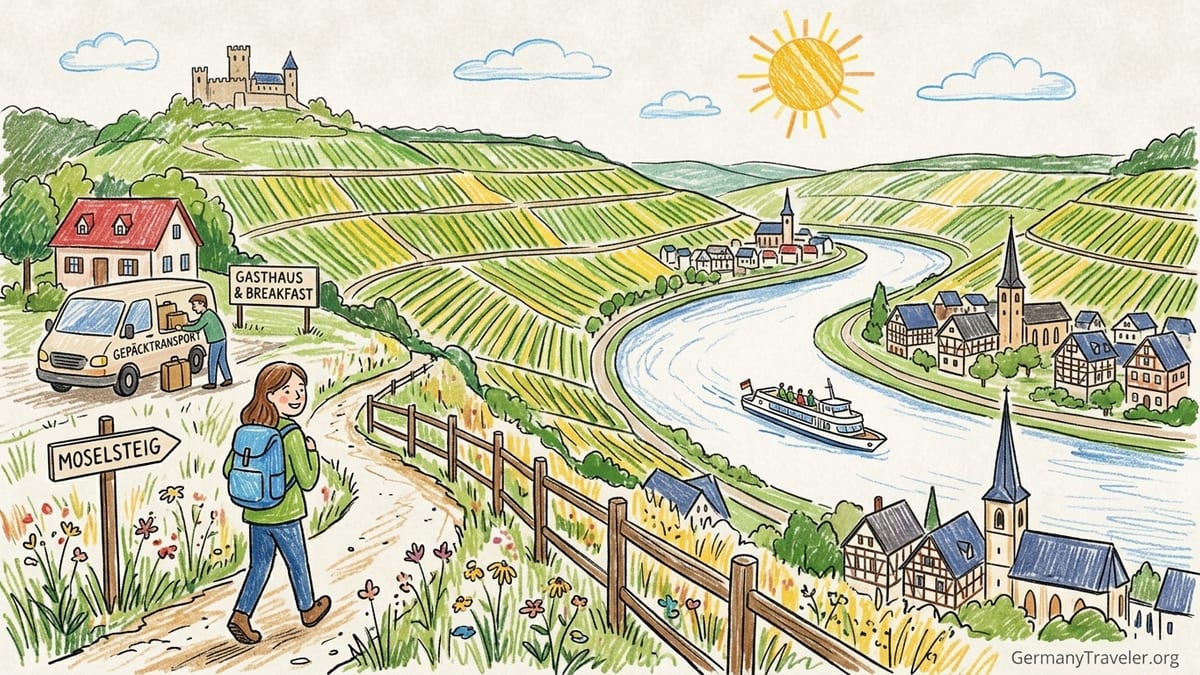
The Moselsteig is a waymarked long-distance trail that follows the Moselle River from Perl near the Luxembourg border to Koblenz, passing through Trier, Bernkastel-Kues, Zell, Cochem and many smaller villages along the way. Rather than organizing each night and transfer yourself, regional tourism boards and specialist tour operators bundle selected stages into multi-day walking holidays. Typical packages on the core Moselsteig sections between Trier and Koblenz include hotel or guesthouse stays, breakfast, printed or digital route descriptions, and the option to add luggage transfer so you only carry a daypack.
As of the 2026 season, official and partner packages on the Moselsteig between Trier and Koblenz commonly span four to eight nights and are priced roughly from the mid-600s to just over 800 euros per person in a double room, depending on standard, season and extras. For example, a seven-night Trier to Bernkastel-Kues package marketed via the Visit Mosel network includes multiple overnight stops in riverside wine villages and can be combined with a flat-rate luggage transfer supplement in the main hiking season from April to October. Another package from Cochem to Koblenz offered through regional tourism channels similarly includes seven nights with breakfast in Cochem, Treis-Karden, Löf, Kobern-Gondorf and Koblenz, with a luggage transfer surcharge available in the same seasonal window.
Within this price range, the inclusions are practical rather than luxurious. Expect small family-run hotels or guesthouses with private bathroom, breakfast buffets featuring German breads, cheeses and cold cuts, and concise but serviceable route materials. Many operators supply a compact information package per room with stage descriptions, map extracts and luggage tags rather than full guidebooks. On some arrangements, particularly those promoted by tourist offices in Bernkastel-Kues or Zell, you may also find extras like a winery tasting, a picnic pack, or a short river cruise between nearby towns.
Because the Moselle Valley is well-connected by local train and bus, walking holidays here are also forgiving if you need shortcuts or contingencies. Packages often include or suggest a return transfer to your starting point by minibus or scheduled boat at the end of the trip. In the Bernkastel-Kues area, for instance, official offers mention organized return transfers to Trier or Zell at fixed morning departure times, while separate boat operators publish 2026 fares for segments such as Trier to Bernkastel, Bernkastel to Cochem or Cochem to Koblenz that hikers can combine with their arrangements.
Choosing Your Section: Trier, Bernkastel, Zell, Cochem or Koblenz
When booking a Moselsteig package you rarely buy the entire 365-kilometer trail. Most hikers select a scenic subsection that balances river views, vineyards and historical towns with a realistic number of walking days. The classic segments for packaged holidays link Trier with Bernkastel-Kues, Bernkastel-Kues with Zell, Zell with Cochem and Cochem with Koblenz. Each stretch has its own flavor and level of challenge, so your choice should reflect both fitness and travel interests.
The Trier to Bernkastel-Kues section appeals to first-time visitors who want a blend of Roman history and progressively more dramatic river scenery. Starting in Germany’s oldest city, you can tour the Porta Nigra and Roman baths before stepping onto hillside paths above the Moselle. The valley here is still broad and pastoral, with vineyard slopes around places like Mehring, Leiwen and Neumagen-Dhron. This makes it a good option for travelers who favor cultural sightseeing and gentler walking over severe climbs, while still enjoying panoramic viewpoints across the river loops.
Bernkastel-Kues to Zell increases the sense of being in a pure wine landscape. Bernkastel-Kues is one of the Moselle’s postcard towns, with half-timbered squares, praised wine shops and estates such as Dr. Loosen and Markus Molitor in the nearby villages. Heading downstream, the Moselsteig traverses terraced slopes and forest ridges above steep vineyards that have produced Riesling for centuries. Zell itself is a compact town dominated by the “Zeller Schwarze Katz” vineyard hillside and serves as an excellent base for wine tastings or an extra rest day on the river.
Farther downstream, Zell to Cochem and Cochem to Koblenz bring you into the tightest loops and steepest slopes of the Lower Moselle. Here, rugged cliffs, castles and the famous Calmont vineyards define the scenery. Packages that focus on these sections typically market themselves to hikers who want more elevation gain and are comfortable on narrower hillside paths. Cochem’s Reichsburg castle, the slate-clad villages like Beilstein and the approach to Koblenz near the Deutsches Eck, where Moselle meets Rhine, make these later sections ideal for travelers who like a strong finale of castles and river confluence views.
Trier to Bernkastel-Kues: Gentle Start Through Wine Country
Packaged holidays from Trier to Bernkastel-Kues usually group Moselsteig stages 5 to 10 into a six to eight night itinerary. A typical arrangement, promoted via Bernkastel-Kues tourism partners, might offer eight nights with breakfast in a chain of riverside villages: starting in Trier, then continuing via Schweich or Longuich, Mehring, Leiwen, Neumagen-Dhron, and one or two nights in Bernkastel-Kues. The walking days often range between roughly 15 and 22 kilometers, with moderate ascents that rarely feel alpine but can still surprise travelers unused to hillside trails.
This section is well-suited to walkers who value cultural context as much as trail mileage. You can spend a pre-hike night in Trier exploring landmarks such as the Roman amphitheater and cathedral before following the Moselsteig out of the city into vine-covered hills. Along the way, traditional wine villages like Mehring or Leiwen offer Straußwirtschaft taverns and riverside promenades, giving an immediate sense of Moselle wine culture. Some legacy offers have combined this hiking section with a three-course dinner or wine museum visit in Bernkastel-Kues, and while packages evolve over time, it remains realistic to expect at least one organized tasting or wine-related activity during a multi-night stay.
Inclusions on current Trier to Bernkastel-Kues packages typically focus on logistics rather than full-board catering. Most offers list overnight stays in small hotels or guesthouses with breakfast, route materials and sometimes a return transfer from Bernkastel-Kues back to Trier at the end of the trip. Luggage transfer is frequently available either included or as a bookable extra, especially in the hiking season from early April to late October. That means you can walk with only water, snacks and a rain jacket while a transporter moves your suitcase, often limited to around 20 kilograms, between accommodations each day.
Difficulty-wise, this stretch is moderate: you will encounter repeated climbs and descents as the Moselsteig regularly leaves the riverside to gain panoramic ridges, but the terrain is generally well-graded and signposted. It is an excellent first long-distance walk for travelers comfortable hiking up to six hours a day who want a soft landing into German walking culture. If you already know you prefer steady vineyard ambles to rocky paths, this is the section to prioritize when comparing packages around the 600 to 800 euro mark.
Bernkastel-Kues to Zell: Classic Vineyard Ridges and Wine Villages
Between Bernkastel-Kues and Zell, the Moselsteig carves through some of the valley’s most celebrated wine terraces and small-scale villages. Packaged hiking holidays often market this stretch as Moselsteig stages 11 to 14, with four to six overnight stays. An example offered by local partners in Bernkastel-Kues includes several hiking days on the trail, overnight stays with breakfast in towns such as Bernkastel-Kues, Traben-Trarbach or Reil, and Zell, plus route information and the option of a luggage transfer. Some versions also build in a return transfer by minibus from Zell back to Bernkastel-Kues, making logistics easy for travelers arriving by train or rental car.
This segment is ideal if your main interest is wine and atmospheric small towns rather than big-city sightseeing. Bernkastel-Kues itself offers cobbled alleys and a dense concentration of wine bars, where you can taste Riesling from prestigious estates located in neighboring villages. Heading downstream, the path passes through or above communities like Zeltingen, Ürzig or Reil, each with their own steep slopes and family wineries. An example package in the broader region advertises four nights with breakfast and three hiking stages that connect villages such as Reil, Zell, Neef and Ediger-Eller, complete with luggage transfer and even a picnic pack, illustrating how focused and wine-centric these itineraries can become.
From a difficulty perspective, Bernkastel-Kues to Zell steps up the challenge compared with the Trier region. The Moselsteig frequently climbs to ridge paths with exposed views over tight river loops, which involves steeper ascents and more sustained descents. Paths remain well-marked and mostly non-technical, but hikers should be comfortable with several hundred meters of elevation gain per day. Fit walkers will appreciate the variety: one morning you might contour along forest paths above vineyard walls, the next you could drop into a side valley village for lunch and then tackle a short, sharp climb back onto the ridge.
For many travelers, this section offers the best balance between demanding scenery and indulgent comforts in town. Because the villages are compact, you can finish a five- or six-hour walk, check into your guesthouse and be tasting single-vineyard Riesling flights within minutes. Packages in this zone often fall in the same broad price band of roughly the high 600s to low 800s euro per person when luggage transfer is added, but can vary with hotel category and extras such as organized tastings or boat trips between neighboring wine towns.
Zell to Cochem: Steeper Slopes and Riverscapes
Zell to Cochem is where the Moselsteig emphasizes rugged scenery and the drama of the valley’s steepest vineyards. This stretch includes highlights such as the Calmont area near Bremm, often cited as one of Europe’s steepest cultivated vineyard slopes, and a string of slate-housed river villages. Official tourism packages focusing on the Zell region advertise three-stage hiking offers that include several overnight stays with breakfast in places such as Reil, Zell, Neef and Ediger-Eller, combined with luggage transfer for each hiking day. These arrangements are usually shorter, often four nights, and can be a good fit if you have limited time but want the Moselle’s most iconic vistas.
Further downstream, regional sales guides list dedicated hiking packages from Zell to Cochem that bundle around six nights of accommodation, breakfast and at least one boat trip. One example outlines an arrangement where hikers complete stages between Zell and Cochem while enjoying a round-trip boat excursion from Cochem to Treis-Karden during the boating season. Inclusions typically mirror other Moselsteig offers: luggage transfer between overnight stops, a compact map and information pack, and occasional extras such as entrance discounts or tasting vouchers arranged through local partners.
The walking itself becomes more demanding here than around Trier or Bernkastel-Kues. Expect steeper hillside traverses, longer climbs and some narrow paths, especially in side sections that flirt with the famous Calmont Klettersteig area, even if most standard packages avoid true via ferrata terrain. Hikers should be steady on their feet and comfortable with heights, as viewpoints often sit directly above dramatic valley drops. On the plus side, the daily stage lengths often remain manageable, and there are frequent opportunities to shorten a day using local trains or boats if fatigue or weather intervene.
Village life on this section is low-key and authentic. Zell, with its “Black Cat” wine branding, offers a compact riverside promenade and several tasting rooms; Neef and Ediger-Eller feel more like quiet winegrowers’ communities, while Cochem introduces a stronger tourist infrastructure with more hotels, restaurants and souvenir shops beneath its hilltop Reichsburg castle. If you want your hiking holiday to shift from under-the-radar wine villages into a slightly livelier small-town setting by the final night, choosing a Zell to Cochem package with Cochem as your endpoint can be a smart move.
Cochem to Koblenz: Castles, Confluence and Grand Finale
The final stretch from Cochem to Koblenz brings the Moselsteig to its conclusion at the Deutsches Eck, where the Moselle meets the Rhine under a monumental equestrian statue. Packaged walking holidays on this section often last six to seven nights, linking overnights in Cochem, Treis-Karden, Löf, Kobern-Gondorf and Koblenz. A current regional offer outlines seven nights with breakfast in these towns, with a seasonal flat-rate surcharge available to add luggage transfer between all accommodations from early April through late October of the 2026 hiking season.
This section is particularly attractive to travelers seeking castles and river panoramas. In Cochem, many hikers dedicate an extra half-day to visiting Reichsburg castle, which crowns the town and offers sweeping views over the river valley. Downstream, Treis-Karden serves as a gateway to Burg Eltz, one of Germany’s most photogenic castles, which can be reached via connecting paths and local buses. Approaching Koblenz, the Moselsteig alternates between quiet hillside stretches and riverside approaches, culminating in the urban riverfront at the Deutsches Eck, where walkers can watch excursion boats lining up along the confluence.
Compared to the vineyard heartland between Bernkastel-Kues and Zell, this lower section of the Moselle feels more varied in land use, with forested heights, rock outcrops and a shorter but still significant presence of terraced vines. Difficulty is moderate to challenging depending on how stages are split; sustained climbs out of side valleys and descents to river towns are common, but most standard packages keep stage distances reasonable for fit walkers used to five to seven hours on trail. About half the overnights take place in villages like Treis-Karden or Kobern-Gondorf, giving a quieter contrast to the busier city of Koblenz at journey’s end.
Many walkers combine this section with additional activities on the Rhine. Some tour operators that cover both rivers offer extended itineraries where luggage transfer continues from Koblenz into the Rhine Valley, including boat trips to famous viewpoints such as the Loreley rock. Even if your package technically ends in Koblenz, it is easy to add a separate Rhine day cruise or a short hiking extension, making Cochem to Koblenz a strategic choice if you want to connect two of Germany’s classic river regions in one holiday.
What Your Money Buys: Inclusions, Luggage Transfer and Extras
Across the Moselsteig, walking holiday packages are designed to remove logistical friction rather than provide luxury pampering. The core inclusions are consistent: several nights in small hotels or guesthouses with breakfast, luggage transport between accommodations on hiking days, and concise route information. Within this framework, price differences often reflect hotel category, single room supplements and seasonal demand rather than radical changes in what is included. For example, a six-day Bernkastel-Kues to Reil arrangement promoted in the Dutch market lists basic hotels, breakfast, route information via an app and optional return transfer for around the mid-600 euro range per person, which is comparable to German-language offers on neighboring sections once luggage transfer is added.
Luggage transfer is arguably the defining extra that turns a Moselsteig walk into a true holiday. Most official and partner offers specify one suitcase per person with a maximum weight of about 20 kilograms, collected from your hotel reception each morning and waiting at the next property by late afternoon. There is usually a clear seasonal window for this service, such as 1 April to 31 October for some Trier to Bernkastel-Kues or Cochem to Koblenz packages. If you travel in shoulder months, you may find that basic accommodation arrangements are available year-round, while luggage transfer operates only within this main season.
Beyond the essentials, extras vary by region and organizer. In the middle Moselle around Bernkastel-Kues and Zell, packages occasionally include a formal wine tasting at a cooperating winery, where you might sample several Rieslings and receive a brief cellar tour. In the Zell region, some short packages highlight a picnic pack provided once per room. Farther downstream, hiking holidays in the broader Moselle area may bundle a boat ride, such as a scheduled cruise between Beilstein and Cochem or a round trip from Cochem to Treis-Karden, into the itinerary. None of these are guaranteed across all offers, so it is worth reading the exact inclusions carefully when comparing prices within the 627 to 815 euro range.
Most packages assume you will arrange your own dinners, which is usually a pleasure rather than a burden on the Moselle. Towns like Bernkastel-Kues, Traben-Trarbach, Zell and Cochem offer numerous wine taverns, Weinstuben and small restaurants where you can dine on local dishes like Flammkuchen, hearty stews or river fish. Breakfasts are typically served buffet-style at your accommodation, and while lavish spreads exist in higher-end houses, even modest guesthouses tend to provide enough variety for a walking day: fresh rolls, boiled eggs, yogurts, sliced meats and cheeses, and fruit.
Matching Sections to Your Fitness and Interests
Because the Moselsteig repeatedly climbs from river level to panoramic ridges, any section will include hills. However, the character of those climbs and the surrounding atmosphere differs enough that your choice can materially influence how your holiday feels. Travelers seeking the mildest introduction to Moselle walking, or who walk more slowly, might favor Trier to Bernkastel-Kues. Here, while the trail still ascends, the valley is wider and the inclines feel more gradual. It is easier to shorten days using buses or trains between river towns, and you can spend off-trail time exploring Trier’s museums and Bernkastel-Kues’s historic center.
If vineyards and wine tastings are your primary interest, the Bernkastel-Kues to Zell or Zell to Cochem sections are particularly rewarding. You will be surrounded by slopes bearing the names of famous single vineyards, pass tasting rooms and cellar doors, and often stay in villages where the majority of residents are connected to wine growing. When comparing packages, look out for those that include at least one formal tasting or provide specific recommendations for partner wineries, especially if you are traveling in harvest season and want to secure appointments at popular estates.
Travelers who prioritize castles, rugged river scenery and a clear sense of journey’s end usually gravitate toward Cochem to Koblenz. This section strings together Reichsburg Cochem, access options for Burg Eltz, and the final approach to the Rhine confluence. The walking is slightly more demanding than around Trier, but you are rewarded with dramatic views and a satisfying last-day finish at the Deutsches Eck. If you have already visited the Rhine on a separate trip, you could instead opt for a Zell to Cochem package that concentrates on the steepest Moselle vineyards and then add an independent boat or train ride from Cochem to Koblenz.
When choosing between similar-priced offers, consider two practical filters beyond scenery: nightly check-in and transfer logistics. Some packages start and end in cities with better long-distance train connections, such as Trier and Koblenz, making them easier to slot into a wider European itinerary. Others include fixed-time return transfers from end towns like Zell or Bernkastel-Kues back to the starting point. If you are flying home the next morning, the certainty of a scheduled minibus transfer or clear boat timetable can be worth as much as a free tasting when it comes to peace of mind.
The Takeaway
A Moselsteig walking holiday between Trier and Koblenz is not just a series of day hikes; it is a curated experience that blends Roman heritage, terraced vineyards, small wine towns and castle silhouettes into a single river narrative. Packaged sections such as Trier to Bernkastel-Kues, Bernkastel-Kues to Zell, Zell to Cochem and Cochem to Koblenz allow you to step into that story with mornings on panoramic paths and afternoons in half-timbered villages, while your luggage quietly follows by van.
With official and partner packages for the 2026 season typically ranging from around 627 to a little over 800 euros per person for multi-day sections, these holidays target travelers with genuine intent to book, not casual day trippers. In return for that investment, you receive pre-selected accommodations, daily breakfasts, route materials and luggage transfer, plus occasional extras such as winery tastings or boat trips. The real luxury, however, is intangible: the freedom to focus on the rhythm of walking, watching the river loops and vineyards unfold without worrying about where you will sleep or how your suitcase will reach the next town.
Whether you choose the gentler hills between Trier and Bernkastel-Kues, the vineyard ridges around Bernkastel-Kues and Zell, the steep slopes and river drama near Cochem, or the castle and confluence finale into Koblenz, the Moselsteig offers a section to match most levels of fitness and appetite for wine. Look closely at daily distances, elevation, included extras and transfer options, then select the package that aligns with your interests. With those pieces in place, your Moselsteig walking holiday can become less about logistics and more about savoring Riesling, viewpoints and the slow pace of a great European river.
FAQ
Q1. How many days do I need for a Moselsteig walking holiday between Trier and Koblenz?
Most packaged Moselsteig holidays between Trier and Koblenz last between four and eight nights, depending on the section. A Trier to Bernkastel-Kues itinerary commonly runs six to eight nights, Bernkastel-Kues to Zell or Zell to Cochem often take four to six nights, and Cochem to Koblenz packages are usually six to seven nights. If you want to link two segments, plan on 10 to 12 days of walking plus travel days.
Q2. What level of fitness is required for Moselsteig sections like Zell to Cochem or Cochem to Koblenz?
The Moselsteig includes frequent climbs from river level to ridge paths, especially between Zell and Cochem and toward Koblenz. While the paths are well-marked and generally non-technical, hikers should be comfortable walking five to seven hours a day with several hundred meters of ascent and descent. If you are used to moderate day hikes in hilly terrain, you should manage these sections, but travelers who prefer gentler walking might favor Trier to Bernkastel-Kues.
Q3. What does a typical Moselsteig package include in terms of accommodation and meals?
Most packages include overnight stays in small hotels or guesthouses with private bathrooms, plus daily breakfast. Dinners are usually not included, which allows you to explore local wine taverns and restaurants in towns like Bernkastel-Kues, Zell and Cochem. Some higher-end offers may include one or two set dinners or tastings, but the standard expectation is bed and breakfast with ample freedom for evening meals.
Q4. How does luggage transfer work on Moselsteig walking holidays?
Luggage transfer is typically offered as an included service or optional surcharge during the main hiking season, often from early April to late October. You leave your suitcase, usually limited to around 20 kilograms, at hotel reception each morning with provided tags; a transport service collects all bags and delivers them to the next accommodation, where they are available by late afternoon. You then walk with a light daypack carrying water, snacks and layers.
Q5. Are wine tastings or boat trips usually part of Moselsteig packages?
Some, but not all, Moselsteig packages include wine-related experiences or river cruises. Around Bernkastel-Kues and Zell it is common to see offers that feature a winery tasting or a picnic pack, while in the Zell to Cochem zone or broader Moselle region certain packages include a short boat trip, such as a cruise from Cochem to Treis-Karden. Always check the exact inclusions, as many base packages focus on hotels, breakfast and luggage transfer, with tastings and cruises available at additional cost.
Q6. When is the best time of year to book a Moselsteig walking holiday?
The main walking season runs from April to October, which is also when luggage transfer services and regular boat schedules operate. April and May offer fresh green vineyards and cooler temperatures; June through August bring longer days and warmer weather; September and early October coincide with harvest, making them especially appealing for wine enthusiasts but also busier. Winter walking is possible on parts of the trail but packaged holidays and luggage transfers are more limited outside the main season.
Q7. How do I reach the start and end points like Trier, Zell, Cochem or Koblenz by public transport?
The Moselle Valley enjoys good rail and bus connections. Trier and Koblenz are both linked to Germany’s long-distance rail network, while intermediate towns such as Wittlich, Bullay, Cochem and Kobern-Gondorf sit on the regional Moselle railway between Trier and Koblenz. Buses and occasional boats connect smaller villages to these hubs. Many packages also offer return transfers by minibus from end towns like Zell or Bernkastel-Kues back to the starting point to simplify departure logistics.
Q8. Can I book only part of a published Moselsteig package or customize the stages?
Some tour operators and regional tourism offices are flexible and allow you to add rest days, upgrade certain hotels or adjust start dates, but they may be less willing to split very short sections into smaller pieces. It is generally possible to request extra nights in hubs like Trier, Bernkastel-Kues, Zell, Cochem or Koblenz. If you want a highly customized itinerary, a specialist walking tour company may be a better fit than a fixed tourist board package.
Q9. Are Moselsteig packages suitable for solo travelers?
Yes, solo travelers regularly book Moselsteig walking holidays, but should budget for single room supplements, which can significantly raise the per-person price relative to couples. Luggage transfer services generally accept solo bookings, and staying in small guesthouses along the river makes it easy to meet other hikers or locals in the evenings. If you prefer company on the trail, look for fixed-date group departures offered by some hiking tour operators.
Q10. How far in advance should I book a Moselsteig walking holiday for 2026?
For trips in the core months of May, June, September and early October 2026, it is wise to book several months in advance, especially if you want specific hotel standards or room types in popular towns like Bernkastel-Kues or Cochem. Some regional offers indicate that full payment is required a few weeks before departure, and late-booking requests are accepted only if room and luggage transfer capacities remain. Booking early increases your chances of securing the exact section, dates and inclusions you prefer.