


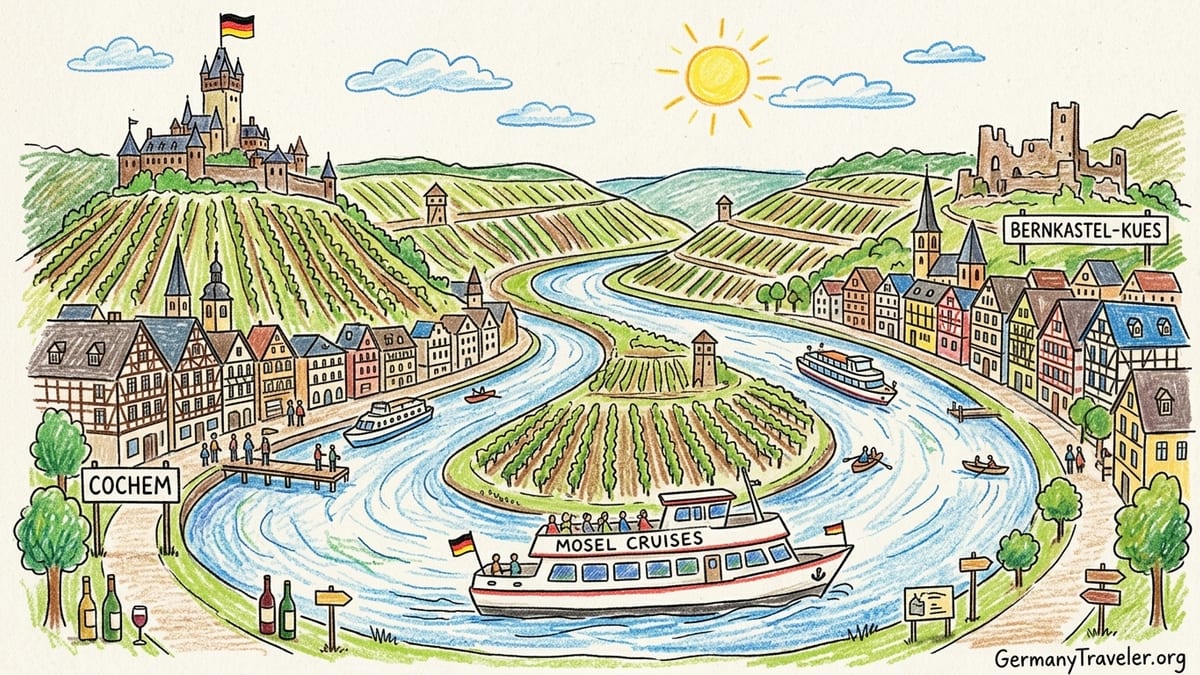
The Moselle between Cochem and Bernkastel-Kues is one of Germany’s most scenic river stretches, a slow, looping valley of vineyards, half-timbered wine villages and hilltop castles. In 2026, an expanded network of local sightseeing boats, one-way cruises and wine-focused excursions makes it easier than ever to explore this region by water, then return by train or bus. This guide compares the main options and helps you decide which Moselle cruise best fits your time, budget and appetite for wine and scenery.
How Moselle river cruising works around Cochem and Bernkastel-Kues
Between Koblenz and Trier, the Moselle curves through dozens of tight bends, with small passenger boats shuttling between riverside towns from roughly April to late October. Around Cochem and Bernkastel-Kues you will find two main types of cruises in 2026: short round-trip sightseeing cruises that depart several times a day from the main town piers, and longer point-to-point journeys that function almost like scenic public transport between wine villages.
The local market is dominated by regional companies such as Personenschifffahrt Gebr. Kolb and Moselrundfahrten, plus Köln-Düsseldorfer (KD), which runs branded one-hour panorama cruises from Cochem using its excursion vessels. A typical sightseeing cruise lasts 50 to 60 minutes and focuses on views of the town, surrounding vineyards and the next river bend, often with multilingual commentary about local history and wine culture.
Longer cruises connect places like Cochem, Beilstein, Treis-Karden and Zell, or on the Middle Moselle, Bernkastel-Kues with Traben-Trarbach, Zeltingen-Rachtig and the monastery at Kloster Machern. Many itineraries can be combined with regional trains or buses along the parallel Moselle railway line, allowing you to cruise one way and return on land without retracing your route on the water.
For visitors, the main decisions are how much time to spend on the boat, whether you prefer a loop cruise or a one-way journey, and how important it is to include wine tastings or castle visits ashore. The following sections break down current 2025 and 2026 timetables and show how to turn them into easy day trips.
Short sightseeing cruises from Cochem
Cochem is the busiest Moselle cruise hub between Koblenz and Trier, and its compact old town, crowned by Reichsburg castle, makes a dramatic backdrop for short boat trips. In the 2026 KD timetable, Cochem features a dedicated “Panorama Cruise” lasting about one hour, running Tuesday to Sunday from late March to mid-October with up to six departures a day at roughly 10:30, 12:00, 13:30, 15:00, 16:30 and 18:00. Adult tickets are around the mid-teens in euros, with reduced fares for children.
These panorama cruises depart from the main KD pier on the riverside promenade, a few minutes’ walk from Cochem railway station. You sail past the old Moselle bridge, below the castle and then along vineyard slopes in both directions, usually without passing through a lock. Commentary points out landmarks like the Bundesbank bunker and nearby wine-growing sites, but the main attraction is the constantly shifting angle on the town and its steep hillsides.
Alongside KD, local operators run “Moselrundfahrt” round-trip cruises of 50 to 60 minutes from a neighboring jetty on the same promenade. Schedules in 2025 show departures roughly every hour during the main season, often starting late morning and running into late afternoon. Tickets are typically sold from a kiosk at the riverside; you simply walk up, choose the next available sailing and board. For most visitors with only a few hours in town, one of these short loops provides an easy, low-stress introduction to Moselle cruising.
If you want to connect sightseeing with a bit more movement along the river, look for Cochem-based trips branded as “Schleusenfahrt” cruises, which continue downriver to the nearest lock before turning around. These usually take 2 to 2.5 hours and show you a less built-up stretch of countryside, but they still start and finish at the same pier, making logistics straightforward for day trippers.
From Cochem to wine villages: Beilstein, Treis-Karden and Zell
To experience the Moselle as a slow journey through wine country rather than a simple loop, consider a point-to-point cruise from Cochem. Personenschifffahrt Gebr. Kolb operates regular services between Cochem and Beilstein with ships such as the Treis-Karden and Maria von Beilstein. Seasonal schedules in recent years have offered several daily departures from around April to late October, with one-way travel times of about 1.5 hours along a particularly picturesque bend known for its steep vineyards and the half-timbered village of Beilstein.
Beilstein is often nicknamed the “Sleeping Beauty of the Moselle,” a compact cluster of slate-roofed houses beneath the ruins of Metternich Castle. Arriving by boat feels almost theatrical as the village gradually reveals itself around a bend. A practical itinerary in 2026 might see you boarding a morning boat from Cochem, arriving in Beilstein around lunchtime, exploring the narrow lanes and castle view, then either cruising back mid-afternoon or catching a bus or taxi onward to another village.
Farther afield, Kolb runs longer “Schleusenfahrt” and day-trip services connecting Cochem with Treis-Karden and occasionally Zell, passing through one of the Moselle locks en route. These journeys can last 3 to 5 hours one way, depending on stops and waiting times at locks. Because the Moselle is a working river, lock passages are not guaranteed to be swift, but they are fascinating to watch. For travelers who enjoy engineering and do not mind a slower pace, these cruises offer an in-depth look at everyday river traffic, from cargo barges to other excursion boats.
When using these services as transport rather than just an excursion, check return options carefully. From Treis-Karden, for instance, the parallel Moselle railway line offers frequent trains back to Cochem and Koblenz in well under an hour, often faster than the boat took to get there. This makes a boat-out, train-back itinerary especially appealing, giving you maximum river time without repeating the same scenery.
Sightseeing and wine cruises from Bernkastel-Kues
Bernkastel-Kues sits on a broad, photogenic bend of the Middle Moselle, ringed by vineyards with the ruins of Burg Landshut on the hill above. It is a major base for Mosel Personenschifffahrt, whose day boat Bernkastel operates a variety of 2025 and 2026 cruises. Timetable leaflets for Bernkastel-Kues show short round trips of about an hour, similar to Cochem’s tours, departing several times daily in season from the town quay on the Bernkastel side.
These short cruises usually head either upriver toward Graach and the famous Doctor vineyard or downriver past the wine estates of Wehlen and Zeltingen-Rachtig. Onboard commentary tends to highlight the region’s Riesling tradition and steep-slope viticulture, pointing out individual vineyard names visible on the hillsides. Prices are comparable to Cochem’s one-hour cruises, often in the low to mid-teens in euros for adults, making them accessible add-ons to a day of strolling and wine tasting in town.
Beyond the basic loops, Bernkastel-Kues offers themed evening cruises such as “Panoramaabendfahrt” sailings on summer Saturdays, sometimes with music or DJ entertainment. These depart around dusk and let you watch the vineyards shift from late-afternoon gold to night-time silhouettes, with the town lights reflecting on the river. Because most evening cruises are round trips, you return to the same pier and can easily walk back to local hotels or wine taverns without worrying about onward transport.
Another popular product is the combined cruise and shore stop at Kloster Machern, a former monastery and winery downstream from Bernkastel-Kues. Timetables list departures with intermediate stops where passengers can disembark at the monastery, visit its wine shop or beer garden and reboard a later boat. This effectively creates a hop-on, hop-off experience focused on food and drink, ideal for those who want a relaxed day anchored around a single scenic place.
One-way journeys between Bernkastel-Kues and other wine towns
While short loop cruises are easy to fit into any itinerary, the Middle Moselle from Bernkastel-Kues truly shines on longer one-way journeys between towns. Traditional day trips link Bernkastel-Kues with Traben-Trarbach or Zell, usually taking several hours and passing a string of small villages and vineyard slopes. Some 2026 regional timetables mention a “Mittelmosel-Fahrt” connecting these towns, although specific start dates can shift from year to year and certain routes have occasionally been postponed or altered.
One classic route runs from Bernkastel-Kues downstream to Traben-Trarbach, an Art Nouveau spa town with a distinctive bridge and hillside castle ruins. Depending on stops and lock timings, the journey can occupy most of a morning or afternoon, leaving enough time ashore for a stroll and a glass of wine before you return by bus. The landscapes along this stretch are quintessential Moselle, with steep vineyard terraces, isolated farmhouses and occasional campsites and small marinas.
Another attractive segment links Bernkastel-Kues with Zeltingen-Rachtig and Kröv, both well-known wine villages. Boats often call at smaller piers such as Wehlen, home to the Wehlener Sonnenuhr vineyard. These stops allow you to hop off in a quiet village, enjoy a tasting at a family-run winery and then continue by land. When planning, it is wise to treat the boat as your scenic highlight and the train or bus as your efficient return leg rather than expecting frequent boat departures in both directions.
For more immersive experiences, some river cruise lines that operate multi-day itineraries on the Rhine and Moselle feature port calls in both Cochem and Bernkastel-Kues. Companies such as Amadeus and others schedule walking tours, castle visits and wine tastings during half-day stops, using the towns as gateways to the surrounding valley. While these larger ships follow fixed itineraries, studying their schedules can inspire do-it-yourself day trips using local boats and public transport between the same highlights.
Scenery, locks and choosing between boat-only and boat-plus-train
Scenically, the section between Cochem and Beilstein is among the most dramatic on the Lower Moselle, with steep, almost amphitheater-like vine slopes and the fairytale profile of Beilstein itself. Between Bernkastel-Kues and Traben-Trarbach, the valley widens slightly but remains deeply carved, with sweeping views of terraced vineyards and hilltop ruins. The quality of light can be striking, especially in late afternoon or early evening when the sun catches the slate soils and rows of vines.
Locks play a key role in shaping your experience. Short sightseeing loops from Cochem or Bernkastel-Kues typically avoid locks, keeping trips to about one hour and eliminating potential delays. Longer “Schleusenfahrt” cruises deliberately include at least one lock passage, often adding 30 to 60 minutes to the journey. Watching a large excursion boat rise or fall alongside a cargo barge can be a highlight for many travelers, but if your time is tight or you dislike waiting, a non-lock cruise may be more comfortable.
When comparing a round-trip boat excursion with a one-way cruise plus train or bus, consider both scenery and schedule. A Cochem to Beilstein round trip maximizes time on the water but repeats the same views in both directions and commits you to the boat’s timetable. By contrast, a Cochem to Beilstein boat combined with a bus or taxi back offers more flexibility to linger in the village, though at the cost of less river time. On the Middle Moselle, a Bernkastel-Kues to Traben-Trarbach boat followed by a bus or taxi return is often more efficient than waiting for a late-day return cruise.
In practice, boat-plus-train works best when the rail line runs close to the river and stations are near the piers, as around Cochem and Treis-Karden. Regional tickets from the Rhineland-Palatinate transport network can make these combinations good value, especially if you are traveling as a couple or family. Study current boat timetables for your travel dates, then look up rail and bus connections on the same day to ensure comfortable transfer times.
Planning, booking and seasonal timing in 2026
Most local Moselle cruises from Cochem and Bernkastel-Kues operate from roughly April to late October, with the heaviest schedules from May through September. KD’s 2026 panorama cruises in Cochem begin in late March and run into mid-October, while Moselrundfahrten and other local operators often start their main timetables in late April or early May. In shoulder months like April and October, expect fewer departures per day and be prepared for cooler conditions on deck.
Booking practices vary by operator. For short one-hour sightseeing cruises, it is usually sufficient to buy tickets at the riverside kiosk 15 to 30 minutes before departure, even in peak season, though weekend afternoons in July and August can be busier. For longer day trips such as Cochem to Beilstein or Bernkastel-Kues to Traben-Trarbach, checking schedules a few weeks in advance and reserving if possible is sensible, especially if you are traveling in a group or want to combine the cruise with a pre-booked winery visit.
Weather on the Moselle can be changeable. On hot summer days, upper decks fill quickly, offering shade under awnings and unbroken views of the valley, while in spring or autumn, lower indoor saloons with large windows become more attractive. Light layers, sun protection and a windproof jacket are useful, particularly on early morning or evening departures when temperatures can feel cooler on the water than in town.
Prices for local cruises tend to be moderate compared with multi-day river cruises. As of recent seasons, expect a one-hour sightseeing cruise from Cochem or Bernkastel-Kues to cost in the low to mid-teens in euros for adults, with family discounts and special offers occasionally available. Longer half-day or full-day cruises are priced accordingly higher but can still represent good value when you treat them as both transport and entertainment, especially on routes that replace a more expensive taxi ride between small villages.
The Takeaway
For many travelers, the best way to experience the Moselle between Cochem and Bernkastel-Kues is to combine a short sightseeing loop with at least one longer one-way cruise through wine country. Start with a one-hour panorama trip from Cochem or Bernkastel-Kues to get your bearings and enjoy the classic town-and-castle views. Then, if time allows, choose a more extended journey like Cochem to Beilstein or Bernkastel-Kues to Traben-Trarbach, returning by train or bus to avoid retracing your steps and to keep logistics simple.
Boat-plus-train combinations work particularly well when you have a full day and are comfortable using regional public transport. Cruising one way and traveling back on land lets you maximize variety, pairing wide river vistas with close-up glimpses of vineyards and villages from the rail line. Those who prefer a slower, more contemplative pace might instead opt for a round-trip cruise that includes a lock passage, trading efficiency for the pleasure of drifting along one of Europe’s most atmospheric wine valleys.
However you structure your day, check 2026 timetables carefully, allow extra time for transfers and be flexible around weather conditions. Even a simple one-hour cruise can be a highlight of a Moselle trip, especially when followed by a glass of local Riesling at a riverside terrace. With thoughtful planning, the boats of Cochem and Bernkastel-Kues become more than just tourist attractions; they are threads that stitch together castles, vineyards and storybook villages into a memorable journey along the river.
FAQ
Q1. Do I need to book Moselle sightseeing cruises from Cochem in advance?
For the standard one-hour panorama and Moselrundfahrt cruises, buying tickets at the riverside kiosk shortly before departure is usually enough, though advance planning is wise for longer day trips.
Q2. Which Moselle cruise offers the best scenery, Cochem or Bernkastel-Kues?
Both are scenic, but Cochem to Beilstein is particularly dramatic with steep slopes and a fairytale village, while Bernkastel-Kues to Traben-Trarbach showcases classic Middle Moselle vineyards.
Q3. Are Moselle cruises suitable for children and families?
Yes, one-hour sightseeing cruises are very family-friendly, with safe decks, indoor seating and gentle motion; some operators offer reduced child fares and family tickets.
Q4. Can I combine a Moselle boat trip with a visit to a winery?
Yes, many travelers cruise one way between towns such as Bernkastel-Kues and Kloster Machern or Cochem and Beilstein, then visit a local winery or wine tavern before returning by boat or bus.
Q5. How do I get back if I take a one-way cruise to another town?
You can usually return by regional train or bus that runs along the Moselle valley, for example between Cochem and Treis-Karden or Bernkastel-Kues and Traben-Trarbach, often in less than an hour.
Q6. What is the best time of year to cruise the Moselle?
The main season runs from April to October; May, June and September typically offer a good balance of frequent departures, pleasant temperatures and fewer peak-summer crowds.
Q7. Will my Moselle cruise go through a lock?
Short sightseeing loops generally do not, while longer “Schleusenfahrt” and day cruises often include at least one lock passage; timetables and descriptions usually indicate this.
Q8. Are Moselle boats accessible for travelers with limited mobility?
Accessibility varies; many boats have ramps and level entry but may include steps to upper decks, so it is best to check specific operators in advance if you use a wheelchair or have mobility concerns.
Q9. What should I wear on a Moselle river cruise?
Dress in comfortable layers with a light jacket, as it can feel cooler on deck than in town; sun protection and flat, non-slip shoes are also recommended.
Q10. Can I bring luggage on local Moselle cruises?
Small bags and daypacks are generally fine, but if you plan to travel with larger luggage on a one-way cruise, contact the operator beforehand to confirm space and any restrictions.