


The Moselle Valley in western Germany folds its way between steep vineyards, medieval towns and storybook castles. It is compact enough to explore in a few days, but varied enough that choosing the right base can shape your entire trip. Booking platforms currently highlight Trier, Cochem and Bernkastel-Kues among the most popular accommodation hubs, yet smaller places like Beilstein or Traben-Trarbach and the junction city of Koblenz can suit very different styles of traveler. This guide compares the main bases on the German Mosel for hotels, restaurants, transport, cruises, wineries and day trips so you can match the valley to the kind of trip you want.
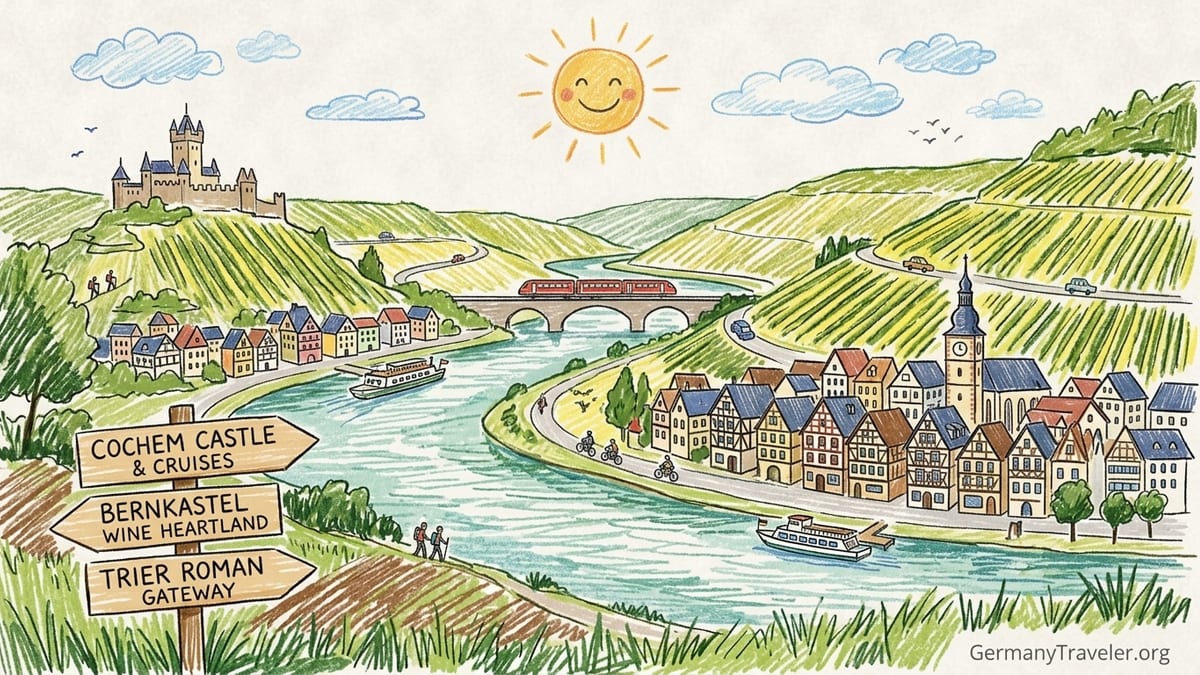
How to Choose Your Moselle Valley Base
Before diving into specific towns, it helps to be clear about what you want from your base. Do you picture yourself waking up under a castle, cycling between villages, tasting Riesling all afternoon, or using the Moselle as a hub for longer rail journeys to places like Luxembourg or the Rhine Gorge. For many visitors, especially on a first trip, it makes sense to select one or two bases and fan out on day trips by train, boat or car rather than changing hotels every night.
In practical terms, Trier works best if you value Roman history, big-city services and good rail connections. Cochem is the classic castle-and-cruises base with strong visitor infrastructure and easy access by train along the river. Bernkastel-Kues has a dense cluster of wine bars and half-timbered houses, making it ideal if wine and historic atmosphere are top priorities. Traben-Trarbach offers art nouveau architecture and serious wine culture in a quieter setting. Beilstein is a tiny, romantic village suited to a slow, mostly car-based stay, while Koblenz allows you to combine Moselle highlights with day trips along the Middle Rhine.
Most travelers split 3 to 5 nights between two contrasting bases, for example 2 nights in Cochem for castle views and boat trips, then 2 or 3 nights in Bernkastel-Kues or Trier for deeper wine exploration and broader day-trip options. Those relying on trains often favor Trier or Cochem; drivers have more flexibility and can comfortably choose smaller villages like Beilstein or riverside hamlets dotted with winery guesthouses.
Cochem: Castles, Cruises and Classic Mosel Scenery
Cochem is the Moselle valley as many visitors imagine it: a compact old town pressed between river and vineyards and crowned by Reichsburg Castle. The town has been a tourism center for decades, so it offers one of the broadest hotel inventories in the valley: everything from small family-run guesthouses and mid-range hotels along the riverfront to simple holiday apartments up the slope. You find pension-style doubles in shoulder season often starting in the lower three-digit euro range per night and river-view rooms in historic hotels edging higher in peak months.
Restaurants in Cochem skew toward traditional German and regional cooking, with plenty of terraces looking directly onto the Mosel. In a single evening you can have a plate of Riesling-flamed pork at a rustic Weinstube, then move a few doors down to a café for Federweißer and Zwiebelkuchen in autumn. The concentration of eateries means you can arrive without set reservations outside of high summer weekends and still find a decent riverside table. Supermarkets and bakeries in the center make it easy to put together picnic supplies for boat days or hikes up into the vineyards.
Transport is one of Cochem’s great strengths. The town lies on the main Mosel railway between Koblenz and Trier with hourly regional trains in each direction, so staying here without a car is straightforward. Boats connect Cochem upriver to Beilstein and downriver toward Treis-Karden and Koblenz in the main season, and larger cruise operators on multi-day itineraries often stop here too. Parking can be tight in the historic core, but there are designated riverfront car parks and larger lots just outside the center, where hotels often direct guests, sometimes for a modest daily fee.
As a base, Cochem easily supports 3 or 4 full days of varied excursions. You can tour Reichsburg Castle, then take a short train ride to the more dramatic Burg Eltz via Moselkern, hike the steep Calmont Klettersteig near Bremm, ride boats to Beilstein, or visit small villages like Ediger-Eller and Senheim with family wineries offering tastings. This mix of castles, vineyard walks and accessible boat trips is why Cochem consistently ranks among the most popular Mosel bases for first-time visitors.
Bernkastel-Kues: Wine Heartland and Half-Timbered Charm
Bernkastel-Kues sits roughly in the middle Mosel and is widely regarded as one of the most atmospheric towns in the valley. Its compact historic core is a tapestry of colorful half-timbered houses packed around the Marktplatz, with the ruins of Burg Landshut perched above. The wider Ferienland Bernkastel-Kues region includes surrounding wine villages and offers a substantial range of accommodation, from simple guesthouses and family-run hotels to spa-focused resorts in the hills. In town, you might stay at a bright, contemporary hotel a short walk from the bridge or in a small garni hotel tucked into a 17th-century house.
Wine is the main attraction. Many of the Mosel’s most recognizable estates maintain tasting rooms or outlets in and around Bernkastel-Kues, and you can spend entire days moving between Weinstuben, wine bars and specialty shops. In the evening, visitors crowd the outdoor tables of traditional restaurants serving Flammkuchen, trout and seasonal dishes matched with local Riesling. Prices for mid-range sit-down meals are typically comparable to other German small towns, but wine by the glass can be strikingly good value considering the quality.
Bernkastel-Kues does not sit directly on a main rail line, so access takes a little more planning. The nearest train stations with regular regional services are in Wittlich and Traben-Trarbach, with buses linking them to town; travel times from Trier or Koblenz usually involve at least one change. Because of this, Bernkastel-Kues works best either for travelers with a car or for those comfortable with regional buses whose timetables thin out in the late evening. On the other hand, river cruise boats and day-trip ships frequently call here in season, and smaller local operators offer short scenic cruises from the town pier.
In terms of day trips, Bernkastel-Kues is a superb base for exploring wine-focused villages like Graach, Wehlen, Zeltingen-Rachtig and Piesport, all surrounded by famous vineyard sites. Many estates accept visitors by prior appointment, and you can structure a full day around two or three tastings combined with an easy walk along the Moselsteig trail or the riverside cycle path. With a car, you can comfortably fill 3 to 5 days using Bernkastel-Kues as your hub, visiting Traben-Trarbach, the art nouveau villas of Bad Bertrich, or even looping south to the Saar wine region.
Traben-Trarbach: Art Nouveau, Wellness and Serious Wine
Straddling both banks of the Mosel, Traben-Trarbach has a quieter, slightly bohemian feel compared with Cochem or Bernkastel-Kues. Its Belle Époque prosperity from the wine trade left a legacy of art nouveau townhouses and warehouses, some of which are now boutique hotels and stylish guesthouses. You find design-forward riverfront properties with saunas and rooftop terraces alongside more traditional family-run hotels and Ferienwohnungen. For travelers seeking a base with character but fewer tour groups, Traben-Trarbach is an appealing choice.
The town has a deep connection to wine. Several well-regarded estates are based nearby, and the cellars and former wine warehouses host seasonal events such as underground Christmas markets. Many hotels offer wine-focused packages that combine tastings with spa access or guided walks through the vineyards. Dining options include cozy wine taverns on both sides of the river and a handful of higher-end restaurants that pair tasting menus with local bottles. While the restaurant scene is smaller than in Cochem, there is enough variety for a three- or four-night stay, especially if you enjoy lingering over slow dinners rather than seeking nightlife.
Traben-Trarbach does have a small train station on a branch line along the Mosel, with regular connections to Bullay, where you can change for the main Koblenz–Trier services. This makes it realistic to visit without a car, though journey times are a bit longer and less direct than from Cochem. River boats call at the town pier, especially in summer, offering links to nearby villages and scenic round-trips. Parking is generally easier than in the bigger hubs, with riverfront spaces and residential streets that feel less pressured in peak season.
As a base, Traben-Trarbach is best for travelers who prioritize architecture, spa time and wine over big-ticket sights. Within a 30 to 40 minute drive you can reach Bernkastel-Kues, the thermal baths of Bad Bertrich or smaller wine villages like Enkirch and Wolf. Hikers and cyclists will find ample routes along both sides of the river, and with a car you can easily fill three or more days with low-key explorations, scenic viewpoints and estate visits while returning each evening to a town that feels lived-in rather than overtouristed.
Trier: Roman City, Transport Hub and Gateway to the Mosel
Trier, widely considered Germany’s oldest city, sits at the western end of the Moselle Valley and functions as both a destination and a practical transport hub. It is significantly larger than river towns like Cochem or Bernkastel-Kues, which means a wide choice of accommodation types and price points. You can stay in international-style chain hotels directly across from Trier Hauptbahnhof, riverside properties near the Roman Bridge, or small guesthouses and apartments in neighborhoods like Olewig with vineyards on the doorstep. City hotels often offer competitive weekend rates outside major events, making Trier good value if you do not need a castle view.
The city’s UNESCO-listed Roman monuments would justify a stay even without the wine. In a single day you can walk from the Porta Nigra city gate through the pedestrianized center to the cathedral, the Imperial Baths and the huge Roman Amphitheater. Around these landmarks, the compact Altstadt is full of cafés, wine bars and restaurants that stay open late by Mosel standards. You can start with coffee and pastries on Hauptmarkt, sample local Riesling and Elbling in a wine tavern, then finish with modern German cooking or Italian, Turkish and vegetarian options that reflect Trier’s size and student population.
Transport is one of Trier’s biggest advantages as a base. Regional and interregional trains run from Trier Hauptbahnhof toward Koblenz along the Mosel, to Cologne via the Eifel line, into Luxembourg and across to Saarbrücken, giving you a network of straightforward day trips by rail. Buses fill in gaps to nearby wine villages and suburbs. This connectivity makes it easy to stay in Trier and take day trips down the Mosel to places like Neumagen-Dhron, Trittenheim or even as far as Cochem, albeit with longer travel times than if you stayed mid-valley. For drivers, multi-story car parks around the center and larger free lots on the edges of town remove the parking stress common in small villages.
Using Trier as a base, you can comfortably fill 4 to 5 days with a mix of urban and river experiences. One day might focus entirely on the city’s Roman heritage, another on wineries along the upper Mosel or Saar reachable by short train rides, and a third on a Mosel boat trip departing from the riverside piers. The trade-off is that you do not wake up directly in the steepest vineyard scenery, but for travelers combining the Mosel with Luxembourg City, Cologne or the Saarland, Trier often offers the most efficient and versatile base in the region.
Beilstein: Tiny Romantic Village on a Dramatic Bend
Beilstein is one of the smallest but most photogenic settlements on the Mosel, tucked beneath the ruins of Burg Metternich on a tight curve of the river. Its cobbled lanes, ivy-clad houses and compact waterfront give it a fairy-tale feel, which is why it appears on many Mosel postcards and draws plenty of day-trippers from Cochem by boat. As a place to stay, it suits travelers who value romance and quiet evenings over a long list of services and nightlife.
Accommodation in Beilstein is limited compared with larger towns. You will find a handful of traditional hotels, some with half-timbered facades and river-view balconies, plus a few small guesthouses and apartments. Because the inventory is tight, rooms can book out well in advance for summer and autumn weekends, and prices often reflect the village’s popularity. Dining options cluster around the central square and the riverbank: several family-run restaurants serve hearty regional dishes, grilled fish and seasonal game, often with terraces facing the Mosel. After the last day boats depart, the village becomes notably more peaceful, with only overnight guests lingering in the streets.
Beilstein has no train station, so access is by car, boat or bus. Many visitors arrive on day cruises from Cochem or by driving along the scenic Mosel road and parking in designated lots outside the compact core. The limited parking inside the village means that hotels often direct guests to specific spaces or shared car parks; if you are arriving with a car on a busy weekend, it is wise to confirm the parking situation with your accommodation in advance. Without a vehicle, staying here for several nights is possible but more constrained, as you will rely on boat and bus timetables that are heavily seasonal.
As a base, Beilstein suits a slow-paced itinerary of two or three nights at most. You can spend one day exploring the lanes, visiting Burg Metternich, hiking to viewpoints above the river and enjoying long lunches on the waterfront. Another day could be devoted to boat trips to Cochem or smaller nearby villages, or to vineyard walks that start right above the houses. For more ambitious day-trip plans, such as visiting Burg Eltz, Bernkastel-Kues or the Rhine, you will likely find it easier to stay in Cochem or Koblenz and visit Beilstein as a side trip.
Koblenz: Where the Mosel Meets the Rhine
Koblenz sits at the confluence of the Mosel and Rhine, making it a strategic base for travelers who want to sample both valleys without packing and unpacking multiple times. It is a regional city rather than a wine village, so the feel is more urban: broad riverside promenades, a substantial shopping district and modern residential areas surrounding the historic quarter near Deutsches Eck. Accommodation runs the full spectrum from large business hotels and riverfront chains to small inns in the Altstadt and apartments in quieter neighborhoods. Prices vary widely, but outside peak Rhine cruise periods you can sometimes find good deals compared with the smaller, highly seasonal Mosel towns.
Eating and drinking in Koblenz reflects its size. In the Altstadt you will find traditional taverns pouring Riesling from the Mosel and Mittelrhein alongside beer halls, wine bars, and international restaurants, including Italian, Asian and Middle Eastern options. Cafés line the squares where locals linger over coffee, while near the train station and modern center you will encounter the usual mix of bakeries and casual chains convenient for quick breakfasts before catching a train or boat.
From a transport perspective, Koblenz is one of the best-connected points in the entire region. The main station is served by frequent long-distance and regional trains along the Rhine to Cologne, Bonn and Mainz and along the Mosel toward Cochem and Trier. River cruises on both the Mosel and Rhine depart from piers close to the center, and major cruise lines often start or end multi-day itineraries here. Parking garages around the core and park-and-ride facilities on the outskirts provide options for travelers arriving by car, although driving in the center during rush hours can be busier than in smaller towns.
As a base, Koblenz can easily anchor 3 to 5 days of day trips. On one day you might take a Rhine cruise through the castle-studded gorge to towns like Boppard or Bacharach; on another, ride the train down the Mosel for a day in Cochem or a boat-hop to Beilstein. The Ehrenbreitstein Fortress, reached by a cable car across the Rhine, adds another major sight without leaving the city. The compromise is that you are not immersed in a single wine village atmosphere in the evenings, but if your priority is seeing as much of both rivers as possible with minimal hotel changes, Koblenz is hard to beat.
Comparing Bases by Hotels, Restaurants, Transport and Day Trips
When you stack these bases side by side, their characters become clear. Trier and Koblenz offer the largest hotel inventories and the broadest price ranges, from budget city hotels to higher-end riverfront properties. Cochem sits in the middle, with long experience catering to holidaymakers and a dense cluster of mid-range options plus numerous guesthouses. Bernkastel-Kues and Traben-Trarbach provide a mix of historic inns, wine hotels and spa properties, while tiny Beilstein has only a small handful of places to stay, many in historic buildings. Booking platforms typically show Trier, Cochem and Bernkastel-Kues at the top of Mosel search results because of this combination of inventory and demand.
For restaurants, Cochem and Bernkastel-Kues stand out for their variety within walking distance, particularly if you prefer traditional regional cooking and want to dine in a different place each night. Trier and Koblenz add more international choice and late-opening venues, which can matter if you enjoy lingering out after 10 pm or want vegetarian or global cuisines. Traben-Trarbach and Beilstein are more limited, better for travelers content with a few well-chosen spots rather than extensive grazing. Across all towns, wine prices by the glass are generally favorable compared with big cities, and even modest restaurants will usually feature local producers on their lists.
Transport access is often the deciding factor. If you are traveling without a car and want straightforward train connections, Trier, Koblenz and Cochem are the most convenient bases, each on the mainline Mosel route and served by frequent regional trains. Traben-Trarbach has branch-line rail access via Bullay, while Bernkastel-Kues and Beilstein rely on buses and boat links. For drivers, choice broadens considerably, and you can weigh atmosphere and scenery more heavily than train convenience. Parking is generally easiest in Trier, Koblenz and Traben-Trarbach, more competitive in Cochem and Bernkastel-Kues at busy times, and limited but manageable in Beilstein with some planning.
In terms of day trips, Trier offers the widest radius, with easy rail access to Luxembourg, the Saar region and upper Mosel villages, plus the ability to reach mid-valley towns with slightly longer journeys. Koblenz excels for combining Mosel with the Middle Rhine, where short train or boat rides lead to castles and famed viewpoints. Cochem supports around four solid days of nearby excursions focusing on castles, boats and vineyards, while Bernkastel-Kues and Traben-Trarbach are ideal for intensive wine-focused itineraries in the middle Mosel. Beilstein best suits a short romantic stay with one or two local outings rather than an extended program of far-flung day trips.
The Takeaway
There is no single “best” place to stay in the Moselle Valley; instead, each major base aligns with a different type of trip. If you imagine castle silhouettes and easy cruises, Cochem is often the most satisfying choice. If you want to immerse yourself in wine culture and historic streets, Bernkastel-Kues or Traben-Trarbach will likely appeal more. For broader rail-based travel and Roman history layered onto wine country, Trier is hard to beat, while Koblenz shines for travelers eager to combine Mosel and Rhine in one itinerary. Beilstein, finally, is perfect if you prefer a tiny village that goes quiet after the last boat leaves.
For many visitors, especially first-timers, starting in Cochem or Bernkastel-Kues for two or three nights, then moving to Trier or Koblenz for another stretch offers the best of both worlds: intimate river scenery followed by a well-connected city base. Whichever combination you choose, planning around concrete details such as hotel availability, restaurant style, train schedules, boat seasons and parking arrangements will help turn the Mosel from a line on the map into a place you move through comfortably, glass of Riesling in hand and steep vineyards just outside your window.
FAQ
Q1. If it is my first time in the Moselle Valley, which base should I choose. Cochem is usually the easiest all-round choice, with good hotels, clear train access, plenty of restaurants and boat trips, plus an iconic castle right above town.
Q2. Which town is best if I care most about wine and tastings. Bernkastel-Kues and Traben-Trarbach are ideal for wine-focused trips, with many estates nearby, atmospheric wine bars and easy access to famous vineyard villages in the middle Mosel.
Q3. Is it possible to visit the Mosel without renting a car. Yes. Bases like Trier, Koblenz and Cochem sit on main railway lines, and you can combine regional trains, buses and boats to reach many sights, though smaller villages require more planning.
Q4. How many nights should I plan for the Moselle if I want a relaxed trip. A minimum of three nights is sensible, but four or five nights split between two bases lets you enjoy castles, cruises and wine tastings without rushing.
Q5. Which base works best for combining the Mosel with the Rhine Gorge. Koblenz is the most efficient choice, positioned where the rivers meet, with frequent trains and boats up and down both the Mosel and the Rhine.
Q6. Where will I find the widest choice of hotels and restaurants. Trier and Koblenz have the largest overall inventories, while Cochem offers the most concentrated range in a small-town setting with strong visitor infrastructure.
Q7. Is Beilstein a good base if I rely on public transport. Beilstein is charming but limited for non-drivers. It works best for short stays using seasonal boats and buses, while longer car-free trips are easier from Cochem or Trier.
Q8. Can I do wine tasting without driving between wineries. Yes. In towns like Bernkastel-Kues, Traben-Trarbach and Cochem you can walk between multiple wine bars and tasting rooms, or join organized tastings that do not require a car.
Q9. Which base is best if I also want to visit Luxembourg City. Trier is the most convenient, with direct trains and buses to Luxembourg, making it easy to add a cross-border day trip to a Mosel itinerary.
Q10. When is parking most difficult, and how should I plan for it. Parking pressure is highest on sunny weekends in summer and during autumn wine festivals in places like Cochem and Bernkastel-Kues; reserving accommodation with confirmed parking or using city bases like Trier can reduce stress.