

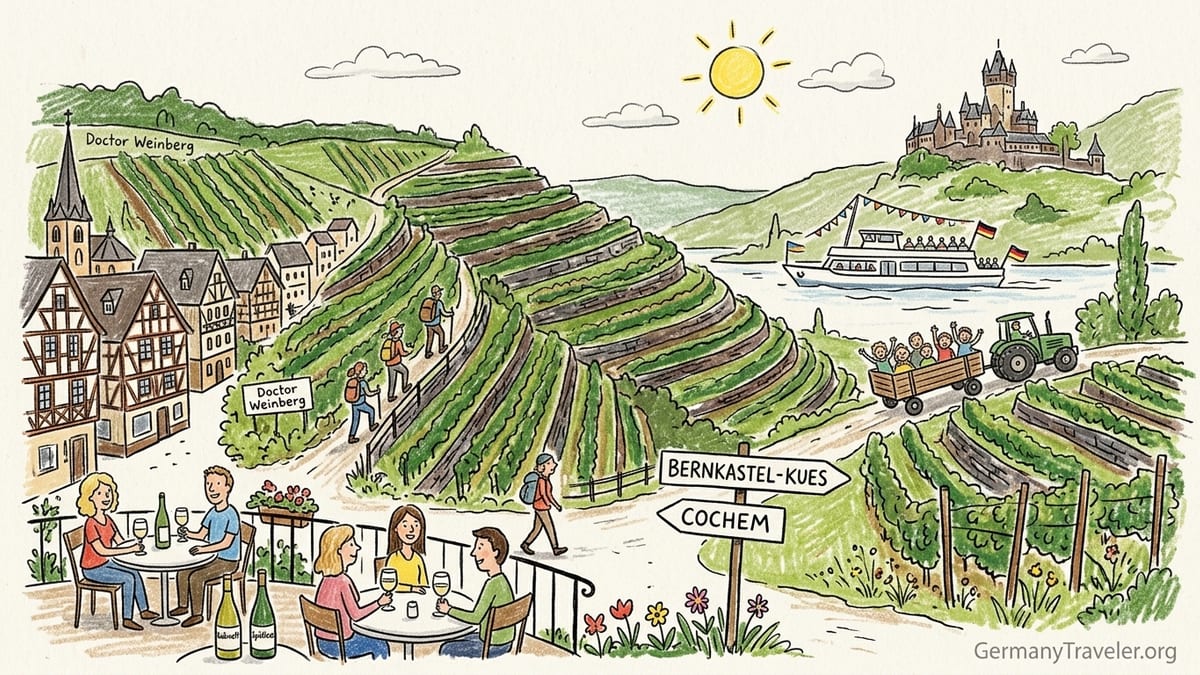
The Moselle Valley between Bernkastel-Kues and Cochem is one of Europe’s most atmospheric wine landscapes, a ribbon of river twisting below slate slopes planted almost entirely to Riesling. For travelers, that scenery now comes packaged in an impressive range of bookable experiences: guided vineyard walks with multi-glass tastings, cellar tours at family wineries, tractor-drawn wagon rides through the vines and leisurely boat trips that fold wine into the river views. This guide explains how those experiences differ, what to expect in the glass and on the trail, and how to choose the right mix of walks, cellars and boat time for your Moselle itinerary.
Why Moselle Valley Wine Tours Are Different
The Middle Mosel, anchored by Bernkastel-Kues, and the stretch around Cochem are shaped by some of Germany’s steepest vineyards and coolest winegrowing conditions. The result is a style of Riesling that is lighter in body, sharply etched by acidity and often infused with slatey minerality. That unique profile is the backdrop for most local tours, whether you are hiking up to viewpoints like the Doctor vineyard above Bernkastel or gliding past terraced slopes near Cochem on a riverboat.
Unlike many wine regions where red blends dominate, the Moselle is overwhelmingly about Riesling. That focus makes it easier for visitors to compare styles during tastings and understand what is in the glass as they move from one winery to another. A typical day might see you taste a dry village Riesling, then a gently off-dry Kabinett from a single steep vineyard, then a sweeter Spätlese or Auslese from late-harvested fruit. Even short tours often include a cross-section of those styles so you can connect what you see in the vineyard with what you taste later in the cellar or on the boat.
The valley’s geography also shapes how wine experiences are designed. Roads cling to the river, villages are compact and public transport is centered on trains and boats rather than extensive rural bus networks. That is why many operators now bundle tastings with guided walks, wagon rides or river cruises and provide transportation between stops. For travelers, the advantage is clear: you can cover more ground, and taste more wines, without needing to drive narrow roads after multiple glasses.
In recent seasons local tourism boards and wineries have expanded their experience calendars. In 2026, for example, visitors can book vineyard hikes with five-wine tastings near Bernkastel-Kues and combined boat-and-vineyard outings from Cochem that include both a river segment and a tasting stop. These are in addition to longstanding cellar tours at classic estates in towns such as Graach, Wehlen and Zeltingen, giving first-time visitors an unusually broad menu of options for a two- or three-day stay.
Understanding Mosel Riesling Styles Before You Taste
To get the most from Moselle tastings, it helps to decode a few German terms that appear on almost every bottle. First is sweetness level. “Trocken” means dry, with little perceptible sugar; “feinherb” or “halbtrocken” generally means off-dry, with a soft cushion of sweetness; and if no dryness term appears, the wine is often gently sweet, especially at the traditional Prädikat levels such as Kabinett, Spätlese or Auslese. In practice, a tasting flight at a Middle Mosel estate might start with a trocken estate Riesling, move to a feinherb Kabinett and finish with a fruity Spätlese that feels overtly sweet.
The Prädikat terms describe grape ripeness at harvest rather than sweetness in the finished wine, but on the Moselle they have become shorthand for style. Kabinett is typically the lightest, often around 8 to 9 percent alcohol, with bright acidity and either off-dry or gently sweet balance. Spätlese is made from riper, later-harvested grapes and usually tastes richer and sweeter, while Auslese is a step up in intensity again and commonly firmly sweet. On tours, guides often pour these wines side by side to illustrate how the same steep slope can produce a featherlight Kabinett for daytime drinking and a concentrated Auslese suited to dessert or cheese.
Many visitors are surprised at how fresh and drinkable even the sweeter Mosel styles feel. The region’s cool climate and steep, slate soils encourage high natural acidity, which keeps Kabinett or Spätlese bottlings from tasting cloying. When you are tasting outdoors on a vineyard terrace above Bernkastel, a glass of off-dry Kabinett can feel more like a thirst-quenching lemonade than a dessert wine. That freshness also explains why local pairing suggestions often lean toward spicy cuisine or salty snacks rather than sugary desserts.
Understanding these labels pays off when booking tours. Experiences advertised as “Riesling flight” or “classic Mosel tasting” usually include a spread from dry to sweet across Kabinett and Spätlese levels, while “dry Riesling focus” tastings will emphasize village and single-vineyard wines marked trocken. If you prefer to avoid sweetness, choose tours that specify dry styles or ask operators in advance whether the included wines skew toward feinherb and fruity or toward trocken bottlings.
Guided Vineyard Walks in Bernkastel-Kues and the Middle Mosel
Guided vineyard walks have become one of the signature ways to experience Mosel wine country. Around Bernkastel-Kues, local guides and winegrowers lead small groups up into the steep slate slopes, often including the famous Bernkasteler Doctor vineyard or the vineyards above Graach and Wehlen. A typical outing lasts two to three hours, with a climb that can feel demanding for some visitors but rewards you with sweeping views over the river’s tight bends and the tiled roofs of villages clustered along the banks.
Current bookable options include vineyard hikes that end with a structured tasting of five wines, usually held either in a simple tasting room, on a terrace overlooking the vines or at a winery in town. On such tours you might taste a dry village Riesling, then progress through a feinherb Kabinett from a steep single vineyard, a fruity Spätlese and sometimes a noble sweet wine such as Auslese. Guides explain how vine age, slope angle and slate type influence each glass, making the tasting feel like a continuation of the walk rather than a separate activity.
Walking difficulty is an important factor. The Middle Mosel’s slopes can be very steep, with loose slate underfoot, so even short vineyard segments may feel more strenuous than a typical countryside stroll. Some tours market themselves as “panorama walks” or “easy vineyard routes,” focusing on lower terraces and farm tracks, while others highlight steeper climbs rewarded with higher viewpoints. Travelers with mobility concerns or those visiting during hot midsummer afternoons may prefer shorter walks combined with cellar visits or wagon rides that keep the uphill effort to a minimum.
Group sizes on vineyard walks typically range from about 8 to 20 participants, with prices often sitting in the range of a modest restaurant meal per person, including multiple tastings. Private walks can be arranged through some wineries and hotels, particularly around Bernkastel-Kues and neighboring villages such as Lieser and Zeltingen. These bespoke options cost more but allow you to set your own pace, specify the balance of dry and sweet wines and incorporate photo stops or picnic breaks in the vineyards.
Cellar Tastings and Winery Visits: How They Work
Cellar tastings at Mosel wineries are the most traditional wine experience in the region. In Bernkastel-Kues, Graach, Wehlen and along the river toward Traben-Trarbach, family estates open vaulted cellars lined with old oak casks and rows of green Mosel bottles resting in stone niches. A standard visit runs about 60 to 90 minutes and includes a guided tasting of between four and eight wines, usually beginning with current-vintage estate Riesling and progressing toward single-vineyard Kabinett, Spätlese and occasionally Auslese bottlings.
Many estates still require advance booking, especially on weekends and during the main travel season from May to October. Some charge a small tasting fee that is waived or deducted if you buy bottles, while others roll the cost of several glasses into a fixed-price “probe” menu. Visitors can expect poured sample sizes rather than full glasses, but across six or seven wines the total consumption can still be equivalent to several standard pours, which is why cellar visits are best combined with walking, taxi transfers or trains rather than self-driving.
Private tastings are widely available for small groups willing to reserve ahead and often involve a winemaker or senior family member. These sessions are ideal if you already have an interest in Mosel Riesling and want to dive into topics such as vine age, spontaneous fermentation or single-site comparisons like Wehlener Sonnenuhr versus Graacher Himmelreich. Public tastings, by contrast, tend to focus on broader explanations suitable for first-time visitors, with straightforward language about sweetness levels and food pairings.
One practical consideration is language. Many Mosel wineries, particularly in the Middle Mosel’s well-visited villages, offer tastings in both German and English. When booking, it is worth confirming your preferred language so the estate can group you appropriately or allocate an English-speaking host. Clear explanation makes a big difference when you are learning to distinguish an off-dry feinherb Riesling from a fully dry trocken wine or comparing how a Kabinett style differs from a Spätlese from the same slope.
Boat-and-Wine Experiences Around Cochem and the Middle Mosel
Riverboats are a defining feature of the Moselle, and operators in Cochem and along the Middle Mosel have increasingly woven tastings into their cruise schedules. Around Cochem, for example, you can book combined excursions that begin with a 40-minute boat trip to a small wine village, followed by a tractor-drawn wagon ride through nearby vineyards including multiple glasses of local wine, then return by boat later in the day. This kind of itinerary gives you both river views and time among the vines without requiring any strenuous hiking.
On the Middle Mosel, day boats shuttle between towns such as Bernkastel-Kues, Traben-Trarbach and Zell, often offering optional wine tastings on board or at partner wineries along the route. Some cruises schedule short stops where passengers disembark for a cellar visit and tasting before rejoining the vessel further downstream. A typical package might include a scenic stretch of river, a guided tasting of four or five Rieslings at a family estate and free time to wander the historic streets of Bernkastel or explore Art Nouveau architecture in Traben-Trarbach.
Compared to on-foot vineyard hikes, boat-and-wine combinations generally have lighter physical demands, making them suitable for travelers who prefer to minimize uphill walking. However, they can involve stairs when boarding vessels and climbing into wagon trailers, so those with limited mobility should confirm accessibility details beforehand. Boats also operate on set timetables, so these tours require a bit more adherence to schedule than self-guided tasting days.
From a wine perspective, river-based tours often emphasize accessible styles designed to please a broad audience. Expect approachable off-dry or lightly sweet Rieslings served in modest tasting portions, sometimes alongside simple snacks such as pretzels or local cheese. If you are keen to taste more specialized dry single-vineyard bottlings, it is worth pairing a boat excursion with at least one focused cellar visit elsewhere in your trip.
Vineyard Wagon Rides and Why Having a Driver Matters
Vineyard wagon tours, common near Cochem and in parts of the Middle Mosel, are a relaxed alternative to hiking the steep slopes. Guests sit on benches in open-sided trailers pulled by a tractor or small vehicle as the route winds through hillside vineyards. Along the way, guides pour several wines, usually around five tasting glasses, talk about local history and pause at viewpoints where you can photograph the river far below. For many visitors, the appeal lies in combining landscape access with minimal physical effort.
These wagon rides, like boat tours, highlight why having someone else handle the driving is essential when wine is involved. Even if each tasting measure is small, several samples across multiple stops quickly add up. Local police regularly monitor river roads, and drink-driving rules are strictly enforced. With hairpin bends, tunnels and narrow stretches between rock faces and river, Mosel roads demand full attention even when completely sober.
Organized tours and wagons typically include transportation back to your starting point, whether that is a quay in Cochem, a hotel in Bernkastel-Kues or a nearby train station. Some itineraries pair a short guided vineyard walk with a return trip by wagon, allowing you to experience the steepness of the slopes on foot before relaxing with tastings on the ride back down. Others link wagons with boats, using the river cruise as one leg of the journey and the vineyard trailer as the other.
For independent travelers, the safest approach on days that include several wineries is to rely on trains, local taxis or pre-booked minibus transfers rather than driving. The train line that threads through Cochem and on toward Koblenz links many river towns, and from Bernkastel-Kues it is straightforward to arrange taxis to villages up and down the Middle Mosel. Building in time to walk between tasting rooms within a village cluster also keeps you from needing to get behind the wheel after multiple glasses.
Choosing Between Public and Private Tours
Moselle Valley wine experiences fall broadly into two categories: public tours that you join as an individual or couple, and private arrangements tailored to your group. Public vineyard walks, cellar tastings and river excursions follow fixed schedules and routes. They are usually more affordable, offer easy booking through tourist information offices or hotel desks and provide a sociable way to meet other travelers. The trade-off is less control over group size, pacing and the exact mix of wines.
Private tours, by contrast, are designed around your priorities. A guide with a vehicle might pick you up at your hotel in Bernkastel-Kues, drive you to two or three wineries in villages like Graach and Wehlen, arrange a vineyard stroll overlooking the river and book a lunch stop with a curated Riesling pairing menu. Because the day is customized, you can specify an emphasis on dry great growth wines, on classic off-dry Kabinett styles or on vertical tastings that follow a single vineyard across multiple vintages. Privacy also means more opportunity for in-depth questions and behind-the-scenes cellar access.
Cost differences can be significant. Public half-day vineyard walks with tastings might be priced similarly to an average dinner per person, while a full-day private driver-guide service covering several wineries and lunch will run substantially higher. For many travelers, a mix works well: one or two public experiences to get oriented, such as a combined boat-and-wagon tour from Cochem or a scheduled vineyard hike in Bernkastel-Kues, followed by a single splurge day with a private driver focused on specific wineries you want to visit.
When comparing options, pay attention to what is included. Some public tours include tasting fees at one or two wineries but expect guests to pay separately if they order extra glasses or snacks. Others fold multiple tastings into a flat price, which can represent strong value. Private operators may or may not include tasting fees and lunch in their quote. If you are planning to purchase bottles, ask whether wineries can ship internationally and whether there are discounts for on-the-day purchases.
Practical Tips: Transport, Timing and Walking Difficulty
Transport planning is central to a smooth Moselle wine trip. If you stay in Bernkastel-Kues or Cochem, you can walk to several tasting rooms within town limits, especially in Bernkastel’s old center where many estates maintain in-village cellars. For wineries in neighboring villages, taxis and private shuttles are the most convenient option from Bernkastel-Kues, while around Cochem and further toward Koblenz the regional train line makes it easy to combine rail with short walks to riverside estates.
For travelers who prefer an entirely car-free trip, public tours that bundle transport and tastings are especially attractive. A day might start with a scheduled bus or minibus transfer to a trailhead above Bernkastel, continue with a vineyard hike and five-wine tasting, then return by bus to town in time for dinner. Another day could involve a morning train to Cochem, a combined boat-and-vineyard excursion with wagon ride and tastings, and an evening train back downriver. Booking these packages through local tourist information centers or reputable operators reduces the need to juggle individual tickets and schedules.
Walking difficulty varies more than many visitors expect. Short, mostly flat riverside paths are accessible to most travelers, but routes that climb into the vineyards can be steep, narrow and surfaced with loose slate. Good walking shoes, sun protection and water are important, particularly in summer. If you are unsure about fitness levels in your group, look for tours explicitly labeled as “easy” or “panorama” and confirm elevation gain in advance. If you enjoy hiking, seek out experiences that include sections of well-known routes, as these often connect viewpoints with wineries in a satisfying loop.
Seasonality also matters. From late spring through early autumn, tours and tastings run most frequently, vines are in leaf and river traffic is at its liveliest. Harvest time, usually from September into October, can be an atmospheric period to visit, with golden foliage on the slopes and pickers at work among the rows. However, wineries may be busier in the cellar and have more limited time for extended tastings, which makes pre-booking even more important. Winter brings quieter towns and fewer boat departures, but cellar tours can feel particularly cozy when paired with hearty local food.
The Takeaway
Planning a Moselle Valley wine tour today means choosing between a range of experiences that go far beyond a quick pour at a tasting bar. Around Bernkastel-Kues and along the Middle Mosel, guided vineyard walks and multi-wine tastings link what you see on the steep slate slopes with what you taste in the glass. In and around Cochem, boat-and-wine combinations and wagon rides add river scenery and easygoing transport into the mix, making it simple to enjoy several glasses without worrying about narrow roads and strict drink-driving rules.
The key is matching the format to your interests, fitness and tolerance for group touring. If you love being outdoors, prioritize vineyard hikes with five-wine tastings and consider adding a section of a well-marked trail above Bernkastel. If you prefer to sit back, focus on cellar visits, wagon rides and cruises that bring the wine to you. Either way, understanding Mosel Riesling styles, planning transport so someone else drives on heavy tasting days and balancing public and private tours will help you build an itinerary that feels both relaxed and rewarding.
With thoughtful planning, even a short stay can include a cross-section of the region: a morning walk through vines above the Middle Mosel with a glass of off-dry Kabinett in hand, an afternoon cellar visit that contrasts dry and sweet single-vineyard wines, and a sunset boat ride near Cochem where the last tasting of the day reflects golden slate slopes glowing above the water. That combination of landscape, wine and river is what makes the Moselle Valley one of Europe’s most compelling destinations for Riesling-focused travelers.
FAQ
Q1. How many tastings are typically included on a Moselle vineyard walk?
Most guided vineyard walks around Bernkastel-Kues and the Middle Mosel include between four and five tastings, often served either during the walk at viewpoints or at a winery or tasting room at the end of the route.
Q2. Are Moselle wine tours suitable if I prefer dry wines?
Yes. While the region is famous for off-dry and gently sweet Rieslings, many wineries now produce a wide range of dry bottlings labeled trocken, and several tours can be tailored or chosen to emphasize these styles if you request this when booking.
Q3. How difficult are the vineyard hikes around Bernkastel-Kues?
Difficulty varies, but many routes involve steep sections on slate paths, which can feel demanding for those unaccustomed to hiking. Easier options exist that focus on lower terraces and panoramic viewpoints with less climbing, so it is important to check the description before booking.
Q4. Do I need a car to visit multiple wineries in one day?
No. In fact, when several tastings are involved, it is safer and more comfortable to rely on trains, boats, taxis or organized tours with a driver rather than renting a car, given the narrow roads, sharp bends and strict drink-driving enforcement along the river.
Q5. What is the difference between public and private Moselle wine tours?
Public tours follow fixed schedules and routes, are usually more affordable and are shared with other travelers. Private tours cost more but offer flexible timing, customized itineraries, tailored wine selections and often more in-depth access to wineries and vineyards.
Q6. Can I combine a Moselle river cruise with winery visits in one day?
Yes. Many operators around Cochem and along the Middle Mosel offer combined boat-and-wine excursions that include a river segment, a visit to one or more wineries or a vineyard wagon ride and return transport, making it easy to fit both experiences into a single day.
Q7. What should I wear for a vineyard walk and tasting?
Sturdy walking shoes with good grip are important on slate paths, along with weather-appropriate clothing, sun protection and a light layer for cooler cellars. Smart-casual attire is sufficient; there is no need for formal clothing at most wineries.
Q8. Are Moselle wine tours family-friendly?
Many vineyard walks, wagon rides and boat trips welcome children, though tastings are reserved for adults. Family-friendly options typically emphasize scenery, short walks and non-alcoholic drinks for younger participants, so it is worth confirming details with the operator.
Q9. How far in advance should I book Moselle wine experiences?
From late spring through autumn, it is wise to book popular vineyard walks, combined boat-and-wine tours and private driver-guided days at least a few weeks in advance, especially for weekends or during harvest season in September and October.
Q10. Can I ship wine home from Moselle wineries?
Many wineries can arrange shipping to European addresses and some offer services for overseas deliveries, though costs and import rules vary by destination. It is best to ask about shipping options and minimum quantities during your cellar visit.