


The Moselle Valley between Trier and Koblenz is not one destination but many: Roman city, castle towns, wine villages and hairpin river bends that all feel surprisingly different from one another. If you have only a few days, the real challenge is not what to see but where to base yourself. This guide compares the valley’s key towns and standout villages so you can decide which deserve an overnight stay and which work best as scenic stops between glasses of Riesling.
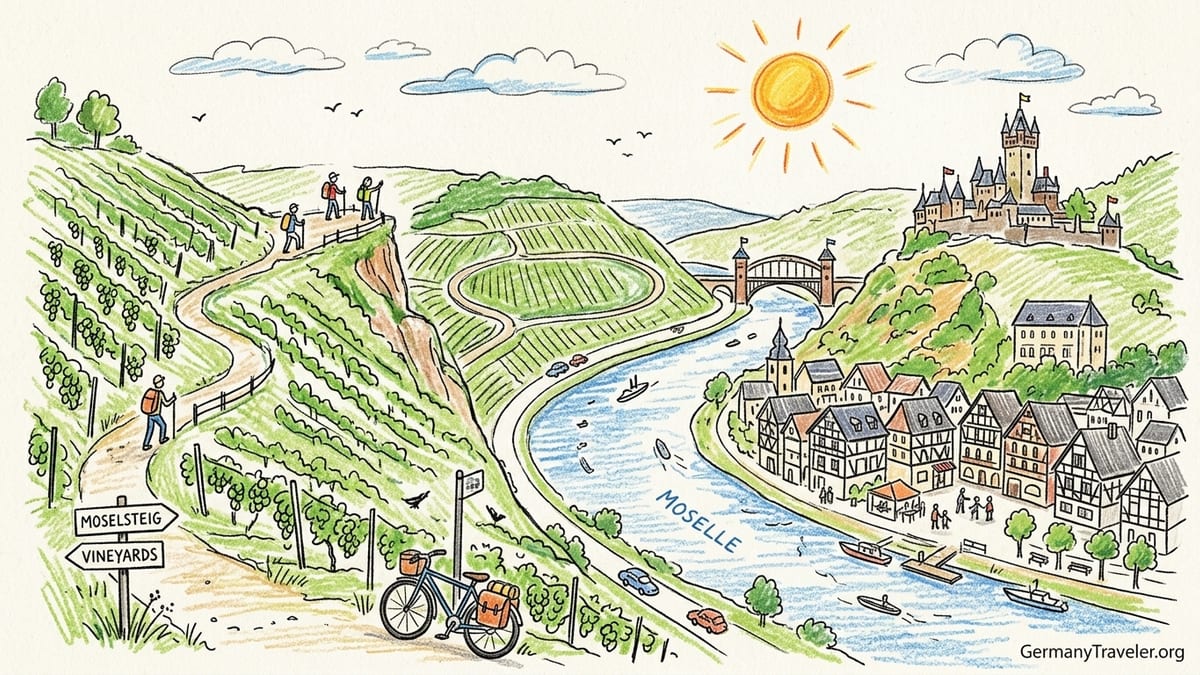
How to Think About the Moselle Valley
For planning purposes, the Moselle between Trier and Koblenz divides naturally into three zones: Upper Moselle around Trier, the Middle Moselle around Bernkastel-Kues and Traben-Trarbach, and the Lower Moselle from Cochem to Koblenz. Trains roughly follow the river from Trier to Koblenz, while buses and boats connect most intermediate towns, which makes it realistic to stay in one or two bases and explore others on day trips.
Most visitors try to combine at least one “city” base with one smaller wine town. Trier gives you major Roman monuments and a genuine urban feel. Bernkastel-Kues, Traben-Trarbach, Zell and Cochem each offer classic river scenery with distinct personalities, while tiny Beilstein, Bremm and Ediger-Eller are about atmosphere rather than a list of sights. Koblenz, at the confluence of the Rhine and Moselle, works well either as a final night or as a day trip if your focus is the valley itself.
Prices are still moderate by Western European standards, especially outside peak summer and big wine festivals. In 2026 it is common to find double rooms in family-run guesthouses in villages like Bremm or Ediger-Eller from around 80 to 120 euros per night including breakfast, while city hotels in Trier and Koblenz often range from about 110 to 180 euros depending on season and location. Restaurant mains in most towns sit in the 15 to 25 euro bracket, with glasses of decent estate Riesling commonly between 5 and 8 euros.
What really matters is matching places to your interests. History fans can justify two nights in Trier. Hikers may want to be near the Moselsteig long-distance trail or the Calmont Klettersteig above Bremm. Wine-lovers might gravitate toward Bernkastel-Kues or the quiet slopes around Ediger-Eller. Couples looking for romance could be happier in Beilstein or Cochem than in larger Koblenz. The sections below spell out which towns are best for which type of trip.
Trier: Roman History and Urban Comfort
If your main reason to come to the Moselle is Roman history, Trier deserves to be more than a quick side trip. Founded around 16 BC and often described as Germany’s oldest city, it concentrates a cluster of UNESCO-listed Roman monuments including the Porta Nigra city gate, the amphitheater and the Imperial Baths, along with later treasures such as the cathedral and the Church of Our Lady. A practical way to see several sites in a day is to buy a combined ticket like the AntikenCard from the local heritage service, which bundles entry to key ruins at a modest discount compared to paying individually.
Trier functions as a real city rather than a resort town, which has pros and cons. On the plus side you get a wide choice of hotels, from modern business chains near the station to boutique stays in historic buildings off the Hauptmarkt. It is easy to find vegetarian options, late-opening supermarkets and lively student bars. On the downside, Trier lacks the intimate riverside charm of smaller Moselle towns and the train line runs a little back from the prettiest bends of the valley, so your classic vineyard views may be limited inside the city itself.
Trier works especially well for travelers who want nightlife and culture alongside day trips. You can spend the morning touring Roman sites, then hop on a regional train along the river to villages like Schweich or Leiwen for an afternoon wine tasting, before returning to Trier for dinner and a concert. With its frequent trains to both Koblenz and Luxembourg, it is also a convenient gateway for those arriving by rail or continuing on to other regions.
As a base, Trier makes sense for at least one or two nights at the start or end of a Moselle itinerary. If your time is very limited and you are primarily interested in half-timbered villages and vineyards, you might instead treat Trier as a long day trip from a central Moselle base like Bernkastel-Kues or Cochem.
Bernkastel-Kues and Traben-Trarbach: Heart of the Wine Country
Bernkastel-Kues sits almost in the geographic and symbolic heart of the Middle Moselle. Germany’s national tourism board highlights it as one of the most beautiful spots on the river, praising its medieval old town, steep vineyards and the ruins of Burg Landshut overlooking the half-timbered Marktplatz. The compact center is a feast of gabled houses and cobbled lanes. On a summer evening, the small square fills with café tables serving flammkuchen and glasses of local Kabinett Riesling from famous slopes like Bernkasteler Doctor.
For many travelers, Bernkastel-Kues is the ideal base if the goal is classic wine village atmosphere with a bit of bustle. You can walk directly from town into the vineyards or onto stages of the Moselsteig trail, join river cruises that run to Traben-Trarbach or Zeltingen, and taste wines at both small family estates and larger producers with modern tasting rooms. Accommodation ranges from historic inns facing the river to contemporary wine hotels slightly uphill, which often include spa areas and terraces facing the vines.
A short way downstream, Traben-Trarbach offers a very different aesthetic. Marketed regionally as a “jewel of the Middle Moselle,” it is known for its Jugendstil and Art Nouveau architecture, riverside villas and an unusual number of underground wine cellars. In winter it even hosts a Christmas market inside some of those cellars, giving the town a moody, lantern-lit feel that contrasts with Bernkastel-Kues’s half-timbered charm. The bridge gate and the ruin of Grevenburg castle above town provide viewpoints over a broad Moselle curve.
As a base, Traben-Trarbach suits travelers who like an architectural mix and a slightly quieter vibe without losing amenities. It has enough cafés and wine bars for relaxed evenings, along with cycling rental shops that make it easy to join the level riverside bike route to Enkirch or Kröv. Public transport is a little less frequent than in Cochem or Trier but still workable, especially in season. If you only have three nights on the Moselle and want one main base, Bernkastel-Kues or Traben-Trarbach are strong candidates for combining wine, scenery and access to both hiking and cycling.
Cochem, Beilstein and the Lower Moselle: Castles and Romance
Further downstream, Cochem is one of the valley’s most photographed towns. The Imperial Castle on the hill, visible from almost every angle, gives it a fairy-tale skyline, and Germany’s national tourism board calls the surrounding holiday region one of the highlights of the Moselle. In practice Cochem feels like a small resort city: there are riverfront promenades, chairlifts to hillside viewpoints, a surprising number of ice cream stands and souvenir shops, and plenty of river cruise departures in high season.
Cochem is an excellent base if you want straightforward logistics, varied activities and nightlife by Moselle standards. You can arrive by direct train from Koblenz or Trier, rent e-bikes at the station to follow the flat riverside cycle path, visit the castle on a guided tour that includes a wine tasting, then finish the day at a wine bar on the Markt. In summer, you may find live music on weekend evenings and several pubs open well past midnight, which is uncommon in smaller villages. Families also appreciate attractions such as the Bundesbank bunker museum or nearby wildlife parks, which give kids a break from wine tasting.
Ten kilometers downstream, tiny Beilstein is the romantic counterpoint to Cochem’s bustle. Often nicknamed the “Sleeping Beauty of the Moselle,” it is officially singled out by Germany Travel as one of the most beautiful villages along the river, with steep lanes, ivy-covered houses and the ruins of Burg Metternich above the tiled roofs. The flip side of its beauty is that the village can feel very busy in the afternoon when excursion boats and tour buses arrive, then fall quiet again after late afternoon when day trippers depart.
Beilstein is best used either as an overnight for couples looking for a storybook atmosphere or as a half-day side trip from Cochem. There are only a handful of small hotels and guesthouses, so prices can be a bit higher per room than in larger towns. If you stay the night, you are rewarded with atmospheric evenings when the alleys empty and the castle ruins catch the last light over the valley. If you simply visit on a day trip, you can comfortably see the village and hike up to the castle in a few hours before moving on.
Zell, Bremm and Ediger-Eller: Quiet Villages and Steep Vineyards
Between Traben-Trarbach and Cochem lies a stretch of Moselle that feels narrower and more intimate, defined by steep vineyards and smaller communities. Zell, which Germany Travel flags as one of the standout towns of the valley, sits at a large river bend and is associated with the “Zeller Schwarze Katz” wine brand. The central lanes have a workaday feel mixed with wine taverns, and the riverfront offers classic promenade views. Zell makes sense for travelers looking for a moderately sized town with a local, less polished atmosphere and good access to both upriver and downriver destinations.
Just south of Zell, Bremm and Ediger-Eller are all about landscape. They sit beneath the Calmont, widely promoted as the steepest vineyard in Europe, where the Moselsteig trail and the Calmont Klettersteig via ferrata pick their way across slopes up to roughly 65 degrees. Local tourism boards describe it as one of the most dramatic viewpoints on the river, with a loop of water almost encircling Bremm far below. The via ferrata is a genuine adventure route, using ladders, steel cables and footholds to traverse the cliff, while the parallel hiking paths offer spectacular views with less exposure.
Bremm is tiny, with a cluster of guesthouses and wine estates facing the river. Ediger-Eller is slightly larger, with a church tower, cobblestone streets and several restaurants that cater to hikers and cyclists using the nearby train station as an access point. Many visitors arrive in the morning from Cochem or Zell, hike one of the Calmont circuits of about 6 to 10 kilometers, then recover over a plate of hearty food and a glass of local Riesling or Pinot Noir in a wine tavern before heading back on the evening train.
As bases, Bremm and Ediger-Eller appeal to travelers who prioritize quiet nights and direct access to hiking over nightlife or shopping. If you stay here, plan your logistics carefully: train connections from Ediger-Eller are decent but less frequent than in Cochem, and you may need to rely on regionally timed buses or taxis, especially in the evening. For many visitors, it is enough to treat Bremm and Ediger-Eller as an all-day hiking and scenery excursion from a larger base such as Cochem or Zell.
Koblenz and the Ends of the Valley
Koblenz sits where the Moselle meets the Rhine at the Deutsches Eck, a broad spit of land with sweeping river views. It feels more like a mid-sized regional capital than a Moselle town, with a compact old quarter, modern shopping streets and substantial forts and castles on nearby hills. Travelers often pair a night in Koblenz with a Rhine cruise or castle visits in the Upper Middle Rhine Valley, using the city as a convenient transport hub.
If your primary interest is the Moselle itself, Koblenz works best as a bookend or a day trip rather than as the main base. The train station sees frequent long-distance services, and local trains up the Moselle make it easy to reach Cochem or smaller communities for the day. Accommodation includes everything from larger business hotels near the station to riverside properties with views up the Rhine, which can be handy if you are arriving late or leaving early by train.
For visitors short on time, a pragmatic approach is to spend two or three nights in a central Moselle base such as Bernkastel-Kues or Cochem, then finish with one night in Koblenz to experience the river confluence and perhaps take the cable car up to the Ehrenbreitstein Fortress before an onward train. This pattern allows you to enjoy both the intimate vineyard landscapes of the Moselle and the bigger-scale drama of the Rhine without changing hotels too often.
At the upper end of the valley, you might hear about smaller places like Neumagen-Dhron, often promoted as Germany’s oldest wine village, or tiny riverside stops close to Trier. These are delightful for a couple of hours of strolling and a tasting at a local estate but rarely justify an overnight stay unless you have very specific interests in local wine history or are cycling the full length of the Moselle cycle route.
Matching Towns to Your Travel Style
To decide where to stay, first rank your priorities among Roman history, half-timbered streets, Riesling and other wines, castles, river scenery, hiking, cycling, nightlife and romantic atmosphere. Then match those priorities with the strengths of each town. A common pattern for a four- or five-night trip is to choose one history or city base plus one or two scenic wine towns, changing hotels once to reduce backtracking.
For Roman history, Trier clearly leads. You could stay two nights there to tour the Porta Nigra, amphitheater, baths and cathedral in depth, then move on to Cochem or Bernkastel-Kues for a more traditional Moselle setting. For half-timbered architecture, Bernkastel-Kues and Beilstein stand out, with Zell and Ediger also offering attractive lanes on a smaller scale. Traben-Trarbach trades timber frames for Art Nouveau facades, which some travelers prefer for photography and a sense of early 20th-century grandeur.
Wine lovers will be happy almost anywhere on the Moselle, but Bernkastel-Kues, Traben-Trarbach and the surrounding villages have perhaps the densest concentration of renowned Riesling vineyards and tasting rooms. In practice, this means you can spend a whole day walking between estates without needing a car, sampling off-dry and dry Rieslings at modest tasting fees that are often waived if you buy a bottle or two. Bremm and Ediger-Eller offer the extra drama of steep-slope viticulture beneath the Calmont, where you can literally watch vineyard workers moving between terraced plots that appear to cling to the rock.
For castles and big river views, Cochem is the obvious choice, with its hilltop Reichsburg and proximity to other castles in the Eifel and Hunsrück hills. Beilstein adds a ruined castle and an almost stage-set village beneath. Koblenz, while not a castle town in the same intimate sense, opens access to Rhine fortresses like Ehrenbreitstein and nearby strongholds on the Rhine gorge, appealing to travelers who want a wider castle circuit.
Outdoor Activities, Nightlife and Romantic Stays
If hiking is a priority, look closely at where the Moselsteig stages pass and which trailheads are near train stations or bus stops. Sections around Bernkastel-Kues, Traben-Trarbach and the Calmont between Bremm and Ediger-Eller are widely described as among the most scenic, combining vineyard paths, forest segments and balcony-like viewpoints. Travelers commonly base themselves in Cochem, Zell or Bernkastel-Kues and use local buses or trains to access individual stages, then return by public transport or taxi.
Cyclists generally prefer the central and lower sections of the Moselle, where the dedicated riverside paths are mostly flat and well surfaced. Renting bikes or e-bikes in Cochem, Bernkastel-Kues or Traben-Trarbach is straightforward; you can ride 30 to 50 kilometers in a day without major climbs, stopping at villages for coffee or wine tastings and using trains or boat services for one-way itineraries. E-bikes are especially popular with visitors who want to detour briefly up into vineyards or side valleys without worrying about fitness levels.
Nightlife on the Moselle is modest compared with major cities, but relative differences matter. Trier and Koblenz have the liveliest bar scenes, with student pubs, cocktail bars and venues that stay busy until late on weekends. Cochem offers a holiday-town version of nightlife: wine bars, beer terraces and occasional live music, with activity usually focused along the Moselpromenade and around the Markt. Bernkastel-Kues, Traben-Trarbach and Zell have enough taverns and seasonal wine festivals to keep evenings sociable, but many places close by 11 pm, especially outside summer.
For romantic stays, think about what “romantic” means to you. If it is candlelit half-timbered squares and tiny lanes, Beilstein and Bernkastel-Kues are very strong choices, especially if you can book a room in a historic house with river views. If you prefer dramatic viewpoints and a sense of adventure, Bremm or Ediger-Eller, with sunset walks to Calmont viewpoints, can feel wonderfully removed from everyday life. Couples who want both romance and amenities might split time between Beilstein or Cochem and a night in a spa-oriented wine hotel near Bernkastel-Kues or Traben-Trarbach.
The Takeaway
The Moselle Valley is compact enough that you can sample many of its highlights in a few days, yet varied enough that no single town can deliver everything. Trier shines for Roman history and urban culture; Bernkastel-Kues and Traben-Trarbach for wine immersion and architecture; Cochem and Beilstein for castles and romance; Zell, Bremm and Ediger-Eller for quieter village life and steep-slope drama; and Koblenz for its role as a transport hub and Rhine–Moselle crossroads.
If you have four or five nights, a balanced itinerary might be two nights in Trier or Koblenz plus two or three nights in a central Moselle base like Bernkastel-Kues, Cochem or Traben-Trarbach, with day trips to smaller places such as Beilstein, Bremm and Ediger-Eller. With a week or more, you can slow down, spend nights in one or two villages, follow sections of the Moselsteig, and perhaps attend a local wine festival, which often feature brass bands, food stalls and tasting stands around the central squares.
Whatever combination you choose, planning around your own interests will pay off more than trying to tick off every “must-see” on the map. Think less in terms of a checklist and more in terms of a few well-chosen bases, time to walk or cycle between them, and enough unstructured hours to sit on a riverside terrace with a glass of Riesling watching barges and tour boats slide past steep green slopes.
FAQ
Q1. How many days do I need in the Moselle Valley?
Most travelers find three to five days enough for a good overview, combining one city base like Trier or Koblenz with at least one smaller wine town such as Bernkastel-Kues or Cochem.
Q2. Which Moselle town is best for first-time visitors?
Cochem is a strong first base thanks to its train connections, castle, river cruises and range of hotels and restaurants, while Bernkastel-Kues is ideal if you prioritize wine and half-timbered streets.
Q3. Is it better to stay in one town or move around?
For short trips, staying in one or two bases and using trains, buses or boats for day trips is more relaxing than changing hotels daily, especially if you want time for wine tastings.
Q4. Do I need a car to explore the Moselle Valley?
No. Trains run along much of the river between Trier and Koblenz, and buses, boats and bike rentals cover most gaps, although a car can be convenient for smaller villages and flexible hiking access.
Q5. When is the best time of year to visit the Moselle?
Late spring to early autumn is ideal, with May, June and September often offering pleasant temperatures, active vineyards and fewer crowds than peak summer and major wine festival weekends.
Q6. Which town is best for hiking the Calmont Klettersteig?
Bremm and Ediger-Eller sit directly below the Calmont and work well as starting points, while Cochem or Zell also make practical bases for a day trip to the via ferrata and viewpoints.
Q7. Where should I stay for the best Moselle Riesling experience?
Bernkastel-Kues, Traben-Trarbach and nearby villages like Zeltingen-Rachtig are excellent for concentrated tasting options, with many estates offering samples and direct cellar-door sales.
Q8. Which Moselle towns have the best nightlife?
Trier and Koblenz offer the liveliest bar scenes, while Cochem has a holiday-town buzz in summer; smaller villages tend to be quiet after dinner, especially outside festival periods.
Q9. Is the Moselle Valley suitable for families with children?
Yes. Flat riverside cycle paths, castles like Reichsburg Cochem, boat trips and occasional wildlife or theme parks near the river make it easy to mix sightseeing with kid-friendly activities.
Q10. How expensive is the Moselle Valley compared with other parts of Germany?
Overall costs are moderate: village guesthouses and mid-range hotels are often more affordable than in major cities, and eating out and wine tastings remain reasonably priced by Western European standards.