


Choosing where to go in Germany can feel like trying to squeeze four different trips into one vacation. There is the museum and nightlife energy of Berlin, the alpine charm of Bavaria, the maritime brick canals of Hamburg, the castle lined banks of the Rhine, and the dark forests and spa towns in the southwest. This guide compares the country’s headline cities, fairy tale castles, nature regions and smaller historic towns, with concrete examples and typical experiences so you can match the right places to your interests, budget and travel style.
How to Choose Your Germany Bases in 2026
If you are coming from North America or Asia, you will most likely land in Berlin, Munich or Frankfurt. From there, fast ICE trains connect the major regions in 2 to 4 hours. As of mid 2026, a typical advance purchase fare on Deutsche Bahn for a 3 hour ICE hop, for example Berlin to Hamburg or Frankfurt to Cologne, can often be found in the range of 20 to 40 euros each way if booked early, while last minute flexible tickets can cost two to three times more. That price difference alone makes it worth deciding a rough route before you arrive and locking in the longest train stretches in advance.
For a classic first trip of 10 to 14 days, many visitors combine one big city, one romantic river or castle region, and one mountain or forest base. A realistic sample route might look like 4 nights in Berlin, 3 nights in the Rhine Valley near Bacharach or St Goar, and 4 nights in Munich with a day trip into the Bavarian Alps. Travelers who prefer smaller places could instead use Hamburg as a softer city landing and then pair it with the Black Forest or the Franconian towns around Rothenburg ob der Tauber.
Families with school age children often do best with fewer bases and apartments close to parks, playgrounds and supermarkets. A family with two kids might, for example, book a two bedroom apartment in Freiburg’s Old Town and use it as a home base for four or five nights to explore the Black Forest by train or rental car, instead of packing and unpacking every second day. Couples more interested in food and nightlife tend to favor Berlin, Munich and Hamburg for their restaurant scenes, cocktail bars and late public transport hours.
Your season matters too. Summer, from June to early September, suits river cruises, outdoor beer gardens and hiking in the Bavarian Alps or Black Forest, though July and August are also the busiest and often most expensive weeks in city centers. Winter is ideal for museum hopping in Berlin or Dresden and for combining Munich with ski resorts like Garmisch Partenkirchen, but driving steep forest roads or narrow Rhine backroads in snow can be slower and occasionally stressful for nervous drivers.
Berlin, Munich, Hamburg and Cologne: Big Cities Compared
Berlin remains Germany’s most visited city, with the widest mix of history, culture and nightlife. A first timer typically focuses on the Brandenburg Gate, the Reichstag building, sections of the Berlin Wall and the museum cluster on Museum Island. In practice you might spend a morning walking from the Brandenburg Gate along Unter den Linden to Museum Island, then queue for the glass dome of the Reichstag in the late afternoon. Neighborhoods such as Kreuzberg, Neukölln and Prenzlauer Berg add cafes, vintage shops and casual restaurants where a main dish might cost around 12 to 18 euros, with street food like currywurst or döner kebab still under 7 or 8 euros in many kiosks.
Munich feels more compact, wealthier and more traditional than Berlin, with beer halls, baroque churches and the Alps hovering on the southern horizon. Marienplatz with its Glockenspiel, the English Garden and the Deutsches Museum are standard stops, and many visitors add a day trip to Neuschwanstein Castle or to the lakes around Tegernsee. A typical beer garden visit for two adults in summer, with two liters of beer and two plates of roast pork or sausages, might run to 40 to 55 euros depending on the venue. Munich works well for couples who like a mix of city strolling and nearby mountain scenery, and for families because many parks have large playgrounds and shallow streams where children can play in warm weather.
Hamburg is Germany’s great maritime city, with red brick warehouses in the Speicherstadt district, the striking Elbphilharmonie concert hall and a working harbor where container ships glide past commuter ferries. A common visitor routine is to take a harbor boat tour from Landungsbrücken, then wander through the old warehouse district and the modern HafenCity redevelopment. Prices here feel similar to Berlin, though waterfront dining can be a little higher. Hamburg suits travelers who like water, modern architecture and live music. For families, the Miniatur Wunderland model railway museum is one of the country’s most popular indoor attractions and can easily fill half a day, especially in bad weather.
Cologne, about an hour from Frankfurt by ICE train, is dominated by its cathedral, one of Europe’s largest Gothic churches. The city’s Roman history museum and its riverfront promenade give it a relaxed, approachable feel. A practical way to see it is to arrive by mid morning, leave luggage in station lockers, walk across the square straight into the cathedral, and then spend the afternoon exploring the Old Town and Rhine embankment. Cologne is also a convenient jumping off point for day trips into the northern part of the Rhine Valley, making it a good compromise base if you want both a lively city and access to castles and vineyards.
Dresden, Heidelberg and Rothenburg: Romantic Historic Towns
Dresden, rebuilt after its wartime destruction, now mixes reconstructed baroque landmarks with modern neighborhoods and a strong cultural scene. The Frauenkirche, the Zwinger palace complex and the riverfront Brühl’s Terrace form the classic sightseeing triangle. From Dresden, many travelers add a day trip to the sandstone cliffs and hiking trails of Saxon Switzerland National Park, which is less than an hour away by regional train. This combination of ornate architecture and dramatic nature is especially appealing for couples, photographers and older families who enjoy walking but prefer to base themselves in a city.
Heidelberg, set on the Neckar River with a ruined castle on the hillside, is one of Germany’s best known romantic towns. In practice, a day here might involve riding the funicular up to Heidelberg Castle, touring the terraces and wine barrel hall, and then strolling the long Hauptstrasse, which is lined with cafes and boutiques. Because Heidelberg is also a university city, it stays lively in the evenings without feeling overwhelmingly touristy. It works well as a gentle introduction to Germany for first timers who may be jet lagged and want something pretty and manageable before tackling a larger city.
Rothenburg ob der Tauber is smaller but even more medieval in appearance, with intact town walls, half timbered houses and narrow cobbled lanes. Many visitors time their visit to join the evening night watchman tour, where a costumed guide walks the walls and streets telling stories from the town’s history. The town’s compact size suits slow travelers and families with younger children, although in peak summer the main lanes can be crowded with coaches in the middle of the day. To experience it more quietly, consider staying overnight and exploring early in the morning or after dinner when most day trippers have left.
Compared with the big four cities, accommodation in these towns is often slightly cheaper and more intimate. In shoulder seasons such as April or October, it is not unusual to find family run guesthouses in Rothenburg or Heidelberg with doubles in the 90 to 140 euro range, while equivalent rooms in central Berlin or Munich might run 150 to 220 euros. For couples, these savings can free up budget for experiences such as a classical concert in Dresden’s rebuilt Semperoper or a private guided tour of Heidelberg Castle.
Rhine Valley and Black Forest: Storybook Rivers and Forested Hills
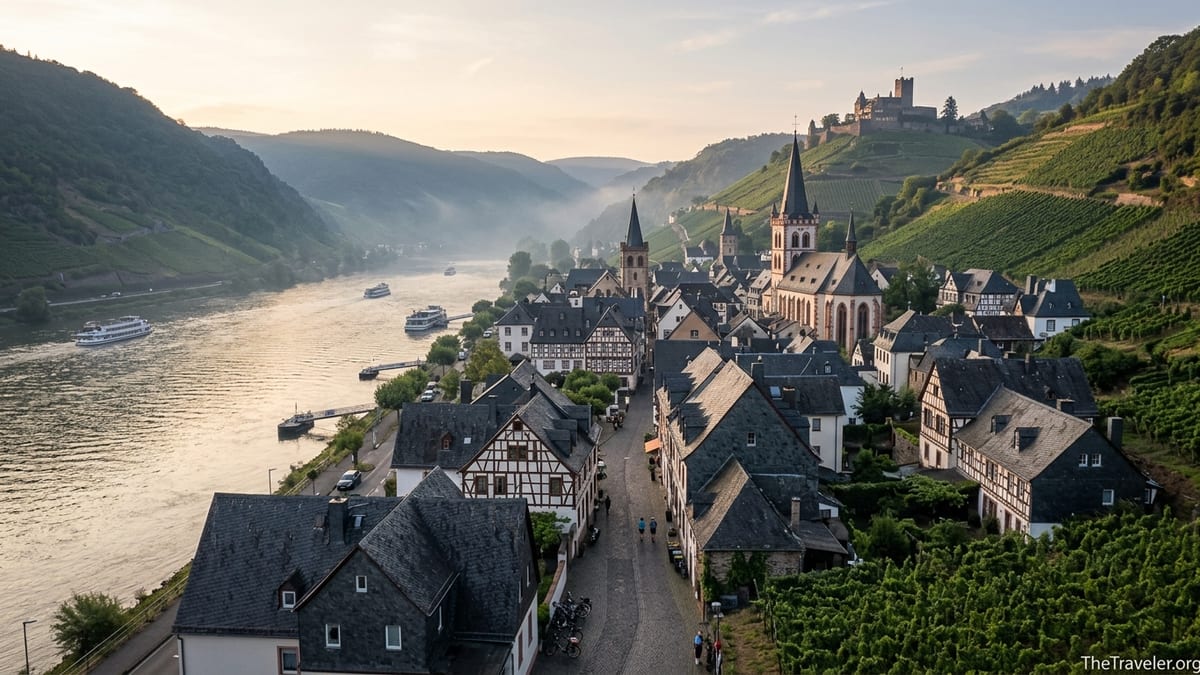
The Middle Rhine Valley between Mainz and Koblenz concentrates dozens of castles and small wine towns along a relatively short stretch of river. Many visitors base themselves in villages such as Bacharach or St Goar, both of which sit beneath hilltop castles and have train stations right in town. A typical day might involve taking a morning riverboat upstream, for example from Bacharach to Boppard, then returning by train while stopping at one of the castles, such as Marksburg in Braubach or the Rheinfels ruins above St Goar. This combination of slow boat travel and quick rail hops lets you sample multiple towns without needing a car.
For couples, the Rhine’s appeal lies in its mix of vineyard walks, half timbered riverfronts and castle hotels perched above the water. It is possible, for instance, to spend two nights in a former castle now run as a midrange hotel, dine on the terrace overlooking passing cruise ships, and then spend the next day cycling a flat riverside path between two wine villages. Families, on the other hand, often gravitate to simple pleasures such as taking the chairlift up from Boppard to the Vierseenblick viewpoint or watching the nightly lights of passing cargo ships from a riverside playground.
The Black Forest, in the southwest near the French border, feels very different. Instead of castles above a single river, you get rolling forested hills, traditional farmhouses and lakeside resorts. Freiburg im Breisgau, often called Germany’s sunniest city, makes an excellent base, with trams that connect the compact Old Town to residential areas and the foothills. From here, day trips by train or bus can reach Titisee lake, the Feldberg ski and hiking area, or the waterfalls and clock shops around Triberg. In practice, a family might spend one day exploring Freiburg’s cathedral square and riding the funicular up the Schlossberg, then the next day renting paddle boats on Titisee followed by cake and coffee at a lakeside cafe.
While both the Rhine Valley and the Black Forest work for all traveler types, there are subtle differences. The Rhine is ideal if this is your first trip to Germany and you imagine riverboats, castles and wine terraces; it slots neatly into routes between Cologne, Frankfurt and Heidelberg. The Black Forest is stronger for travelers who like hiking, quiet villages and spa culture, and it pairs naturally with Strasbourg and Alsace in France or with Lake Constance further south. In winter, low level snow can make some Black Forest roads scenic but slow, so rail based travelers often prefer Freiburg or Baden Baden, which have good public transport connections year round.
Bavarian Alps and Castle Country
South of Munich, the landscape rises quickly into lakes and foothills and then into the Bavarian Alps proper. Garmisch Partenkirchen, the twin town at the base of Germany’s highest peak, the Zugspitze, is one of the main hubs. Visitors commonly ride the cogwheel train and cable car up toward the summit for expansive views and a short glacier walk in summer, or they hike lower level gorges like the Partnachklamm, which is especially atmospheric after rainfall. In winter, the same town serves as a full scale ski resort with rental shops along the main streets and regional trains delivering skiers directly to the station.
Nearer to Munich, Füssen and Schwangau anchor the famous royal castles of Neuschwanstein and Hohenschwangau. A realistic day trip from Munich involves taking the morning train to Füssen, boarding the shuttle bus to the village below the castles, and then climbing the hill on foot or by horse drawn carriage for your timed entry slot. In busy months, tickets for Neuschwanstein often sell out days in advance, so it is wise to reserve online as soon as you know your date. While the exterior views, especially from the Marienbrücke bridge, live up to the fairy tale reputation, the interior tours are relatively short and tightly scheduled, something to consider if you are traveling with small children.
The Bavarian Alps region suits couples seeking romantic scenery, hikers, and families with teens who enjoy outdoor activities. Summer options include renting bikes around alpine lakes, tackling marked trails with lift assisted ascents, and swimming in lidos where day entry can be under 10 euros for adults. In shoulder seasons such as May and late September, you may find better availability and lower prices in guesthouses, though some high mountain lifts close for maintenance between ski and hiking seasons, so always double check operations before planning a specific summit excursion.
Compared with the Rhine or Black Forest, the Alps feel more dramatic but also more weather dependent. A rainy day in Bacharach can still be spent tasting wine under vaulted ceilings, while a fogged in day in Garmisch may wipe out mountain views entirely. For that reason, many travelers choose to stay at least three nights in an alpine base so that they have some flexibility to swap activities if the forecast shifts.
Matching Destinations to Couples, Families and Short Trips
For couples on a first visit, a balanced 10 day route could be Berlin, Rhine Valley and Munich. Four nights in Berlin allow time for major sights and at least one evening in its restaurant and bar districts, three nights in the Rhine Valley can mix castles, boating and wine, and three nights in Munich plus a day trip to the Bavarian Alps provide a final blend of city life and mountain scenery. Those more interested in romance and old architecture than nightlife might instead choose a loop of Hamburg, Dresden and Heidelberg, with a day in the Saxon Switzerland cliffs thrown in between Dresden and the next leg.
Families often fare better concentrating on two bases rather than trying to visit every highlight. A common pattern is to spend a week split between a city and a nature base, such as four nights in Hamburg or Berlin followed by four nights in the Black Forest around Freiburg, or three nights in Munich combined with five in a lakeside village near Füssen or Garmisch. In Freiburg, for instance, you will find trams that accept day tickets and a compact Old Town where children can play in the shallow Bächle water channels while adults sit at cafe tables nearby. In the Bavarian Alps, many guesthouses provide family rooms with bunk beds and included breakfasts, which simplifies mornings before hikes.
Travelers on a short trip of five to seven days need to be more selective. A long weekend from other parts of Europe might be best spent entirely in Berlin, Munich or Hamburg, with perhaps a single day trip to Potsdam, Salzburg or the lakes. For a one week trip from overseas, a realistic plan could be to fly into Frankfurt, spend three nights divided between Cologne and the Rhine Valley, and then travel by train to Munich for three or four nights. Pushing beyond that, for example trying to also include Berlin, often results in more time on trains than in the places you came to experience.
In budget terms, big cities generally cost more for central accommodation but offer cheaper street food and more competition among restaurants, while small towns may have slightly lower room rates but fewer budget dining options. As a rough, conservative guideline for 2026, couples staying in midrange hotels in major cities might plan on 160 to 230 euros per night for a double room plus 60 to 90 euros per day for food if they mix sit down meals with bakery breakfasts and supermarket snacks. In smaller towns and nature regions, that same couple might find rooms in the 110 to 170 euro range but spend similar amounts on food because of fewer low cost alternatives.
The Takeaway
Germany rewards travelers who pick a few regions and explore them in depth rather than collecting as many cities as possible. Berlin offers the broadest sweep of recent history and culture, Munich and Hamburg add distinctive regional flavors, and Cologne anchors the north end of a Rhine Valley full of castles and wine villages. Smaller cities such as Dresden, Heidelberg and Rothenburg ob der Tauber provide a more intimate, storybook atmosphere without forcing you to sacrifice comfort or connection to the rail network.
Nature lovers can choose between the gentle, castle studded Rhine, the evergreen folds of the Black Forest and the sharper drama of the Bavarian Alps, each with its own rhythm and climate. Couples might lean toward river valleys and romantic towns, while families often thrive in walkable bases like Freiburg, Garmisch or Rothenburg, where most daily activities lie within a short stroll or tram ride. There is no single best place in Germany, but matching your route to your interests, season and pace will make your own version of the country feel exactly right.
When planning, anchor your itinerary around two or three primary bases such as Berlin, the Rhine Valley, Munich, the Black Forest or the Bavarian Alps, and then add short side trips or smaller towns from there. Use Germany’s reliable trains for the long jumps, consider renting a car only for specific rural segments, and leave at least one unplanned day in each base for spontaneous discoveries. Whether you end up listening to street musicians on a bridge in Heidelberg, watching ships slide past vineyards on the Rhine, or eating ice cream on a Freiburg square as church bells ring, the details will shape the trip far more than the number of cities you tick off.
FAQ
Q1. How many days do I need for a first trip to Germany?
For a first visit that includes at least one major city and one scenic region, plan on 10 to 14 days. That gives enough time for Berlin or Munich plus either the Rhine Valley, the Black Forest or the Bavarian Alps without feeling rushed.
Q2. Is it better to rent a car or travel by train in Germany?
For most visitors, especially those focusing on Berlin, Munich, Hamburg, Cologne, Dresden, Heidelberg and the Rhine Valley, trains are usually faster and less stressful. A rental car becomes more useful in the Black Forest or small alpine valleys where bus frequencies drop, particularly for families with gear or travelers with mobility concerns.
Q3. Which German city is best for nightlife and food?
Berlin has the widest range of nightlife, from late opening bars in Kreuzberg to clubs in former industrial spaces, along with a strong street food scene. Munich and Hamburg also have excellent restaurants and beer culture, but Berlin offers the broadest variety on a typical short trip.
Q4. Where should I go in Germany for castles and romantic scenery?
For classic castles along a river, focus on the Middle Rhine Valley between Mainz and Koblenz, basing in towns such as Bacharach, St Goar or Boppard. For a single fairy tale castle, the Neuschwanstein and Hohenschwangau pair in the Bavarian Alps near Füssen is the most famous choice.
Q5. What is the best base for exploring the Black Forest?
Freiburg im Breisgau works well for most travelers because it combines a lively university town with easy public transport into surrounding hills, lakes and villages. Baden Baden suits those who prioritize spa culture, while smaller places like Triberg or Titisee feel more like traditional resort towns.
Q6. Is Rothenburg ob der Tauber worth an overnight stay?
Yes, if your schedule allows it. Staying overnight lets you enjoy the walled town early in the morning and after sunset when day trippers have left, making the lanes and viewpoints far more peaceful and atmospheric than at midday.
Q7. Can I visit both Berlin and Munich on a one week trip?
It is possible, as high speed trains between Berlin and Munich take around four hours, but you will need to accept a faster pace. Many travelers on a one week trip choose either Berlin plus a nearby region such as the Rhine, or Munich plus the Bavarian Alps, to reduce time spent in transit.
Q8. What is the best season to visit Germany for outdoor activities?
For hiking, river cruises and beer gardens, late May through September generally offers the most reliable conditions, with July and August being warmest and busiest. For skiing and Christmas markets, late November through early January is best, though days are short and some smaller attractions close in winter.
Q9. Which destinations are most family friendly?
Families often do well in Freiburg and the Black Forest, in Garmisch Partenkirchen and the Bavarian Alps, and in smaller historic towns like Rothenburg or Bacharach. These places offer walkable centers, easy day trips, access to playgrounds and outdoor space, and a mix of indoor and outdoor activities to handle changing weather.
Q10. How far in advance should I book tickets for Neuschwanstein Castle?
In popular months, especially June through September and around school holidays, it is wise to book Neuschwanstein tickets at least several days ahead, and earlier if your dates are fixed. Same day tickets often sell out, which can be frustrating if you have already traveled to Füssen specifically for the visit.