


Choosing where to base yourself in Germany shapes everything about your trip: the castles you can day‑trip to, how late you can stay out, whether Christmas markets are on your doorstep or a train ride away. This guide compares Germany’s key hubs for first‑time visitors and shows how Berlin, Munich, Hamburg, Cologne, the Rhine Valley, the Black Forest and wider Bavaria work for couples, families, nightlife, Christmas markets, road trips and train‑based holidays.
How to choose your German base
Germany is compact enough that fast ICE trains connect the major cities in a few hours, yet diverse enough that each makes a very different base. A couple staying three nights in Berlin for galleries and nightlife will want a very different area and hotel than a family using the Rhine Valley as a hub for castle day trips and Christmas markets. Before locking in non‑refundable rooms, think about whether you want a single base with day trips or a short route linking two or three contrasting regions.
For first‑time visitors without a car, Berlin, Munich, Hamburg and Cologne all work extremely well. You can arrive by flight or international train, rely on dense U‑Bahn and S‑Bahn networks, and add easy side trips like Potsdam from Berlin or Neuschwanstein from Munich using regional trains and tour buses. If you are comfortable driving, pairing a big city with a scenic region such as the Rhine Valley or the Black Forest gives you both culture and landscapes in one itinerary.
Season matters more than many travelers expect. In December, basing in a city with strong Christmas markets such as Cologne or Munich puts stalls, mulled wine and skating rinks right outside your hotel. In September and early October, Munich becomes much more expensive because of Oktoberfest, while the vineyards above the Middle Rhine are at their most beautiful. In high summer school holidays, families appreciate lakes and shaded forests around Freiburg or Garmisch‑Partenkirchen instead of dense city heat.
Budget is another key filter. A midrange double room in central Berlin or Hamburg can still start around the equivalent of 120 to 160 euros per night in shoulder seasons, while boutique hotels near Munich’s Theresienwiese festival grounds during Oktoberfest can easily cost several times that. Scenic smaller towns such as Bacharach on the Rhine or Titisee in the Black Forest often offer simple guesthouses and apartments at lower nightly rates, especially for longer stays or midweek visits.
Berlin: best for first‑timers, nightlife and history
As capital and largest city, Berlin is the most flexible base in Germany for first‑time visitors and culture‑seekers. Its neighborhoods feel more like a cluster of villages than a single downtown, so where you stay shapes your experience. For a first visit, many travelers choose Mitte for walking access to Museum Island, the Brandenburg Gate and the Reichstag, with plenty of hotels in the midrange to upscale bracket within a ten to fifteen minute stroll of major sights. Couples who prefer independent cafés and galleries often gravitate to Prenzlauer Berg or leafy streets near Kollwitzplatz, where you find stylish apartments and smaller design hotels.
Berlin’s reputation for nightlife is well‑earned, and if clubbing is a focus, staying near Friedrichshain or Kreuzberg cuts late‑night taxi costs. Hostels and budget hotels around Warschauer Strasse make it easy to reach venues along the Spree as well as the East Side Gallery by day. In contrast, families might feel more comfortable in quieter, greener pockets such as Charlottenburg, close to the zoo and the Charlottenburg Palace gardens, or in well‑connected residential districts within the S‑Bahn ring that still offer playgrounds and easy grocery shopping.
Berlin is also an efficient base for car‑free travel. The main station, Berlin Hauptbahnhof, has direct ICE trains to Hamburg, Munich and Cologne, and frequent regional trains to Potsdam for palace complexes and lakes. Many apartments and hotels near the Tiergarten or Hauptbahnhof sell day tickets or welcome cards that fold transit and discounts together, making three or four nights in Berlin a strong start or finish to a longer German itinerary. Even with only public transport, you can combine city days with short escapes to lakes such as Wannsee in summer.
Prices in Berlin remain relatively gentle compared with some Western European capitals. Outside of major trade fairs and New Year, you can often find central three‑star hotel rooms under the equivalent of 150 euros per night and hostel dorms in well‑rated properties for significantly less if you book a few months ahead. For travelers looking to stretch a budget while still enjoying extensive museums, street food and nightlife, Berlin is usually the best base in Germany.
Munich and Bavaria: Alpine romance, beer culture and road trips
Munich offers a very different feel to Berlin: compact, affluent and steeped in Bavarian traditions. For first‑time visitors, staying inside or directly around the Altstadt ring is ideal. Here you can walk from Marienplatz to the Viktualienmarkt, the Residenz and major museums in minutes, and be on an S‑Bahn to the airport or a regional train toward the Alps without changing lines. Boutique hotels and traditional guesthouses in this central zone suit couples seeking a romantic, walkable base with good restaurant options.
Munich also anchors classic Alpine day trips. With a rental car or guided tour, you can reach Neuschwanstein Castle near Füssen, the lakes around Garmisch‑Partenkirchen or the Herrenchiemsee palace in a long day. Travelers who want to be closer to the mountains often split their stay, spending a couple of nights in the city then two or three nights in a town such as Garmisch or Berchtesgaden. These Bavarian bases give you cable cars, alpine lakes and hiking trails at your doorstep while still linking back to Munich by train in a few hours.
Oktoberfest heavily influences where to stay and what you pay. For the 2026 festival dates in late September and early October, hotels within walking distance of the Theresienwiese grounds are already setting minimum‑stay requirements and higher nightly rates. During this period, many visitors choose districts a short U‑Bahn ride away, like Glockenbachviertel, Maxvorstadt or areas along the U3 and U6 lines, which balance festival access with more typical neighborhood nightlife and more moderate pricing. Booking six to twelve months in advance is wise if you want specific properties or room types during the festival season.
Families may prefer quieter, leafy areas such as Nymphenburg or the neighborhoods around the English Garden, where you can rent bikes, picnic by the river and still reach the city center in fifteen to twenty minutes by tram or subway. In wider Bavaria, small lake towns like Prien am Chiemsee or Tegernsee work well as summer bases for swimming and boats, and as launching points for scenic drives through the foothills. Self‑catered apartments and farm stays are common in these rural areas and can be good value for longer stays, particularly for road trips where you want parking and more space.
Hamburg: maritime flair, nightlife and family‑friendly city breaks
Hamburg, spread along the Elbe with its huge port and warehouse districts, offers a strong alternative to Berlin for travelers who like water, architecture and a less hectic feel. Many first‑time visitors base themselves near the city center around the Binnenalster lake, where large hotels and business properties sit within walking distance of the Rathaus, major shopping streets and boat tours. From here, the Speicherstadt and modern HafenCity waterfront are readily accessible on foot or by short U‑Bahn rides.
For couples and nightlife‑focused trips, districts such as St. Pauli and the Schanzenviertel bring a mix of bars, small music venues and street art. Choosing a hotel on a quieter side street, slightly back from the Reeperbahn itself, lets you enjoy the nightlife scene while still being able to sleep. Rooms in converted warehouses or design hotels in HafenCity can also suit travelers who want a contemporary, maritime theme along with views of the Elbphilharmonie and passing ships.
Families often prefer more relaxed, green neighborhoods. Staying near Planten un Blomen park, with its playgrounds and open spaces, works well for those with young children. You are only a short hop from Miniatur Wunderland, one of the city’s most popular indoor attractions, and you still have easy access to ferry routes along the river included in local transport passes. The combination of city conveniences and water gives Hamburg strong appeal as a long weekend base, especially in late spring and summer.
Accommodation prices in Hamburg are similar to or slightly above Berlin, with business travel creating peaks during trade fairs. Travelers who do not mind a ten to fifteen minute S‑Bahn commute can find better rates in outlying but well‑connected districts, using the central station as a hub for onward day trips. North Sea and Baltic Sea coastal towns are reachable by regional trains for those who want a day on the water without changing base entirely.
Cologne and the Rhine Valley: castles, Christmas markets and scenic trains
Cologne is one of Germany’s best bases for a combination of big‑city conveniences and quick access to Rhine Valley scenery. Staying near the main station puts you right beside Cologne Cathedral and the Hohenzollern Bridge, with fast trains running south along the river to Bonn, Koblenz and the Middle Rhine Gorge. This makes it easy to combine a few nights in Cologne with day trips to smaller river towns, especially for visitors relying on rail passes or regional day tickets.
In December, Cologne’s multiple Christmas markets help make it a festive base. Hotels within a short walk of the cathedral and Alter Markt squares are popular with couples and families who want to step out of the lobby directly into lights, stalls and ice rinks. Prices in these central areas rise on key weekends of Advent, so more budget‑minded visitors look across the river in Deutz or a few tram stops away in neighborhoods with simpler guesthouses and apartments.
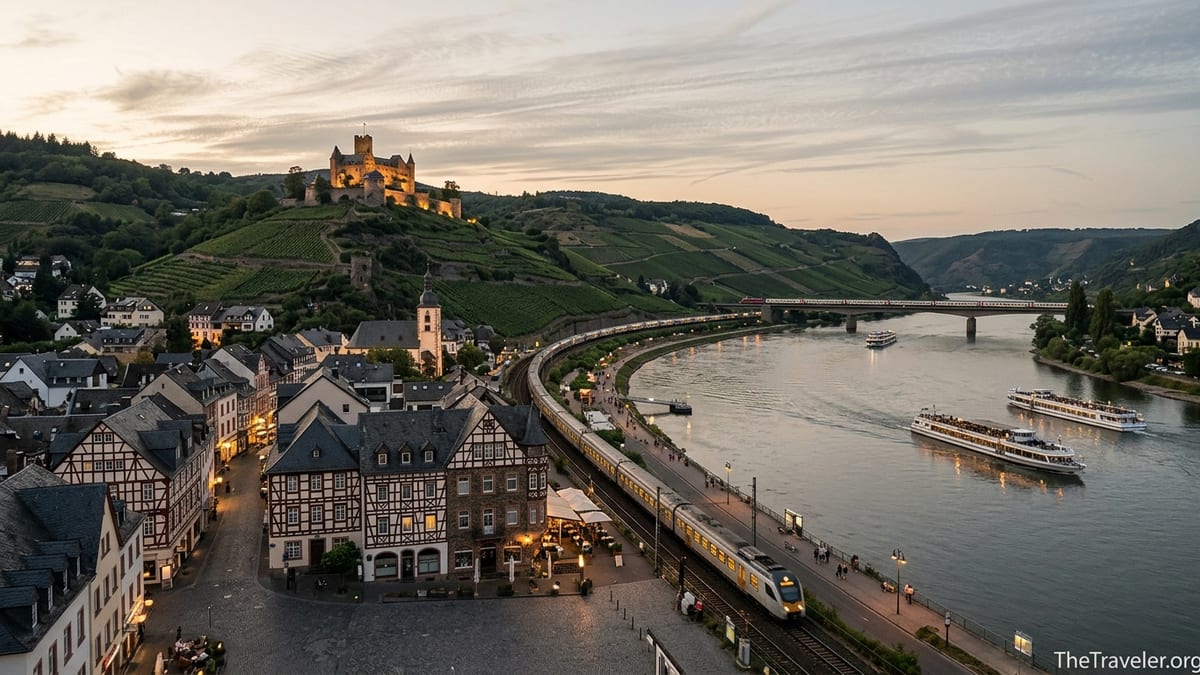
For a more immersive Rhine Valley experience, many travelers choose to stay directly in the UNESCO‑listed Upper Middle Rhine towns instead of commuting back to a major city every night. Small places such as Bacharach, St. Goar or Boppard sit along the slow stretch of river between Bingen and Koblenz, where hilltop castles, terraced vineyards and bends in the river come every few minutes by train or boat. From a base like Bacharach, you can ride regional trains or boats to visit castles such as Marksburg or Rheinfels, hike sections of the cliff‑top trails and return to a quiet village evening in a half‑timbered inn.
If you are driving, basing in a Rhine town gives you flexible access to both riverbanks, side valleys and nearby wine regions. Parking is easier in smaller towns than in Cologne’s inner districts, and guesthouses often include breakfast and local advice on ferry crossings and viewpoints. For train‑based travelers, choosing a town served by frequent regional trains on both sides of the river makes it simple to string together castle visits without needing a car. Rooms in Rhine Valley guesthouses and small hotels can be good value outside peak festival and wine‑harvest weekends, making this region attractive for longer, slower trips.
The Black Forest and southwest Germany: nature, spas and car‑free valleys
The Black Forest region in southwest Germany is ideal for travelers who want forests, spa towns and smaller villages as a contrast to big cities. Freiburg is the most practical base for first‑timers without a car. Its compact old town, dominated by the cathedral square and streams running along cobbled lanes, is full of guesthouses, apartments and midrange hotels. Direct trains connect Freiburg to Basel, Karlsruhe and Frankfurt, and regional trains and buses run into surrounding valleys for hiking, lakes and cable cars.
Travelers with a car can choose higher‑altitude bases in the Hochschwarzwald, such as around Titisee, Schluchsee or Feldberg. These small resort towns offer easy access to forests, lakes and viewpoints, with a mix of hotels, chalets and holiday apartments. Many accommodations in the Black Forest participate in local guest card schemes that provide free regional bus and train travel during your stay, which can be particularly helpful for linear hikes or for leaving the car parked for a day.
For couples interested in spa culture and dining, traditional spa towns such as Baden‑Baden or Baiersbronn combine grand hotels and thermal baths with high‑end restaurants. On the other hand, families might prefer lakefront apartments near Titisee or chalets close to child‑friendly walking trails and summer toboggan runs. The region works well in both summer, when you can swim and hike, and in shoulder seasons, when cooler weather makes thermal baths and forest walks especially appealing.
Because the Black Forest covers a wide area, it is usually better to pick one or two well‑connected valleys rather than attempting to cross the whole region from north to south. Driving times on winding forest roads can be longer than they appear on a map. Travelers who prefer to stay car‑free can treat Freiburg as a hub, using regional trains to reach destinations like Titisee for a day and returning in the evening, while those on road trips might combine a few nights in a spa town with a couple of nights on Lake Constance or in nearby wine villages.
Matching bases to your travel style
If this is your first trip to Germany and you only have a week, a simple structure works best. Many visitors start with three or four nights in Berlin or Munich to cover major city sights, then add three nights in either the Rhine Valley or the Black Forest for castles and countryside. This keeps base changes to a minimum while still delivering a mix of urban culture and landscapes. Traveling by train between these hubs is usually straightforward, and you can decide whether to rent a car only for the rural segment.
Couples often prioritize atmosphere and walkability when choosing where to stay. In cities, that might mean a boutique hotel on a quiet side street in Munich’s old town, or an apartment above a café in Berlin’s Prenzlauer Berg. In scenic regions, it could be a riverside inn in Bacharach with castle views, or a chalet overlooking meadows near Garmisch‑Partenkirchen. Accepting a slightly smaller room in a historic building or a guesthouse without a lift can often buy you a far more charming location.
Families tend to value space, kitchen facilities and access to playgrounds and green areas. Apartments in Hamburg near Planten un Blomen, family rooms in Cologne on quieter streets a short tram ride from the cathedral, or holiday flats around Titisee and Tegernsee with separate bedrooms can all work well. Being within a ten to fifteen minute walk of a train or tram stop often matters more than being directly next to a major square, especially if you are pushing a stroller or managing tired children in the evenings.
Nightlife travelers usually put late‑night transport and local noise levels at the top of their list. Staying in or near Berlin’s Friedrichshain, Kreuzberg or Neukölln, Munich’s Glockenbachviertel or Hamburg’s St. Pauli shortens late‑night journeys but calls for properties with good soundproofing. Checking recent guest reviews for mentions of street noise, club crowds and bar closing times can be as useful as looking at star ratings, particularly if you want to balance going out with getting some sleep.
The Takeaway
There is no single “best” place to stay in Germany, only bases that fit different trips. Berlin remains the strongest all‑round choice for first‑time visitors focused on history, culture and nightlife, with good value and excellent train links. Munich and wider Bavaria shine for Alpine landscapes, beer halls and festival culture, while Hamburg, Cologne and the Rhine Valley offer water, castles and Christmas‑market atmosphere in season. The Black Forest and Bavarian Alps reward travelers who are ready to slow down, rent a car or learn regional train timetables, trading big‑city buzz for forests, lakes and mountain views.
When comparing accommodation options, decide first what you want to do most days, then pick a base that keeps those experiences close. A slightly smaller room in the right neighborhood is usually worth more than a bigger room far from the places you will spend your time. With thoughtful planning, Germany’s cities, castles and train lines fit together into itineraries that feel both efficient and relaxed, whether you are visiting for nightlife, family holidays, Christmas markets or a scenic road trip.
FAQ
Q1. For a first trip to Germany, is Berlin or Munich a better base? For most first‑time visitors, Berlin is the more flexible and budget‑friendly base, with a huge range of museums, history sites and nightlife, plus strong rail connections for onward travel. Munich is better if you particularly want Alpine day trips, beer gardens and Bavarian culture and are comfortable with generally higher hotel prices.
Q2. Where should I stay if I want to visit a lot of castles by train? For castle‑focused trips without a car, staying in the Middle Rhine Valley around towns like Bacharach, Boppard or St. Goar works very well, because frequent regional trains and boats connect many castles and viewpoints along a short stretch of river. From Cologne you can also day‑trip to this area, but basing in a Rhine town usually cuts travel time and adds atmosphere.
Q3. Which German base is best for Christmas markets? Cologne, Munich and Hamburg all host major Christmas markets in late November and December, with several distinct market areas within each city. Staying within walking distance of at least one main market square means you can drop in for an hour in the evening without planning a full excursion, which is especially convenient in cold weather or when traveling with children.
Q4. Do I need a car to enjoy the Black Forest or Bavaria? A car gives you more freedom in rural areas, but it is not essential. Freiburg, Garmisch‑Partenkirchen and many lake towns are connected by regional trains and buses, and some Black Forest accommodations provide guest cards that include local transport. If you prefer not to drive, choose bases with direct rail access and plan hikes or excursions that start and end at train or bus stops.
Q5. How far in advance should I book hotels for Oktoberfest in Munich? For stays between late September and early October when Oktoberfest runs, it is wise to book six to twelve months ahead if you want to be within walking distance or a short subway ride of the festival grounds. Closer to the dates, you may still find rooms in outer districts or nearby towns, but prices are higher and minimum‑stay requirements more common.
Q6. Is it better to stay in Cologne or directly in a Rhine Valley town? If you want big‑city dining, museums and nightlife alongside one or two Rhine day trips, basing in Cologne works well. If your priority is scenery, castles and quiet evenings, staying in a smaller Rhine town is usually more rewarding, with shorter travel times to viewpoints and boat piers and more of a village atmosphere.
Q7. Which German city is best for nightlife‑focused trips? Berlin has the most extensive nightlife scene, with clubs and bars concentrated in districts like Friedrichshain, Kreuzberg and Neukölln and late‑running public transport. Hamburg’s St. Pauli and Reeperbahn area and Munich’s Glockenbachviertel also offer strong nightlife, though on a smaller scale and generally with earlier closing times than Berlin.
Q8. What is a good base in Germany for families with young children? Family‑friendly bases include Berlin’s greener neighborhoods near the zoo and Tiergarten, Hamburg areas close to Planten un Blomen park, and lake or forest towns such as Titisee in the Black Forest or Tegernsee in Bavaria. These locations combine outdoor space and playgrounds with manageable access to city centers or key sights by train or car.
Q9. Can I do Germany as a train‑only holiday without renting a car? Yes. Germany’s long‑distance and regional trains connect major cities, Rhine and Moselle river towns, Black Forest hubs like Freiburg and many Alpine gateways. If you pick bases near main stations or on frequent regional lines and allow extra time for connections, you can comfortably cover a week or two using only trains and local public transport.
Q10. How many bases should I plan for a ten‑day trip to Germany? For ten days, two or at most three bases usually work best. A common pattern is four nights in a major city such as Berlin or Munich, three nights in a scenic region like the Rhine Valley or Black Forest, and three nights in another city such as Hamburg or Cologne, minimizing packing and travel days while still giving variety.