


Traveling across Germany by train is usually faster than driving, often cheaper than flying and far less stressful than trying to decode dozens of local transport rules. With dense Intercity-Express (ICE) high-speed lines linking Berlin, Munich, Hamburg, Cologne, Frankfurt and Nuremberg, plus an extensive web of regional trains, you can cover most itineraries efficiently if you understand how the system works and which tickets really save money.
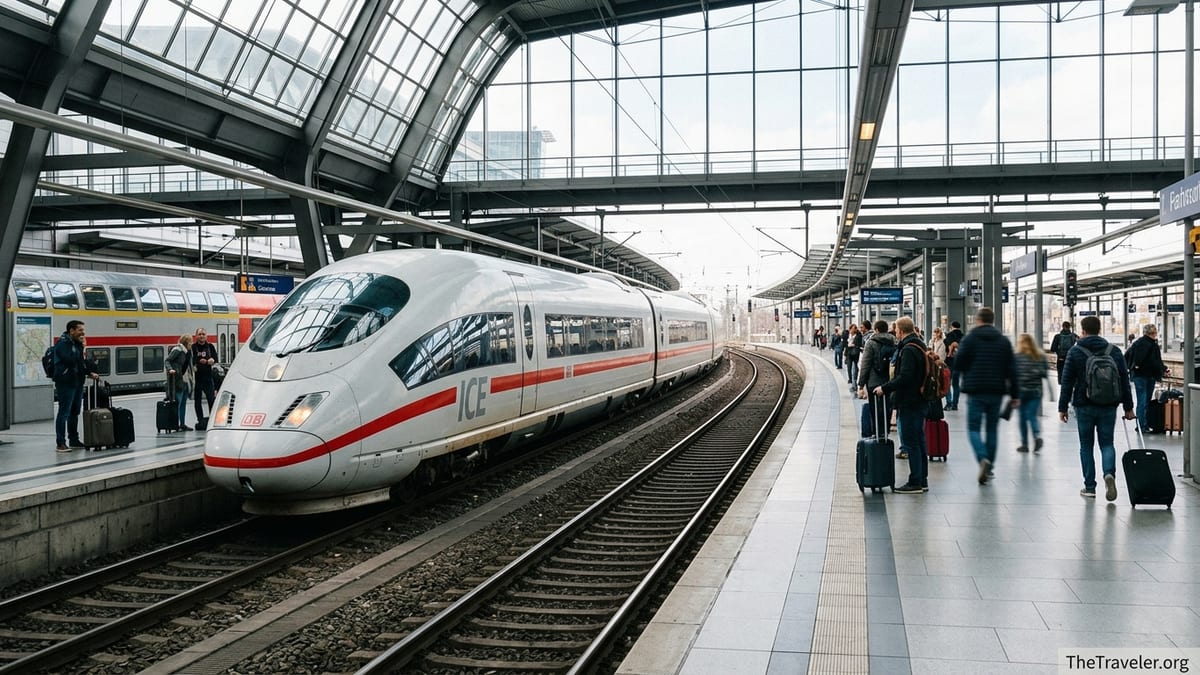
How the German Rail Network Fits Together
Germany’s rail system has two main layers most visitors use. At the top are long-distance services branded ICE, IC and EC that connect the major cities at up to around 250 to 300 km/h on dedicated high-speed lines. Below that is a dense network of regional trains, labeled RE, RB and S-Bahn, which connect suburbs, smaller cities and rural areas. On a typical trip from Berlin to Munich or Frankfurt to Cologne you will often combine both layers, for example taking an ICE into a hub such as Frankfurt or Nuremberg and a regional train for the last 30 to 60 minutes into a smaller town.
Deutsche Bahn, usually shortened to DB, runs almost all ICE and most IC trains, plus a large share of regional trains. In some regions private operators run local routes, but for planning purposes you can still see nearly everything inside the official DB Navigator app or on DB’s booking platforms. A Berlin visitor might, for instance, open the app and see ICE trains to Hamburg, regional RE trains to cities such as Rostock and private orange-liveried trains to the Baltic coast, all within one trip search.
Frequent hubs make it easy to chain cities together without backtracking. Frankfurt and Hanover are key north–south junctions, while Cologne and Mannheim anchor east–west flows. If you book a ticket from Hamburg to Munich the itinerary might route you via Hanover and Würzburg or via Berlin and Nuremberg, depending on departure time and availability of fast ICE “Sprinter” services. Understanding these hubs matters because it gives you confidence to accept a connection with a short change time when the app says it is officially protected.
For most visitors, the practical takeaway is simple. Use ICE for medium and long hops between major cities and rely on regional trains to reach castles, wine towns and hiking areas. Once you understand the main trunk lines between Berlin, Munich, Hamburg, Cologne, Frankfurt and Nuremberg, you can add side trips without having to rework your entire itinerary.
Key ICE Routes Between Major Cities
Several ICE corridors are especially useful for classic first-time itineraries. The flagship high-speed route between Berlin and Munich runs largely on a dedicated line via Leipzig, Erfurt and Nuremberg and can take as little as about four hours on the fastest trains. Many departures are branded Sprinter and make fewer stops, while others add intermediate cities such as Bamberg or Coburg. If you are visiting Nuremberg’s old town and also want time in Berlin and Munich, this single corridor covers your entire triangle without needing a car.
Another heavily used route links Hamburg with Munich via Hanover, Kassel, Würzburg and Nuremberg. Depending on the exact train and time of day, Hamburg to Munich can take roughly six hours, which is competitive with flying once you factor in airport transfers. This same north–south spine offers direct trains from Hamburg to Nuremberg and Hamburg to Frankfurt, so it is straightforward to start a trip in the port city, drop down to Frankfurt for the Rhine region and continue to southern Bavaria, all by ICE.
In western Germany, the Cologne to Frankfurt high-speed line mirrors the A3 motorway for much of its length and usually takes about an hour from Cologne main station to Frankfurt main station on the fastest trains. Many services stop at Frankfurt Airport’s Fernbahnhof station, which sits directly beneath the long-distance terminal. This is particularly useful if you fly into Frankfurt and then want to go straight to Cologne, Bonn or Düsseldorf without going through downtown Frankfurt at all. A visitor could land at 10:00, walk downstairs to the station, catch an 11:00 ICE and be drinking coffee next to Cologne Cathedral just after midday.
The Rhine–Main–Danube corridor is equally important. Hourly ICE services connect Frankfurt with Nuremberg and Munich via Aschaffenburg and Würzburg, often continuing beyond Munich toward Salzburg or Vienna. From Frankfurt to Munich via this route you can expect a travel time of around three and a half to four hours on a direct ICE. For someone planning a loop like Frankfurt, Nuremberg, Munich and back, this single line plus regional branches to places such as Rothenburg ob der Tauber or Regensburg covers a classic cultural circuit almost entirely on rails.
ICE Versus Regional Trains: When Speed Matters
The main advantage of ICE over regional trains is speed. On long stretches such as Berlin to Frankfurt or Hamburg to Munich an ICE can be twice as fast as a chain of regional services, and it offers reserved seating, air conditioning and on-board food. For example, Cologne to Frankfurt on the high-speed ICE takes about an hour, while the slower but scenic regional route along the Rhine with RE and RB trains can take closer to two and a half hours. If you have tight museum reservations or only one night in a city, that time difference adds up quickly.
Regional trains come into their own for short and medium hops and for scenic detours. Traveling from Nuremberg to Bamberg or from Munich to Garmisch-Partenkirchen is usually on RE or RB trains. Seats are not reserved, but the flexibility is high: with most regional day tickets and local passes you can hop on any train in the allowed region and time window. A common example is using an ICE from Frankfurt to Cologne, then switching to an RE along the Middle Rhine to explore towns such as Boppard and Bacharach at leisure.
Comfort levels differ too. ICE trains have a more intercity feel with open-plan cars, power sockets at almost all seats, luggage racks and quiet zones. Many have bistro cars selling snacks, simple hot meals and drinks. Regional trains are more basic commuter stock. They are fine for trips of one to two hours but can feel crowded at peak times, especially around big cities and during summer weekends. If you are traveling with large suitcases between major cities or you value a guaranteed seat, ICE is usually the better experience.
Cost is the other big trade-off. Flexible ICE tickets bought last minute can be relatively expensive, especially in first class, while regional tickets and local day passes are often very good value if you are traveling off-peak or staying within a single federal state. For instance, if you only need to go from Munich to Regensburg and back in one day, a regional day ticket may cost less than half of a flexible long-distance fare and still get you there in about an hour and a half each way.
Tickets, Seat Reservations and the DB Navigator App
Most visitors now buy tickets digitally. The central tool is the DB Navigator app, which shows timetables in real time, sells tickets for almost all ICE and IC services and many regional routes, and stores your tickets as QR codes on your phone. You enter origin and destination, choose a date and time, then see a list of options with travel times and prices. Once the ticket is purchased it appears under the “Journeys” section of the app, ready for inspection when staff pass through your carriage.
Germany uses two main fare types for long-distance trains. Fully flexible fares are more expensive but allow you to take any train on your route that day. Cheaper advance fares tie you to the specific train shown on your booking but can be significantly lower in price if booked early. It is common to see Berlin to Munich advance fares in the range of roughly 30 to 60 euros for a one-way second-class ticket if purchased several weeks in advance, while a fully flexible ticket on the same route bought on the day can cost considerably more. For short hops like Frankfurt to Cologne, advance fares can also be attractive when bought early.
Seat reservations on ICE and IC trains are optional but strongly recommended on busy days such as Fridays, Sunday afternoons or around national holidays. When you book in the app you can add a reservation for a small additional fee per journey segment. This allows you to choose window or aisle, quiet car or family area and, in some cases, table seats. On the day, the small digital displays above each seat show whether it is reserved and for which part of the journey. If you board a Berlin to Munich train in Leipzig and the display shows a reservation only from Nuremberg onwards, you can sit there until that station without conflict.
Regional trains usually do not have reservations. Instead, the strategy is to board early and move toward the ends of the train, which are often less crowded. If you know a particular regional route is heavily used, for example the lines from Munich into the Alps on sunny winter weekends, consider taking an earlier departure than you strictly need. With long-distance tickets, if your reserved ICE is heavily delayed or canceled, DB staff usually allow you to switch to another service. Keeping the DB Navigator app installed and notifications enabled helps, because it will flag platform changes, delays and recommended alternative trains automatically.
Rail Passes, Local Tickets and When They Make Sense
For many international visitors, the German Rail Pass provided by Deutsche Bahn is the most straightforward option when planning intensive train travel within a fixed period. It offers unlimited travel on almost all DB-operated trains on a set number of days within a one-month window and can be used on ICE, IC and regional services. Pricing is tiered by class, number of travel days and whether you are a solo traveler or using a twin version for two people traveling together. As a rough reference point, a multi-day second-class pass usually makes sense if you plan at least four to six longer ICE trips within a month, for example Berlin to Hamburg, Hamburg to Cologne, Cologne to Frankfurt and Frankfurt to Munich plus some regional side journeys.
Another option is an Interrail or Eurail Global Pass, which covers travel in Germany plus other European countries. These passes are most useful if your itinerary crosses borders frequently, such as Amsterdam to Cologne, Cologne to Munich, then onward to Vienna or Zurich. If you mainly stay within Germany, a dedicated German Rail Pass is often simpler, while point-to-point advance tickets can be cheapest if you only have two or three long-distance trips on your entire journey.
On the regional level, several state and local passes can save money for slower travel days. Examples include day tickets that cover unlimited regional trains in a particular federal state, such as Bavaria or North Rhine-Westphalia, from morning until late at night. These are particularly good value for couples or small groups planning short hops, for instance Munich to Nuremberg with stops in Ingolstadt, or Cologne to Bonn and Koblenz with town visits along the Rhine. The trade-off is that they only allow slower regional trains and usually exclude ICE and IC services.
There are also subscription-style products for residents that occasionally make sense for longer stays, such as nationwide local transport tickets offering unlimited use of most regional and city transport. For a short-term visitor, these are primarily worth considering if you are based in a single city for a month or more and expect to use local and regional trains daily. In most classic two-week vacation itineraries, a mix of advance ICE tickets for the long hops and occasional regional day tickets covers needs more economically than a full subscription.
Planning Classic Itineraries: City Hops and Scenic Detours
A popular first-time itinerary combines Berlin, Hamburg, Cologne and Frankfurt. One common pattern is to start in Berlin for three or four nights, then take a roughly two-hour ICE to Hamburg for a taste of the port and Elbphilharmonie area. From Hamburg you can ride an ICE south to Cologne in around four hours, perhaps planning your arrival so you step out of the station directly facing Cologne Cathedral. After two nights near the Rhine, another short ICE hop of about an hour brings you to Frankfurt, where you can explore museums, the reconstructed Altstadt and nearby wine regions before flying home.
Another classic loop connects Frankfurt, Nuremberg and Munich. You might spend two nights in Frankfurt, including a day trip by regional train along the Rhine to towns such as Rüdesheim or Boppard, then ride an ICE via Würzburg to Nuremberg in roughly two hours. Nuremberg itself makes an ideal base for exploring Franconia, with regional trains to Bamberg’s old town, Rothenburg ob der Tauber via Ansbach and the beer cellars of Forchheim. From Nuremberg, direct ICE services reach Munich in around an hour. Munich can then serve as a hub for day trips by regional train to Salzburg, Regensburg or the Bavarian Alps.
Travelers with more time often combine big-city hops with slower scenic legs. For example, you could take an ICE from Berlin to Frankfurt, then swap to a regional train along the Middle Rhine between Koblenz and Mainz, getting off at small wine towns and rejoining the main line later in the day. Or you can connect Hamburg and Munich entirely by ICE but carve out a day for regional rides into the Harz mountains or to the seaside near Lübeck and Travemünde. The key is to choose one or two scenic regional days and keep the rest of your long-distance travel as direct as possible.
In peak summer and around major trade fairs, it makes sense to build in a cushion for busy trains. If you know you must be in Munich by a specific evening for a concert, consider booking a mid-morning ICE with reserved seats rather than the very last possible departure. Likewise, on Sundays at the end of long weekends it is wise to reserve seats on routes such as Cologne to Berlin or Hamburg to Frankfurt, since these can be especially busy with returning weekend travelers.
Luggage, On-board Experience and Practical Tips
Germany does not have airline-style checked luggage on trains, so you bring your bags on board and keep them near your seat. ICE trains have overhead racks for small suitcases and backpacks, larger racks at carriage ends and some spaces between back-to-back seats where a medium suitcase can slot in. A common practical setup for visitors is one wheeled suitcase that fits easily into the overhead rack and a smaller daypack that can sit under the seat in front. On regional trains the storage is similar but more basic, with fewer dedicated luggage racks and more reliance on overhead shelves and free floor space near doors.
There is no weight limit, but you must be able to carry your luggage up and down station stairs and into the train quickly. At major stations such as Berlin Hauptbahnhof, Munich Hauptbahnhof or Frankfurt Hauptbahnhof, escalators and lifts are widely available, but some smaller stations only have stairs or a single lift that can be crowded at peak times. If you are changing at busy hubs with short transfer times, aim for luggage you can move in one trip. Many travelers find a 55 to 65 centimeter suitcase plus a small shoulder bag the upper practical limit before transfers become stressful.
On-board life is straightforward once you are settled. ICE trains provide power outlets at nearly every seat and free or low-cost Wi-Fi on most services, though reliability can vary in rural areas. Bistro cars or mobile trolleys sell coffee, soft drinks, wine, sandwiches and simple hot dishes like pasta or currywurst. You are also allowed to bring your own food and drink. On regional trains facilities are more limited, so picking up snacks and water at station bakeries or supermarkets before boarding is wise, especially for journeys over 90 minutes.
Ticket checks are usually conducted once per journey segment. Staff scan the QR code in your app or on a printed ticket and may ask for an ID if you use certain discounted fares or passes. On ICE trains you can often use a digital self check-in feature in the DB Navigator app in combination with a seat reservation, which lets you register your presence at a seat so staff do not need to check your ticket in person. This is particularly convenient if you are working or resting and prefer not to be disturbed.
When Renting a Car Becomes the Better Option
Trains are the default for city-to-city travel in Germany, but there are situations where renting a car is more practical. The most obvious is when your itinerary focuses heavily on rural areas with limited rail coverage, such as small villages in the Black Forest, parts of the Moselle valley or remote alpine valleys near the Austrian border. While regional trains and occasional buses reach many trailheads and resort towns, there are still pockets where connections are infrequent, especially in the evenings and on Sundays. If you plan multiple remote guesthouses or want to stop at viewpoints spontaneously, a car offers more freedom.
Group size also shifts the calculation. For a couple traveling between Berlin, Hamburg, Cologne and Frankfurt, rail almost always wins on both cost and convenience, especially if you use advance fares or a rail pass. For a family of five planning to visit several small towns and rural attractions within a compact region, a rental car can become cost-competitive when you factor in the price of five long-distance tickets or multiple regional day passes. In addition, packing car seats, strollers and luggage for young children can be easier when you have a vehicle parked directly outside your accommodation rather than needing to navigate station platforms.
Season and road conditions play a role too. In winter, main rail lines are generally reliable even in snow, and you avoid driving on icy roads you do not know well. In contrast, a summer trip focused on lakes, hiking trails and rural guesthouses might be more enjoyable with a car if you are comfortable driving on German motorways and country roads. As an example, a week based in a single Bavarian village near the Alps with day trips to small lakes, farm shops and out-of-the-way viewpoints might be better suited to a car, while a culture-heavy tour of Berlin, Dresden, Leipzig and Munich remains best done by rail.
Hybrid strategies often work best. You could begin with a rail-based week connecting cities by ICE, then pick up a rental car for three or four days at a place like Munich, Freiburg or Nuremberg for rural exploration, returning it before your final long-distance hop by train. This way you avoid the cost of parking and the stress of driving into dense city centers while still having maximum flexibility in the countryside. When comparing options, remember to include parking fees, fuel, potential tolls in neighboring countries and the time spent picking up and returning the vehicle.
The Takeaway
Germany’s modern rail system makes it surprisingly easy to string together complex itineraries without renting a car, provided you understand the basic structure of ICE versus regional trains, how tickets and reservations work and where rail passes actually save money. High-speed ICE lines connect Berlin, Munich, Hamburg, Cologne, Frankfurt and Nuremberg in a web of fast links, while regional services fill in the gaps to smaller towns, castles and landscapes. With a few well-chosen advance fares and perhaps a German Rail Pass for intensive travel, most visitors can move quickly and comfortably between destinations.
At the same time, it helps to be realistic. Not every village is on a rail line, some popular regional routes can be crowded at peak times and there are situations, especially in remote rural areas, where a rental car is more effective. The most satisfying trips often combine fast ICE hops between major cities with slower regional detours for scenery, and, where needed, a short car rental to reach places that trains and buses do not serve well. By aligning your ticket choices, luggage setup and daily plans with how the German network is actually built, you can spend less time worrying about logistics and more time enjoying your journey.
FAQ
Q1. Do I need to reserve a seat on ICE trains in Germany?
Seat reservations are optional on ICE trains, but they are highly recommended on busy days such as Fridays, Sundays and national holidays, and on popular routes like Berlin to Munich or Cologne to Frankfurt. Without a reservation you can still board with a valid ticket and look for an unreserved seat, but you may have to move if someone has booked it for part of the journey.
Q2. How early should I book ICE tickets to get good prices?
Advance fares for long-distance trains usually become available several months ahead and tend to be cheapest in the earlier booking window. Prices typically rise as departure day approaches, especially for popular times and routes. As a practical rule, booking key ICE journeys two to eight weeks ahead often gives a good balance between price and flexibility for most visitors.
Q3. Can I use the same ticket on ICE and regional trains?
It depends on the fare you buy. Many long-distance tickets are valid from your origin to destination and allow you to use specific regional trains at the start or end of the route, as long as they are included in the itinerary when you book. In contrast, regional day tickets usually only allow RE, RB and S-Bahn trains and exclude ICE and IC services, so you need to check the ticket conditions carefully.
Q4. Is the German Rail Pass worth it for a two-week trip?
The German Rail Pass can be good value if you plan several long ICE journeys within a short period, such as Berlin to Hamburg, Hamburg to Cologne, Cologne to Frankfurt and Frankfurt to Munich. If your itinerary only includes one or two long-distance trips and several short regional hops, buying individual advance tickets and occasional regional day passes is often cheaper than a full pass.
Q5. How much luggage can I bring on German trains?
There is no formal weight limit on German trains, but you must be able to carry your bags yourself and store them safely near your seat. Most travelers manage comfortably with one medium wheeled suitcase plus a smaller backpack or shoulder bag. Very large or multiple heavy suitcases can be awkward on station stairs and in busy carriages, especially during peak times.
Q6. What happens if my ICE train is delayed and I miss a connection?
If a delay on a DB-operated train causes you to miss an officially planned connection, staff normally allow you to take the next suitable train to your destination. The DB Navigator app often suggests alternative connections automatically and can show a note that your ticket is valid on other services because of the delay. If in doubt, speak to staff at a service desk or on the platform before boarding.
Q7. Are German trains usually on time?
Punctuality varies by route and time of day. Many regional trains and some ICE services run close to schedule, but delays do occur, particularly on busy corridors and during bad weather or construction work. It is wise to build a little buffer into tight plans, especially when catching a flight or a time-critical event, and to keep an eye on live updates in the DB Navigator app.
Q8. Can I eat and drink on German trains?
Yes. You are allowed to bring your own food and drink onto trains, and many ICE services also have bistro or restaurant cars that sell snacks, simple hot meals and beverages. Regional trains rarely offer on-board catering, so it is sensible to buy water and snacks at station bakeries or supermarkets before boarding for journeys longer than about an hour.
Q9. Is first class on ICE trains worth the extra cost?
First class on ICE trains offers wider seats, a bit more legroom, a generally quieter environment and, on some services, at-seat service for food and drinks. Whether it is worth the extra cost depends on your budget and priorities. For a short hop like Cologne to Frankfurt, many travelers are happy in second class, while for a long daytime ride such as Hamburg to Munich some people enjoy the added comfort of first class.
Q10. When should I choose a rental car instead of relying on trains?
A rental car makes sense when your plans focus on rural areas with limited rail service, when you are traveling as a larger group visiting many small towns in a compact region, or when you want maximum flexibility for spontaneous stops. For classic city itineraries linking Berlin, Hamburg, Cologne, Frankfurt, Nuremberg and Munich, trains are generally easier and more efficient, but a short car rental can complement them for countryside segments.