


Southern Germany packs an impressive variety of experiences into a relatively compact region. Within a few hours by train or car, you can move from Alpine peaks to half-timbered medieval streets, from grand royal castles to sleek car museums. For first-time visitors it can feel overwhelming to choose where to focus limited days. This guide compares the major destinations in southern Germany, with a particular focus on how they work for city lovers, mountain scenery, castles, couples and families.
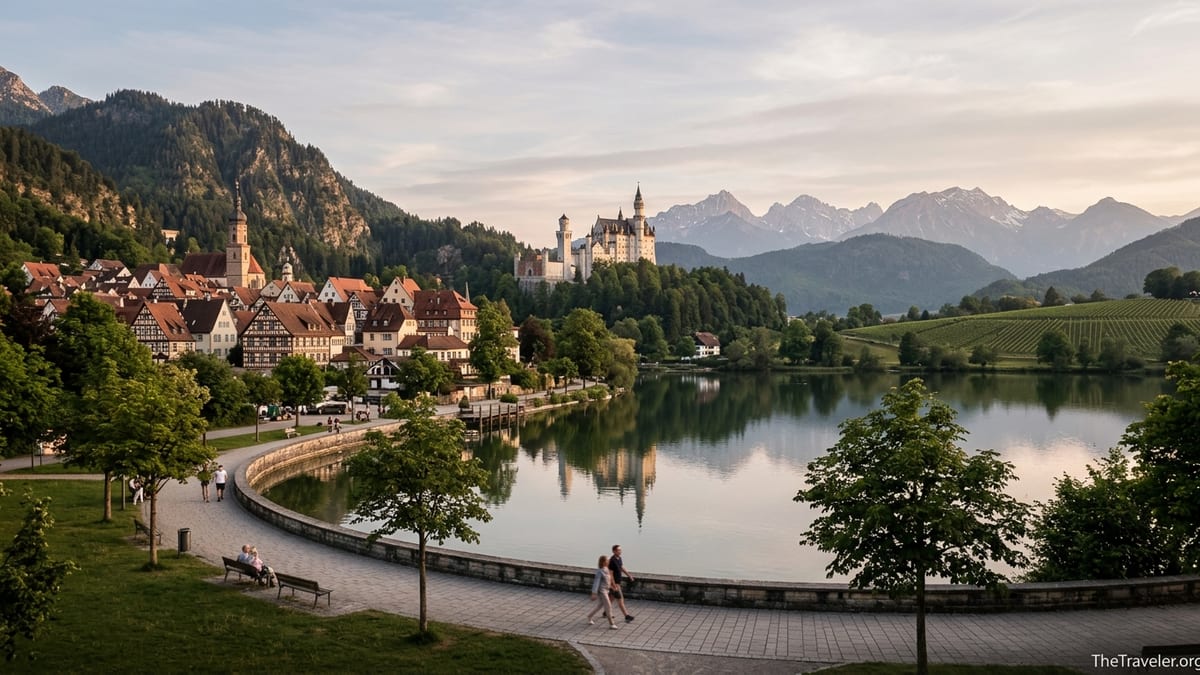
How to Use This Southern Germany Destination Guide
Think of southern Germany as a triangle stretching from Stuttgart in the west to Munich in the east and down to the Austrian border. Within this area lie the Bavarian Alps, the Black Forest, Lake Constance and several of the country’s most atmospheric old towns. Distances are manageable. For example, the train from Munich to Nuremberg typically takes about 1 hour 10 minutes, and Munich to Garmisch-Partenkirchen around 1 hour 20 minutes. That makes it realistic to combine cities and mountain bases on a seven to ten day trip.
This article focuses on ten of the most popular bases: Munich, Neuschwanstein (using Füssen or Schwangau), Garmisch-Partenkirchen, Berchtesgaden, the Black Forest, Lake Constance, Heidelberg, Rothenburg ob der Tauber, Nuremberg and Stuttgart. Each section highlights what the destination does best and where it might fall short, so you can match places to your interests rather than trying to see everything.
Prices vary seasonally, but as a broad reference point, a centrally located midrange hotel double in Munich or Heidelberg often runs in the range of 130 to 220 euros per night in high season, while smaller Alpine towns like Garmisch-Partenkirchen, Füssen or Berchtesgaden sometimes offer doubles from around 110 to 180 euros depending on view and facilities. In most places, guest cards from local tourist offices give discounts on local transport and attractions, which can substantially reduce on-the-ground costs for families.
All of the destinations discussed are reachable by public transport. Trains connect the cities and larger towns, with buses or local trains covering the final stretches to castle villages and lakes. This makes southern Germany particularly attractive for travelers who prefer not to rent a car, although a car is helpful for more dispersed Black Forest and Lake Constance itineraries.
Munich: Lively Capital and Best All-Round Base
Munich is the largest city in southern Germany and an ideal starting point for many itineraries. The compact old town centers on Marienplatz, where visitors gather to watch the famous Glockenspiel figures perform on the tower of the Neues Rathaus. A few streets away, Viktualienmarkt operates as a daily food market with butchers, cheese stalls and seasonal fruit stands, plus an open-air beer garden where you can sit with a plate of roast chicken and a liter of local lager. The city’s extensive public transport network makes it easy to reach sights such as Nymphenburg Palace or the BMW headquarters without a car.
For green space in an urban setting, Munich’s Englischer Garten stretches from the edge of the old town far to the northeast. It combines wide lawns, streams and lakes with traditional beer gardens such as the popular one at the Chinesischer Turm, where long tables under chestnut trees fill up on warm evenings. At the southern edge of the park, river surfers ride the artificial Eisbach wave, a distinctive Munich spectacle that often stops passersby on their way to the nearby art museums.
Munich works well for both couples and families. Couples can enjoy evenings in classic beer halls, browse galleries such as the Alte Pinakothek, then take romantic walks along the Isar River. Families benefit from reliable public transport, numerous playgrounds in parks, and kid-friendly museums including the Deutsches Museum of science and technology. Day trips are straightforward: guided excursions or regional trains connect Munich to Neuschwanstein, Salzburg, Regensburg and the Dachau Memorial, allowing visitors to see highlights without changing hotels.
On the downside, Munich is one of the more expensive places in this guide, particularly during major trade fairs and the Oktoberfest period in late September and early October. Travelers focused almost entirely on mountains or small towns might prefer to limit their time here to two or three nights, using it mainly as an arrival and departure hub.
Neuschwanstein and the Bavarian Fairy-Tale Castles
Neuschwanstein Castle, perched on a rugged hill above the village of Hohenschwangau near Füssen, is arguably the most famous castle in Germany and a powerful draw for first-time visitors. Commissioned by King Ludwig II of Bavaria in the 19th century, its white towers and dramatic mountain backdrop inspired the iconic castle silhouette used by a major American entertainment company. Nearby Hohenschwangau Castle, painted in warm yellow, offers a contrasting, more lived-in royal residence. Together they make this area particularly attractive for travelers whose top priority is castles and royal history.
In practical terms, most travelers stay in the nearby town of Füssen or in the village of Schwangau. Füssen offers a walkable old town with pastel-colored buildings, small hotels and guesthouses, and easy access to regional trains. Schwangau and Hohenschwangau sit closer to the castles and provide a more rural feel, with many properties offering views of the castle ridges from balconies. Shuttle buses and walking paths link the ticket center with the castle entrances, and a short but steep walk or a horse-drawn carriage ride takes visitors up to Neuschwanstein’s gates.
This area suits couples looking for a romantic setting and families keen on a classic castle experience. Children often enjoy the combination of castle interiors, forest paths and nearby lakes such as Alpsee, where pedal boats and lakeside walks provide downtime after tours. A typical visit might combine morning castle tours with an afternoon hike to viewpoints like Marienbrücke, which offers one of the best angles on Neuschwanstein and the surrounding valley.
The main drawbacks are crowds and timing constraints. Access to Neuschwanstein’s interior is by timed guided tour only, and tickets in summer or during long weekends often sell out in advance. Lines for shuttle buses and the bridge viewpoint can be long at peak times of day. Travelers who want a broader range of activities beyond castles may prefer to base in Garmisch-Partenkirchen or Berchtesgaden and visit Neuschwanstein as a day or overnight side trip.
Garmisch-Partenkirchen and Zugspitze: Alpine Adventure Hub
Garmisch-Partenkirchen, usually shortened to Garmisch, sits at the foot of Germany’s highest peak, the Zugspitze. It functions as a year-round mountain resort, with hiking and alpine lakes in summer and skiing, winter hiking and toboggan runs in colder months. Cable cars and cogwheel trains connect the town to mountain areas like the Garmisch-Classic area and up to the Zugspitze plateau, where visitors can step out onto viewing platforms that look across to Austrian peaks on clear days.
For active travelers, few destinations in southern Germany offer such a range of options in one place. In summer, families can choose from well-marked trails of varying difficulty, including easy routes to the picturesque Eibsee, where rowboats and stand-up paddle boards dot the turquoise water. In winter, the region promotes family-friendly offers on the Zugspitze and surrounding mountains, with sledding areas, beginner slopes and designated winter hiking paths that do not require skiing experience.
Garmisch works particularly well as a base for travelers who want a genuine Alpine atmosphere without crossing into Austria or Switzerland. Traditional houses with painted facades line streets in the historic Partenkirchen district, and many guesthouses offer mountain views from balconies. Couples can combine active days with spa visits and candlelit dinners in cozy inns, while families appreciate apartment-style accommodations with kitchens and proximity to playgrounds and cable car stations.
The town is less ideal for travelers whose interests focus primarily on urban culture or nightlife. While there are cinemas, bars and occasional festivals, evenings are generally quieter than in Munich or Stuttgart. Public transport connections from Garmisch to other major destinations are good but less direct than in the big cities, so travelers trying to cover a large number of regions in a short time might find it more efficient to concentrate on either the Bavarian Alps or the Black Forest and Lake Constance.
Berchtesgaden and Königssee: Dramatic Scenery and Quiet Villages
Berchtesgaden occupies a corner of southeastern Bavaria that is almost entirely surrounded by Austria, giving it a dramatic mountain setting even by Alpine standards. The town itself has an attractive center with arcaded streets and traditional houses, but the main draw is the surrounding Berchtesgaden National Park. Here, deep valleys and steep peaks create some of the most striking scenery in Germany, centered on the emerald waters of Lake Königssee. Electric boats carry visitors along its fjord-like surface to the pilgrimage church of St. Bartholomä, backed by cliffs and peaks that rise almost straight out of the water.
Beyond the lake, the region offers numerous walking and hiking options, from gentle valley paths along the Ramsauer Ache to more demanding routes that climb above tree line. The area also has significant 20th century history. The site known as the Eagle’s Nest, or Kehlsteinhaus, sits on a rocky outcrop reachable by bus from the Obersalzberg area above Berchtesgaden and offers panoramic views across the Alps. Visitors typically combine the viewpoint and documentation center there with more nature-focused days on the lake or in the national park.
Berchtesgaden is especially appealing to couples seeking dramatic natural backdrops and to families who like a slower pace of travel. Many guesthouses have family rooms and apartment units, and guest cards supplied by accommodations often include free or discounted local bus travel. For example, it is common for visitors to stay three or four nights and alternate boat trips with easy walks and occasional rainy-day visits to local salt mines or small museums.
The area is somewhat more remote than Garmisch-Partenkirchen, and public transport journeys from Munich require a change in Salzburg or Freilassing, so it is not as efficient for multiple long day trips. Travelers interested in combining this scenery with larger city experiences often pair Berchtesgaden with stays in Munich or Salzburg rather than making it their only base in southern Germany.
Black Forest and Lake Constance: Forest Trails and Lakeside Towns
The Black Forest in southwest Germany offers a different kind of mountain landscape from the Bavarian Alps. Instead of sharp peaks, it is characterized by densely forested hills, deep valleys and scattered farmsteads. Popular bases include the university city of Freiburg, known for its Gothic minster and lively market, and resort towns like Titisee-Neustadt near Lake Titisee, as well as Triberg, which promotes itself around waterfalls and traditional clockmaking. Visitors typically come for hiking, cycling, spa hotels and a sense of rural tradition, including hearty regional food and the famous Black Forest cake.
The region is ideal for travelers who enjoy quieter nature experiences and want to mix small towns with countryside. Couples might choose a romantic guesthouse in a side valley, spending days on scenic drives or long walks to viewpoints such as Feldberg or Schauinsland, then relaxing in hotel saunas in the evening. Families often appreciate attractions such as open-air museums that showcase historic farm buildings, or adventure playgrounds and toboggan runs that appear near cable car stations.
Lake Constance, shared between Germany, Switzerland and Austria, pairs nicely with the Black Forest on a loop through southern Germany. German lakeside towns such as Konstanz, Meersburg, Lindau and Friedrichshafen offer a summer holiday feel, with lakeside promenades, half-timbered houses and frequent ferry connections between them. In Meersburg, for example, it is common to spend a morning touring the medieval upper castle and newer palace, then descend to the waterfront for an afternoon ice cream or a short boat trip across to another town.
Both the Black Forest and Lake Constance work best in late spring through early autumn, when walking paths and lake cruises operate fully and outdoor terraces come to life. They are strongly suited to couples and families seeking relaxed, nature-oriented days rather than intense sightseeing schedules. Travelers without a car can still visit by train, but bus timetables in more rural stretches can be sparse, so a rental car gives more flexibility than in the Bavarian Alps or along the main city rail corridors.
Heidelberg, Rothenburg, Nuremberg and Stuttgart: City Comparisons
Heidelberg is one of Germany’s most romantic small cities, set along the Neckar River and watched over by the partly ruined Heidelberg Castle. A funicular railway links the old town with the castle terraces and higher viewpoints, giving sweeping views of red rooftops and church spires. The old town combines baroque facades, a long pedestrian shopping street and university buildings that give the city a youthful energy. Couples are particularly drawn to Heidelberg’s blend of history and riverside strolls, while families appreciate the relatively compact center and car-free core.
Rothenburg ob der Tauber offers perhaps the most concentrated medieval atmosphere in southern Germany. Its intact city walls, towers and half-timbered houses have made it a fixture on Romantic Road itineraries. In the evening, when day-trippers leave, overnight guests can join the well-known Night Watchman tour that departs from the main square and introduces the town’s history with humor and storytelling. This setting is highly appealing for couples who want a storybook backdrop and for families with children who enjoy the feeling of walking along fortified walls and through narrow cobbled lanes.
Nuremberg, by contrast, combines a picturesque old town with a more complex history. The Kaiserburg Castle crowns the hill above the old center, while below it market squares, churches and a network of traditional half-timbered houses create classic views. The city is also a key destination for travelers interested in 20th century history, with a documentation center at the former rally grounds and a museum at the Nuremberg Trials courthouse. Compared with Rothenburg, Nuremberg feels more like a lived-in city, with a substantial local population, extensive tram and metro network and a wide range of restaurants and shops.
Stuttgart sometimes flies under the radar for international visitors but is a strong choice for certain travelers. The city sits in a basin surrounded by vineyards, and two major automobile museums, the Mercedes-Benz Museum and the Porsche Museum, attract car enthusiasts from around the world. Wine-themed walking trails weave up the slopes around the city, and suburban districts offer views over roofs and railway lines. Stuttgart can be particularly appealing for families or small groups where some members want museum time and shopping, while others prefer wine tasting or relaxed afternoons in leafy neighborhoods.
Which Destinations Work Best for Different Travelers
For city-focused travelers who still want a sense of local character, Munich and Heidelberg form a strong combination. Munich delivers big-city energy, major museums and classic beer culture, while Heidelberg adds romantic river scenery and a castle without overwhelming visitors with its size. Nuremberg and Stuttgart broaden the urban mix, with Nuremberg leaning toward history and traditional markets and Stuttgart standing out for modern architecture and car culture.
For mountain scenery and outdoor activity, Garmisch-Partenkirchen and Berchtesgaden are the two standout bases. Garmisch offers easier rail connections and more of a resort-town feel, while Berchtesgaden provides arguably the most dramatic valley-and-lake scenery in southern Germany around Lake Königssee. Travelers who prioritize famous castles may choose to pair either town with a stay near Neuschwanstein, or visit Neuschwanstein as a day trip from Munich before or after their mountain days.
Couples seeking romantic settings gravitate to Heidelberg for its castle terraces at sunset, Rothenburg for its storybook lanes after dark, and the Neuschwanstein area for lake walks with castle silhouettes. A multi-night stay in one of these places, combined with a few days in Munich or along Lake Constance, creates a well-rounded honeymoon or anniversary trip. For a more nature-heavy romantic itinerary, substituting Berchtesgaden or the Black Forest for one of the city nights works well.
Families often find the best balance by combining one major city with one or two smaller bases. Munich pairs well with Garmisch-Partenkirchen for cable cars and lakes, or with the Black Forest or Lake Constance for gentler walking and swimming. For children particularly interested in castles and knights, Rothenburg, Neuschwanstein and Nuremberg’s imperial castle offer complementary experiences in a single itinerary. Parents should factor in travel times between bases, aiming for no more than three or four location changes in a two-week trip to avoid constant packing and unpacking.
The Takeaway
Southern Germany rewards travelers who move beyond a checklist of famous names and instead match destinations to personal interests. Munich provides the most versatile base, with strong rail connections and an appealing mix of historic squares, beer gardens and green spaces. Neuschwanstein, Garmisch-Partenkirchen and Berchtesgaden supply the classic images of Alps and castles that many visitors dream of before arriving.
To the west, the Black Forest and Lake Constance introduce a softer landscape of forests, farmhouses and lakeside promenades, best enjoyed at a slower pace. Heidelberg, Rothenburg, Nuremberg and Stuttgart demonstrate the region’s variety of urban experiences, from medieval walls and romantic ruins to sleek car museums and hillside vineyards. None of these places is objectively “best” in every category, which is precisely why a thoughtful combination can create such satisfying trips.
When planning, consider which matters more to you: museums or mountains, famous icons or quieter corners, moving every couple of days or settling into one place and exploring by day trips. With those priorities in mind, use the destinations in this guide as building blocks, rather than a strict checklist. The result is likely to be a more relaxed, more personal journey through one of Europe’s most rewarding regions.
FAQ
Q1. How many days do I need to see the highlights of southern Germany
Most travelers should plan at least 7 to 10 days to combine one major city like Munich or Stuttgart with one or two additional bases such as Garmisch-Partenkirchen, Berchtesgaden, the Black Forest or Lake Constance. With less than a week, it is better to focus on one city and one scenic region rather than trying to touch all the places listed in this guide.
Q2. Is it better to rent a car or rely on trains and buses
Trains and buses work very well for routes between major cities and popular Alpine towns like Garmisch-Partenkirchen, Füssen and Berchtesgaden. Travelers concentrating on Munich plus one mountain area can manage easily without a car. A rental car becomes more useful in the Black Forest and around Lake Constance, where villages and trailheads are more spread out and bus frequency can be low, especially outside peak season.
Q3. When is the best time of year to visit southern Germany
Late spring through early autumn is ideal for most travelers. May, June and September often deliver comfortable temperatures for walking and sightseeing, with lush landscapes and long daylight hours. July and August bring warmer weather and full operation of lake cruises and mountain lifts, but also higher prices and more crowds. Winter appeals to those interested in skiing and Christmas markets, though some attractions and boat routes operate on reduced schedules.
Q4. Which base is best if my main interest is castles
For castles, staying near Neuschwanstein and Hohenschwangau offers the densest concentration of royal residences, especially when combined with day trips to Linderhof Palace from Munich or Garmisch-Partenkirchen. Heidelberg and Meersburg add romantic castle ruins and lake views, while Nuremberg’s imperial castle and Rothenburg’s fortified walls provide a strong sense of medieval history. Building an itinerary around two or three of these locations will deliver a variety of castle experiences.
Q5. What is the best choice for families with younger children
Munich is an excellent starting point for families thanks to its playground-filled parks, child-friendly museums and reliable public transport. Garmisch-Partenkirchen and Berchtesgaden suit families that enjoy outdoor activities, with easy lake walks, cable car rides and boat trips. The Black Forest and Lake Constance are also very family friendly, offering gentle trails, lake swimming areas and a slower pace that allows for naps and unstructured playtime.
Q6. Which destination works best for couples on a romantic trip
Heidelberg and Rothenburg ob der Tauber are classic romantic choices, with cobbled streets, historic architecture and atmospheric evenings once day-trippers leave. The Neuschwanstein area, especially around Alpsee and the village of Schwangau, offers dramatic views and lakeside walks that appeal to couples. For those who prefer nature to old towns, Berchtesgaden and the quieter parts of Lake Constance provide striking landscapes and small guesthouses ideal for slower stays.
Q7. Can I visit Neuschwanstein Castle as a day trip from Munich
Yes. Many visitors take a train from Munich to Füssen, then transfer to a local bus for the short ride to Hohenschwangau, making it a full but manageable day trip. Guided tours in English and other languages also run from Munich, combining coach transport with pre-arranged castle tickets. Travelers who prefer a slower pace sometimes stay one or two nights in Füssen or Schwangau, allowing time for both castles and nearby lake walks.
Q8. How expensive is southern Germany compared with other parts of Europe
Southern Germany is generally comparable to other popular areas of Western Europe. Munich and Stuttgart tend to be more expensive for accommodation and dining than smaller towns, especially during major events. Alpine villages and Black Forest guesthouses can offer better value, particularly for multi-night stays and family rooms. Self-catering apartments and supermarket picnics help reduce costs, and regional train tickets or day passes can lower transportation expenses.
Q9. Is it possible to visit both the Bavarian Alps and the Black Forest in one trip
Yes, many itineraries combine the Bavarian Alps with the Black Forest or Lake Constance, especially on trips of 10 days or longer. A typical route might start in Munich, continue to Garmisch-Partenkirchen or Berchtesgaden for mountain scenery, then travel west by train or car to Freiburg or a Black Forest village before looping back through Heidelberg or Stuttgart. The key is to limit the number of bases so that travel days do not dominate the itinerary.
Q10. Do I need to speak German to travel comfortably in these regions
Basic English is widely understood in hotels, restaurants and tourist offices across southern Germany, especially in cities and popular destinations like Neuschwanstein and Garmisch-Partenkirchen. In smaller villages and rural Black Forest areas, English may be less common, but travelers usually manage with simple phrases, translation apps and gestures. Learning a few German words such as greetings and polite expressions adds to the experience and is appreciated by locals.