


Western Germany rewards travelers who like to mix historic cities with romantic river scenery, fairytale castles and serious wine. The challenge is not whether to go, but how to choose between Cologne and Düsseldorf, Rhine or Moselle, Koblenz or Trier, and whether to add lesser known regions like the Eifel and Saarland. This guide compares the main hubs and valleys in practical terms, so you can match specific towns and landscapes to your interests, whether you are planning a long weekend, a weeklong road trip, or a relaxed wine holiday.
How to Choose Your Base in Western Germany
For most trips to western Germany you will build your itinerary around one or two bases and then add day trips by train, boat or car. Cologne and Düsseldorf are the main entry points, with large international airports and fast ICE rail connections from cities such as Frankfurt, Berlin and Paris. From either city it is usually 30 to 90 minutes by regional train to Bonn, Koblenz or Aachen and around two hours to Trier or Cochem, so you can arrive in the morning, check in by lunchtime and be walking along the Rhine or Moselle by late afternoon.
Think first about what matters most for this trip. If you want big city museums, nightlife and shopping, Cologne and Düsseldorf are clear leaders. If you are traveling primarily for castles and river scenery, you will likely be happier basing in Koblenz, Cochem or a smaller Rhine or Moselle town where you can board boats and hiking trails directly. Wine lovers may prefer Moselle hubs like Bernkastel Kues or Trier, where riverside promenades are lined with tasting rooms and seasonal wine festivals. Families might combine a soft landing in Cologne or Bonn with a few quieter nights in the Eifel hills or along the Moselle, where traffic is slower and many guesthouses are used to hosting children.
Your transport style matters too. The Rhine Valley is very train friendly, with frequent services along both banks and easy boat connections, which makes it ideal if you do not want to drive. Moselle and Eifel towns can be reached by public transport, but a rental car gives more freedom for vineyard visits, hilltop castles and lakes. Road trippers often design loops such as Cologne to Bonn, Rhine Valley, Moselle Valley, Eifel and back in seven to ten days, staying two or three nights in each region rather than changing beds every day.
Cologne and Düsseldorf: Big Cities on the Rhine
Cologne is the obvious first stop for many visitors, dominated by its Gothic cathedral near the main station and compact Old Town along the Rhine promenade. The historic alleys around the cathedral and the squares of the Altstadt mix medieval looking facades with brewery pubs serving Kölsch beer, while shopping streets like Hohe Strasse and Schildergasse form a busy pedestrian spine. In practice this means you can arrive by train, drop your bag at a nearby hotel and be sitting at an outdoor table with river views within minutes, a major advantage for short weekend breaks.
For culture focused travelers, Cologne’s museums are a strong draw. The Museum Ludwig showcases modern art a few steps from the cathedral, while the Romano Germanic Museum preserves Roman era finds from when the city was a key outpost of the empire. Families often combine a cathedral climb with the nearby chocolate museum on the Rheinauhafen peninsula, where children can watch production lines and sample chocolate from the tasting fountain. In the evening the riverside promenades and bridges are popular for sunset walks, with plenty of casual restaurants that work well for mixed groups.
Düsseldorf, around 30 to 40 minutes from Cologne by frequent train, feels more polished and modern. The Altstadt is compact but famous for its long line of bars and breweries serving altbier, often described as the city’s “longest bar.” South along the river, the MedienHafen redevelopment mixes warehouses with contemporary architecture by star architects around the Rhine Tower, and offers stylish waterfront restaurants that suit couples or business travelers who want a more contemporary setting. High end shopping on Königsallee and regular art events mean Düsseldorf works especially well for travelers who like galleries and fashion as much as historic sights.
From a practical point of view, Cologne suits first timers who want a strong sense of history and a central rail hub for day trips to Bonn, Koblenz or the Ahr Valley. Düsseldorf is a good choice if you find Cologne’s Old Town too crowded and noisy at night or if you want easy access to the airport and conference venues. Many visitors simply spend one or two nights in each, using the short train ride between them as a chance to enjoy two quite different urban atmospheres along the same river.
Bonn and Aachen: Compact Cities with Character
Bonn, just south of Cologne, is smaller and more relaxed yet still sits directly on the Rhine. The former West German capital has a pleasant center with pedestrian streets, Beethoven’s birthplace museum, and a string of modern cultural institutions in the so called Museum Mile, such as the Bundeskunsthalle and the Haus der Geschichte with exhibitions on postwar German history. The riverside promenade and adjacent parks are ideal for families with children who need green space to run around after train journeys or museum visits.
Accommodation in Bonn typically offers good value compared with Cologne, especially on weekends when business travel is lighter. You will find midrange chain hotels near the station for around the same nightly budget as simple guesthouses in the smaller river towns, which can make Bonn a smart base if you want urban comforts but plan day trips by train to places like Königswinter, where a rack railway climbs to the Drachenfels with sweeping Rhine views, or to Remagen and the remains of its famous bridge. Couples often enjoy an evening cruise from Bonn’s piers followed by dinner at one of the casual restaurants in the Südstadt, a historic residential district with handsome 19th century facades.
Aachen, near the borders with Belgium and the Netherlands, is different again. It is known for its cathedral, where Charlemagne is buried, and a historic core that feels more like a university town than a Rhine city. The compact center can be explored in half a day on foot, combining the cathedral, town hall and a café break with local pastries such as Aachener Printen. Aachen works well as a base if you want to visit both Germany and neighboring Maastricht or Liège by train in a few days, or if you are driving a cross border Benelux and Germany loop.
For most first time visitors focused on river valleys, Bonn is usually more convenient than Aachen, because it sits directly on the main line between Cologne and Koblenz and integrates easily into Rhine itineraries. Aachen comes into its own if you are particularly interested in Carolingian history, if you love thermal baths, or if you are flying into airports in Belgium or the Netherlands and want to start with a smaller German city rather than a major hub.
Koblenz, Cochem and the Rhine: Castles and River Cruises
Koblenz is the practical gateway to what many people imagine when they hear “Romantic Rhine.” The city sits where the Moselle meets the Rhine at the Deutsches Eck headland, with a cable car crossing the river to the Ehrenbreitstein Fortress on the opposite bank. From the fortress terrace you see long lines of cargo barges and cruise boats moving along a bend of river framed by vineyards and villages, a preview of the scenery you will enjoy on day trips. Trains run frequently from Koblenz along both riverbanks, making it easy to hop between small towns like Boppard, Braubach or St. Goar even without a car.
For many travelers Koblenz makes a good two or three night base. You can combine a morning fortress visit and stroll through the old town with an afternoon cruise south through the UNESCO listed Upper Middle Rhine Valley, where cliffs, castles and terraced vineyards line a stretch of around 65 kilometers between Koblenz and Rüdesheim. Boat trips are usually offered in stages, so in practice you might ride a midmorning boat from Boppard to St. Goar, explore the ruins of Rheinfels Castle above town, then return by late afternoon train. Prices for regional cruises are typically comparable to a modest restaurant meal, making them an easy add on for couples or families.
Cochem, on the Moselle west of Koblenz, offers a more small town feel but still has good rail connections. Its hillside Reichsburg Castle, open daily in the main season with guided tours, is one of the region’s most photographed sites, rising above a tight cluster of half timbered houses and riverfront cafés. Many visitors arrive by train, walk ten minutes through town to reach their guesthouse, then spend the evening tasting local Riesling at a wine pub or on the terrace of a modest hotel. The compact center and clear focus on holidaymakers make Cochem an easy, low stress base for first time visitors who want castle drama without needing to navigate a large city.
When comparing Koblenz and Cochem, think about your priorities. Koblenz is best if you want straightforward access to both the Rhine and Moselle on day trips, especially if using trains and boats rather than a rental car. Cochem works well if your main aim is to relax in one scenic town, perhaps add a side trip to Burg Eltz deep in the forest, and spend evenings on the riverfront. Road trippers sometimes stay one or two nights in each, using the drive between them along the Moselle as a highlight in itself.
Rhine vs Moselle: Wine Towns and River Valleys
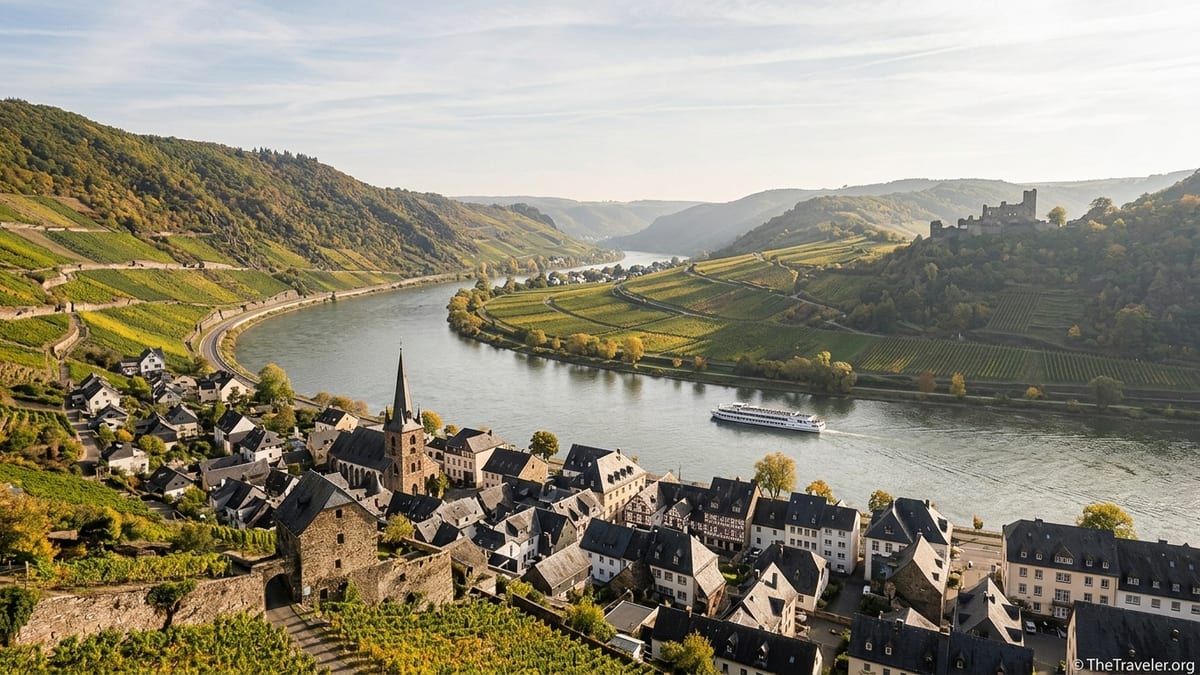
The Rhine and Moselle valleys both combine vineyards, castles and river views, yet they feel noticeably different on the ground. The Middle Rhine Valley between roughly Bingen and Koblenz is narrower and more dramatic, with steep slate cliffs, frequent small towns and many castles within a short distance. Towns like Bacharach, Boppard and St. Goar serve as overnight bases, each with a cluster of guesthouses, a few supermarkets and several traditional restaurants where you can find regional dishes and local wines by the glass. Distances are short and trains and boats frequent, so you can comfortably explore several towns in two or three days.
The Moselle Valley, by contrast, curves gently in wide loops between Trier and Koblenz, with slopes almost entirely planted with vines. Towns such as Bernkastel Kues, Traben Trarbach and Zell feel more overtly focused on wine, with tasting rooms on the main streets and seasonal festivals that fill the riverfront with food stalls and music. Views from hillside chapels or castle ruins look out across broad patterns of vineyards and meanders, which many travelers find especially photogenic. The pace feels slightly slower than on the Rhine, making the Moselle particularly appealing for longer stays of three to five nights, especially if you enjoy walking or cycling along the riverside paths.
Wine enthusiasts often favor the Moselle for its concentration of Riesling producers and the chance to visit family run estates by appointment. It is common to structure days around one or two tastings, then add a short hike or village visit in between, returning to a base in Bernkastel Kues or Trier by late afternoon. Casual wine drinkers may be just as happy on the Rhine, where they can sample local bottles by the glass at almost any restaurant without needing to plan formal tastings. If you are traveling with children or anyone who is not especially interested in wine, the Rhine’s mix of castles, short boat rides and frequent trains can be easier to balance with other interests.
From a logistical perspective, both valleys are easy to reach from Cologne or Frankfurt. The Rhine integrates slightly better with trains, while the Moselle rewards having a car for visits to side valleys and more remote viewpoints. Budget wise, small town guesthouse prices are broadly similar in both regions, though wine festivals and peak summer weekends can push up rates and reduce availability. Booking popular periods such as early autumn harvest time a few months ahead is prudent if you want river view rooms in the most in demand towns.
Trier, Eifel and Saarland: Road Trips and Quiet Landscapes
Trier, west of the Moselle Valley near the Luxembourg border, markets itself as Germany’s oldest city, with substantial Roman remains and a relaxed, student influenced atmosphere. The Porta Nigra city gate, amphitheater and imperial baths can all be visited on foot from the central square, so you can combine a day of sightseeing with café breaks and a stroll along the Moselle promenade. As a base, Trier suits travelers who want a medium sized city with good rail connections and a strong restaurant scene but who also value access to quieter landscapes in multiple directions.
To the north of Trier lies the Eifel, a region of wooded hills, volcanic lakes and small towns. Driving or taking regional buses, you can visit places such as the medieval center of Monschau, the crater lakes near Daun, or the Nürburgring racing circuit, which holds events and track days throughout much of the year. Accommodation ranges from simple guesthouses on village squares to small spa hotels near lakes, with pricing often more modest than in the Rhine wine towns. For families and road trippers, the Eifel can provide a restful pause between more crowded city or river days, with opportunities for short walks, swimming in summer lakes and exploring castle ruins on hilltops.
South of Trier and west of the Rhine, the Saarland region remains off the radar for many international visitors, yet it offers its own mix of industrial heritage, forested hills and wine. The Saar River forms a famous loop at the Saarschleife viewpoint near Mettlach, where a treetop walkway leads to a panoramic platform over the bend and surrounding forests. Nearby, the city of Saarbrücken combines baroque architecture with a distinct identity shaped by its proximity to France. Travelers who enjoy less visited regions, slower tourism and cross border cuisine often find a few nights in Saarland to be a welcome contrast after time in the better known Rhine and Moselle corridors.
A classic road trip loop that includes these areas might run from Cologne to Bonn and the Rhine Valley, then via Koblenz or Cochem to the Moselle and Trier, before cutting north through the Eifel back towards Cologne or Düsseldorf. In seven to ten days this allows you to experience big city culture, iconic river scenery, Roman history and quiet rural landscapes, with daily driving times kept to roughly two hours or less. Even if you rely on trains, you can link Cologne, Koblenz, Trier and Saarbrücken and then use local buses or occasional car rentals for short forays into the hills.
Matching Destinations to Couples, Families and Wine Lovers
Couples often gravitate to the Rhine and Moselle valleys for their combination of scenery, wine and walkable historic centers. A typical romantic stay might pair two nights in Bacharach or Boppard with three nights in a Moselle town such as Bernkastel Kues or Cochem, giving time for sunset boat rides, walks through vineyards and candlelit dinners in half timbered houses. Cities like Cologne and Düsseldorf, with their bars, galleries and riverfront promenades, work well at the start or end of a couples trip, especially if you enjoy live music or design focused hotels.
Families with school age children may prefer a mix of city and countryside. Cologne is popular because its central station connects easily to the airport and other regions, while family friendly attractions like the chocolate museum and zoo are straightforward to reach by tram. A move to Bonn or Koblenz then offers more relaxed evenings and access to short boat trips, cable cars and castles such as Ehrenbreitstein or Reichsburg Cochem, which tend to engage children more than extended museum tours. Accommodation wise, apartment style hotels and guesthouses in the smaller towns can make it easier to self cater simple meals and keep overall costs down.
Dedicated wine travelers usually focus on the Moselle, Saar and neighboring regions such as the Mittelrhein and Ahr, often visiting in late spring or early autumn. Many estates still prefer visitors to book tasting appointments in advance, especially if you want a more detailed explanation in English, so building some flexibility into your schedule helps. Staying centrally in Trier or Bernkastel Kues lets you reach several wineries by short drives or even bike rides along the river, then return to towns with restaurants that offer extensive lists by the glass and bottle. Remember that public transport back to small villages can be limited in the evening, so either plan to stay overnight near tastings or pace your activities carefully if driving.
Budget conscious travelers can enjoy all these regions with careful planning. City cards in Cologne or Düsseldorf sometimes bundle museum entries and public transport at a discount, while in river valleys many guesthouses offer breakfast included, making a simple picnic lunch from local bakeries an easy way to control daily spending. Visiting outside the absolute peak of July and August, for instance in May, June or late September, often brings lower accommodation rates and less crowded boats and castles while still offering long daylight hours and generally mild weather.
FAQ
Q1. How many days do I need to see the highlights of Western Germany?
Most travelers are satisfied with 7 to 10 days, which allows time for one major city such as Cologne or Düsseldorf, plus both the Rhine and Moselle valleys and perhaps a short visit to Trier or the Eifel. If you have only 4 or 5 days, focus on either the Rhine from Cologne to Koblenz or a Cologne and Moselle combination to avoid spending most of your time in transit.
Q2. Is it better to stay in Cologne or Düsseldorf as a base?
Cologne suits first time visitors who want major historic sights, especially the cathedral and Old Town, and convenient rail links south along the Rhine. Düsseldorf is a good base if you prefer a modern feel, enjoy shopping and design, and want easy access to its airport. Since trains between the two take under an hour, some travelers split their stay to experience both atmospheres.
Q3. Do I need a car to explore the Rhine and Moselle valleys?
You do not need a car for the Middle Rhine between roughly Bingen and Koblenz, where trains, buses and boats run frequently and towns are close together. A car becomes more useful on the Moselle and in the Eifel and Saarland, where some viewpoints, small villages and wineries sit away from main train lines. Many visitors compromise by using trains for the Rhine and renting a car for a few days in the Moselle or Eifel.
Q4. Which river valley is better for wine, the Rhine or the Moselle?
Both valleys produce excellent wines, but the Moselle and its side valleys have a particularly dense concentration of Riesling estates and a reputation for steep slate vineyards. Serious wine travelers often prioritize Moselle bases like Bernkastel Kues or Trier, while casual drinkers may be just as happy sampling local bottles in Rhine towns such as Boppard or Bacharach without planning winery appointments.
Q5. What is the best time of year to visit Western Germany’s river valleys?
Late spring from May into June and early autumn around September are often ideal, with long daylight and usually mild weather. July and August can be busier with higher prices and more crowds on boats and in popular castles, while winter brings quieter towns and Christmas markets in cities such as Cologne, Düsseldorf and Trier but fewer boat services and shorter opening hours in some attractions.
Q6. Are these destinations suitable for families with children?
Yes, most of Western Germany is very family friendly. Cities like Cologne and Bonn offer zoos, interactive museums and parks, while river towns provide boat trips, cable cars and castle visits. Choosing accommodations with larger rooms or apartments and building in downtime in quieter areas such as the Eifel or smaller Moselle villages can make trips smoother with younger travelers.
Q7. How expensive is it to travel in Western Germany compared with other parts of Europe?
Costs are generally moderate. City hotel prices in Cologne or Düsseldorf can rise during major trade fairs, but outside those dates it is often possible to find midrange rooms at prices similar to other central European cities. Smaller towns along the Rhine and Moselle may offer better value, especially in guesthouses that include breakfast. Public transport is usually efficient and competitively priced compared with renting a car for the entire trip.
Q8. Can I visit both the Rhine and Moselle valleys in one trip?
Yes, combining both is common and quite easy. Many itineraries start in Cologne, continue to a Rhine base such as Koblenz or Boppard for a few days of cruises and castle visits, then move on to Cochem, Bernkastel Kues or Trier on the Moselle. With 7 to 10 days you can experience both valleys without rushing, especially if you limit yourself to two or three overnight bases.
Q9. Which destinations are best for travelers who prefer quieter, less touristy areas?
In addition to smaller Rhine and Moselle villages away from the busiest stretches, regions such as the Eifel hills and Saarland tend to see fewer international visitors. Towns like Monschau in the Eifel or areas around the Saarschleife viewpoint in Saarland offer walking trails, forests and smaller guesthouses that appeal to travelers seeking a slower pace and more local atmosphere.
Q10. Is English widely spoken in Western Germany’s tourist areas?
In major cities like Cologne, Düsseldorf and Bonn and in well known river towns, you will usually find hotel and restaurant staff who speak at least basic English, and information at main sights is often available in multiple languages. In smaller villages and rural areas, English may be less common, but visitors generally manage well with a few German phrases, gestures and the help of translation apps.