


I thought I knew the Black Forest before I ever set foot there. My imagination was full of cuckoo clocks, chocolate cake and a single waterfall in Triberg. It took a loop through Freiburg, Titisee, Feldberg, Gengenbach, Baden-Baden and a scatter of small villages to realise how much broader, quieter and more complicated the Schwarzwald really is.
Planning a Black Forest Loop Instead of a Single Base
On my first trip I made the classic mistake of planning the Black Forest as a day trip from somewhere else. Once I started plotting train times between Freiburg, Titisee, Triberg and Baden-Baden, I realised that what looks like a single green blob on the map is actually a wide highland plateau stitched together by slow, scenic regional lines. That is when I changed course and planned a loop journey, with three bases and a rental car for part of it.
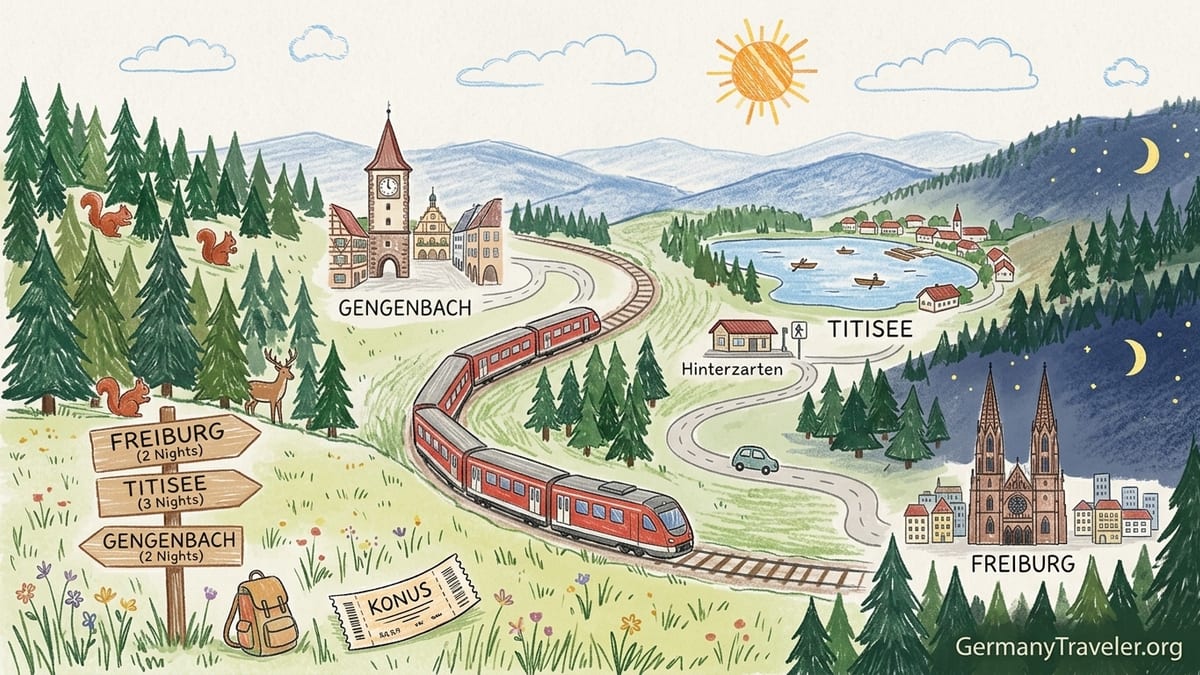
I arrived by train into Freiburg im Breisgau, then used regional trains along the Höllentalbahn to Titisee and Feldberg, and separate lines north toward Offenburg and Gengenbach. For the southern section, my guesthouse near Titisee issued a KONUS guest card, which acted as a free ticket on most regional buses and trains across the Black Forest for the duration of my stay in that municipality. The card covered second class transport within a large network spanning many of the forest’s towns, including the Höllentalbahn and local buses, so I hardly touched my wallet for transit during those days.
My assumption had been that I would “base in Freiburg and pop out” to places like Triberg and Baden-Baden. In reality, journey times mount quickly on winding valley lines. Freiburg to Triberg took about 90 minutes with a change, Freiburg to Baden-Baden more than an hour again, so I split my time instead. I based two nights in Freiburg, three near Titisee and Feldberg, and two in Gengenbach to sample the northern edge and the Rhine valley.
The change from imagining a hub-and-spoke trip to accepting a slow loop changed my expectations. Distances in kilometres are deceptive in the forest. Once I embraced the idea of letting the regional trains and small roads dictate the pace, the whole experience felt less like checking sights off and more like moving through layers of one big landscape.
Freiburg: Sunny Gateway with More City Than Forest
Freiburg was my first surprise. I had pictured a half-timbered village on the edge of a pine forest, but Freiburg is a lively university city with trams, busy squares and café terraces that stay full long into the evening. The forest here sits more as a backdrop on the hills than as an immediate cocoon around you.
I stayed near the edge of the Altstadt, within walking distance of the cathedral and the main station. That location allowed me to roll a suitcase from the train, drop it at the hotel and be on a tram to the Wiehre district in minutes. The Freiburg Welcome card, sold through the local transport association, offered discounts on city activities and covered trams and buses for a fixed daily price, which made hopping between the old town and the cable car base straightforward.
My first walk “into the Black Forest” from Freiburg was actually up Schauinsland. I took tram line 2 to the end and then a bus that climbed steadily through suburbs into proper conifers. The Schauinslandbahn cable car is not included in the KONUS scheme or regular city tickets, so I paid separately at the station. Even in early summer, a light wind cut across the open summit and I was glad for a thin jacket. From the top, the mountains of the southern Black Forest spilled away in long, hazy ridges. That view adjusted another assumption: the Black Forest is not a single, uniform swathe of trees, but a tangle of valleys, farms and open highlands.
Food in Freiburg leaned more toward cosmopolitan than rustic. I expected heavy dumplings and pork at every turn, but ended up eating a vegetarian Flammkuchen on a terrace near the Münster one evening and picking up a slice of Black Forest cake at a city bakery the next day. It was very good, but also made me realise something else. In Freiburg the Schwarzwälder Kirschtorte is almost a brand logo. Later in the smaller villages I found simpler versions with less show and more kirsch, which I preferred.
South of Freiburg: Titisee, Feldberg and Forest That Finally Feels Wild
From Freiburg I took the Höllentalbahn toward Titisee, a route that feels designed to sell train travel. The line climbs steeply through a narrow gorge, crosses viaducts and dives through tunnels. With my KONUS card from a guesthouse near Titisee, this ride did not cost me anything extra. I simply showed the card to the conductor when asked. Looking out the window, I finally saw the close-packed spruce and fir forests that match the Black Forest stereotype.
In Titisee I had assumed I would find a cosy lakeside village. The reality by the station and along the main promenade is unapologetically tourist-heavy, with rows of souvenir shops, clock stores and cafés. The lake itself is beautiful, especially if you walk away from the central jetty along the shore path, but the core feels more like a resort strip. I stayed in a small family-run guesthouse a few minutes uphill from the lake, and that short climb made all the difference. Evenings were suddenly quiet, and I woke to cowbells instead of tour bus engines.
My mistake here was underestimating the scale of Feldberg. On the map, Feldberg, Titisee and Hinterzarten appear almost adjacent. On foot and by bus, the hills and valleys between them stretch time. One day I took a regional bus from Titisee up to Feldberg Pass to reach the Feldbergbahn cable car. The bus was included in KONUS, but the cable car ticket was not. Current winter price lists posted at the station showed combined lift passes for the wider Feldberg ski area, while summer visitors like me bought a simpler return ticket only for the main cable car. At the top station, wooden boardwalks led out to viewpoints and hiking trails snaked off along the ridges.
The weather here was much harsher than I had expected given the early summer date. While Freiburg had been warm in a T-shirt, Feldberg was several degrees cooler, with low cloud scudding across the summit and wind strong enough to send hats skittering along the gravel. I started a ridge walk toward the Feldberg summit with gloves pulled from my daypack, silently congratulating my past self for ignoring the forecast and packing layers. This contrast between the mild Rhine valley and the chilly high forest repeated itself throughout the trip.
Triberg and Gengenbach: Tourist Trap vs Timeless Town
Ask most foreign visitors about the Black Forest and Triberg appears early in the conversation. I went expecting kitsch and waterfalls and ended up finding both, though in different measures than I had assumed. From Titisee I rode the train toward Triberg, changing in Donaueschingen. The route doubles as part of the German Clock Road, passing valleys with clock workshops and farmhouses perched on green slopes.
Triberg station sits above the town, and the walk down into the centre is steep enough to remind you that these are real hills. The main street is a narrow funnel of cuckoo clock shops, cafés and hotels. I had timed my visit for late afternoon, hoping the bus tours would have moved on. Some had, but clusters of visitors still queued for photographs under enormous clock faces. I paid the waterfall entry fee at the ticket booth by the lower entrance. Official information in 2026 lists summer tickets at around 9 euros for adults, with a small reduction in winter, and that matched what was charged. The path up beside the falls is attractive, with wooden walkways, viewpoints and red squirrels that are far too used to humans.
What surprised me most in Triberg was how little of the town beyond the waterfalls and the clock shops is emphasised. There is a church and some quieter residential streets, but it is hard to shake the feeling that everything funnels you back toward the same few storefronts. My original plan had included a night here. After an afternoon visit, I was glad I had chosen instead to stay elsewhere and use Triberg as a stop, not a base.
By contrast, Gengenbach, reached by regional train from Offenburg, felt like the old Black Forest town I had been looking for. The station is a short, flat stroll from the walled Altstadt, where half-timbered houses line a wide main square. I stayed in a small inn above a restaurant just inside the town gate. The inn participated in a regional guest card scheme that included KONUS coverage, so again my local train and bus travel was effectively prepaid through the visitor tax.
Gengenbach rewarded slow time. I wandered the side streets in early morning while bakery vans were still unloading bread, then walked up to a chapel on the hillside for a view back over the tiled roofs. In the late afternoon, when day trippers thinned out, I took a circular walk through nearby vineyards and back along the Kinzig river. This balance of liveable small town and quick access to footpaths made me wish I had given Gengenbach an extra night and used it as a base for exploring more of the central and northern Black Forest.
Baden-Baden and the Northern Black Forest: Elegance at the Edge
From Gengenbach I drove north into the edge of the Northern Black Forest, skirting toward Baden-Baden. The change in atmosphere from the southern highlands around Feldberg was immediate. Here, the forest feels drier and more open, the valleys wider, and the towns carry a spa-town elegance shaped by centuries of visitors. I returned my rental car at Baden-Baden’s station, then took a bus into the centre, where grand 19th-century buildings flank manicured parks.
Baden-Baden does not participate fully in the KONUS guest card scheme, so I could not rely on free regional transport here. Instead, I bought standard regional train and bus tickets through the local transport association. That was a helpful reminder that regional guest cards are a patchwork. Even within the greater Black Forest area, each municipality chooses whether and how to participate, so you cannot assume that one card will cover you everywhere. In practice, this meant my days based in spa towns were slightly more expensive for transport than the days based in small forest villages.
The town itself handles its forest access differently from the southern villages. From the centre, waymarked walking routes lead directly into the trees. One afternoon I followed a path from the Kurhaus area up toward the Merkur mountain station. The climb wound past villas into mixed forest, with occasional views back over the town and the Rhine valley haze beyond. A funicular runs to the summit of Merkur, with tickets sold at the lower station. Prices were posted in both German and English, and in 2026 remained modest compared with major alpine cable cars. At the top, the view north along the forest ridge illustrated how the Northern Black Forest unrolls like a long, wooded balcony above the Rhine.
What I had not expected was how much of Baden-Baden’s appeal lies in doing very little. After action-heavy days around Feldberg, sitting in a park with a coffee, watching locals and visitors drift between the colonnades and the casino, felt like reset time. If I had planned differently, I would have scheduled Baden-Baden either at the very start or the very end of my loop to act as a decompression chamber, rather than wedging it in between hiking days.
Driving, Trains and Guest Cards: What Actually Worked
Before this trip I assumed I would either need a rental car for the entire time or that trains alone would be enough. The reality sat in the middle. The combination that worked best for me was to rely on trains and buses covered by guest cards for the Freiburg, Titisee and Gengenbach segments, and to rent a car only for two days to explore more remote trailheads and small villages between those bases.
The regional trains themselves were reliable but not fast. Many routes are single track and wind through valleys, which makes for beautiful window-gazing but also means that a missed connection can cost you an hour. I learned to accept this and plan only one or two main moves in a day. The KONUS guest card, issued automatically by participating hosts when you check in and pay the local tourist tax, saved noticeable money over those days, especially on routes like Freiburg to Titisee, Titisee to Feldberg bus connections, and local trains around Gengenbach. The card covered second class travel on participating bus, tram and regional train networks across a wide Black Forest area, but not on long-distance ICE or IC trains and not on most cable cars or special tourist lines.
Driving added flexibility in places where bus frequencies drop in the afternoon. I picked up a compact rental car in Freiburg and drove the Schwarzwaldhochstrasse portion above the Rhine valley, detouring into quiet villages for short walks. Parking in small towns was often free or very cheap in signed municipal lots on the edge of the centre, with a short stroll into the old streets. In Titisee and Triberg, parking lots near the main attractions charged posted fees, with machines that accepted coins and in some cases cards. I always kept some euro coins handy for rural machines that had not yet gone fully digital.
For hikers, one surprise was how well waymarked many trails are directly from stations and bus stops. In Hinterzarten, for example, I stepped off the train, followed yellow and green signs out of the village and within fifteen minutes was on a forest path with no cars in earshot. I had over-prepared with GPS downloads and offline maps, but on clear days and main routes, the local trail signage was usually enough.
If I changed one logistical thing next time it would be to cluster my KONUS nights. Because the card is tied to each stay and municipality, switching accommodations every night resets the card but also fragments its usefulness. Staying at least two or three nights in each KONUS-participating base and planning outward excursions from there gives the best balance between variety and simple, free transport.
Weather, Seasons and How the Forest Felt Different North and South
I visited in late spring and again for a shorter return in early autumn, and both times the weather reshaped my plans. In the south, around Feldberg and the high plateau, conditions were always cooler and more volatile than in Freiburg or Baden-Baden. On one June day I left Gengenbach under blue skies and arrived near Feldberg under low cloud and drizzle, with temperatures at least eight degrees lower. That made me grateful for flexible plans and reinforced the advice I had heard from locals: treat the Black Forest like low mountains, not like just “hills behind town.”
In the Northern Black Forest, particularly around Baden-Baden and the ridge road, the weather felt slightly drier and more settled during my stays. Forest walks here alternated between dense conifer stands and more open mixed woods with broadleaf trees, and there were more frequent clearings with views over the Rhine valley. The landscape itself felt more like a long, undulating ridge. In the south, the forest wrapped around high, rounded summits and deep basins dotted with lakes like Titisee and Schluchsee, so walks often combined dense forest sections with sudden open moor-like plateau areas.
The emotional feel differed too. The Southern Black Forest around Titisee and Feldberg felt wilder and more remote once I stepped away from the lake promenades and lift stations. Even short walks from trailheads quickly left traffic noise behind, and the combination of boggy ground, wind and distant cowbells made it feel closer to an alpine foothill region. The north felt more domesticated. Paths often linked viewpoints, huts and historical sites, and I was rarely far from a bench or a signed side-trail back to a parking area.
If you have flexibility on timing, my experience pointed to late September as the sweet spot. On my shorter autumn visit, the forests above Gengenbach glowed in early colour, the days were still long enough for comfortable hikes, and the main school holiday crowds had thinned. Some high mountain facilities began to shorten their operating hours outside of peak season, so it became more important to check cable car and bus timetables, but the compensation was quiet trails and cool, clear evenings that made spa towns like Baden-Baden particularly appealing.
What I Would Do Differently Next Time
Every trip rewrites the next one. Looking back on my Black Forest loop, a few decisions stand out as things I would adjust on a return visit. The first is time allocation. I gave Titisee two full days and Feldberg only one, while treating Gengenbach as a brief stop. In hindsight, I would shift at least one of those Titisee days to Gengenbach or another central-north base town like Haslach or Wolfach. The lake is pleasant, but once you have walked the shoreline and taken a short boat ride, the extra time is better spent getting into quieter valleys.
I would also resist the temptation to chase too many named sights in one go. On paper, it is possible to visit Triberg, a farm museum valley and a lake all in a single long day, especially with a rental car. In practice, that compresses everything into snapshots. My most satisfying days were those when I chose one core activity, such as hiking a loop on Feldberg or exploring Baden-Baden’s forest paths, and allowed space around it for small, unplanned stops at roadside chapels, village cafés or quiet corners of town squares.
The final adjustment would be in how I treat the guest card systems. On this trip, I more or less took whatever card each host handed me at check in and only later realised how valuable the KONUS coverage and, in the highland region, the separate Hochschwarzwald Card can be for specific attractions. Next time, I would choose accommodations more deliberately based on which cards they issue, especially if I planned to use included or discounted entries to lifts, museums or guided activities. That might mean paying slightly more per night in a participating guesthouse but spending less overall on experiences.
Despite these tweaks, the biggest lesson was that the heart of the Black Forest lies in the spaces between the famous names. Triberg, Titisee and Baden-Baden provide anchors and recognisable labels on a map, but the memories I return to most often are the unnamed viewpoints on quiet forest roads, the anonymous bakery where the Black Forest cake was more kirsch than cream, and the cool stillness of a path behind Gengenbach at sunset.
The Takeaway
Travelling beyond Triberg in the Black Forest shifted my understanding from a postcard of one waterfall and one cake to a layered landscape of ridges, villages and forest that demands time and rewards slowness. Moving in a loop instead of striking out on day trips from a single base let me feel how different the northern, central and southern sections truly are, from the spa-town polish of Baden-Baden to the brisk, high pastures near Feldberg.
The guest card systems, especially KONUS, turned out to be more than small perks. In practice they reshaped how I moved, nudging me toward regional trains and buses and away from fitting the forest into a single driving day. My assumptions about where to stay were also challenged. The town that looked most famous on paper, Triberg, worked best for me as an afternoon excursion, while less heralded Gengenbach quietly became the place I now recommend most often as a base.
If you are planning your own Schwarzwald journey, the most useful question to ask might not be “Is Triberg worth it?” but “How much time can I give the forest itself?” Once you treat the Black Forest as a region to live in for a week, not a checklist to complete in a day, the details of guest cards, bus routes, forest walks and village bakeries start to fall into place. The surprises then are less about crowds or prices and more about how quickly the forest begins to feel like somewhere you could return to in every season.
FAQ
Q1. Is Triberg worth visiting if I am short on time?
Yes, Triberg is worth a stop for the waterfalls and a sense of the Black Forest’s clock-making image, but in my experience it works best as a half-day visit rather than a base. The main street is very focused on souvenir shops, and if you have limited time you may get more variety by combining Triberg with a quieter town such as Gengenbach.
Q2. How useful was the KONUS guest card for getting around?
For me the KONUS guest card was one of the most useful tools on the trip. In participating municipalities, my accommodation issued it at check in, and it acted as a ticket for second class travel on many regional buses and trains across the Black Forest during my stay. It did not cover long-distance trains or most cable cars, but for routes like Freiburg to Titisee, Titisee to Feldberg Pass and local trains around Gengenbach, it meant I did not have to buy individual tickets.
Q3. Do I need a rental car to explore the Black Forest properly?
You can see a great deal of the Black Forest by train and bus alone, especially if you base in towns with good connections such as Freiburg, Titisee, Hinterzarten or Gengenbach. I chose to rent a car for two days to reach quieter trailheads and to drive scenic ridge roads at my own pace. That combination worked well. If you dislike driving on narrow mountain roads, you can skip the car and focus on rail-accessible valleys and well-served bus routes.
Q4. How different did the northern and southern Black Forest feel?
To me the south around Feldberg and Titisee felt higher, cooler and wilder, with rounded summits, deep basins and lakes tucked into the landscape. Once I left the main resorts, paths quickly became quiet and the forest felt remote. The northern Black Forest near Baden-Baden and the ridge roads felt more open and domesticated, with mixed woods, frequent viewpoints over the Rhine valley and easier access from spa towns and villages.
Q5. When is the best season to visit based on your experience?
I visited in late spring and again in early autumn. Late spring offered lush greenery and long days, but the high areas around Feldberg were still cool and changeable. Early autumn, particularly late September, was my favourite, with early colour in the trees, comfortable hiking temperatures and fewer crowds. In both seasons I needed layers, because temperatures at higher elevations were significantly lower than in Freiburg or Baden-Baden.
Q6. Which town would you choose as a base if you returned?
If I returned for a week, I would likely split my time between Gengenbach in the central-north and a village near Feldberg or Hinterzarten in the south. Gengenbach offered a beautiful old town feel with easy train access along the Kinzig valley, while the southern base made it simple to reach highland hikes and lakes. I would still include Freiburg and Baden-Baden for city and spa time, but probably as shorter stays at the beginning or end of the trip.
Q7. How expensive were attractions like waterfalls and cable cars?
On my trip, the Triberg waterfalls charged around 9 euros for an adult ticket in summer, with a slightly lower price in winter, and this matched current official information. Cable cars such as the Schauinslandbahn near Freiburg and the Feldbergbahn near Feldberg charged separate tickets, generally less than major alpine gondolas but still noticeable if used often. These lifts were not included in the KONUS card, though some regional guest cards offered small discounts.
Q8. What kind of hikes did you enjoy most?
My favourite hikes were moderate half-day loops that combined forest sections with open views. In the south, a ridge walk from the Feldbergbahn top station across rounded summits gave wide panoramas and a sense of the region’s height. Around Gengenbach, a circular route through vineyards and low forested hills above the town offered softer scenery and easy navigation. From Baden-Baden, the path up through the woods toward the Merkur funicular blended town views with genuine forest walking.
Q9. How crowded did the main sights feel?
The main sights varied. Triberg and central Titisee felt crowded in the middle of the day, especially when tour buses were parked nearby. Early morning and late afternoon were noticeably quieter. Feldberg’s summit area near the cable car stations attracted people on fine days, but even there, stepping a little way along side trails reduced the sense of crowding. Towns like Gengenbach and many smaller villages had a steady but gentle flow of visitors rather than dense crowds.
Q10. What would you pack differently after this trip?
After experiencing how quickly weather changed between valleys and high ridges, I would put even more emphasis on layers. A light waterproof jacket, hat and gloves earned their place in my daypack even in June. I would also bring comfortable walking shoes suitable for both town cobblestones and muddy forest paths, and a small supply of euro coins for rural parking machines and small cafés that did not take cards. With those basics, the Black Forest felt welcoming rather than logistically difficult.