


Eastern Germany might be one of Europe’s easiest regions to explore by train. Dense rail networks, integrated local transport and a powerful 49 euro monthly pass mean you can string together Berlin, Potsdam, Leipzig, Dresden and even wilderness areas like Saxon Switzerland or the Spreewald without ever touching a car. This guide focuses on how to do it in practice: which trains to take, what tickets to buy, how to deal with luggage and where you can realistically reach nature using only public transport.
Understanding Germany’s Rail System for This Route
Planning an Eastern Germany itinerary starts with understanding the three main categories of trains you will use. For fast hops between major cities like Berlin, Leipzig and Dresden, long-distance trains branded ICE and IC are usually the quickest, often with air conditioning, onboard bistro and reserved seats. A typical ICE from Berlin Hauptbahnhof to Leipzig Hauptbahnhof takes around 1 hour 15 minutes in normal conditions and, if booked in advance with a saver fare, can cost from under 20 euros one way in second class on less popular departures. These long-distance services are not covered by the nationwide 49 euro Deutschlandticket, so you pay per journey.
For budget-conscious travelers or those using the Deutschlandticket, regional trains are the workhorses of this itinerary. These include Regionalexpress (RE), Regionalbahn (RB) and S-Bahn suburban lines. They are slower and make more stops, but they connect almost every town along your route and feed into local buses, trams and metros on a single ticket. For example, an RE from Berlin to Leipzig might take close to three hours with changes, but you can ride it using only the Deutschlandticket and then immediately board Leipzig’s trams without buying anything extra.
Within each city, local transport companies run dense networks of U-Bahn, S-Bahn, trams and buses that are integrated with the rail system and ticketing. In Berlin and Potsdam, the Verkehrsverbund Berlin-Brandenburg (VBB) sets common fares and zones that cover S-Bahn lines, regional trains, trams and buses. Leipzig and Dresden are covered by their own transport associations, which also integrate city trams and the surrounding regional trains. In practice, this means you can step off an intercity train and rely on the same ticket, or the same monthly pass, to reach your hotel by tram or bus.
For most visitors, the key decision is whether to base the trip around the Deutschlandticket or to piece together long-distance fares. If you expect to ride regional and local transport frequently over several days, including day trips into nature, the flat-rate pass usually pays off quickly. If your plan is a short, fast city-hopping journey with only two or three major long-distance segments, advance-purchase ICE tickets might be more convenient and only slightly more expensive overall.
Tickets and Passes: How to Keep Costs Under Control
The most significant development for train travelers in Germany is the nationwide Deutschlandticket, a monthly subscription that gives unlimited travel on local and regional public transport across the country. The standard price has been 49 euros per month for adults, and it is valid on all regional and suburban services such as RE, RB, S-Bahn, U-Bahn, trams and most local buses operated by participating transport associations. You can use it freely between Berlin, Potsdam, Leipzig and Dresden on regional trains, as well as for local travel within these cities. It does not cover ICE, IC, EC or other long-distance trains, and it is issued as a personal ticket, which means it is non-transferable.
Because the Deutschlandticket is sold as a subscription, you typically buy it through a local transport app such as BVG or S-Bahn Berlin, or at a customer center, and set the start date for the first day of a calendar month. Visitors can usually pay with a major credit card, although some channels still prefer German or SEPA bank accounts, so it is worth checking conditions well before your trip. If you will be in Germany only for part of a month, you still pay for the full month, so the pass makes most sense if you will be doing intensive travel over at least a week.
If you prefer flexibility or are staying only a few days, you can combine ordinary single or day tickets with targeted long-distance fares. In Berlin and Potsdam, for example, a standard Berlin ABC single ticket covering the city plus Potsdam area costs a small single-digit euro amount and is valid for a continuous journey plus short transfers. Day tickets for Berlin AB or ABC zones can be cost effective if you expect to ride trams and U-Bahn multiple times, especially on sightseeing days that include a side trip to Potsdam’s palaces. In Saxony, Leipzig and Dresden offer their own city day passes and regional day tickets that allow unlimited use of suburban trains and trams within a specified area until early the next morning.
For long-distance segments where you want speed, such as Berlin to Leipzig or Berlin to Dresden in around two hours or less, consider booking with Deutsche Bahn’s saver fares. If you search several weeks in advance on less busy days or off-peak times, you may find second-class fares from roughly 20 to 30 euros on ICE or IC trains. The main trade-off is flexibility: the cheapest tickets are often tied to specific trains, and changes can be expensive. A common strategy is to use the Deutschlandticket or day passes for regional travel and nature excursions, then add one or two long-distance tickets to keep the overall trip duration reasonable.
Core Intercity Routes: Berlin, Potsdam, Leipzig and Dresden
Berlin is your natural entry point, with a central hub at Berlin Hauptbahnhof. From here, frequent S-Bahn and regional trains radiate to all corners of the city and beyond. The short hop to Potsdam is one of the easiest day trips in Germany: S-Bahn line S7 and several regional trains connect Berlin city stations with Potsdam Hauptbahnhof in roughly 25 to 40 minutes, depending on where you board. With the Berlin ABC zone covered either by a day ticket or the Deutschlandticket, you can ride as often as you like and simply walk or take a tram from Potsdam station to Sanssouci Palace and the New Garden.
Travel between Berlin and Leipzig illustrates the choice between speed and cost. Fast ICE trains generally run at least hourly and take around 1 hour 15 minutes between Berlin Hauptbahnhof and Leipzig Hauptbahnhof in normal timetable periods. Booking these in advance can save a lot of time, especially if your stay in Leipzig is limited to one or two nights. On the other hand, regional connections using RE and RB trains are slower and can involve changes in cities like Lutherstadt Wittenberg, but they are fully covered by the Deutschlandticket and may appeal if you are following a slower, more budget-conscious itinerary with stops along the way.
Berlin to Dresden is another important corridor. Intercity services typically connect Berlin Hauptbahnhof or Südkreuz to Dresden Hauptbahnhof in about two hours, passing through the flat landscapes of Brandenburg and Saxony. Advance-purchase IC tickets can keep costs manageable, but if you are traveling on a tight budget and have time, you can piece together regional routes via towns such as Elsterwerda or Cottbus. Regional travel on this route can easily take three hours or more, but it is included in the Deutschlandticket and also lets you board connecting S-Bahn lines in Dresden to continue straight into the Elbe valley or up toward the Ore Mountains.
Potsdam itself can serve either as a stand-alone base or as an easy extension of Berlin. If you prefer a quieter atmosphere but still want frequent rail access, staying near Potsdam Hauptbahnhof allows you to day-trip into Berlin using the same regional lines and S-Bahn you would use in reverse. Trains often run several times an hour at peak times, and the integrated tariff means you do not need separate city and commuter tickets. In practice, a traveler might sleep in Potsdam, catch an early S-Bahn into Berlin Mitte for museums, then return in the evening for a walk through the park at Sanssouci, all on a single all-day ABC ticket or with the Deutschlandticket.
Nature Without a Car: Saxon Switzerland, Spreewald and Lakes
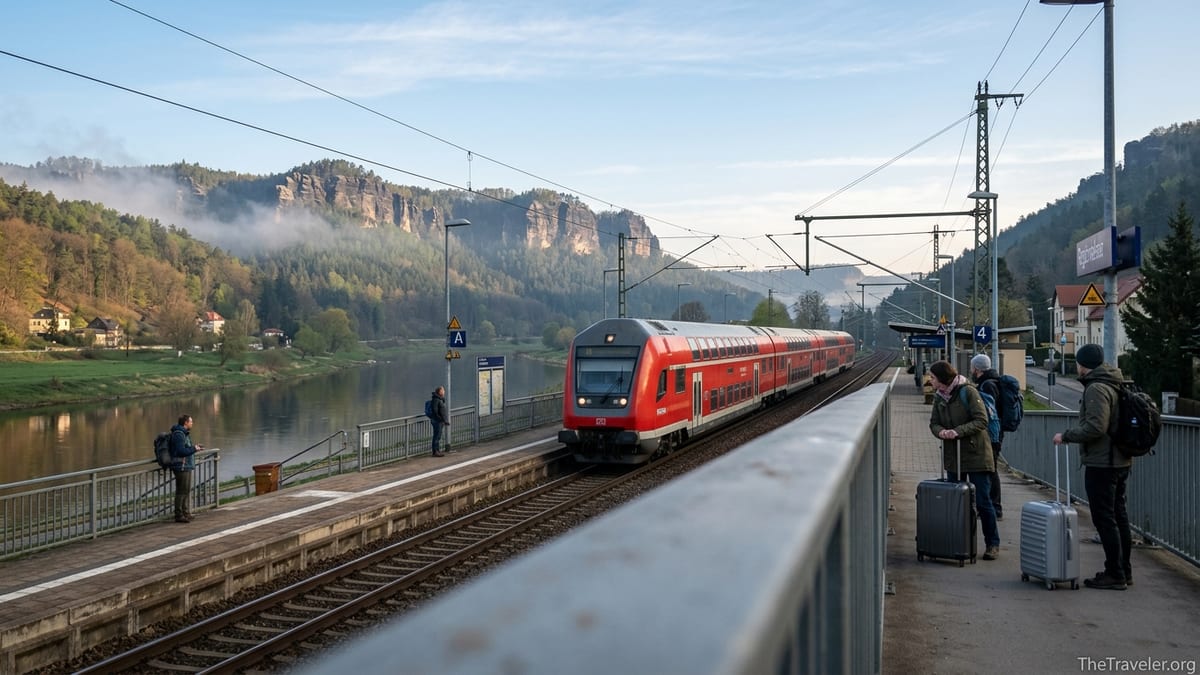
One of the strongest arguments for exploring Eastern Germany by rail is how easily you can reach serious nature without driving. The most famous example is Saxon Switzerland National Park, a striking sandstone landscape southeast of Dresden. From Dresden Hauptbahnhof or Dresden-Neustadt, you can take the S-Bahn line along the Elbe to towns like Rathen or Bad Schandau in under an hour, with trains generally running several times per hour during the day. From these small stations, local buses and ferries fan out to trailheads, viewpoints like the Bastei Bridge and hilltop fortresses.
Bad Schandau functions as a practical gateway for hikers traveling only by public transport. Trains arrive on the south bank of the Elbe, from where a short ferry ride crosses to the town on the north bank. Local buses and a small tram line into the Kirnitzsch valley connect to popular routes, and many trailheads begin right on the edge of town, eliminating the need for any private vehicle. The entire journey from Dresden to the start of a hike can be made using regional trains, buses and ferries, usually all covered by regional day tickets or by the Deutschlandticket for the rail and bus sections.
From Berlin or Leipzig, the Spreewald biosphere reserve is another realistic nature excursion without a car. Regional trains from Berlin Hauptbahnhof or Ostkreuz run to Lübbenau and other Spreewald towns that act as embarkation points for canoe trips and traditional punt boat excursions. Walking from the station into town centers usually takes around 10 to 15 minutes, and rental agencies often sit right on the canals. A typical day trip might see you leaving Berlin mid-morning, paddling quietly through the forested waterways for several hours, then returning on an afternoon RE train using only regional tickets or your Deutschlandticket.
Closer to Berlin and Leipzig, many lakes and low hills are also rail-accessible. From Berlin, S-Bahn lines and regional trains lead to lakes such as Wannsee and Müggelsee, where you can step off the train and be at the shoreline in minutes. From Leipzig, local trains and S-Bahn services reach the so-called Neuseenland, a chain of former open-cast mines that have been flooded into recreational lakes. Towns like Markkleeberg are just a short suburban ride away and have walking and cycling paths circling the water. In each case, careful choice of accommodation near a station lets you start hiking or swimming days with nothing more than a short walk from the platform.
Regional Transport in Each City: How to Move Around Easily
Berlin’s public transport network can feel overwhelming at first glance, but it is straightforward when you think in layers. S-Bahn and U-Bahn lines form the backbone, with trams and buses filling the gaps. Stations like Hauptbahnhof, Alexanderplatz, Friedrichstrasse and Ostkreuz serve as key nodes where long-distance, regional and urban services intersect. Tickets are based on zones: A and B cover the main city, while C extends to surrounding areas including Potsdam and the airport. With any AB or ABC day ticket, or with the Deutschlandticket, you can hop on and off S-Bahn, U-Bahn, trams and buses without worrying about separate fares.
Potsdam’s network is smaller and more relaxed. From Potsdam Hauptbahnhof, modern trams head out toward Sanssouci Park, the Dutch Quarter and residential areas around the lakes. Most visitors only need to remember that if they hold a valid Berlin ABC ticket or a Deutschlandticket, they can switch between S-Bahn, regional trains and these trams without extra payment, as all are part of the same VBB fare zone system. Staying within walking distance of either Potsdam Hauptbahnhof or a central tram stop is usually enough to cover all main sights on foot and by tram.
Leipzig is famous among rail fans for its huge historic Hauptbahnhof, but its real advantage for visitors is the tight integration between regional rail and trams. When you arrive, you can walk directly from the mainline platforms into the station’s shopping arcade and then out to tram stops serving all directions. Many hotels and guesthouses are within 10 to 15 minutes on foot or a short tram ride. For shorter stays, a 24-hour city ticket plus occasional Deutschlandticket-backed regional rides to nearby lakes or towns can be more economical than renting a car even for small groups.
Dresden’s system is centered on Dresden Hauptbahnhof and Dresden-Neustadt, both of which are linked by frequent trams and S-Bahn services. Many of the city’s main attractions, from the rebuilt Frauenkirche to the Zwinger palace complex, are within a 10 to 20 minute tram ride of either station. The same S-Bahn lines that carry commuters also extend along the Elbe into Saxon Switzerland, so you can board a suburban train near your city accommodation and be in the middle of sandstone cliffs within an hour. Because trams and trains share a ticket system, using a day ticket or Deutschlandticket lets you move seamlessly between baroque architecture and hiking trails on the same day.
Luggage, Seat Reservations and Station Logistics
Traveling this route by train with luggage is generally straightforward if you follow a few simple practices. Most long-distance and regional trains have overhead racks for small and medium bags, plus luggage shelves at the ends of carriages for larger suitcases. On ICE and IC trains between Berlin, Leipzig and Dresden, you may need to lift your bag up several steps from the platform, so packing a suitcase you can comfortably carry matters more than on airport-style rolling routes. When boarding, it is polite to move your luggage quickly out of the door area to avoid blocking other passengers.
Seat reservations are optional on many ICE and IC trains but can be a good investment on busy days, especially Fridays, Sundays and holiday periods. Reservation fees are modest compared with the ticket price and guarantee you a specific seat for the long-distance segment, which is helpful if you have bulky luggage or are traveling with children. On regional trains, seats are generally first come, first served, and there are no reservations. At peak commuter times or on popular leisure routes such as the S-Bahn to Saxon Switzerland on sunny weekends, trains can become crowded. In those cases, traveling early in the morning or outside the busiest midday window can make a big difference in comfort.
Major stations on this route are well equipped with services useful to travelers. Berlin Hauptbahnhof, Leipzig Hauptbahnhof and Dresden Hauptbahnhof all offer lockers in various sizes, usually coin or card-operated and rentable for several hours or a full day. This makes it easy to store your luggage and explore a city between check-out and an evening train. Supermarkets, bakeries and simple restaurants are typically located in or near the station concourses, so you can pick up picnic supplies for the train or a hike in Saxon Switzerland without detours.
Accessibility is another strong point of German rail infrastructure. Most major stations have lifts, escalators and tactile paving, and many newer trains have low-floor entrances or fold-out ramps. That said, some smaller regional stations, especially in rural Saxony and Brandenburg, still involve stairs or high steps into the train. If step-free access is essential, it is wise to check the “barrier-free” information in the journey planner or app for each connection. In many cases, choosing a different departure time or route can secure a fully accessible alternative without changing the overall duration significantly.
Sample Itineraries Using Only Trains and Local Transport
To see how the pieces fit together, imagine a one-week itinerary anchored by the Deutschlandticket. You might start in Berlin for three nights, using S-Bahn and U-Bahn to explore neighborhoods and museums and taking a day trip to Potsdam. On day four, you ride regional trains via Lutherstadt Wittenberg to Leipzig, perhaps stopping for a quick look at the historic center before continuing. After two nights in Leipzig, you board a regional train to Dresden, changing once along the way, and then use Dresden’s S-Bahn on your final day for a hiking excursion into Saxon Switzerland. Throughout, you never buy a single extra rail ticket beyond the monthly pass, only occasional city day tickets where useful.
For travelers who value speed on the long legs but still want car-free access to nature, a hybrid approach works well. Another sample itinerary would be to purchase advance ICE tickets from Berlin to Leipzig and from Leipzig to Dresden, scheduling them at times that fit your hotel check-in and check-out. In each city, you then rely on local day passes or the Deutschlandticket for urban transport and nearby day trips. From Dresden, you might allocate one full day for an S-Bahn and bus combination into Saxon Switzerland and another for a gentler Elbe valley bike ride, renting bicycles directly in the city and carrying them on selected regional trains where permitted.
If your time is even more limited, you can still sample both urban and natural highlights with carefully chosen day trips. Staying in Berlin, for instance, you could dedicate one day to Potsdam’s palaces, another to a long regional journey into the Spreewald for canoeing, and a third to a fast ICE hop to Leipzig or Dresden and back the same day. This kind of pattern uses a mix of regional passes and individual long-distance tickets but avoids hotel changes, which can be appealing for families or travelers who prefer a single base.
In all these scenarios, the essential planning tool is a reliable journey planner app, ideally the official rail operator’s or the local city transport app. These allow you to filter for regional trains only, which is crucial when traveling with the Deutschlandticket, and to check real-time platform information and delays. Once you become comfortable glancing at these apps and recognizing the train categories, stringing together car-free routes across Eastern Germany becomes little more complicated than planning a city’s metro trip.
The Takeaway
Exploring Eastern Germany by train is not just feasible, it is often the most enjoyable and economical way to connect major cities and natural landscapes. Berlin, Potsdam, Leipzig and Dresden are tied together by frequent rail services, and each city’s local transport network plugs directly into regional lines that reach lakes, forests and sandstone cliffs. With the Deutschlandticket providing a simple, flat-rate option for month-long regional travel, even complex itineraries can be reduced to a single digital pass and a handful of targeted long-distance tickets.
By understanding the basic train categories, choosing the right mix of passes and point-to-point fares, and leveraging integrated local transport systems, you can craft a car-free journey that feels both flexible and efficient. Whether you are gliding past Elbe vineyards toward Saxon Switzerland, stepping off a tram into Potsdam’s palace gardens or unpacking your luggage directly in the grand halls of Leipzig’s Hauptbahnhof, the rail network becomes part of the experience. For travelers who value sustainability, comfort and the ability to improvise, Eastern Germany’s trains and trams offer an inviting way to move at your own pace.
FAQ
Q1. Can visitors from abroad buy the Deutschlandticket for this route?
Yes. Most transport apps and customer centers sell the Deutschlandticket to non-residents, usually as a monthly subscription paid by credit card or SEPA, though conditions vary by provider.
Q2. Does the Deutschlandticket cover all trains between Berlin, Leipzig and Dresden?
No. It covers only local and regional trains such as RE, RB and S-Bahn. High-speed ICE and IC intercity services require separate long-distance tickets.
Q3. How far in advance should I book ICE or IC tickets?
Booking three to eight weeks ahead usually offers the best balance of price and availability, especially for popular routes like Berlin to Leipzig or Berlin to Dresden on weekends.
Q4. Do I need to reserve seats on regional trains?
No. Regional trains in this area generally do not offer seat reservations. Seating is first come, first served, so traveling outside peak commuter hours improves your chances of finding a seat.
Q5. Is it realistic to visit Saxon Switzerland as a day trip from Dresden by public transport?
Yes. S-Bahn trains from Dresden reach gateway towns like Bad Schandau in under an hour, with buses and ferries connecting directly to popular hiking areas.
Q6. Can I reach Spreewald from Berlin without renting a car?
Yes. Regional trains run from Berlin to towns such as Lübbenau, from where it is a short walk to canoe rentals and boat tours in the Spreewald canals.
Q7. Are large suitcases a problem on German trains?
Usually not. Most long-distance and many regional trains have luggage racks near the doors or at the coach ends, but you should still pack a suitcase you can comfortably lift.
Q8. How do I know if my train is regional or long-distance in journey planners?
In most apps, long-distance services are labeled ICE, IC or EC, while regional ones use abbreviations such as RE, RB and S. Filtering for “local transport only” usually hides long-distance trains.
Q9. Is it better to base in one city or to change hotels along the route?
Both work. With fast ICE links, you can day-trip from Berlin to Leipzig or Dresden, but staying a night or two in each city offers a more relaxed pace and easier early-morning nature trips.
Q10. Are German train stations safe to use early in the morning or late at night?
Major stations like Berlin, Leipzig and Dresden are generally well lit and staffed, but, as in any large city, it is sensible to stay aware of your surroundings and keep valuables secure.