


Eastern Germany combines heavyweight cultural cities, tranquil waterways and dramatic sandstone peaks, all stitched together by one of Europe’s most efficient rail networks. For first-time visitors, it can feel like a lot: Berlin’s nightlife and museums, Dresden’s baroque skyline, Leipzig’s creative energy, the palace parks of Potsdam, and the forested canals of the Spreewald. This guide pulls the region together, focusing on Berlin, Brandenburg, Saxony and Saxony-Anhalt, with concrete examples of routes, costs and places to stay so you can confidently plan your first trip.
Orienting Yourself: The Eastern Germany Essentials
When travelers talk about eastern Germany, they usually mean the federal states that once formed the GDR: Berlin, Brandenburg, Saxony, Saxony-Anhalt, Thuringia and Mecklenburg-Western Pomerania. For a first visit focused on cities and easy nature escapes, most people concentrate on Berlin and Brandenburg plus Saxony and Saxony-Anhalt, since they are tied together by dense train links and can be combined into a one to two week itinerary without renting a car.
Berlin is the main entry point, with direct flights from across Europe and North America, and fast rail connections from hubs like Frankfurt and Munich. From Berlin, it is around 30 minutes by regional train to Potsdam, about 1 hour to the Spreewald region, 2 hours to Leipzig and roughly 2 hours to Dresden on Intercity or ICE trains. Saxon Switzerland National Park and the Bastei Bridge are an easy onward hop from Dresden, while places like Wittenberg and Dessau in Saxony-Anhalt sit on the rail line between Berlin and Leipzig.
For a first-timer, a logical structure is to treat Berlin as your base for four or five nights, add two or three nights split between Dresden and Saxon Switzerland, and another two or three nights in Leipzig or the Spreewald. If you prefer a slower pace, you can simply pair Berlin with either Dresden or Leipzig for a week, adding day trips instead of changing hotels frequently.
Eastern Germany is generally safe, walkable and well signposted in both German and English in major cities. Card payments are widely accepted, though you will still encounter smaller cafés and Spreewald boat operators that prefer or only take cash, so it is sensible to carry at least 30 to 50 euros in notes and coins for incidentals each day when you leave the big cities.
Berlin, Potsdam and the Urban Heart of the Region
Most first-time itineraries start with Berlin, where you can easily fill three to five days without leaving the city. You might spend one day around Museum Island and Unter den Linden, visiting the Pergamon’s temporary exhibitions or the Neues Museum before heading to the Brandenburg Gate and the Memorial to the Murdered Jews of Europe. Another day could be devoted to the East Side Gallery, the Berlin Wall Memorial on Bernauer Strasse and the trendy cafes and bars of Kreuzberg and Neukölln. In practice, a 24-hour Berlin public transport ticket for zones AB costs around 10 to 12 euros and will get you between these areas on U-Bahn and S-Bahn trains plus buses and trams.
Accommodation in central Berlin ranges from simple hostels at roughly 30 to 40 euros per night in shared dorms to mid-range hotels in Mitte or Prenzlauer Berg for about 110 to 180 euros per night for a double room outside big event periods. For example, a basic but modern chain hotel near Alexanderplatz might quote 140 euros for a flexible double in October, while an apartment-style hotel in Friedrichshain could be closer to 170 euros during summer weekends. Prices rise sharply during events like the Berlin Marathon in late September or the Christmas market season in December, so booking several months ahead is wise.
Potsdam, the small city just southwest of Berlin, works well as a day trip. Regional trains and S-Bahn services run at least every 20 minutes from Berlin Hauptbahnhof and other central stations, taking around 30 to 40 minutes. Once there, you can walk or take local buses to Sanssouci Park, where ornate palaces and terraces unfold over landscaped gardens. A typical day ticket covering Berlin and Potsdam (zones ABC) costs only a few euros more than a Berlin-only ticket and lets you travel out in the morning, tour the palaces and historic Dutch Quarter, then return for dinner in Berlin.
First-time visitors often underestimate distances within Berlin, so it is smart to group sights by neighborhood and factor in 30 to 40 minutes of transit whenever you cross the city. For instance, going from the East Side Gallery in Friedrichshain to Charlottenburg Palace in the west involves at least one train change and close to 45 minutes door to door, even though both lie within the city limits.
Brandenburg and the Spreewald: Canals, Villages and Slow Travel
Step outside Berlin’s ring and Brandenburg feels rural and quiet, with pine forests, lakes and small towns replacing apartment blocks. The Spreewald, a protected biosphere reserve about 100 kilometers southeast of Berlin, is the standout destination for first-timers. This landscape of alder forests and hundreds of canals can be reached by regional train in roughly an hour from Berlin to Lübben or Lübbenau. From those stations, it is a 10 to 15 minute walk into the harbor areas where traditional flat-bottomed boats depart.
Classic Spreewald “Kahnfahrt” boat tours typically last two to three hours and cost in the region of 18 to 25 euros per adult, depending on route and season. Longer themed tours, such as full-day excursions into the Hochwald (high forest), can cost around 30 to 40 euros per person. Operators often post their price lists at the dock, and it is common to simply show up, choose a route and pay cash on the spot before boarding. Many companies also rent canoes for about 25 to 35 euros per day, including a basic map of the waterways.
Accommodation in the Spreewald is skewed towards guesthouses, family-run hotels and holiday apartments. For instance, a simple double room in a pension in Burg or Lübbenau might be listed at 80 to 110 euros per night in high season, often including breakfast. At the higher end, spa hotels with indoor pools and wellness areas can easily exceed 180 euros per night. Because services thin out significantly in the off-season, visiting between May and September gives you the best chance of regular boat departures, open restaurants and mild weather.
Even if you do not stay overnight, the Spreewald makes a rewarding day trip. A realistic schedule is to take a mid-morning train from Berlin, enjoy a two-hour boat tour and a late lunch of local specialties like Spreewald gherkins and freshwater fish, then stroll back to the station for an evening train. Travelers with a nationwide public transport pass such as the Deutschlandticket can usually use it on the regional trains and buses involved, making the outing very cost-effective compared with buying individual tickets.
Dresden, Saxon Switzerland and the Bastei Bridge
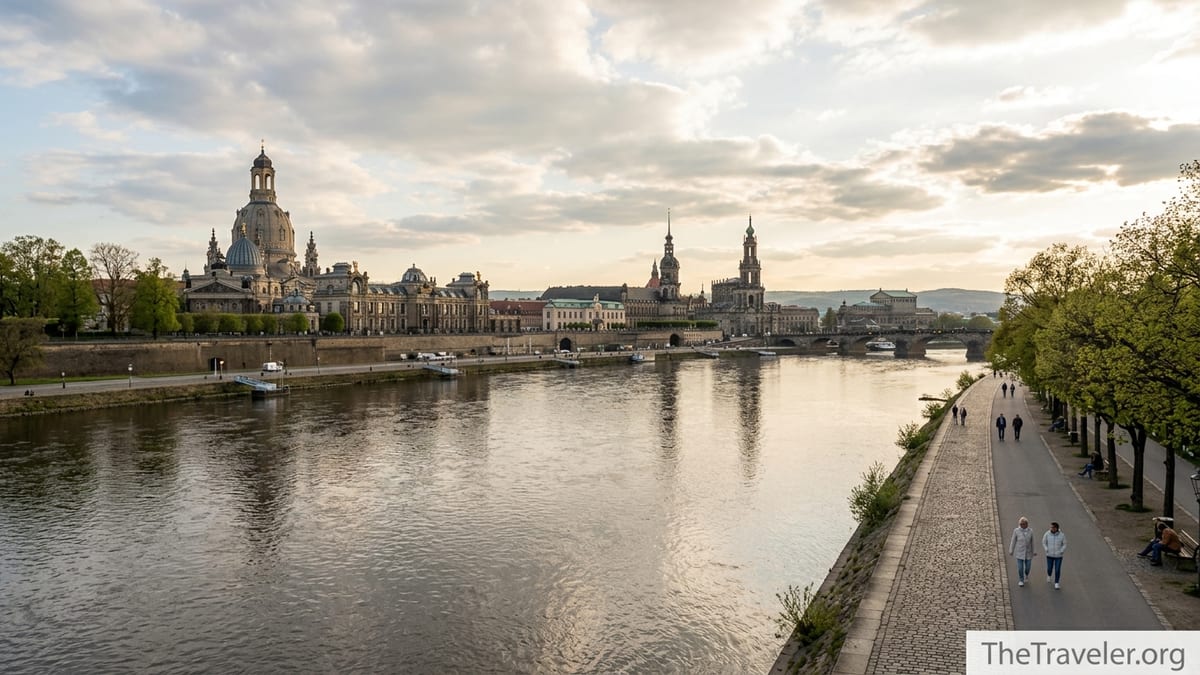
Dresden, the capital of Saxony on the Elbe River, combines baroque architecture with a relaxed, lived-in feel. Many visitors focus on the compact Altstadt, where the reconstructed Frauenkirche, the Zwinger palace complex and the Fürstenzug mural sit within an easy walk of each other. Across the river, the Neustadt district is filled with independent bars, courtyards and street art and is a good place to base yourself if you prefer nightlife and more affordable restaurants. Mid-range hotels in central Dresden usually fall between 90 and 150 euros per night for a double, with prices rising during events like the annual Striezelmarkt Christmas market.
Saxon Switzerland National Park, roughly 40 kilometers southeast of Dresden, is one of the most dramatic landscapes in Germany and surprisingly easy to reach on public transport. To visit the famous Bastei Bridge on a day trip, travelers typically take the S-Bahn line S1 from Dresden Hauptbahnhof to Kurort Rathen, a journey of about 35 minutes, then follow signs to a small ferry that crosses the Elbe. After a short crossing, a well-marked path climbs through forest and rock formations to the Bastei plateau in around 40 minutes, with no technical hiking required for the main viewpoints.
Costs for this outing are modest. A standard regional train ticket between Dresden and Rathen is usually under 10 euros each way, with the ferry adding only a few euros per person. The national park itself does not charge an entrance fee, though there may be small charges for specific viewpoints or the ruins of Neurathen Castle. In total, a round-trip excursion from Dresden including trains, the ferry and perhaps a snack at a viewpoint café can easily come in under 30 euros per person, or less if you already hold a valid public transport pass.
For first-time visitors with an interest in hiking, it is worth allocating at least one night in the region instead of only day-tripping. Guesthouses in villages like Bad Schandau, Rathen or Königstein commonly offer double rooms from about 80 to 130 euros per night. Staying locally lets you walk classic routes like the Malerweg stages at a more relaxed pace, catch sunrise or sunset at the Bastei, and avoid the peak midday crowds that arrive on tour buses from Dresden and Prague.
Leipzig, Saxony-Anhalt and Culturally Rich Side Trips
Leipzig has quietly emerged as one of eastern Germany’s most engaging city breaks, with a mix of trade-fair history, music heritage and contemporary art. From Berlin, direct trains take around 1 hour 15 minutes on the fastest services or closer to 2 hours on regional routes. Once in Leipzig, most key sights are walkable from the compact city center, including St. Thomas Church, associated with J.S. Bach, and the Museum of Fine Arts. A single day public transport ticket for Leipzig’s local network tends to cost around 7 to 8 euros, but many visitors find they walk most places.
Leipzig’s accommodations are slightly cheaper on average than Berlin’s. Expect around 90 to 140 euros per night for a modern mid-range hotel within walking distance of the Hauptbahnhof, with occasional deals dipping under 80 euros outside peak trade fair dates. Neighborhoods like Südvorstadt and Plagwitz have a more local, creative atmosphere, with repurposed factory buildings turned into galleries and clubs, and are still only a short tram ride from the center.
Saxony-Anhalt slots naturally into a Berlin–Leipzig route. Lutherstadt Wittenberg, the town associated with Martin Luther and the Reformation, lies about 40 to 60 minutes by regional train from either city. Dessau, known for the Bauhaus buildings, is roughly 1 hour from Berlin and even closer from Wittenberg. A common pattern is to base in Berlin or Leipzig and visit one or both towns on day trips, spending the morning in museums and historic churches and the afternoon wandering residential districts that showcase interwar modernist architecture.
Because these smaller cities see fewer overnight tourists than Berlin or Dresden, hotel prices are often attractive. Standard business-style hotels near the station might list doubles between 70 and 110 euros per night. They can be a smart choice if you want a quiet night between busy city days, especially if you plan to rent a car and continue on towards Harz Mountain towns like Quedlinburg in neighboring regions.
Getting Around: Trains, Road Trips and Practical Transport Tips
Eastern Germany is easiest to explore by train, especially for first-time visitors. Berlin, Dresden and Leipzig are all on major Deutsche Bahn corridors, and dense regional networks spread out into Brandenburg, Saxony and Saxony-Anhalt. High-speed ICE and Intercity trains connect the main hubs, while slower Regionalexpress and S-Bahn trains reach smaller towns like Lübbenau in the Spreewald or Kurort Rathen in Saxon Switzerland. Stations are clearly signed, and announcements are typically made in German and English on long-distance services.
For many visitors, a nationwide public transport pass called the Deutschlandticket offers good value. In 2026 the standard price of this subscription ticket is around 63 euros per month and it is valid on almost all local and regional trains, S-Bahn, U-Bahn, trams and buses throughout Germany, but not on high-speed ICE or other long-distance trains. If you plan to take several regional day trips, such as Berlin to Potsdam, Berlin to Spreewald and Dresden to Saxon Switzerland in the same calendar month, the pass often pays for itself compared with buying multiple individual tickets.
Renting a car becomes more attractive if you want flexibility in very rural areas or are planning a dedicated road trip. For example, a one-week compact car rental picked up in Berlin and dropped off in Leipzig might run in the range of 250 to 400 euros before fuel and toll-free highway driving. This can make sense for a couple or small group visiting scattered lakes in Brandenburg or looping through small towns in Saxony-Anhalt. However, parking in central Berlin and Dresden is paid and can be stressful, so many travelers choose a hybrid approach: rely on trains for city to city travel, then rent a car for two or three days in a smaller city to explore nearby countryside.
Within cities, contactless payments are increasingly accepted on public transport, but most visitors still use printed tickets or app-based passes. In Berlin and Leipzig, ticket inspectors travel without uniforms and conduct random checks, so it is essential to validate any paper tickets in the small red or yellow machines before boarding trains or trams. Fines for traveling without a valid ticket are typically around 60 euros per incident and are rigorously enforced.
What It Costs: Sample Budgets and Money-Saving Strategies
Compared with major Western European capitals like Paris or London, eastern German cities are moderately priced, though costs have risen in recent years. A realistic daily budget for a mid-range traveler in Berlin or Dresden in 2026 often falls in the 140 to 220 euro range per person, including a central hotel room, public transport, meals and a few paid attractions. Couples sharing a room can trim costs by splitting accommodation and transport expenses.
As a concrete example, imagine a couple spending four nights in Berlin in October. They book a mid-range hotel in Mitte for 160 euros per night, totaling 640 euros. Each buys a Berlin ABC day ticket for two of the days they plan longer outings at roughly 12 euros per person per day and uses single tickets on the lighter days, spending around 40 euros each on local transport for the stay. If they budget 20 euros per person for breakfast and lunch combined, then 25 to 35 euros each for a casual dinner with a drink, daily food costs land around 90 to 120 euros for two. Add museum entries, maybe 10 to 20 euros per person per day, and they are looking at about 200 to 230 euros per day on the ground, excluding flights.
In smaller towns like Lübbenau, Wittenberg or Bad Schandau, accommodation and dining can be noticeably cheaper. A guesthouse double might run 90 euros including breakfast, and a hearty dinner in a local restaurant could be 15 to 20 euros per person before drinks. For travelers mixing cities and countryside, one approach is to spend fewer nights in central Berlin and more in satellite towns, using day trips into the city instead of basing directly in the most expensive districts.
To save money, consider traveling outside of peak holiday periods, which in Germany include school vacations and December’s Christmas market season. Visiting in late April, May, September or early October often means mild weather and somewhat lower hotel rates. Booking flexible train tickets in advance on long-distance routes like Munich to Berlin can also cut costs, though regional trains, which the Deutschlandticket covers, have fixed pricing and no reservations, making them an easy, predictable choice for shorter hops within the east.
First-Time Planning: Itineraries and Seasonal Advice
Planning your first trip to eastern Germany starts with choosing the length of your stay and deciding how many hotel changes you are comfortable with. For a one-week visit focused on variety without rushing, a classic plan is four nights in Berlin and three nights in Dresden or Leipzig, sprinkled with day trips. From Berlin, you might visit Potsdam one day and the Spreewald on another. From Dresden or Leipzig, you could set aside a full day for Saxon Switzerland and the Bastei Bridge or a cultural day trip to Wittenberg.
If you have ten to twelve days, you can slow the pace and add more nature. One popular loop is to arrive in Berlin for four nights, continue to Leipzig for three nights, then move on to Dresden for three nights with a final night in a village near Saxon Switzerland before flying or taking the train onward. With this structure, you avoid backtracking and get a sense of how the region’s big cities, smaller towns and natural areas fit together.
Season matters. Winter offers atmospheric Christmas markets in cities like Dresden, whose Striezelmarkt is among the oldest in Germany, but days are short and some boat and hiking services in the Spreewald and Saxon Switzerland run on limited schedules. Spring and autumn are ideal for hiking and city walks, with average daytime temperatures often in the low to mid-teens Celsius and fewer crowds. Summer brings long days and lake swimming, but you may need to book popular hotels and Spreewald guesthouses weeks in advance.
Finally, build some flexibility into your days. Berlin’s museums can easily absorb an entire rainy afternoon, while a sunny forecast might tempt you to shift plans and take the train out to the Elbe sandstone cliffs a day earlier than planned. Trains in Germany run frequently enough that adjusting on the fly is feasible, provided you keep an eye on the difference between regional services covered by passes and high-speed trains that require separate tickets and reservations.
FAQ
Q1. How many days do I need for a first trip to eastern Germany?
Most first-time visitors are comfortable with 7 to 10 days, which allows 3 to 5 days in Berlin plus time for Dresden or Leipzig and at least one nature-focused day trip.
Q2. Is Berlin a good base for day trips to the rest of eastern Germany?
Berlin works well for day trips to Potsdam, the Spreewald and towns like Wittenberg, but destinations such as Saxon Switzerland are more comfortably visited from Dresden to avoid very early starts and late returns.
Q3. Do I need to rent a car to see Saxon Switzerland and the Bastei Bridge?
No. Regular S-Bahn trains from Dresden to Kurort Rathen, a short ferry ride and a marked walking trail make it straightforward to visit the Bastei Bridge using only public transport.
Q4. What is the Deutschlandticket and should I buy it?
The Deutschlandticket is a monthly pass valid on most local and regional public transport across Germany. It can be good value if you plan multiple regional train trips in one month, but less useful if you are relying mainly on long-distance ICE services.
Q5. Are eastern German cities safe for solo travelers?
Yes, cities like Berlin, Dresden and Leipzig are generally safe, including for solo travelers, provided you follow usual urban precautions like avoiding poorly lit areas at night and watching your belongings on crowded transport.
Q6. How expensive is accommodation in eastern Germany compared with western cities?
On average, hotels and guesthouses in Berlin, Dresden and Leipzig are somewhat cheaper than equivalents in cities like Munich or Frankfurt, with good mid-range doubles often available for under 180 euros per night outside major events.
Q7. Can I visit the Spreewald as a day trip from Berlin?
Yes. Regional trains from Berlin to Lübben or Lübbenau take about an hour, and from there you can walk to the harbors for boat tours and still be back in Berlin by evening.
Q8. When is the best season to hike in Saxon Switzerland?
Late spring, summer and early autumn are the most pleasant times, with longer daylight, generally dry trails and regular ferry and bus services connecting villages and trailheads.
Q9. Do I need to speak German to travel in eastern Germany?
No. English is widely spoken in hotels, museums and larger restaurants, especially in Berlin and other cities, though learning a few basic German phrases is appreciated and useful in rural areas.
Q10. How far in advance should I book trains and hotels?
For peak seasons like summer and December, aim to book central hotels one to three months ahead. Long-distance train tickets with savings fares are also cheaper when bought in advance, while regional trains typically do not require reservations.