


Southern Germany is one of Europe’s easiest places to combine a major cultural city with classic Alpine scenery. Munich pairs naturally with the Bavarian Alps, where you can tour fairytale castles, ride cable cars to Germany’s highest peak and cruise on emerald lakes within a single trip. The main planning choice is not if you should go, but how many days to spend and whether to rely on a rental car or the country’s dense train network.
How Many Days You Really Need in Munich and the Bavarian Alps
For most travelers, the sweet spot for a Munich and Bavarian Alps itinerary is between 5 and 10 days. Four days works if you move fast and focus on highlights such as Munich’s Old Town, Neuschwanstein Castle and a single mountain base like Garmisch-Partenkirchen. With 5 days, you can add either the Zugspitze area or Berchtesgaden. A 7-day trip comfortably links Munich, Garmisch-Partenkirchen, Neuschwanstein and Berchtesgaden. Ten days allows for slower mornings, extra hikes and weather flexibility in the high mountains.
Distances are shorter than many first-time visitors expect. Munich to Füssen, the gateway town for Neuschwanstein, is roughly a 1 hour 45 minute to 2 hour drive depending on traffic, and around 2 hours by regional train with a change in Buchloe or Kaufbeuren. Munich to Garmisch-Partenkirchen by car or direct regional train is usually around 1 hour 20 minutes. Reaching Berchtesgaden from Munich involves a longer leg: around 2.5 hours by car, or approximately 3 to 3.5 hours by train with a change in Freilassing or Salzburg.
Season affects how you use your time. In summer, long daylight hours make it realistic to fit a lake walk and mountain cable car ride into the same day. In shoulder seasons like April or November, early sunsets and changeable weather favor shorter drives and extra time built in around Zugspitze or Königssee in case clouds or wind force cable car closures. In winter, some mountain roads remain clear but you must factor in snow and ice, slower driving and potential seasonal closures of hiking paths.
Rental Car vs Train: What Works Best for Southern Germany
The choice between renting a car and relying on trains is not just about comfort. It shapes your route, your daily rhythm and sometimes what you can realistically see in a day. A compact rental car picked up at Munich Airport or Munich Central Station gives maximum flexibility for side trips to lakes like Eibsee, Walchensee or Hintersee and for reaching rural guesthouses. Daily rental prices fluctuate, but outside peak August you might find a small automatic from a major agency for roughly 60 to 90 euros per day including basic insurance, plus parking and fuel.
Driving in Bavaria is straightforward for most experienced drivers. Roads to Füssen, Garmisch-Partenkirchen and Berchtesgaden are well maintained and clearly signed. The main downsides are parking and potential congestion. At Neuschwanstein, parking lots near Hohenschwangau village are usually paid and can fill by mid-morning in July and August. Around Lake Eibsee beneath Zugspitze, parking is paid and capacity is limited, so day trippers in high season sometimes queue for a space if arriving late morning. In Berchtesgaden, parking near the Königssee boat docks is large but also paid and can be very busy on sunny weekends.
Trains work very well if you prefer not to drive, especially between Munich and hubs such as Garmisch-Partenkirchen, Füssen and Berchtesgaden. On many days you can use regional passes such as the Bayern Ticket to cover a full day of travel within Bavaria by regional trains and most local buses at a fixed price, which is often cost effective for couples or families who are comfortable with set timetables. From Garmisch-Partenkirchen, you can continue by cogwheel train toward Zugspitze or by bus to Eibsee. From Berchtesgaden, frequent local buses connect to Königssee and to the salt mine.
A hybrid approach works well for a 7 or 10 day trip. Some travelers base in central Munich without a car for 2 or 3 nights, using public transport and perhaps a guided coach trip to Neuschwanstein, then pick up a rental car only for the Alpine portion. Others do the opposite, renting from day one and keeping the car even while in Munich, budgeting for garage parking at their hotel. Which option suits you depends on your comfort with city driving and how much spontaneity you want for photo stops and short detours in the mountains.
4- and 5-Day Munich & Bavarian Alps Itineraries
With just 4 days, you should prioritize Munich and a single mountain region. A realistic 4-day route could be 2 nights in Munich and 2 nights in Garmisch-Partenkirchen, using day trips to Neuschwanstein and Zugspitze. On Day 1, arrive in Munich, stroll Marienplatz and the Viktualienmarkt, and overnight near the Old Town or main station for easy transport. Day 2, either take an early regional train or drive to Füssen, spend the late morning touring Hohenschwangau or viewing Neuschwanstein from below and the surrounding meadows, then continue to Garmisch-Partenkirchen for the night.
On Day 3 of a 4-day trip, head for Zugspitze, Germany’s highest peak at nearly 3,000 meters. From Garmisch-Partenkirchen, you can take the cogwheel train to the Zugspitzplatt area and transfer to a cable car up to the summit, or drive or bus to Eibsee and take the cable car directly. Operating hours vary by season, but in summer first departures are typically around early to mid-morning, and the ride itself takes around 10 minutes by cable car. Clear days offer wide views over both Germany and Austria, while cloudy days may be better spent walking the lakeshore path at Eibsee instead. Return to Munich in the late afternoon or early evening, then fly out on Day 4.
If you have 5 days, you gain room for either a slower pace or an extra highlight. A 5-day loop by car could be Munich to Füssen and Neuschwanstein for 1 night, then Garmisch-Partenkirchen and Zugspitze for 2 nights, followed by 2 nights back in Munich. Alternatively, you could base in Munich throughout, using one day for Neuschwanstein, one day for Garmisch-Partenkirchen and Zugspitze, and one flexible day for either Herrenchiemsee Palace on Chiemsee Lake or a shorter lake trip to Tegernsee using regional trains. Travelers who prefer trains might book a hotel near Munich’s main station and rely on early departures to maximize their days, accepting that some evenings will involve returning to the city rather than staying in the mountains.
7-Day Route: Munich, Neuschwanstein, Garmisch, Zugspitze & Berchtesgaden
A full week in southern Germany allows you to combine Munich with both the Zugspitze area and Berchtesgaden without rushing. One efficient 7-day route by rental car starts with 2 nights in Munich, followed by 2 nights in Garmisch-Partenkirchen, 1 night near Füssen for Neuschwanstein and 2 nights in Berchtesgaden, then return to Munich for departure. If you prefer fewer hotel changes, you can also pair 3 nights in Garmisch-Partenkirchen with 3 nights in Berchtesgaden and 1 in Munich.
On a clockwise loop starting in Munich, you might spend Day 1 and Day 2 exploring the city’s museums, beer gardens and neighborhoods like Schwabing or the English Garden. On Day 3, drive around 1 hour 20 minutes to Garmisch-Partenkirchen and spend the afternoon on an easy valley hike such as the Partnach Gorge area or a short cable car ride with views back to the town. Overnight in a guesthouse with mountain views close to the center so you can easily walk to dinner. On Day 4, head for Zugspitze and Eibsee, building in a backup plan of a lakeshore circuit walk if summit visibility is poor.
Day 5 could take you from Garmisch-Partenkirchen to Füssen in roughly 1.5 hours by car, or around 2 hours if traveling by train with a change. Schedule your entry time for Neuschwanstein or Hohenschwangau with some buffer, as parking and the uphill walk to the castle can add 30 to 40 minutes. Consider visiting the Marienbrücke viewpoint, which offers classic photos of Neuschwanstein if the path is open and conditions are safe. Afterward, either overnight in Füssen’s compact old town or continue part of the way toward Berchtesgaden to break up the next day’s driving.
On Day 6, continue to Berchtesgaden, which by car from Füssen typically takes around 3 hours depending on chosen route and stops. On arrival, stroll through town and perhaps visit the salt mine or the local brewery. Day 7 is ideal for Königssee, often described as one of Germany’s most beautiful and cleanest lakes, where electric boats shuttle visitors to St. Bartholomew’s Church and deeper into the national park. If you have time before returning to Munich or Salzburg the next day, short walks at nearby Hintersee offer quieter forest and lake scenery.
10-Day Slow Itinerary with Extra Alpine Lakes
With 10 days, you can turn the same circuit into a slower-paced trip that allows for weather delays and spontaneous stops. One option is 3 nights in Munich, 3 nights in Garmisch-Partenkirchen, 1 or 2 nights near Füssen and Neuschwanstein, and 2 or 3 nights in Berchtesgaden. Another is to add an extra lake region, such as Tegernsee and Schliersee south of Munich, or the Chiemsee area en route to Berchtesgaden, instead of an additional city.
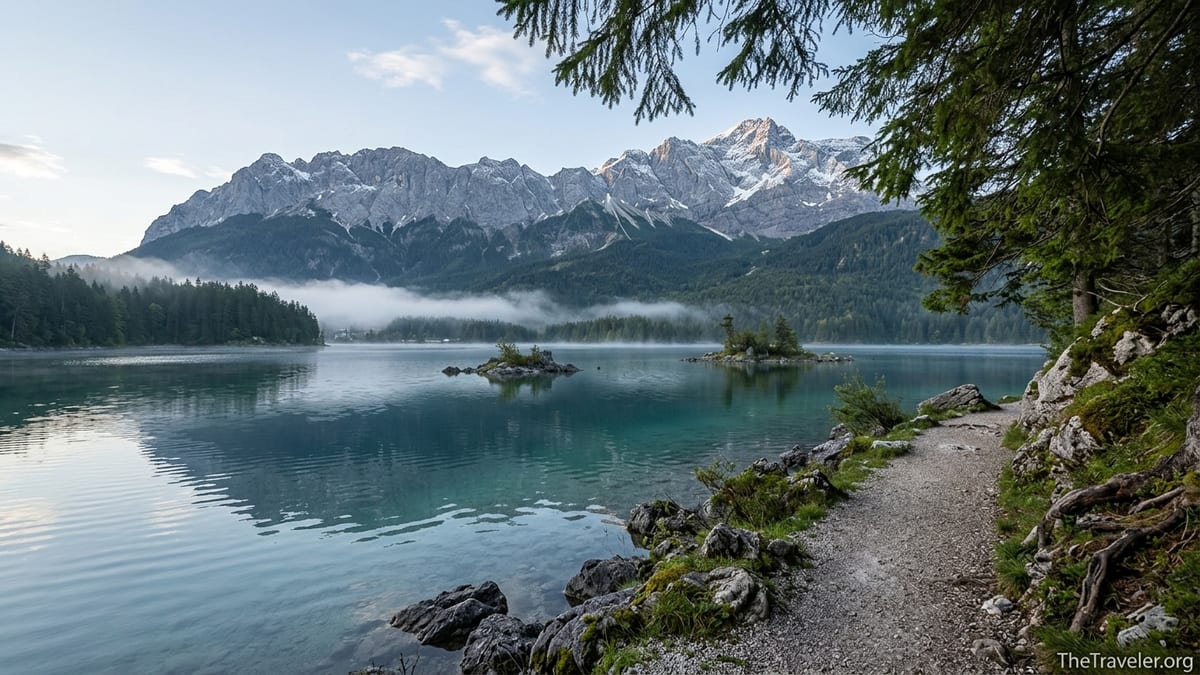
On a 10-day route, you might dedicate Day 4 in Garmisch-Partenkirchen to a second mountain experience besides Zugspitze. This could be a ride up a different cable car, a full-day hike depending on fitness level or a relaxed wander through nearby Mittenwald with its painted houses and violin-making tradition. You could also set aside a half-day for Eibsee even if you are not going to the summit. The lake’s clear green water at the foot of the Zugspitze and the circuit path around its shore are a highlight in their own right, especially on calm mornings when reflections of the mountains are strongest.
Between Garmisch-Partenkirchen and Berchtesgaden, a 10-day itinerary can include additional lakes such as Walchensee or Chiemsee. For example, you might break the drive with a stop at Lake Chiemsee, joining a short boat ride to Herreninsel to glimpse Herrenchiemsee Palace, then continue in the late afternoon to Berchtesgaden. Once based there, you can use your extra nights for both Königssee and a second outing, such as the Jennerbahn cable car for panoramic views, a half-day at Hintersee or a visit to the documentation center and historic site on the Obersalzberg above town.
Extra time also lets you plan for wet weather. Instead of feeling pressured to ride the Zugspitze cable car on a day of heavy cloud, you might swap your plan and visit museums or thermal baths, then wait for a clearer morning for the summit. Similarly, if thunderstorms are forecast in late afternoon, you can schedule your Königssee boat trip early and retreat to Berchtesgaden for a café break while showers pass. Ten days gives room for these kinds of adjustments without sacrificing key highlights.
Planning Around Neuschwanstein, Zugspitze and Berchtesgaden
Neuschwanstein, Zugspitze and Berchtesgaden each require some practical planning. For Neuschwanstein, pre-booking timed tickets is strongly recommended, especially from late spring through early autumn and around holidays. Guided tours inside the castle are relatively short but tightly scheduled, and late arrivals may forfeit their slot. The walk from the ticket center in Hohenschwangau up to Neuschwanstein takes roughly 30 to 40 minutes uphill at a steady pace. Shuttle buses and horse-drawn carriages operate up part of the route for an extra fee but cannot drop passengers at the castle door, so some walking remains unavoidable.
At Zugspitze, cable car and cogwheel train schedules vary by season, and wind or storms can temporarily suspend operations. It is wise to check the current status and forecast a day or two ahead, especially outside mid-summer when the weather can change quickly. Ticket types range from basic ascent and descent to combined options that include both the cogwheel train and cable car. Prices are substantial for a family, so choosing a clear day maximizes value. At Eibsee, even if you decide not to go to the summit, you can rent a rowing boat in season or simply walk the lakeshore path, which offers frequent views of the turquoise water and surrounding peaks.
Berchtesgaden’s main attraction for many travelers is Königssee, a long, narrow lake framed by steep rock walls. Electric passenger boats depart near the village of Schönau am Königssee and stop at landmarks such as St. Bartholomew’s Church before continuing deeper into the national park. In high season, queues for boats can lengthen by late morning, so early departures are helpful for a quieter experience. Other popular activities in the area include visiting the salt mine, riding the Jennerbahn cable car or hiking to viewpoints above Lake Hintersee. Most of these are reachable by local buses, but a car makes it easier to combine more than one location in a single day.
Food and lodging are relatively straightforward to arrange as long as you book well in advance for July, August, Christmas and school holidays. In Munich, international chains, boutique hotels and apartment-style stays cluster around the main station and in neighborhoods like Glockenbachviertel. In Garmisch-Partenkirchen, family-run pensions with balconies and mountain views are common, while Berchtesgaden offers both traditional guesthouses in town and modern hotels closer to Königssee. Travelers planning a 7 or 10 day loop should consider at least one hotel with laundry facilities or access to a self-service laundromat, as mountain activities can quickly fill a suitcase with wet or muddy clothes.
Car-Free Itineraries vs Self-Drive Routes
If you prefer not to drive, it is entirely possible to craft a 4 to 7 day itinerary that combines Munich, Garmisch-Partenkirchen, Zugspitze and even Berchtesgaden by train and bus. One car-free 5-day plan could involve 3 nights in Munich and 2 nights in Garmisch-Partenkirchen. Use regional trains to visit Neuschwanstein via Füssen on one day and Garmisch-Partenkirchen on another, then spend your final full day on Zugspitze and Eibsee. With a Bayern Ticket, you can often keep costs predictable while enjoying the scenery out the window instead of focusing on driving and parking rules.
For a car-free 7-day itinerary that includes Berchtesgaden, you might spend 2 nights in Munich, 2 nights in Garmisch-Partenkirchen and 3 nights in Berchtesgaden. Trains connect Munich with both Garmisch-Partenkirchen and Berchtesgaden, though the latter usually involves a change along the way. Once in each Alpine base, local buses and mountain railways handle most onward transport. The Zugspitze cogwheel train starts from Garmisch-Partenkirchen and stops near Eibsee, while buses from Berchtesgaden reach Königssee, Hintersee and the Obersalzberg area.
Self-drive routes excel if you are traveling as a family, carrying a lot of luggage or seeking out smaller lakes and viewpoints. For example, drivers can easily add short photo stops at roadside chapels, secluded farm tracks with wide valley views or lesser-known lakes like Hintersee and Walchensee that require more time by bus. A 7 or 10 day self-drive loop might also weave in overnight stays at traditional farm stays or wellness hotels with saunas and pools, which tend to sit outside the main towns. Having your own vehicle makes it simple to depart early to beat tour bus traffic at Neuschwanstein or to linger at a mountain hut without worrying about the last bus home.
Regardless of transport mode, a practical tactic is to treat key mountain experiences as flexible within your date range. Instead of tying your only possible Zugspitze day to a nonrefundable ticket, consider staying two or three nights in Garmisch-Partenkirchen and watching the forecast. Likewise, if strong rain is predicted over Berchtesgaden, you might reschedule your Königssee outing and explore Salzburg or local museums instead. Building some elasticity into your itinerary is easier on 7 and 10 day trips but still possible with 5 days if you avoid stacking all your mountain days at the very end of your stay.
The Takeaway
Munich and the Bavarian Alps lend themselves to routes ranging from a fast 4-day taster to a relaxed 10-day loop that links city culture with mountain adventure. Four and 5-day itineraries focus on Munich plus one or two star highlights such as Neuschwanstein and Zugspitze, ideally with at least one night based in the Alps. Seven days allow you to add Berchtesgaden and its lakes, while 10 days provide enough breathing room for extra Alpine lakes, spa time and backup days for the high peaks.
Your main strategic choices are whether to rent a car and how many times to change bases. Car-free travelers can rely on Bavaria’s strong rail and bus networks, especially around Garmisch-Partenkirchen and Berchtesgaden, while self-drivers gain more flexibility for little-known lakes and spontaneous detours. In every case, planning around timed entries at Neuschwanstein, seasonal cable car timetables at Zugspitze and boat schedules on Königssee will help you avoid queues and make the most of clear weather.
By anchoring your trip with a few fixed stays in Munich and one or two Alpine towns, and by building a margin of flexibility around weather-sensitive days, you can tailor a 4, 5, 7 or 10 day itinerary that matches your pace and priorities. Whether you prefer museum halls and beer gardens or ridge walks and lake reflections, southern Germany offers a compact yet varied route that feels much larger than the distances on the map suggest.
FAQ
Q1. Is it better to rent a car or use trains for a Munich and Bavarian Alps trip?
For most visitors, trains work very well between major hubs like Munich, Garmisch-Partenkirchen, Füssen and Berchtesgaden, especially with regional day passes. Renting a car is more convenient if you want to reach smaller lakes, stay in rural guesthouses or keep your schedule flexible around weather, but it adds parking costs and requires confidence driving in mountain areas.
Q2. How many days should I spend in Munich versus the Alps?
On a 4 or 5 day trip, many travelers choose 2 nights in Munich and 2 or 3 nights in the Alps. With 7 or 10 days, a common pattern is 2 to 3 nights in Munich and the rest spread across Garmisch-Partenkirchen, the Füssen area and Berchtesgaden so that at least half your time is based in the mountains.
Q3. Can I visit Neuschwanstein, Zugspitze and Königssee in only 4 days?
It is technically possible but not recommended, as you would spend a large share of your time in transit and be very vulnerable to poor weather. With only 4 days, it is wiser to focus on Munich, Neuschwanstein and a single Alpine base such as Garmisch-Partenkirchen and Zugspitze, and save Berchtesgaden and Königssee for a longer trip.
Q4. Do I need to book Neuschwanstein Castle tickets in advance?
Advance booking is strongly advised from late spring through early autumn and during school holidays. Same-day tickets often sell out, and timed entry slots are strictly enforced. Booking ahead lets you plan your travel around a known time and reduces the risk of traveling to Füssen only to find no suitable tour available.
Q5. When is the best time of year to visit Munich and the Bavarian Alps?
Late May through September offers the most reliable conditions for mountain views and lake walks, with July and August the busiest months. Shoulder seasons like late April, October and early November can be quieter and atmospheric but bring cooler temperatures and more changeable weather, while winter is ideal for snow scenery and skiing but requires more flexibility for road and cable car conditions.
Q6. Is Zugspitze worth the cost if the weather is uncertain?
Zugspitze tickets are a significant expense, so it is best to go on a day with at least partial clear skies. If the forecast is mixed, you could still consider visiting and combining the summit with time at Lake Eibsee, but if a dense cloud layer is expected to cover the peak all day, many travelers prefer to wait and spend that money when views are more likely.
Q7. Can I base in just one Alpine town instead of moving every night?
Yes, and this often makes for a more relaxed trip. Garmisch-Partenkirchen works well as a base for Zugspitze, Eibsee and day trips toward Füssen, while Berchtesgaden suits travelers who want to focus on Königssee, Hintersee and nearby Salzburg. With 7 or more days, combining two Alpine bases plus Munich usually strikes a good balance between variety and packing less often.
Q8. How kid-friendly is this itinerary for families?
The region is generally very family-friendly, with easy lake walks, boat rides, cable cars and short castle tours that appeal across ages. Families may find a rental car especially helpful for carrying gear and adjusting quickly to nap times or bad weather. Choosing accommodations with family rooms, playgrounds nearby or access to a pool can also help keep children happy on longer itineraries.
Q9. Are there good options for travelers who do not hike?
Yes. Many of the most famous views are accessible by cable cars, cogwheel trains and boat rides with minimal walking, and towns like Munich, Garmisch-Partenkirchen and Berchtesgaden can be enjoyed at a gentle pace. Short, mostly flat lakeside paths at places like Eibsee, Tegernsee or Königssee provide scenic experiences without requiring mountain hiking experience or special equipment.
Q10. How far in advance should I book hotels for a summer or Christmas trip?
For stays in July, August or over Christmas and New Year, it is wise to book core hotels and popular guesthouses several months in advance, especially in smaller towns like Füssen and Berchtesgaden. In shoulder seasons and midweek, you often have more flexibility, but booking at least a few weeks ahead still improves your chances of securing central locations and better rates.