


Southern Germany rewards slow travel. Medieval towns, mountain lakes, half-timbered villages and deep forests all sit within a day’s travel of each other, but the region only really shines when you plan realistic driving or train times and give each stop at least one unhurried night. This guide pieces together 5, 7, 10 and 14 day itineraries that combine Munich, the Romantic Road, the Bavarian Alps, Lake Constance and the Black Forest, with practical examples of how long journeys actually take, where to sleep and how to choose between car and rail.
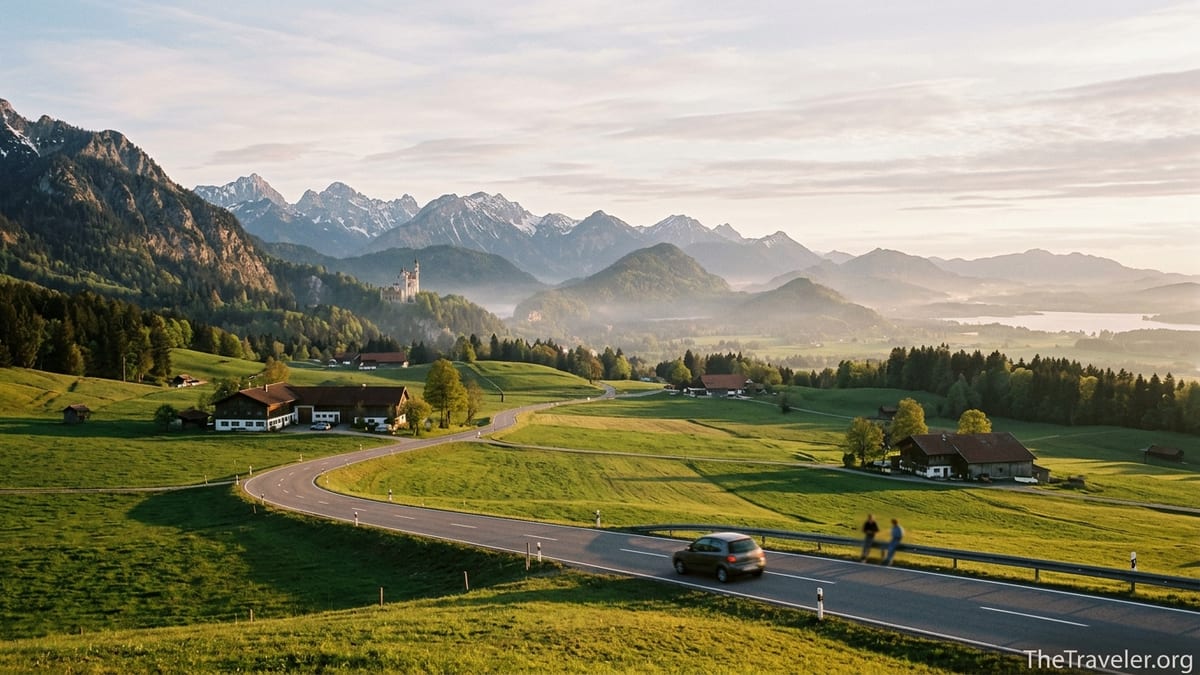
How to Structure a Southern Germany Trip
Southern Germany covers two large states, Bavaria and Baden Württemberg, so the key decision is whether you will rely on public transport or rent a car. Trains and regional buses are frequent between major hubs like Munich, Füssen, Lindau, Freiburg and Stuttgart, and a Munich to Füssen regional service typically takes around 2 to 2.25 hours each way with a change in Kaufbeuren or direct at busy times. Driving the same route via the A96 and B17 is generally 1.75 to 2 hours in normal traffic, which gives you a sense of how much ground you can realistically cover in a day without rushing.
The other structural choice is whether to travel in a loop or a straight line. Many travelers fly in and out of Munich and make a loop from the city to the Alps, on to Lake Constance, then through the Black Forest and back along or near the Romantic Road. Others prefer an open-jaw route, arriving in Munich and departing from Stuttgart, Zurich or Frankfurt, which reduces backtracking and works well for 10 or 14 day itineraries that end in the Black Forest.
Season and budget also matter. In peak summer and during Oktoberfest, a midrange double room in Munich can jump from around 130–170 euros per night to 250 euros or more, while in quieter hubs like Füssen or Konstanz you may still find comfortable guesthouses in the 110–160 euro range. Rail passes such as the Bayern Ticket or Baden Württemberg Ticket give good value for regional trains if you are moving every couple of days, whereas a compact rental car from Munich Airport often starts around 40–60 euros per day before fuel and parking.
For all the itineraries below, overnight counts assume you are on the ground by mid to late morning on day one and departing in the afternoon or evening on the final day. If you land late at night or have an early departure, add one extra night at your gateway city so you are not trying to drive or navigate trains while jet-lagged.
5 Days: Munich and Bavarian Highlights
A 5 day itinerary works best if you concentrate on Munich and the nearby Alps, with a taste of the Romantic Road rather than trying to squeeze in Lake Constance or the Black Forest. Plan to spend three nights in Munich and two in Füssen or Garmisch-Partenkirchen so you can see both the city and at least one famous castle or alpine lake without turning each day into a long transfer.
On day one and two, base yourself in central Munich near the Hauptbahnhof or Marienplatz to minimize metro use. Spend day one walking the Altstadt, from Viktualienmarkt to the Residenz, and leave time for a relaxed evening in a classic beer hall where a main dish such as schnitzel or roast pork usually runs 15–22 euros. On day two, consider a half-day visit to Nymphenburg Palace or the Dachau Memorial Site; both are easily reached by S-Bahn and bus in under an hour from central Munich.
Day three is your transfer into the Alps. If you choose Füssen, aim for a morning train departure so you arrive late morning and can stroll the old town or the shores of the Lech river. A regional rail journey from Munich to Füssen takes just over two hours on a through service when available, while driving is similar in total time but gives you flexibility to detour to places like Wieskirche, a rococo pilgrimage church just off the route. Overnight in Füssen for two nights and dedicate day four to Neuschwanstein and Hohenschwangau. Expect to spend most of that day between shuttle buses, walks up to the castle and touring the interiors, so it is wise not to schedule onward travel afterward.
If you prefer Garmisch-Partenkirchen, you can either drive about 1.5 hours from Munich along the A95 or take a regional train in around 80–90 minutes. A two night stay allows one full day to ride the Zugspitze cable car or cog railway and walk around Eibsee, a vivid alpine lake where small rowing boats and pedalos can be hired in good weather for roughly 20–30 euros per hour. On day five, return to Munich for last shopping and your flight, allowing at least half a day for the journey and airport procedures.
7 Days: Munich, Romantic Road and Bavarian Alps
With a week you can add the Romantic Road to your Munich and Alps combination. The Romantic Road is a themed route that runs roughly from Würzburg in the north to Füssen in the south, linking towns like Rothenburg ob der Tauber, Dinkelsbühl and Augsburg. Many visitors focus on the most atmospheric section between Rothenburg and Füssen, which can be comfortably incorporated into a 7 day plan if you have a car.
A classic 7 day route might allocate two nights in Munich, two in Rothenburg ob der Tauber and three in Füssen or Garmisch. From Munich, driving to Rothenburg via the A9 and A6 typically takes around 3 hours, while relying on trains means changing in Nuremberg and Steinach and taking just under 3 hours in total. Staying inside Rothenburg’s medieval walls for two nights allows you to walk the fortifications at dusk, visit the town hall tower and enjoy an early morning when tour buses have not yet arrived.
On day four, drive the southern Romantic Road section towards Füssen, detouring through villages like Dinkelsbühl or Nördlingen if you have time. This is a full but doable day by car if you keep sightseeing stops focused and accept that you will not see every town in depth. Without a car, it is usually more efficient to train from Rothenburg to Füssen with changes in Steinach and Augsburg and then use local buses around the castle area.
Days five to seven are spent in the Bavarian Alps. From a base in Füssen you can visit Neuschwanstein, hike around Alpsee, and, time permitting, take a bus over the nearby Austrian border to Reutte for a half-day change of scenery. If you choose Garmisch instead, hikes through the Partnachklamm gorge or a trip on the Zugspitze cable car are realistic full-day outings. In either case, cap your week with a final evening back in Munich or stay in your alpine base and travel directly to the airport if flight times and connections allow enough buffer.
10 Days: Adding Lake Constance or the Black Forest
With 10 days you can link Bavaria with either Lake Constance or the Black Forest without turning the itinerary into constant one-night stands. A balanced plan is to choose one of these western regions and keep at least two-night stays in each stop. A sample route using a rental car might read: Munich, Füssen, Lake Constance, Black Forest, and finishing in Stuttgart or back in Munich.
One practical breakdown is 3 nights Munich, 2 nights Füssen, 2 nights on Lake Constance and 3 nights in the Black Forest. After your time in Füssen, drive west towards Lake Constance, with Lindau a popular first stop. The journey from Füssen to Lindau by car generally takes about 2.5 hours via the B310 and A7/A96, while by regional trains you are looking at 3 to 3.5 hours with changes in Kempten and sometimes Immenstadt. A stay in Lindau or nearby Wasserburg lets you enjoy lakeside promenades, short ferry rides across to Bregenz in Austria and simple pleasures such as an evening plate of local fish at a harbor restaurant.
Continue around the lake towards Meersburg or Konstanz, where medieval streets, vineyard-covered slopes and easy ferry connections make it straightforward to explore without a car for a day. For example, Konstanz to Meersburg is a short ferry hop that runs regularly throughout the day, and many visitors build a relaxed day around the crossing, a walk through Meersburg’s old town and a visit to a lakeside wine tavern where a glass of local white might cost 5–7 euros. If you prefer to keep driving, the lake shore roads can be slow in peak summer, so factor that into your timing.
From Lake Constance, head north into the Black Forest. Lindau or Konstanz to Freiburg by car usually takes about 2.5 hours in light traffic, while an Interregio Express or regional train from Konstanz to Freiburg often takes about 2.5 to 3 hours with a change in Offenburg. Base yourself in Freiburg im Breisgau for three nights to explore the historic center, ride the Schauinslandbahn cable car up into the hills or rent e-bikes for a day trip into the vineyards around the Kaiserstuhl. Evenings here tend to be more relaxed than in Munich, with many travelers gravitating towards small wine bars where a simple tarte flambée and a glass of Baden Pinot Noir can make a budget-friendly dinner.
If you are flying out of Stuttgart or Frankfurt, you can drive or train there on day ten, allowing half a day for the journey and airport processes. From Freiburg, a high-speed train to Frankfurt is commonly around two hours, while to Stuttgart it is around 2 to 2.5 hours depending on the service. If you must return to Munich, plan for 4 to 5 hours by train with at least one connection and try to avoid same-day long-distance travel plus an early morning flight where possible.
14 Days: Full Southern Germany Loop by Car or Train
Two weeks let you make a satisfying loop that includes Munich, the Romantic Road, the Bavarian Alps, Lake Constance and the Black Forest, with some room for slower days and bad weather. The most comfortable pattern is to alternate longer travel days with lighter sightseeing days and keep most stays at two or three nights. Many travelers will find a car most efficient, but the route is also possible by rail with a mix of regional trains and the occasional bus or taxi for last miles.
A commonly suggested allocation might look like: 3 nights Munich, 2 nights Rothenburg ob der Tauber, 2 nights Füssen or Schwangau, 2 nights around Garmisch-Partenkirchen or Berchtesgaden if you want extra alpine time, 2 nights on Lake Constance, and 3 nights in the Black Forest. Driving Munich to Rothenburg takes around 3 hours, Rothenburg to Füssen via the Romantic Road villages is a full sightseeing day, and Füssen to the western Alps or Lake Constance is 2 to 3 hours depending on your exact route. Lake Constance to Freiburg or another Black Forest base is again 2 to 3 hours, and Freiburg back to Munich is around 4 to 5 hours by car with service stops.
For travelers relying on rail, think in terms of half-day transfers. Munich to Rothenburg typically takes just under 3 hours with two changes, Rothenburg to Füssen around 4 to 5 hours with connections in Steinach and Augsburg, and Füssen to Lindau or Konstanz around 3 to 4 hours with one or two changes. Lake Constance to Freiburg is often 2.5 to 3 hours, and Freiburg to Munich around 4 to 5 hours with at least one intercity section. Booking point-to-point tickets a few weeks ahead on long-distance segments can bring the cost down, while regional day passes work well for shorter hops and same-day returns.
A 14 day loop also leaves space for less heralded stops that balance the headline sights. On the lake, you might spend one night in busy Konstanz and another in quieter Überlingen or on the island of Reichenau, where evenings are more about strolls through vegetable fields and simple lakeside guesthouses than bars. In the Black Forest, a mix of Freiburg and a smaller spa town such as Badenweiler or Hinterzarten offers both urban comfort and deep-forest walks. In mountain areas, consider at least one night in a family-run guesthouse with half-board, where a set dinner of soup, main and dessert can be good value compared to ordering à la carte in tourist centers.
Whatever variation you choose, the rule of thumb on a 14 day trip is to avoid more than four or five base changes. Each move uses packing time, check-in, and orientation, which can cumulatively consume the equivalent of a full day. It is often better to skip one extra town and instead use an existing base for a relaxed day trip, such as visiting Nördlingen from Rothenburg or taking a local train from Freiburg to nearby Titisee for a lakeside walk and slice of Black Forest cake.
Car vs Train: What Works Best Where
Southern Germany is one of the few regions in Europe where both car and train are viable for most visitors. A car gives obvious flexibility on scenic routes like the Romantic Road and makes it easy to combine short stops, such as a morning in Dinkelsbühl followed by an afternoon hike in the Allgäu foothills. Parking charges in smaller towns usually range from a few euros for half a day in public lots to 10–20 euros per night at hotels, and fuel prices fluctuate but can add a noticeable cost on a two-week loop if you cover long distances.
Trains shine between major hubs and when you base in a single region. For example, a traveler who wants to divide time between Munich, Garmisch-Partenkirchen, Lake Constance and Freiburg can link these by a combination of direct regional trains and one or two intercity services, often with journey times of 1.5 to 3 hours per leg. Many German states offer regional day tickets valid on most non-high-speed services within the state and sometimes into bordering areas, which can be economical for couples or small groups taking multiple legs in a single day.
Weather and driving style also matter. In winter and early spring, mountain roads around the Bavarian Alps and Black Forest can be affected by snow or ice, and rental cars will usually come fitted with appropriate tires but may still require cautious driving. In these seasons, basing in cities like Munich or Freiburg and using trains plus organized excursions can reduce stress. In high summer, some scenic roads and lakeside villages can become heavily congested in the middle of the day, so an early start and pre-booked parking are wise if you are driving to extremely popular spots like Neuschwanstein.
Whenever you are uncertain, test a sample leg both ways. Look up a midday Munich to Füssen train to see current timings and fares, then compare that with estimated fuel and toll costs plus parking if you rented a car. For many travelers, the combination of a car for a few days in the Alps and Romantic Road, then trains for longer intercity stretches between Lake Constance, the Black Forest and departure airports, strikes a good balance between independence and convenience.
The Takeaway
Designing a Southern Germany itinerary is not about checking off as many postcard names as possible, but about matching realistic travel times with the experiences you value. A 5 day trip can comfortably cover Munich and the Bavarian Alps, while a 7 day itinerary adds the Romantic Road without sacrificing rest. With 10 days you can incorporate either Lake Constance or the Black Forest, and 14 days allow for a full loop that samples all five regions in a measured way.
The most successful itineraries usually share a few traits: they keep base changes to a sensible minimum, they avoid very long transfer days back to back, and they balance high-profile sights like Neuschwanstein and Rothenburg with gentler days on lakes or forest trails. Whether you lean towards driving scenic backroads or watching the countryside roll past from a train window, Southern Germany rewards travelers who leave enough space between destinations to simply sit in a beer garden, listen to church bells and let the trip feel like a holiday rather than a race.
FAQ
Q1. Is 5 days enough for Southern Germany?
Five days are enough for Munich and a nearby alpine base such as Füssen or Garmisch-Partenkirchen, but too short to add Lake Constance and the Black Forest without rushing.
Q2. Do I need a car to drive the Romantic Road?
A car makes the Romantic Road much easier because you can stop in villages between major towns, but it is still possible by combining regional trains and buses if you limit the number of stops.
Q3. When is the best time of year to follow these itineraries?
Late spring and early autumn offer a good balance of mild weather, open mountain trails and more moderate hotel prices, while peak summer and major festivals are busier and more expensive.
Q4. How far in advance should I book accommodation along this route?
In busy months it is prudent to book popular bases like Munich, Füssen, Konstanz and Freiburg several months ahead, especially for weekends or if you need family rooms.
Q5. Are these routes suitable for families with children?
Yes, provided you limit one-night stays and allow rest days; castles, lakeside promenades and short forest walks near Freiburg or Garmisch are usually popular with children.
Q6. Can I do these itineraries by train only?
It is entirely possible to cover Munich, the Alps, Lake Constance and the Black Forest by train, though you may need occasional buses or taxis for last-mile journeys to smaller villages.
Q7. How much should I budget per day for this kind of trip?
Budgets vary, but many midrange travelers in Southern Germany find that 150 to 250 euros per day for two people covers accommodation, meals, local transport and modest sightseeing.
Q8. Is driving in Southern Germany difficult for visitors?
Most visitors find driving manageable thanks to clear signage and good roads; the main challenges are urban traffic, paid parking and adjusting to local speed limits and motorway etiquette.
Q9. Which city is best to fly into for these itineraries?
Munich is the most convenient gateway for loops that combine the Romantic Road and the Bavarian Alps, while Stuttgart, Zurich or Frankfurt can work well as exit airports after the Black Forest.
Q10. Are there any must-book-in-advance sights on these routes?
Tickets and time slots for Neuschwanstein Castle are the most important to reserve, and in high season some mountain cable cars and popular guided tours can also benefit from advance booking.