


Southern Germany is one of Europe’s easiest regions to explore by rail. Dense train networks link Munich, Nuremberg, Stuttgart, Heidelberg, Freiburg and Lake Constance, while scenic lines through the Black Forest and along the Bodensee shoreline turn simple transfers into memorable journeys. Knowing which tickets to buy, how to plan connections and when a rental car actually makes more sense will save you both money and time.
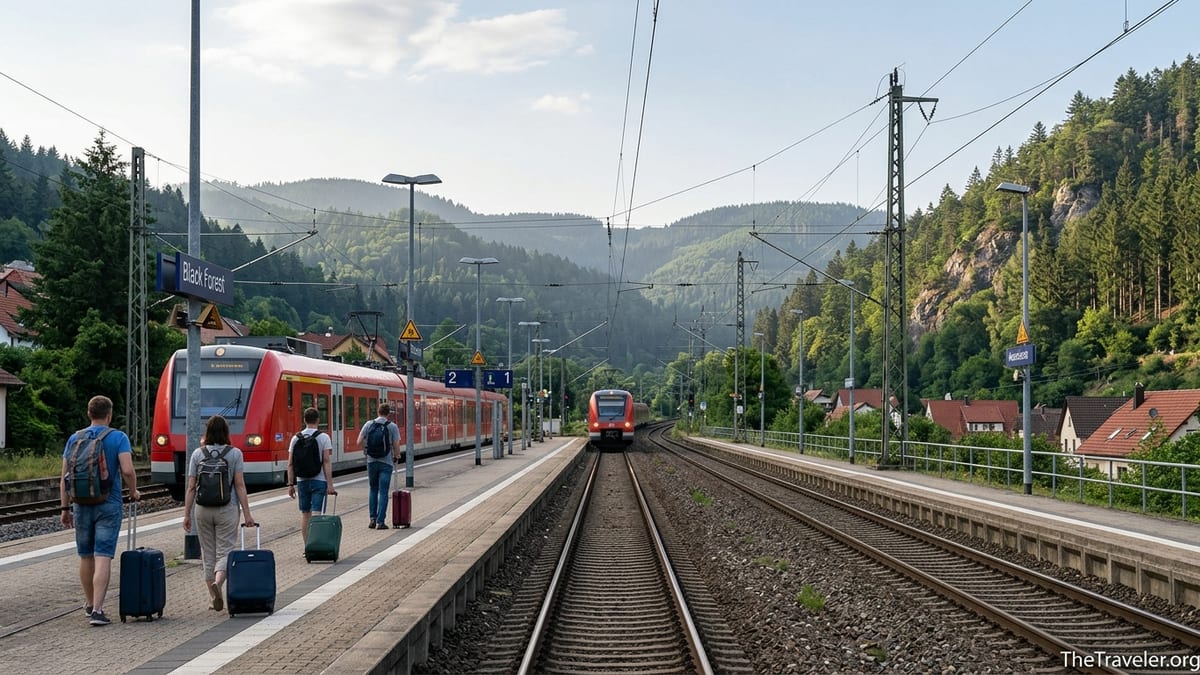
Why Southern Germany Works So Well by Train
Southern Germany combines big-city hubs with compact historic centers and strong regional rail networks, which makes it unusually well suited to train travel. Munich, Nuremberg, Stuttgart and Freiburg all have central stations within walking or short tram distance of the old town. For many trips, you can step off a train at Munich Hauptbahnhof or Stuttgart Hauptbahnhof and be in the main sightseeing area in 10 to 15 minutes on foot, eliminating the need for taxis or ride-hailing services.
Deutsche Bahn’s long-distance Intercity Express and Intercity services connect the main cities at high speed, while a dense web of Regional Express and Regionalbahn trains fills in the gaps. A typical long-distance journey such as Munich to Stuttgart by ICE is about 2 hours, and Munich to Nuremberg is around 1 hour, with several departures each hour in daytime. Regional trains are slower but stop at more intermediate towns and are covered by attractive day passes.
For visitors, the biggest advantage of using trains in southern Germany is predictability. Timetables are fixed months in advance, digital displays are widely available in English, and printed tickets or mobile passes are usually enough to board without turnstiles. On a practical level, this means you can land in Munich on a Tuesday morning, hop on an S-Bahn from the airport into the city, and then continue by train to Nuremberg or Regensburg the same afternoon without ever renting a car.
There is also a qualitative aspect: much of southern Germany’s appeal lies in its landscapes and historic cores, not in high-speed highways or suburban retail strips. Trains from Freiburg into the Black Forest or along Lake Constance offer views you would not safely enjoy from a steering wheel. In many medieval towns, driving a rental car right to your hotel is impossible due to pedestrian zones, while the station sits within easy reach.
Core City Routes: Munich, Nuremberg, Stuttgart, Heidelberg, Freiburg, Lake Constance
Most itineraries in southern Germany begin or end in Munich. From Munich to Nuremberg, frequent ICE and IC trains cover the route in roughly 1 hour, ideal if you value speed and comfort. A budget-conscious alternative is the Regional Express line on the same corridor, usually taking about 1 hour 40 minutes. If you hold a regional day ticket rather than a long-distance fare, you will typically be using these regional trains.
From Munich to Stuttgart, direct ICE trains commonly take about 2 hours. This route is particularly convenient if your plan is to connect onward to Heidelberg or Freiburg. For example, a traveler could leave Munich mid-morning, reach Stuttgart around lunchtime, store luggage in station lockers for a quick walk to Schlossplatz and the Königstrasse shopping street, then take a late afternoon train onward to Heidelberg, which is usually another 40 to 60 minutes by regional or IC service via Mannheim.
Heidelberg itself does not sit on a major ICE line, but it is well connected through Mannheim, one of southwestern Germany’s key rail hubs. A realistic itinerary from Munich or Nuremberg to Heidelberg is therefore to change in Stuttgart or Mannheim. Once in Heidelberg, local buses or trams from the central station bring you to the Altstadt and the funicular up to Heidelberg Castle within 15 to 20 minutes, making a car largely unnecessary for a short stay.
Freiburg im Breisgau and Lake Constance are natural extensions of a southern Germany rail loop. From Stuttgart, direct trains to Singen or Konstanz on Lake Constance, or to Freiburg via Offenburg, are common. A typical Stuttgart to Freiburg journey by IC or regional express is about 2.5 hours, often passing vineyards and the edge of the Black Forest. From Freiburg, another 1.5 to 2 hours by regional train brings you to Konstanz or other Bodensee towns, so travelers can comfortably manage a route like Munich – Stuttgart – Heidelberg – Freiburg – Lake Constance over a week without touching a steering wheel.
Key Scenic Rail Lines in the Black Forest and Along Lake Constance
Beyond the main corridors, southern Germany hides several classic scenic railways that turn transit days into highlights. One of the most noteworthy is the Black Forest Railway between Offenburg and Singen. This line climbs from the Rhine Valley into wooded hills, navigating numerous tunnels and viaducts, before descending toward the Hegau volcanic landscape and eventually linking toward Lake Constance. Travelers commonly ride at least the stretch between Offenburg and Villingen to experience forested valleys and traditional villages.
Another standout is the Höllentalbahn between Freiburg im Breisgau and Donaueschingen via the Höllental valley. This route includes some of the steepest standard-gauge sections in Germany and passes near Titisee, a resort town on a glacial lake popular for walking and boat trips. A simple day trip example would be to base yourself in Freiburg, take a morning Höllentalbahn train up to Titisee for lakeside strolling and lunch, then continue on the same line to Donaueschingen before looping back to Freiburg in the late afternoon.
Along Lake Constance, regional trains follow large sections of the north shore, connecting towns like Radolfzell, Überlingen, Friedrichshafen and Lindau. The track often runs close enough to the water that you can see sailboats and the Alps on clear days. Travelers on a summer trip could, for example, ride from Konstanz to Friedrichshafen in around 1 hour on a regional train, spend the afternoon visiting the Zeppelin Museum or strolling the harbor, then continue another hour or so to Lindau for an evening in the island old town.
For those interested in less obvious routes, smaller lines such as the branch from Titisee to Seebrugg in the Black Forest, or local connections along the Upper Rhine between Freiburg and Basel, also reward slow travel. Many of these segments are covered by the same regional day tickets and national passes as the bigger routes, making it easy to combine famous cities with quiet forest valleys or lakeside stops without extra planning.
Ticket Options: Deutschlandticket, Regional Day Passes and Long-Distance Fares
As of 2026, the most discussed ticket in Germany is the nationwide Deutschlandticket, a monthly subscription for local and regional public transport that costs around 63 euros per calendar month. It covers virtually all regional trains, S-Bahn, U-Bahn, trams and local buses across Germany, but not long-distance ICE, IC or EC trains. For a traveler spending at least a full week riding mostly regional trains and city transport in southern Germany, subscribing for a single month can be excellent value.
Regional day passes remain attractive for shorter or more concentrated stays. In Bavaria, the Bayern-Ticket provides unlimited travel on regional trains and most local transport within the state for one day, after a weekday start time in the morning and all day on weekends. Pricing is structured per group, with a solo traveler paying less than a group of three or four, which makes it popular for families or friends doing a day trip, for example from Munich to Nuremberg and back or from Munich to the foothills near Garmisch-Partenkirchen.
In Baden-Württemberg, the Baden-Württemberg-Ticket offers similar benefits, giving one day of unlimited regional travel within the state, including routes like Stuttgart to Freiburg, Offenburg into the Black Forest and many local branch lines. A pair of travelers based in Stuttgart might, for instance, use one Baden-Württemberg-Ticket to ride to Tübingen in the morning, continue to the Black Forest Railway around Villingen in the afternoon, and return to Stuttgart at night without worrying about individual fares for each leg.
For trips focused on fast long-distance trains, especially between major cities, advance-purchase Sparpreis or Super Sparpreis tickets on ICE and IC services can be cost-effective and time-saving. These fares tie you to specific trains but can bring the cost of a Munich to Stuttgart ICE ticket down compared with a flexible fare purchased on the day. A realistic combination on a two-week holiday might be to book a few long-distance point-to-point ICE tickets for longer hops, such as Berlin to Munich or Frankfurt to Stuttgart, and then rely on the Deutschlandticket or state day passes for all travel once you are settled within southern Germany.
Planning Your Route and Timing Connections
When planning a rail itinerary through southern Germany, it helps to think in segments. One common circuit could look like: Munich – Nuremberg – Stuttgart – Heidelberg – Freiburg – Lake Constance – Munich. Each segment is typically 1.5 to 3 hours by train, so it is possible to move every two or three days without feeling rushed. A traveler with 10 days might spend two nights each in Munich, Nuremberg, Heidelberg and Freiburg, with a final two nights at Lake Constance before returning to Munich or Zurich.
Germany’s timetabling culture supports precise planning, but it is wise to allow realistic connection times, especially when changing from long-distance ICE services to regional trains. For example, if you arrive in Stuttgart from Munich on an ICE with a scheduled arrival of 11:58 and want to continue to Heidelberg on a regional train at 12:05, the 7-minute connection may be technically valid but stressful if your first train is a few minutes late. Building in at least 20 to 30 minutes for intercity to regional transfers gives you breathing room for grabbing a snack and finding the correct platform.
Storing luggage at major stations can make day trips and stopovers smoother. Many hubs such as Munich, Nuremberg, Stuttgart and Freiburg offer coin-operated or card-operated lockers in multiple sizes. As a concrete example, a traveler heading from Munich to Freiburg could plan a three-hour lunch stop in Stuttgart, placing a medium suitcase in a station locker, walking to the Schlossplatz area for a quick museum visit or meal, then retrieving the luggage and boarding a later train without carrying bags around town.
Even without speaking German, most visitors find wayfinding manageable. Departure boards typically list both the final destination and important intermediate stops, so you might look for a train labeled “RE to Konstanz” even if you are only traveling as far as Friedrichshafen. Many regional services display both train type and number, such as “RB 31,” which can be cross-checked against printed itineraries or smartphone apps. In practice, following platform numbers and the scheduled departure time will usually be enough to avoid mistakes.
Luggage, Comfort and Onboard Experience
Trains in southern Germany are generally designed with travelers in mind, and handling typical vacation luggage is rarely difficult. Long-distance ICE and IC trains offer dedicated luggage racks at carriage ends and overhead shelves above seats, easily fitting a medium checked suitcase plus a day pack. Regional trains vary more in layout; some modern double-decker carriages have generous space near doors and staircases where suitcases and folded strollers can be parked, while older units may rely on overhead racks only.
A practical strategy is to travel with one wheeled suitcase in the 60 to 70 centimeter range and a backpack or shoulder bag as your personal item. On busy routes such as Munich to Salzburg or Stuttgart to Lake Constance during summer weekends, boarding earlier in the train can secure luggage space. If you are two people traveling together, one can step inside quickly to claim a rack while the other lifts bags up from the platform.
Food and drink vary by train category. ICE and many IC trains carry a Bordbistro or at least a small snack bar where you can buy coffee, soft drinks, simple hot dishes and beer. Regional trains rarely sell anything onboard, so picking up snacks and water in station kiosks or bakeries before boarding is a good habit. In major stations like Munich or Stuttgart, you could easily buy takeaway sandwiches or pretzels, then enjoy them during a 2-hour journey through the countryside.
Seating comfort is usually good enough for trips up to three hours. ICE trains have reserved and unreserved sections, and seat reservations are recommended for popular routes on Friday afternoons or Sunday evenings. Many regional trains have no reservations and operate on a first-come, first-served basis. On scenic lines in the Black Forest or along Lake Constance, try to sit on the side facing the valley or lake for better views, which locals on board can often help you identify if you ask politely.
When a Rental Car Becomes Useful
Despite the strength of the rail network, there are situations where renting a car in southern Germany is genuinely useful. Remote villages, small lakes or hiking trailheads in the Alps and the deeper Black Forest often lie several kilometers from the nearest station or bus stop. For example, if you want to stay at an isolated guesthouse on a hillside above Lake Titisee or explore multiple small wine villages along the Kaiserstuhl near Freiburg in a single day, relying solely on infrequent local buses could consume hours in transfers.
Renting a car for just a portion of your trip can bridge these gaps without sacrificing the convenience of rail for the main legs. A common pattern is to travel by train between major cities, then pick up a rental car for 2 or 3 days in a smaller hub such as Freiburg, Constance or Lindau. You could, for instance, arrive by train in Freiburg, explore the old town that afternoon, collect a car the next morning, drive to outlying Black Forest villages, waterfalls and viewpoints for two days, then return the car and continue by train to Stuttgart or Munich.
Timing matters. Urban driving and parking in Munich, Nuremberg or Stuttgart is often more of a burden than a help due to one-way systems, parking fees and pedestrian-only historic centers. For that reason, it is usually smarter to collect rental cars at the edge of your city stays rather than at the airport on arrival. An American couple flying into Munich might spend three car-free days in the city using S-Bahn and trams, then pick up a compact rental near the station on day four for a loop through rural Upper Bavaria or the Allgäu before dropping it in Freiburg or another city.
Costs for car rental in Germany vary, but you can expect a compact manual transmission vehicle to start in the region of several dozen euros per day before fuel, insurance and tolls in neighboring countries if you cross borders. When comparing this to train costs, remember to factor in that highway fuel prices are significantly higher than in North America and that parking in popular tourist towns can add up. For a solo traveler or couple primarily visiting larger cities and popular day-trip destinations, trains plus regional buses and the occasional taxi often remain both cheaper and less stressful than driving.
Putting It All Together: Sample Itinerary Ideas
To see how these pieces fit in practice, consider a 10-day train-focused trip starting and ending in Munich. Days 1 and 2 could be spent in Munich itself, using S-Bahn and U-Bahn covered by either a local day pass or, if you have subscribed, the nationwide Deutschlandticket. On day 3, you might take a morning ICE or regional train to Nuremberg for an overnight stay, visiting the Kaiserburg castle and the historic center within easy walking distance from the station.
On day 4, travel from Nuremberg to Stuttgart, leaving time for an afternoon walk around Schlossplatz and possibly a visit to the Stuttgart TV Tower or one of the automotive museums by S-Bahn and bus. Days 5 and 6 could then be dedicated to Heidelberg, reached by train via Mannheim, with one full day exploring the Old Bridge, university quarter and castle terrace. Most of this can comfortably be done on foot or by short tram rides.
From Heidelberg, day 7 might take you by train via Karlsruhe and Offenburg along the Black Forest Railway to Freiburg, turning the transfer into a scenic ride past wooded hills and small spa towns. Spend day 8 in Freiburg and the Höllental, using regional trains to Titisee or even on to Donaueschingen, before returning to Freiburg in the evening. Days 9 and 10 could then focus on Lake Constance, traveling by regional train to Konstanz or Friedrichshafen, enjoying lakeside promenades and boat rides, and finally returning to Munich on a longer train leg on your last day.
For travelers who want a driving component, you could adapt this loop by inserting a 2-day rental car segment between Freiburg and Lake Constance. After your Black Forest rail adventures, pick up a car in Freiburg, drive the next morning via winding forest roads to small villages such as St. Peter or Triberg, then continue toward the lake with flexibility to stop at viewpoints and lesser-known beaches. Drop the car in Constance or Lindau and complete your journey by train back to Munich, avoiding a final long highway drive.
FAQ
Q1. Is the Deutschlandticket enough for a whole trip in southern Germany?
The Deutschlandticket can cover most or all transport if you mostly use regional trains, S-Bahn, U-Bahn, trams and buses, but it does not include long-distance ICE or IC trains, so for faster intercity journeys you may still want separate long-distance tickets.
Q2. Should I reserve seats on German trains?
Seat reservations are optional on ICE and many IC trains and can be useful on busy routes or weekends, while on regional trains reservations are usually not available and seating is first-come, first-served.
Q3. How early should I arrive at the station before my train?
Arriving 15 to 20 minutes before departure is usually enough at major stations like Munich or Stuttgart, giving you time to find the platform, check departure boards and board without rushing.
Q4. Can I bring large luggage on regional trains?
Yes, large suitcases are generally allowed at no extra charge, but space can be limited, so traveling with one medium suitcase and one small bag per person makes boarding and storage much easier.
Q5. Are trains in southern Germany reliable in winter?
Services generally run year-round, but in winter heavy snow or storms can cause delays; building some flexibility into your schedule and checking live updates on the day of travel is wise.
Q6. Is it cheaper to buy tickets in advance?
Advance-purchase fares for long-distance ICE and IC trains are often significantly cheaper than flexible same-day tickets, while regional day passes and the Deutschlandticket are usually fixed price and can be bought closer to travel.
Q7. Do I need to validate my ticket before boarding?
Many digital and long-distance tickets do not require validation, but some local paper tickets must be stamped in small blue or yellow machines on the platform, so if in doubt ask staff or watch what local passengers do.
Q8. Is driving in Munich, Nuremberg or Stuttgart recommended?
Driving in these large cities is usually more hassle than help due to traffic and parking, so most visitors manage better using public transport and only renting a car for rural segments of their trip.
Q9. Can I visit smaller Black Forest villages without a car?
Larger towns such as Freiburg, Triberg and Titisee are easy by train and bus, but reaching scattered hamlets and remote trailheads often requires either careful planning around limited buses or a short rental car period.
Q10. Are there night trains within southern Germany?
While some early morning and late evening regional and intercity services exist, true overnight sleeper trains within southern Germany are limited, so most journeys are comfortably done during daytime hours.