


Northern Germany is built for train travel. Dense rail networks link Hanseatic cities, half-timbered towns, Baltic beaches and North Sea islands, often with simple fares and predictable timetables. With a bit of planning, you can stitch Hamburg, Bremen, Lübeck, Kiel, Rostock, Schwerin and Stralsund into a relaxed rail itinerary, then add a rental car only where it genuinely saves time or opens up rural corners that trains and buses cannot reach.
Understanding Northern Germany’s Rail Network
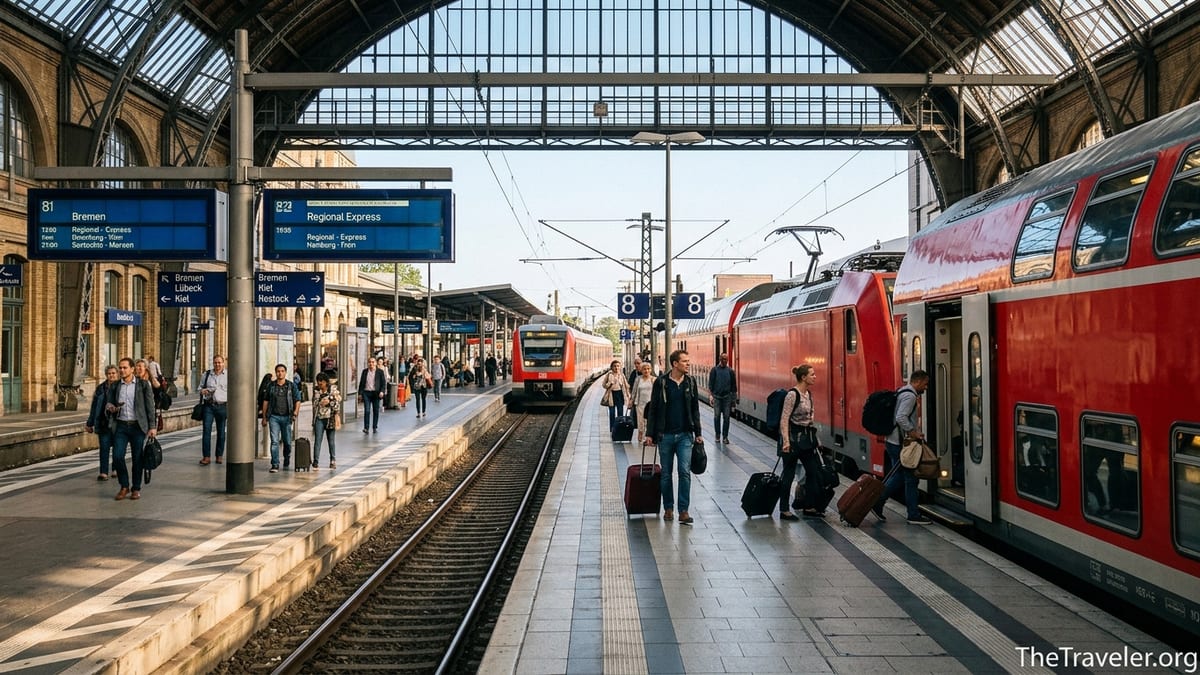
For trip planning, picture Hamburg as the main hub of northern Germany. From Hamburg Hauptbahnhof, frequent Regional-Express and regional trains fan out west to Bremen, north to Kiel and Flensburg, and east towards Lübeck, Schwerin, Rostock and Stralsund. On most of these corridors, journey times between major cities sit between 45 minutes and 2.5 hours, and services typically run at least every hour in daytime.
Bremen forms a smaller western hub, with direct regional services south to Osnabrück and Hannover and north to Bremerhaven on the North Sea. Lübeck acts as a gate to the Baltic coast, with local trains continuing to seaside resorts such as Travemünde and Timmendorfer Strand. Kiel, Rostock and Stralsund are the main springboards for exploring Schleswig-Holstein’s fjord country and Mecklenburg-Vorpommern’s long Baltic shoreline, including islands such as Rügen and Usedom.
Most long-distance Intercity and ICE services also pass through Hamburg and Bremen, and a few reach Rostock or Stralsund, but for the city-to-city hops covered in this guide, regional trains are usually fast enough and far better value. They serve central stations, require no reservation, and integrate smoothly with local buses, trams and ferries, which matters as soon as you head for a beach or ferry pier.
Because northern Germany is relatively flat and compact, distances are manageable without flying or driving. For example, Hamburg to Bremen by regional train is roughly 1 hour, Hamburg to Lübeck about 45 minutes, and Hamburg to Rostock around 2.5 hours with a change in Schwerin or on a direct Hanse-Express service. These timings make it realistic to combine several cities and coastal day trips in a one- or two-week itinerary by rail alone.
Key City-to-City Routes and Typical Journey Times
For many travelers, the first decision is how to connect Hamburg, Bremen and the Baltic ports in a logical loop. A classic clockwise route would be Hamburg – Bremen – Hamburg – Lübeck – Kiel – Hamburg – Schwerin – Rostock – Stralsund, adding coastal side trips along the way. Because regional tickets are flexible, you can adjust overnight stops without rebooking specific trains.
Hamburg to Bremen is one of the busiest regional corridors in the north. Regional-Express services usually take about 1 hour between Hamburg Hauptbahnhof and Bremen Hauptbahnhof, running at least hourly during the day. It is common to see both regional and faster Intercity trains on this line; if you rely on regional passes or the Deutschlandticket you must simply choose the trains marked RE or RB in timetables.
Hamburg to Lübeck is even shorter. Regional trains travel the 60-kilometre route in about 45 minutes, often twice per hour during peak times. Lübeck’s historic centre and the short onward ride to Travemünde make this one of the easiest day trips from Hamburg. By contrast, Hamburg to Kiel takes about 1 hour 15 minutes to 1 hour 30 minutes on direct regional trains, which run at least hourly. Because both Lübeck and Kiel sit at the end of separate branches, you usually return to Hamburg or connect via regional lines across Schleswig-Holstein if you want to join them up.
Heading east, Hamburg to Schwerin typically takes around 1 hour 15 minutes on a Regional-Express, with several departures a day. From there, the same line continues north to Rostock in roughly another hour, and from Rostock it is about 2 hours by regional train to Stralsund, often along the same Hanse-Express corridor. In practice, this means Hamburg to Rostock is usually around 2.5 hours by regional trains, and Hamburg to Stralsund about 3.5 to 4 hours, depending on connections.
Tickets and the Deutschlandticket: What Makes Sense in 2026
Since January 2026, the nationwide Deutschlandticket has become the backbone of budget rail planning. Priced at around 63 euros per month, it allows unlimited travel on local and regional public transport across Germany, including regional trains, S-Bahn and most city buses and trams. It is valid in second class only and does not cover long-distance services such as ICE, IC or private long-distance operators. In northern Germany, that effectively means you can ride almost all the trains mentioned in this article as long as they are categorised as Regional-Express, Regionalbahn or S-Bahn.
The Deutschlandticket is sold as a monthly subscription, typically via Deutsche Bahn’s Navigator app or local transport apps such as the Hamburg transport association’s app. While technically an ongoing subscription, you can usually cancel monthly, so many visitors buy it for the calendar month of their trip and cancel again before the next billing date. For a two-week itinerary through Hamburg, Bremen and the Baltic coast with several city passes and regional excursions, the pass often pays for itself after just a few medium-length trips and some local transport rides.
If your time in Germany is shorter, or your rail travel is concentrated into only one or two heavier days, regional day passes can be more efficient. Each northern state offers its own day ticket products, typically valid for unlimited regional travel within the state (and sometimes neighbouring states) for one day. As an example, a Schleswig-Holstein day ticket usually covers regional trains and most local transport across Schleswig-Holstein and Hamburg for a fixed price per day for individuals or small groups. Similar offers exist in Mecklenburg-Vorpommern and Lower Saxony. Pulling fare examples directly from current sales pages is useful when planning, as actual prices fluctuate with periodic tariff changes.
For point-to-point trips where you will not ride much else that day, standard regional fares or saver fares booked in advance can be cheaper. For example, a single Hamburg to Schwerin regional ticket bought a few days ahead can cost significantly less than a full-day state ticket if you are not continuing farther. The key is to compare the cost of a one-way fare plus perhaps one urban ticket at your destination with the cost of a day pass or the pro-rated daily cost of a Deutschlandticket.
Planning Routes to Coastal Resorts and Islands
Northern Germany’s real charm lies along its coasts and islands, and here the train remains your best friend for most major resorts. From Lübeck, frequent regional trains reach Travemünde, where you can stroll between the old fishing harbour and the sandy Kurstrand. The journey from Lübeck Hauptbahnhof to Travemünde Strand station typically takes around 20 to 30 minutes. On busy summer weekends, these short trains can be crowded, so aim for earlier departures if you want a seat and space for luggage.
From Hamburg, another popular Baltic outing is to head east via Lübeck towards Timmendorfer Strand and Scharbeutz. Regional trains call at Timmendorfer Strand within roughly one hour from Hamburg, making it realistic to visit for a half-day swim and dinner before returning to the city. These coastal stations are usually within walking distance of the beach promenade, with occasional local buses to more remote stretches of sand.
Farther east, Rostock acts as the main hub for the wider Baltic coast. A short regional or S-Bahn-style train ride brings you from Rostock Hauptbahnhof to Warnemünde, a seaside resort with a broad beach and busy cruise pier. Travel time is about 20 minutes and trains run at least every 15 to 30 minutes during the day. From Stralsund, regional trains continue across the causeway to the island of Rügen, stopping at Binz, Sellin and the terminus at Sassnitz, with travel times from Stralsund to Binz often around an hour. With the Deutschlandticket or appropriate regional pass, you can comfortably ride from Hamburg all the way to a Rügen beach town in a single long day using only regional services.
Access to the North Sea islands often involves a combination of train and ferry. For example, to reach the island of Sylt, you would typically take a regional train from Hamburg to Westerland on Sylt via Husum and Niebüll, usually taking about 3 to 3.5 hours. For the East Frisian islands from Bremen or Hamburg, you would ride regional trains to coastal towns such as Norden, Emden or Wittmund, then transfer to buses and ferries. Timetables are coordinated in many cases, but connections can be tight; factor in wait times at ferry piers during peak season.
When It Pays to Rent a Car
Trains and buses in northern Germany reach far more places than in many other countries, but there are still situations where a rental car adds real value. One clear case is when you want to string together several small coastal villages or rural lakes in one day, places that are served only every few hours by buses. For example, exploring the Holstein Switzerland lake district south of Kiel, or hopping between quiet beaches on the Darß and Zingst peninsula east of Rostock, often involves sparse bus timetables. With a car, you can detour to viewpoints, thatched-roof hamlets and hiking trailheads that would be hard to reach on public transport.
A car is also practical if you are traveling as a family or group with bulky beach gear, bicycles or watersports equipment. While most regional trains in northern Germany accept bikes, space is limited and may require a separate bike ticket. On summer weekends, it is not unusual to see cyclists turned away from already full trains on the most popular routes to the coast. Renting a small estate car or van for a couple of days around Rostock or Kiel can be more comfortable and, shared between four people, not much more expensive than multiple bike tickets and long waits on platforms.
One-way car rentals between major northern cities, such as picking up a compact car in Hamburg and dropping it in Rostock or Kiel, are widely offered by large international brands and German providers. The exact one-way fee varies by company, vehicle type and dates, and is usually disclosed during the reservation process. Before committing to a one-way rental, compare the surcharge with the cost and simplicity of returning the vehicle to the same city and continuing by regional train instead.
However, it rarely makes sense to rent a car solely for the highway hops between major cities mentioned earlier. Traffic around Hamburg and Bremen can be congested at peak times, parking in historic centres is often expensive, and speed limits or roadworks can negate any theoretical time savings over a non-stop regional train. In most cases, a smart compromise is to base yourself in a city that is well connected by rail, then rent a car only for one or two days of intensive countryside exploration, returning it before moving on to the next major stop by train.
How and Where to Book: Apps, Machines and Counters
The simplest way for most visitors to handle northern Germany rail bookings is to use a combination of the Deutsche Bahn Navigator smartphone app and local transport association apps. The DB Navigator app lets you search schedules for almost all train operators, filter for regional trains only if you hold a Deutschlandticket, and buy single fares, day tickets and seat reservations for long-distance trains. You can also load a Deutschlandticket into the app if you purchase it through Deutsche Bahn.
At stations, red Deutsche Bahn ticket machines and local operator machines sell regional and long-distance tickets. In Hamburg, for example, you might use a Hamburg transport association machine for a short S-Bahn ride, or a Deutsche Bahn machine for a Regional-Express ticket to Bremen or Schwerin. Machines usually have English-language menus, accept major credit cards, and allow you to purchase state day tickets and some local passes on the day of travel. At busy hubs like Hamburg Hauptbahnhof, you will also find staffed counters, which are useful if you are unsure about pass combinations or need help after a disruption.
For rental cars, it is usually best to book with a major firm online in advance, especially in peak summer months along the Baltic and North Sea coasts. Locations at or near the main station in Hamburg, Bremen, Lübeck, Kiel and Rostock are common, which makes it easy to switch between train and car. When comparing prices, watch for included mileage, fuel policies, one-way surcharges and insurance coverage, which can vary significantly between offers. If you plan only a short rural loop, picking up and dropping off in the same city often keeps costs lower.
If you prefer to avoid apps, it is still entirely possible to travel using only station machines and paper tickets, particularly if you rely on simple products such as state day tickets or single regional fares. The trade-off is that you may lose the convenience of live delay alerts and platform changes that smartphone apps provide. For most rail-heavy itineraries, combining a monthly Deutschlandticket in an app with occasional paper tickets for special journeys strikes a good balance between flexibility and simplicity.
Practical Tips for Smooth Regional Train Travel
Even with straightforward tickets, a few habits can make regional train travel in northern Germany smoother. First, always check whether your planned train is a regional service or long-distance. In apps and station displays, look for designations such as RE, RB or S for S-Bahn, which are covered by regional tickets and the Deutschlandticket. Trains marked ICE or IC require separate long-distance tickets and are not included, even if they run on the same tracks between the same cities.
Boarding regional trains with luggage is usually uncomplicated, as most sets used in northern Germany have wide doors and at least some low-floor sections. Still, on busy summer weekends, coastal trains can fill quickly. Try to board early at the starting station, stow large bags on dedicated racks at carriage ends rather than blocking aisles, and keep valuables with you. If you need priority seating, look for clearly marked sections near the doors, and carriages with wheelchair symbols.
Delays and minor changes are part of rail travel everywhere. In northern Germany, moderate delays of 5 to 15 minutes are not unusual, especially on lines undergoing track works. Live updates in apps or on station departure boards will usually show track changes and expected arrival times. Because regional tickets tend to be flexible, you can usually board the next available train if a connection is missed. For tight transfers to ferries or evening events, build in a buffer of at least one extra connection where possible.
Finally, be prepared for ticket inspections. On regional trains, plainclothes or uniformed staff regularly check tickets, including Deutschlandtickets in digital form. Make sure your QR code is ready and that your phone has enough battery for the entire journey. If you are using a regional day ticket for a group, ensure that the correct names are filled in where required before boarding. Fines for traveling without a valid ticket are substantial and rarely waived for visitors who claim confusion.
The Takeaway
Northern Germany lends itself naturally to a rail-based itinerary, with Hamburg anchoring a network of regional lines that reach Bremen, Lübeck, Kiel, Rostock, Schwerin and Stralsund in under half a day. With the 2026 Deutschlandticket providing unlimited regional travel for a fixed monthly price, and flexible state day tickets covering intensive single days of exploration, most travelers can comfortably rely on trains and local public transport for the bulk of their journey.
A rental car still has its place, especially for reaching secluded beaches, lake districts and sparsely served peninsulas, or for families traveling with lots of gear. The sweet spot is to keep intercity hops and main sightseeing moves on rails, then add a short car rental in one or two hubs where it obviously widens your options. By mixing these tools, you can experience both the historic Hanseatic cities and the quieter landscapes between them without the stress of continuous driving.
FAQ
Q1. Is the Deutschlandticket worth it for a one-week trip in northern Germany?
For a full week that includes several intercity hops plus local trams and buses, the Deutschlandticket often pays off, especially if you travel on at least three or four different days.
Q2. Can I use the Deutschlandticket on trains between Hamburg and Bremen?
Yes, as long as you use Regional-Express or other regional trains on this route. It is not valid on ICE or IC long-distance services that sometimes run the same corridor.
Q3. Do I need seat reservations on regional trains in northern Germany?
No, seat reservations are generally not offered or required on regional trains. You simply board with a valid ticket and find any free seat, though services can be busy in summer.
Q4. How early should I buy regional day tickets or state tickets?
You can usually buy state day tickets on the day of travel at station machines or in apps. Prices are fixed, so there is little advantage to buying them far in advance.
Q5. Is it realistic to visit Lübeck or Bremen as a day trip from Hamburg by train?
Yes, both cities are around an hour from Hamburg by regional train, with frequent departures. Many visitors use Hamburg as a base and visit one or both on separate days.
Q6. When is renting a car better than using trains on the Baltic coast?
A car becomes useful when you want to string together several small beaches, rural villages or hiking areas in one day, especially where buses run only every few hours.
Q7. Are bicycles allowed on regional trains in northern Germany?
In most cases yes, but you often need a separate bike ticket and space is limited. On busy summer weekends, particularly to coastal resorts, bike spaces can sell out.
Q8. How do I reach the island of Rügen by public transport?
Typically you ride regional trains to Stralsund, then continue on regional services across the causeway to towns such as Bergen, Binz or Sassnitz on Rügen.
Q9. Can I rely on English at ticket machines and information desks?
Most larger stations offer English-language menus on machines, and staff at main ticket counters in cities like Hamburg or Bremen generally speak at least basic English.
Q10. What happens if my regional train is delayed and I miss a connection?
With flexible regional tickets or passes you can usually board the next available regional train. Just check live departure boards and allow extra time for tight onward connections.