


Northern Germany rewards travelers who choose their base carefully. Within a few hours by train you can switch from Hamburg’s port-city energy to quiet brick-lined Hanseatic streets, from long Baltic beaches on Rügen to the wild surf of the North Sea. This guide compares the main hubs and seaside resorts in the north and helps you decide where to stay for city breaks, couples’ escapes, family trips, beach holidays, road trips and car free travel.
How to Choose Your Base in Northern Germany
The distances in Northern Germany are modest, but choosing a smart base can save you long travel days. Hamburg is the obvious hub for first timers and short breaks, with its international airport and fast rail links. From there, direct trains reach Lübeck in about 45 minutes, Travemünde and the Baltic in roughly 1 to 1.5 hours, and the North Sea towns and islands in 2 to 4 hours depending on the connection. For a week or more, many travelers split time between a city and an island or coastal resort.
Think about your priorities. If this is mainly a city break with a side trip to the coast, Hamburg or Lübeck work best. If you want long beach days, dunes and bike paths with only a token city visit, then Rügen, Sylt or a North Sea resort such as St Peter Ording or Cuxhaven will be more satisfying. Rügen gives you grand spa architecture and calmer Baltic waters, while Sylt and the North Sea towns feel wilder and windier, especially in spring and autumn.
Budget also plays a role. On summer weekends you can find simple double rooms around 120 to 160 euros in Hamburg outside the very top tier, while Baltic and North Sea resorts can jump to 180 to 250 euros or more for a midrange room close to the beach in July and August. Self catering apartments are common on Rügen, Sylt and along both coasts and can be good value for families staying a week, especially outside school holidays.
Transport style is another key factor. Northern Germany is relatively easy without a car if you stick to major hubs. Hamburg, Lübeck, Travemünde, Binz on Rügen, Westerland on Sylt, St Peter Ording and Cuxhaven all have rail connections or dedicated regional buses from the nearest station. For smaller villages on Rügen, the North Frisian islands or remote Wadden Sea spots, having a car gives you more flexibility, but it is rarely essential if you are willing to combine trains, buses, ferries and bikes.
Hamburg: Best All Round Base and City Break
Hamburg is the logical starting point for most trips to Northern Germany. As the country’s second largest city, it has a major airport and is a key rail hub, but it remains compact enough to explore comfortably over two or three days. For sightseeing and first time visitors, the most convenient areas to stay are the Altstadt and Neustadt around the Rathaus, the Speicherstadt and HafenCity warehouse district, and the edges of St Pauli for nightlife minded travelers. These quarters put you near the Elbe riverfront, harbor tours, the Elbphilharmonie concert hall and shopping streets while keeping public transport on your doorstep.
If you like modern waterfront architecture, look at hotels in HafenCity or the Speicherstadt area. Here you will find converted brick warehouses and new glass fronted properties, often with views of the canals. Many midrange hotels between the Inner Alster lake, Speicherstadt and the harbor offer doubles from about 130 to 180 euros outside the peak Christmas market and trade fair periods. For a more bohemian feel, consider the Sternschanze and Karoviertel districts west of the center, which are full of cafes, bars and small guesthouses and are still within a few U and S Bahn stops of major sights.
Hamburg also works well as a base for car free side trips. A day trip to Lübeck’s UNESCO listed old town is straightforward by regional train, and continuing to Travemünde lets you step straight onto the Baltic beach promenade. Other popular day excursions include the Altes Land fruit growing region on the Elbe and the port city of Cuxhaven at the mouth of the river. If you are planning a longer coastal or island stay, many travelers spend two nights in Hamburg on arrival to shake off jet lag, then move on by train to the Baltic or North Sea for four or five nights before returning to Hamburg for a final evening.
Hamburg’s accommodation range is wide, from hostels around St Georg and the central station through boutique hotels near the Alster to business chains in Hafencity. For solo travelers and couples who want nightlife, the area around St Pauli and the Reeperbahn is lively and convenient, but choose streets a few blocks away from the noisiest bars if you are a light sleeper. Families may prefer quieter districts like Eimsbüttel or Winterhude, where vacation apartments are common, and where you can reach the center in 10 to 20 minutes by U Bahn while enjoying parks and playgrounds nearby.
Lübeck and Travemünde: Compact Culture and Easy Baltic Access
Lübeck offers a gentler alternative to Hamburg while still giving you good connections to the Baltic coast. Its island shaped old town, framed by the Trave river, is a UNESCO World Heritage site packed with brick Gothic churches, patrician houses and narrow lanes. Staying anywhere within or just outside the old town walls lets you cover the main sights on foot. Midrange hotels and pensions in the historic core often charge around 120 to 160 euros for doubles in spring and autumn, with rates peaking in December for the popular Christmas markets.
The advantage of Lübeck as a base is the combination of culture and access to the sea. In about 20 to 30 minutes by regional train or bus you can be in Travemünde, Lübeck’s seaside district at the mouth of the Trave. There, a long sandy beach, spa promenade and Germany’s oldest lighthouse make for classic Baltic resort scenery. If you stay directly in Travemünde you are literally across the road from the sand in many hotels and apartments, and you can still visit Lübeck’s old town on day trips by boat or bus. This split makes Lübeck and Travemünde ideal for couples who want some museum and cafe time alongside leisurely beach walks.
For car free travelers, Lübeck is one of the easiest Baltic bases. Direct trains link it to Hamburg, and from Lübeck Hauptbahnhof you can reach smaller Baltic spots such as Timmendorfer Strand or Scharbeutz with simple regional connections. Families often choose apartments in Travemünde or nearby resort villages, where you have kitchen facilities and can walk to the beach with strollers and beach toys. Parking is easier than on the islands, but if you arrive by train you can manage with local buses and bike rentals along the coast.
If you are planning a road trip, Lübeck makes sense as the first stop driving north from Berlin or Hanover. You can base yourself in the old town for two nights, then continue along the Baltic coast to Wismar, Rostock and Rügen. Travelers short on time sometimes do the opposite: a long weekend based in Lübeck, with one full day in the old town and another split between Travemünde and a boat tour along the coast, before heading back south without going as far as the islands.
Rügen: Baltic Island for Families, Heritage and Road Trips
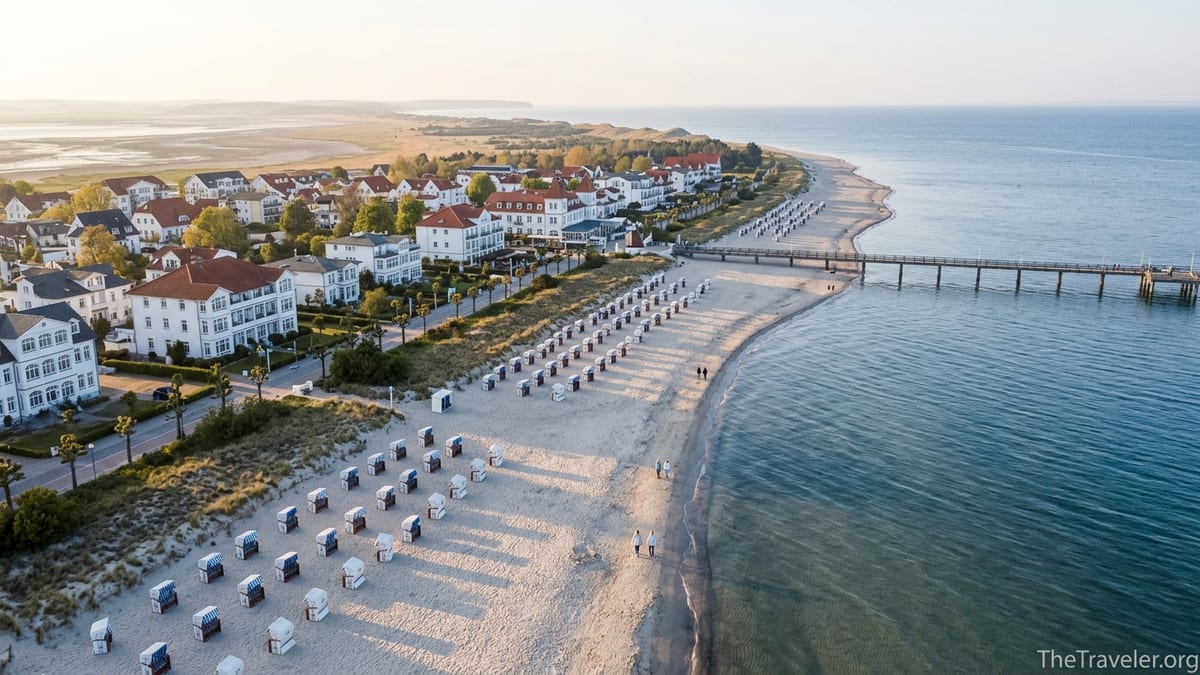
Rügen, Germany’s largest island, is one of the country’s classic seaside destinations. It offers long sandy beaches on its eastern shore, chalk cliffs in Jasmund National Park and historic seaside resorts with white villas and wooden piers. The island is connected to the mainland by road and rail, so you can arrive by direct regional trains from Stralsund to hubs like Binz and Sassnitz. For visitors choosing a base, the main options are the resort towns of Binz and Sellin, the quieter villages around Baabe and Göhren, or the northern coast near Glowe and Juliusruh.
Binz is the best known resort on Rügen and suits first time visitors, especially families and couples who want facilities on their doorstep. Its four kilometre sandy beach, long promenade with cafes and shops and proximity to the narrow gauge steam railway make it easy to fill a week without a car. At the height of summer, simple guesthouse doubles can be around 150 to 200 euros per night close to the seafront, with more modest prices in May, June and September. Sellin, a short drive or bus ride south, feels a little quieter and more intimate, with a striking pier and less commercial atmosphere, which many couples prefer.
For road trips and active travelers, Rügen rewards moving around. You might spend three nights in Binz or Sellin for the beach and spa atmosphere, then two nights in the north near Glowe or Juliusruh to explore the long Schaabe beaches and the Jasmund cliffs. Self catering apartments are widespread, particularly in smaller villages, where you can find weekly rentals that work out cheaper than hotels if you are staying longer. Many of these include parking, and coastal hiking trails often start within walking distance from your door.
Car free visitors can still enjoy Rügen, but route planning matters. The island’s train stations and bus network connect major resorts, and in high season bicycle rentals are easy to find in Binz, Sellin and Baabe. Without a car, basing yourself in one of these resort towns is far more convenient than in remote farmsteads or inland villages. Families appreciate that beaches on the Baltic side are generally more sheltered than on the North Sea, and that many sections are supervised in summer with shallow entry to the water. Shoulder seasons in May, early June and late September can offer good weather with fewer crowds and lower accommodation prices.
Sylt: North Sea Chic and Windy Beach Escapes
Sylt is the most famous of Germany’s North Frisian islands, known for its long western beaches, thatched houses and a reputation for upscale dining and nightlife. A causeway and car train connect it to the mainland, and there are also ferry links from Denmark, so it is reachable whether or not you have a vehicle. The main town is Westerland, which has the island’s rail station and most year round services. Many first time visitors choose to stay here for convenience, especially if they are traveling without a car, since shops, restaurants and the main beach are all within a short walk.
For families, Wenningstedt just north of Westerland is often described as the island’s family friendly spot. It offers a wide sandy beach backed by dunes, plenty of holiday apartments and a slightly quieter feel than the main town, while still being only a short bus or bike ride away. Kampen, further along the coast, is Sylt’s most exclusive village, with boutique hotels and high end restaurants, better suited to couples seeking a luxury escape than to budget conscious travelers. Smaller places like Hörnum in the south or List in the north work well for those who value nature and walking paths over nightlife.
Accommodation prices on Sylt vary strongly by season. In July and August, expect to pay a premium: midrange doubles in Westerland or Wenningstedt can easily exceed 200 euros per night, and self catering apartments often require weeklong stays. Outside the peak weeks, particularly in late spring and early autumn, prices soften, and you may find simple guest rooms under 150 euros. Travelers looking to experience Sylt without the crowds sometimes come in October or April, when you can still enjoy long beach walks in bracing weather and reserve tables at popular restaurants more spontaneously.
Sylt can work both as a standalone island holiday and as part of a wider North Sea itinerary. Without a car, staying in Westerland or Wenningstedt keeps logistics easy, with buses, bike rentals and marked trails connecting the rest of the island. With a car, you gain flexibility to reach smaller villages and viewpoints, but parking near the most popular beach accesses can be tight in summer. For couples who like design hotels and good dining and do not mind the higher prices, Sylt delivers memorable sunsets, dune landscapes and a distinctly different atmosphere from the Baltic resorts.
Baltic Resorts Beyond the Islands: Relaxed Seaside Bases
If you want Baltic beaches without committing to an island, Northern Germany’s mainland coast offers numerous resort towns within easy reach of Hamburg and Lübeck. Places such as Timmendorfer Strand, Scharbeutz and Kühlungsborn combine long sandy beaches, promenades, cafes and family friendly infrastructure. Many visitors base themselves in one of these towns for a full week in summer, renting a holiday apartment close to the water, and make occasional day trips to nearby cities for variety.
Travelers who prefer to stay close to a rail line should look at the resorts on the Lübeck Bay. From Lübeck, regional trains serve Timmendorfer Strand and Scharbeutz in under an hour, and buses link smaller communities along the shore. Accommodation ranges from basic pensions that might charge around 100 to 140 euros a night for a double in shoulder season, to beach front hotels and spa complexes costing more. These towns are particularly practical for families with young children, who value flat, lifeguarded beaches and playgrounds near the promenade.
For couples, the appeal of the mainland Baltic lies in its slower rhythm and evening strolls rather than nightlife. You can plan days around biking along the coast, visiting small harbors and enjoying simple fish restaurants. If you are traveling by car, it is easy to combine two or three different stretches of coast over a week, for example starting near Lübeck, then continuing east towards Rostock and the Darss peninsula before returning inland. Outside high summer, many hotels run midweek wellness offers and spa packages that appeal to off season travelers.
Compared with the islands, these mainland resorts are often slightly less expensive and can be less crowded in peak weeks, especially if you avoid the best known names. They are also easier to reach for a long weekend from Hamburg or Berlin. For car free travelers on a budget who still want daily access to the Baltic, staying in a small hotel or guesthouse in one of these towns can be a good compromise between cost and convenience.
North Sea Towns: St Peter Ording, Cuxhaven and Beyond
The North Sea coast of Schleswig Holstein offers a contrasting atmosphere to the Baltic, with stronger tides, wide mudflats and more dramatic weather. St Peter Ording is one of the best known resorts here, famous for its vast beach, stilt houses and reputation as a spa and sulphur spring. Its beach is so wide that certain sections allow cars to park directly on the sand, and even in high season you can usually find space to fly a kite or walk in relative quiet once you move away from the main access points.
St Peter Ording suits both families and active travelers. The resort is made up of several districts spread along the coast, each with hotels, apartments and campsites. A typical midrange hotel within walking distance of the dunes might cost between 130 and 190 euros per night in summer, while self catering apartments cater to longer stays. The surrounding Eiderstedt peninsula is laced with bike paths and small villages, so having a car or bikes is useful, although local buses connect the main districts and the railway station.
Cuxhaven, at the mouth of the Elbe, is another popular base for North Sea trips. It combines a working harbor with spa districts such as Döse and Duhnen, where dikes and beaches face out toward the Wadden Sea. Here, many visitors plan around low tide to join guided mudflat walks or ride horse drawn carriages out to offshore islands when conditions allow. Cuxhaven has the feel of a small city rather than a pure resort, with a broader range of shops and services and a mix of hotels targeting both holidaymakers and business travelers.
Other North Sea options include Büsum, known as a lively small port with a family friendly promenade, and smaller Wadden Sea towns strung along the coast toward the Danish border. Compared with Sylt, these mainland resorts are generally more affordable and easier to reach by car from Hamburg, making them attractive for families and road trippers. For car free visitors, basing yourself in a well connected town like St Peter Ording or Cuxhaven keeps transfers manageable while still offering an authentic North Sea experience.
Best Bases by Trip Type: Couples, Families, Road Trips and Car Free Travel
For couples, the choice often comes down to how much you value city life versus seclusion. A short break focused on dining, concerts and galleries fits naturally with Hamburg, where you can book a design hotel near the Inner Alster and walk to most attractions. For a slower pace, consider a few nights in Lübeck’s old town followed by several days in Travemünde, Sellin on Rügen or Kampen or Wenningstedt on Sylt. Booking a sea view room or a small spa hotel can transform even a simple itinerary into a romantic escape.
Families with younger children usually prioritize easy beach access, playgrounds and self catering options. Binz, Sellin, Baabe and Göhren on Rügen all offer flat Baltic beaches, frequent ice cream stops and a wide selection of apartments. On Sylt, Wenningstedt and Westerland provide lifeguarded beaches and amusement options near the promenade. For those who prefer the mainland, St Peter Ording, Travemünde and the Lübeck Bay resorts are built around family friendly facilities and long shallower beaches, making them straightforward choices for a first seaside holiday in Germany.
Road trippers can link several of these bases in a loop. One popular route starts in Hamburg, continues to Lübeck and Travemünde, then heads to Rügen for three or four nights before crossing by ferry or driving back toward the North Sea through Mecklenburg and Schleswig Holstein. Another option is a purely coastal circuit, beginning in Cuxhaven or Büsum, following the North Sea coast up to Husum and St Peter Ording, then cutting across to the Baltic for a final stop near Lübeck. With a car, it is easier to stay in smaller villages outside the main resorts where you may find better value guesthouses.
For car free travelers, the key is to anchor your itinerary around rail hubs and use local buses or boats for shorter hops. Hamburg as a starting point, followed by Lübeck and Travemünde, then a direct train to Binz on Rügen or Westerland on Sylt, makes for a varied two week trip without any need to drive. In high season, check accommodation availability early, especially on the islands and in North Sea towns, since apartments and midrange hotels often book up months in advance for school holiday weeks.
The Takeaway
Northern Germany offers more variety than many visitors expect, and there is no single best place to stay. Hamburg is the most versatile base for short stays and culture, Lübeck and Travemünde deliver a compact mix of history and Baltic beaches, Rügen excels for family friendly island holidays, Sylt is ideal for those seeking North Sea drama and style, and the mainland North Sea towns provide wide horizons and lower key charm. The right choice depends on how you like to travel, your budget and whether you plan to rely on trains or a car.
Whichever base you choose, it makes sense to slow down rather than trying to see everything in one trip. Spending at least three nights in each location allows you to settle into the local rhythm, explore on foot or by bike and cope with changeable North German weather. With thoughtful planning, you can pair a lively city stay with a restorative stretch of coast or island time and leave with a much richer sense of Northern Germany’s landscapes and culture.
FAQ
Q1. If I have only four days, where should I base myself in Northern Germany?
For a first visit with four days, staying entirely in Hamburg is usually the most practical. You can spend two full days exploring the city and use one or two days for easy day trips, for example to Lübeck and Travemünde or to Cuxhaven, without changing hotels.
Q2. Is Rügen or Sylt better for a first time beach holiday?
Rügen is generally better for a first time beach holiday, especially for families, thanks to its calmer Baltic waters, wide choice of resorts like Binz and Sellin and many self catering apartments. Sylt suits travelers who prefer a wilder North Sea atmosphere and do not mind higher prices.
Q3. Can I visit the Baltic and North Sea coasts without renting a car?
Yes, as long as you base yourself in well connected hubs. Hamburg, Lübeck, Travemünde, Binz on Rügen, Westerland on Sylt, St Peter Ording and Cuxhaven are all reachable by train, with local buses and ferries covering the remaining stretches.
Q4. What is the most budget friendly place to stay near the sea in Northern Germany?
Mainland Baltic resorts and some North Sea towns are typically more budget friendly than Sylt. Smaller Baltic towns near Lübeck and North Sea places such as Büsum or certain districts of Cuxhaven often offer more modest hotel and apartment prices than the islands in peak season.
Q5. When is the best time to book accommodation on Rügen or Sylt?
For July and August, it is wise to book several months in advance, especially if you want a specific apartment or sea view room. For shoulder seasons such as May, June and September, you usually have more flexibility, but weekends and public holidays can still sell out early.
Q6. Which base is best for travelers who love museums and culture but still want a beach day?
Lübeck with side trips to Travemünde works very well for this combination. You can stay in the historic old town with its museums and churches, then reach the Baltic beach in about half an hour by train or bus.
Q7. Is it worth having a car on Sylt or Rügen?
A car offers more flexibility on both islands, especially if you want to explore smaller villages and remote beaches. However, if you base yourself in hubs like Binz on Rügen or Westerland or Wenningstedt on Sylt, you can manage comfortably with trains, buses and bike rentals.
Q8. Which Northern Germany base is best for a romantic weekend?
For a romantic weekend, consider a boutique hotel near Hamburg’s Inner Alster, a historic guesthouse in Lübeck’s old town or a sea facing hotel in Travemünde, Sellin or Kampen on Sylt. All offer atmospheric settings with good restaurants for evening walks and dinners.
Q9. Are North Sea resorts too windy for families with small children?
The North Sea is generally windier than the Baltic, and weather can change quickly, but many families still enjoy places like St Peter Ording, Wenningstedt and Westerland. Bringing windproof layers and planning indoor options such as pools or spa facilities makes it easier to adapt.
Q10. How many bases should I plan for a 10 day trip in Northern Germany?
For 10 days, two or at most three bases work best. A common pattern is three nights in Hamburg, four nights on Rügen or Sylt and three nights in either Lübeck or a North Sea or Baltic resort, which balances variety with manageable travel days.