


The romantic river valleys of western Germany are closer together than many travelers realize. The Rhine and the Moselle meet at Koblenz, yet the experience you get on each river can feel surprisingly different. If you are planning a first-time trip and only have a few days for one river region, choosing between them becomes a very practical decision that affects everything from your budget to how many castles you can reasonably see in a day.
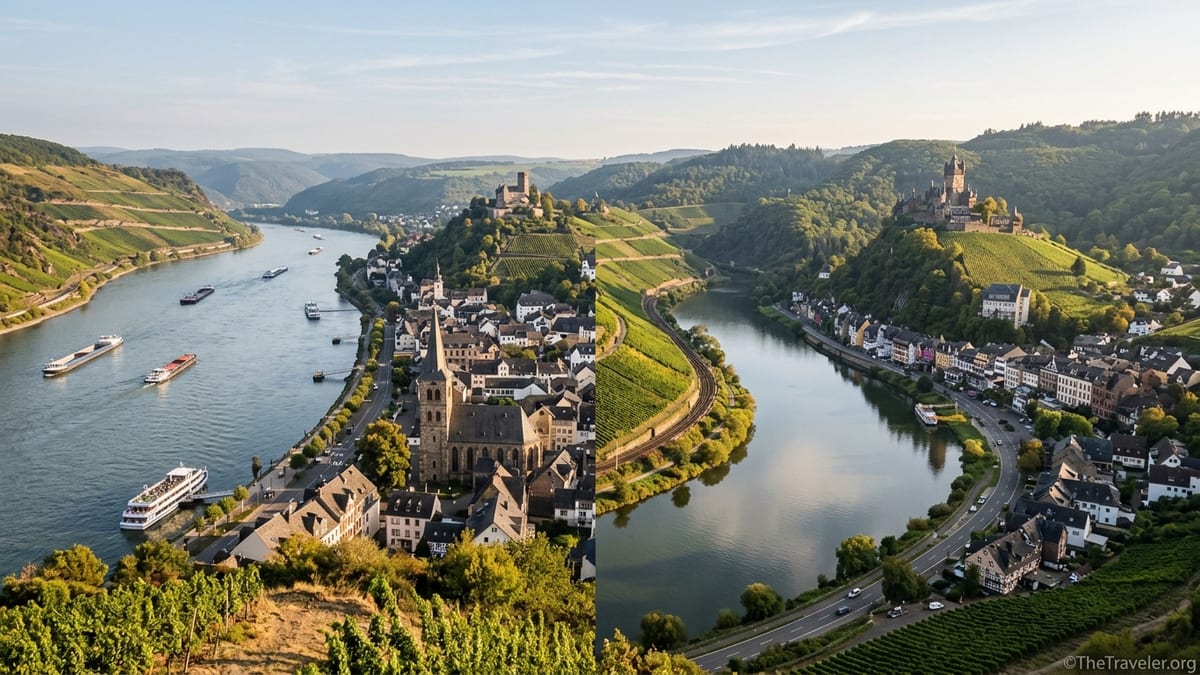
Rhine vs Moselle at a Glance
The classic stretch of the Rhine that most visitors focus on is the Upper Middle Rhine Valley between roughly Bingen and Koblenz, a UNESCO-listed corridor of steep slopes, ruined castles and busy river traffic. Passenger ferries and long-distance cruise ships share the water with barges, while trains and the B9 and B42 roads run along both banks. It feels energetic, sometimes hectic, and visually dramatic, with a castle or fortress on almost every bend.
The Moselle Valley by contrast is a narrower, looping river that winds from Trier to Koblenz through some of Germany’s steepest vineyards. Towns like Cochem and Bernkastel-Kues are smaller than their Rhine counterparts and the river traffic is lighter, giving the valley an intimate, slower-paced atmosphere. Vineyards feel closer, often pressing right up against the half-timbered houses and river promenades.
Travelers who want a quick hit of big scenery and easy, frequent transport connections often gravitate to the Rhine. Those who prefer a quieter holiday focused on wine, walks and a few key sights usually find the Moselle a better match. Because both rivers are connected by rail via Koblenz, it is entirely possible to sample each in a single trip, but with limited days most visitors do better by choosing a primary base in one valley.
In cost terms, the regions are broadly similar, with glass-for-glass wine prices and midrange hotel rates often slightly lower on the Moselle. Entrances to the major castles and short river cruises on either river tend to fall in the same rough band, making personal priorities more important than pure budget when deciding between them.
Castles and History: Big-Name Sights vs Intimate Fortresses
If your idea of the perfect river trip is counting castles, the Rhine has the edge in sheer numbers along a short distance. Between Bingen and Koblenz you pass landmarks such as Rheinstein, Reichenstein, Sooneck, Katz, Maus and the sizeable ruins of Rheinfels above St Goar. Marksburg near Braubach stands out as a highlight because it is one of the few Rhine hilltop castles never destroyed and offers tours that walk you through original defensive structures rather than pure 19th century reconstruction.
The Moselle cannot match that castle-per-kilometer density, but its best fortresses feel more dominant in the landscape. Reichsburg above Cochem rises steeply from the forested hill directly over the town, and many travelers comment that from a distance it looks more like the fairy tale castles they picture before arrival. The castle is largely a 19th century reconstruction yet the approach on foot or shuttle through Cochem’s lanes makes it feel fully integrated with the town.
For history beyond the medieval period, the Moselle has a clear trump card in Trier, widely regarded as Germany’s oldest city and filled with significant Roman remains. The black stone Porta Nigra gate, the remains of vast baths and an ancient amphitheater provide an entirely different historical layer from anything on the Rhine. Visitors who want to combine Roman history with wine-tasting day trips often choose the Moselle specifically for this reason.
On the Rhine, the historical narrative skews more to the Middle Ages and early modern trade, with the Lorelei rock, medieval toll castles and 19th century Romantic tourism featuring prominently. If you want the archetypal “Rhine in Flames” fireworks and castle-illuminations, this river is where those big events take place, typically clustered around summer weekends and drawing substantial crowds to towns like Koblenz and St Goar.
Vineyards, Wine Culture and Tasting Experiences
Both valleys are Riesling territory, and both showcase steep, terraced vineyards that look almost vertical from the riverbank. The Moselle’s slopes are often even more dramatic than those on the Rhine, including record-steep sites that are still worked largely by hand. For many wine-focused travelers, this gives the Moselle a slight edge on atmosphere: when you sit on a terrace in Bernkastel-Kues or Zell, the vines can feel close enough to touch.
In practical terms, you will find wine bars and tasting rooms in virtually every town in both valleys, along with seasonal wine festivals in late summer and autumn. A typical glass of local Riesling in a riverfront bar might cost the equivalent of a few euros, with tasting flights in family-run wineries often priced to encourage generous sampling. Recent reports note that wine prices have risen modestly since 2024, but they remain reasonable by Western European standards, and you rarely need to book tastings weeks in advance outside peak festival weekends.
The Rhine offers a broader spread of wine experiences at different price points, from casual tastings in villages like Bacharach and Boppard to high-end, design-forward wineries on the slopes above Rüdesheim. Many travelers combine a short ferry hop across the Rhine with a walk through vineyard trails that connect multiple estates. However, because the Rhine corridor is busier and more developed, wine tourism can feel a little more commercial and structured.
On the Moselle, the wine culture often feels smaller-scale and more personal. Many guesthouses double as small wineries, and it is not unusual for the owner pouring your tasting to have spent the morning in the vines. The Moselle Cycle Route and vineyard paths above towns like Cochem and Bernkastel-Kues give visitors the chance to walk or cycle right past the plots whose names appear on the bottles they taste that evening.
River Cruises, Boats and On-the-Water Experiences
Short, local cruises are straightforward on both rivers, but the feel is quite different. On the Rhine between Bingen, Bacharach, St Goar and Boppard, large day-cruise boats operate frequent schedules in the main season, letting visitors hop between towns while watching castles slide past. These boats can be popular with group tours, especially on sunny weekends from late spring through early autumn, so expect commentary in multiple languages and busy sundecks.
Longer multi-day Rhine itineraries operated by European river cruise lines often combine the castle-lined Middle Rhine with sections of the Main or Danube. These cruises are heavily marketed in English-speaking countries, which is why so many visitors first hear about the Rhine Valley via cruise brochures. For travelers who want a largely all-inclusive experience, these ships provide convenient access to major Rhine towns but can limit deeper exploration, since shore time is usually measured in hours.
On the Moselle, river traffic is thinner and many cruises focus specifically on a slower appreciation of the landscape. From bases like Cochem, Bernkastel-Kues or Trier, you can join one-hour panorama trips, half-day excursions to neighboring towns or evening cruises with local wine tastings. Typical prices for a basic one-hour Moselle panorama cruise are in the single-digit to low double-digit euro range per adult, with themed evening sailings costing a little more.
Some Rhine and Moselle itineraries are now combined into a single loop, linking Cologne, Koblenz, Cochem, Trier and back via the Rhine. These mixed routes appeal to travelers who want to sample both valleys without managing all the logistics themselves. However, if you are traveling independently by train or car, it remains easy to add your own flexible “mini cruise” sessions on either river simply by booking day boats locally.
Towns, Hotels and On-the-Ground Atmosphere
Choosing a base town is often where the Rhine and Moselle feel most different. On the Rhine, popular bases include Bacharach, St Goar, Boppard and Rüdesheim. Bacharach and Boppard have pretty riverfronts and enough services to support a several-night stay without feeling too large. St Goar sits opposite the ruins of Rheinfels Castle, giving it a particularly dramatic skyline. Rüdesheim is famous for its wine taverns and busy lanes, which appeal to travelers who like a more festive evening scene.
On the Moselle, Cochem is the main tourist center thanks to its striking castle views, compact old town and constant stream of day trippers. Bernkastel-Kues, with its winding medieval lanes and riverside promenade, offers a slightly more relaxed feel, while Traben-Trarbach mixes Jugendstil architecture with wine warehouses and riverside walkways. Trier anchors the western end of the valley and works well for travelers who want a city base with Roman monuments and easy day trips to smaller towns.
In both valleys, you can expect a wide mix of accommodation from simple guesthouses and family-run pensions to modern boutique hotels and a handful of upscale castle stays. Typical midrange doubles in high season often fall somewhere in the three-figure euro range per night, although prices vary with location and dates. The Moselle tends to offer slightly gentler pricing, especially outside Cochem and major festival weekends, while Rhine tariffs in honeypot towns during summer and during big events such as fireworks weekends can climb noticeably.
The overall atmosphere in Rhine towns leans busier and more international. English menus are common, coach groups appear regularly and restaurants can be lively late into the evening. Moselle towns are not empty by any means, particularly in summer and during wine festivals, but evenings can feel quieter and more local once day trippers depart. Travelers who value peaceful riverside walks after dinner often mention the Moselle as a better fit.
Train Travel, Roads and How Easy Each Valley Is to Explore
Transport infrastructure is a key factor if you will not be driving. The Rhine corridor between Cologne, Koblenz, Bingen and Mainz is one of Germany’s major rail arteries, with long-distance trains plus frequent regional services linking river towns. From Koblenz you can reach central Rhine bases such as Boppard in minutes and towns like Bacharach or Bingen in under an hour on local trains that hug the river.
The Moselle has a dedicated rail line running between Koblenz and Trier with stops in river towns such as Cochem and Bullay. Regional express trains typically cover Koblenz to Trier in around one hour and twenty minutes, with multiple departures daily, and slower local services link smaller villages. This makes it entirely feasible to stay in one town and day-trip to several others by train without renting a car.
For drivers, both valleys are linked by well-maintained roads that trace the river’s course. On the Rhine, the main riverside roads can be busy with through traffic, particularly on holiday weekends and during peak commuting times near larger centers. Parking in small Rhine towns is often limited around the station and waterfront, which means you might park a short walk away on busy days. Views from the road are nonetheless superb, and many visitors treat the Rhine as a classic European road trip.
The Moselle road network is generally calmer and more sinuous, following the river’s pronounced loops past steep vineyards and small villages. Many travelers describe this as one of Europe’s most pleasant leisurely drives, with frequent pull-outs and lay-bys where you can stop for photographs. For cyclists, the Moselle Cycle Route has received strong reviews and official recognition in recent years, reflecting its combination of good surface, clear signage and scenic variety along the water.
Scenery, Crowds and Seasonal Considerations
Visually, you will notice several contrasts. The Rhine’s valley is wider, with the river itself appearing broad and powerful, flanked by tall cliffs and large-scale castles that read clearly from a distance. Barges, ferries and cruise ships constantly move along the water, adding to the sense of a very active working river. Photographs from viewpoints above Boppard or from castle terraces often capture a sweeping panorama with multiple bends and villages visible at once.
The Moselle is more serpentine and intimate. Because the river curves so frequently, you often see only short segments of water framed by vineyard-covered hills, which creates a feeling of seclusion even between well-visited towns. Classic Moselle perspectives include views of tight river loops from hilltop lookouts, or scenes where half-timbered houses, church spires and steep terraced vines compress into one compact frame.
In terms of crowds, the Rhine absorbs significantly higher visitor numbers, particularly on sunny weekends between May and September and during major events like fireworks and some wine festivals. Towns such as Rüdesheim and sections of the Rhine promenade in Koblenz can feel very busy with group tours. The Moselle certainly sees spikes in Cochem and Bernkastel-Kues, especially in high summer and during harvest season, but many smaller towns retain a gentler pace and feel less dominated by tour groups.
Both regions are enjoyable from late spring through autumn. July and August bring the warmest weather and the most reliable boat schedules but also the largest crowds. In late September and early October you are more likely to see active harvesting in the vineyards and to encounter new wine at seasonal stands and festivals, though some smaller operations may reduce boat frequency outside summer. Winter is much quieter on both rivers, with limited cruises but atmospheric riverside walks, occasional snow on the slopes and Christmas markets in larger towns such as Koblenz and Trier.
Which Valley Should You Choose?
If you have only two or three nights and you want the most iconic picture-book experience of German castles in a compressed area, the Upper Middle Rhine between Bingen and Koblenz is usually the more efficient choice. You can base yourself in a single town such as Bacharach, Boppard or St Goar, use frequent trains or ferries to visit neighboring villages and castles, and see a striking concentration of towers and ruins in a short time frame.
Travelers who are more interested in wine, relaxed riverside evenings and scenic walks or cycle rides through vineyards often find the Moselle more rewarding. A stay in Cochem or Bernkastel-Kues, with day trips to Trier or smaller villages, offers a slower, more intimate river experience with excellent opportunities to meet small-scale wine producers and explore narrow medieval streets after day trippers have left.
For families, the decision can hinge on interests. Children who are excited by big castles, frequent boat rides and the spectacle of a busy river may be better served by the Rhine. Those who enjoy biking along a mostly flat riverside path, short hikes to panoramic viewpoints and smaller towns that feel easy to navigate on foot might be happier on the Moselle. In both regions, many hotels and guesthouses are well used to hosting international visitors and can provide local tips on family-friendly activities.
Some travelers split a week between the two valleys, using Koblenz as a hub or transferring directly between a Rhine base and a Moselle base via train. This works particularly well if you fly into a major airport like Frankfurt or Cologne, spend a few nights on the Rhine for castles and big-sky scenery, then shift to the Moselle for wine country and Roman history before continuing on to other parts of Germany or neighboring countries.
The Takeaway
In the end, there is no objective winner between the Rhine and Moselle valleys, only a better match for your travel style, timeframe and interests. The Rhine offers concentrated spectacle, with a castle seemingly on every hill, fast and frequent train links, and a lively atmosphere on both the water and the riverbanks. It is often the right choice for first-time visitors who want an instant, high-impact introduction to Germany’s river landscapes.
The Moselle delivers gentler rhythms, closer contact with the vineyards and a strong combination of wine culture, medieval towns and Roman heritage. It rewards slower itineraries and appeals particularly to couples, walkers and cyclists who want to feel immersed in a specific stretch of river scenery rather than to tick off as many castles as possible.
If you picture your ideal evening as a glass of Riesling on a quiet riverside promenade after a day exploring small towns, the Moselle is likely to feel like “your” valley. If you dream of dramatic castles, busy boat traffic and seeing many famous names in a short distance, the Rhine will probably serve you better. With good rail links between the two, you can always plan to return and experience the other river on a future trip.
FAQ
Q1. Is the Rhine Valley or the Moselle Valley better for a first-time visitor to Germany?
The Rhine Valley is usually better for first-time visitors who want maximum castles and big scenery in a short time, while the Moselle suits travelers who prefer quieter wine towns and a slower pace.
Q2. Which valley has easier public transport for getting around without a car?
The Rhine has more frequent and faster trains along its main corridor, but the Moselle also has reliable regional trains between Koblenz, Cochem and Trier, making both workable without a car.
Q3. Where are the best base towns on the Rhine for a two- or three-night stay?
Popular Rhine bases include Bacharach and Boppard for charm and good transport, St Goar for castle views and Rüdesheim if you want a livelier evening scene with many wine taverns.
Q4. Where are the best base towns on the Moselle for a two- or three-night stay?
Cochem is the main Moselle hub with a dramatic castle and many services, while Bernkastel-Kues offers a slightly quieter medieval core and Trier adds substantial Roman history to day-trip options.
Q5. Which river is better for wine lovers?
Both valleys are excellent for Riesling, but many wine lovers favor the Moselle for its intimate vineyard scenery and personal, small-scale tasting experiences in family-run wineries.
Q6. Are river cruises more interesting on the Rhine or the Moselle?
Rhine cruises offer denser castle scenery and more boat options, while Moselle cruises tend to be calmer and emphasize winding river loops, steep vineyards and smaller villages.
Q7. Is one valley generally cheaper than the other?
Prices are broadly similar, but the Moselle often has slightly lower average hotel and dining costs outside the busiest towns and festival periods, while Rhine hotspots can be pricier in peak season.
Q8. Which valley is better for cycling and easy walking?
The Moselle is often preferred for cycling thanks to its well-regarded riverside cycle path and gentle gradients, while both valleys offer numerous vineyard walks and short hikes to viewpoints.
Q9. Can I visit both valleys in one trip without renting a car?
Yes, you can connect the two easily by train through Koblenz and use regional services and local boats to explore key towns on each river, even on a short itinerary.
Q10. When is the best time of year to visit the Rhine and Moselle valleys?
Late spring to early autumn offers the fullest range of cruises and open attractions, while September and early October add grape harvest activity and wine festivals, along with cooler temperatures.