

Western Germany offers a compact mix of Gothic cathedrals, modern cities, romantic river valleys and vineyard-clad hillsides, all within a few hours of each other by train. For first-time visitors, this region is one of the easiest introductions to Germany: English is widely spoken, public transport is reliable, and distances are short. This guide walks you through the key cities of Cologne, Düsseldorf, Bonn, Aachen and Trier, the Rhine and Moselle valleys, how to visit castles and wine regions, and what to know about trains, driving, costs and first-time trip planning.
Orientation: How Western Germany Fits Together
When travelers talk about western Germany, they often mean the stretch centered on North Rhine-Westphalia and Rhineland Palatinate, roughly between Cologne in the north and Trier in the south, and between the Rhine and Moselle rivers. Cologne, Düsseldorf and Bonn sit along the Rhine in the industrially important but increasingly green and livable Rhineland. Further south, Koblenz marks the spot where the Moselle flows into the Rhine, and beyond that the Rhine Valley becomes narrower and steeper, dotted with castles and vineyards. The Moselle Valley runs from Trier toward Koblenz in a series of tight bends lined with half-timbered villages and Riesling vines.
As a first-time visitor, it helps to picture everything along two corridors. The north-south Rhine rail line links Cologne, Bonn, Koblenz and Bingen, with frequent regional trains stopping in small river towns. The Moselle rail line branches off at Koblenz and follows the river through Cochem toward Trier. With this mental map, you can base yourself in one or two cities and add day trips into the valleys rather than packing and unpacking every night.
Most international visitors fly into Cologne Bonn Airport or Düsseldorf Airport. Both are connected by frequent suburban and regional trains to their respective city centers in under 15 minutes. Frankfurt Airport is another major gateway, about one hour by high-speed ICE train from Cologne, and under two hours by regional routes from Koblenz or Mainz, which makes it a practical entry or exit point for a Rhine or Moselle itinerary.
Climate-wise, the region is milder than much of Germany. Expect cool, often damp winters and pleasantly warm summers. April, May, September and early October are particularly good months for walking in vineyards and river cruises, with long daylight hours and fewer crowds than mid-summer. Late September and early October bring wine festivals in towns such as Bernkastel-Kues and Cochem, when village squares fill with tasting stands and brass bands.
Cologne: Gothic Spires and Lively Neighborhoods
Cologne is usually the first stop in western Germany. Step out of the main station and you are face to face with Cologne Cathedral, a towering Gothic church that dominates the skyline. Many first-time visitors head straight inside, then climb the south tower for sweeping views over the Rhine and the dense city center. Allow at least an hour if you plan to visit both the nave and the tower. From the cathedral it is a short walk to the old town with its pastel houses, narrow lanes and riverside promenade, where traditional breweries serve local Kölsch beer in small 0.2 liter glasses that the servers replace almost automatically until you put a coaster over your glass.
Beyond the postcard old town, Cologne has a distinctly local, down-to-earth character. The Belgian Quarter around Brüsseler Platz is popular with younger travelers for its cafes and independent shops, while Ehrenfeld, a few stops west on the S-Bahn, shows off street art, concert venues and converted industrial spaces. Shoppers head to Hohe Straße and Schildergasse, two pedestrian streets running south from the cathedral, with a mix of big brands and department stores. On a rainy afternoon, families often visit the Chocolate Museum on the Rhine, where exhibits explain how cocoa is grown and processed and visitors can watch chocolate being made behind glass.
Typical central hotels in Cologne range widely in price depending on trade fairs and large events. On a normal weeknight outside major fairs, a clean three-star hotel within a 10 to 15 minute walk of the cathedral might cost somewhere around 110 to 160 euros per night, while simple private rooms in hostels or guesthouses can be closer to 60 to 90 euros. Neighborhoods such as Altstadt-Nord, Neustadt-Nord and the Belgian Quarter are convenient for first-timers, with easy tram access and plenty of restaurants.
Cologne is also a rail hub. Fast ICE trains link it with Frankfurt, Berlin and Brussels, while regional trains run along both banks of the Rhine. Many first-time visitors use Cologne as a base for a few nights, taking a day trip south to Bonn or north to Düsseldorf, and another day into the nearby Siebengebirge hills or along the river to Koblenz. With the nationwide flat-fare ticket introduced in 2026, priced at about 53 euros per month for unlimited local and regional travel in second class, it has become easier for visitors staying a week or more to use regional trains extensively without constant ticket calculations.
Düsseldorf, Bonn and Aachen: Culture, History and Day Trips
Düsseldorf lies less than 30 minutes by train from Cologne but feels quite different. Its compact Altstadt lines the Rhine and is known for Altbier, a copper-colored top-fermented beer served in traditional pubs along narrow lanes. A riverside promenade connects the old town with the modern MedienHafen district, where remodeled warehouses sit alongside striking contemporary office buildings and upscale restaurants. The Königsallee, or Kö, is the main shopping street, with trees, a canal and a concentration of high-end fashion boutiques and department stores.
Hotels in Düsseldorf’s city center and near the main station are often slightly more business oriented than in Cologne, reflecting the strong trade fair calendar. In quiet periods, a four-star hotel a short walk from the Altstadt might price rooms around 130 to 190 euros, while more modest options near the station can be lower. The city itself is a pleasant overnight base, but for many first-time visitors it also works as a half or full day trip from Cologne, easily reached on frequent regional trains included in most regional day tickets.
South of Cologne, Bonn offers a calmer and more residential atmosphere. Once the capital of West Germany, it has leafy streets, embassies turned into offices and several notable museums along the so-called Museum Mile. Classical music fans visit the Beethoven House, the composer’s birthplace, while others enjoy strolling the pedestrian center or along the Rhine path toward the former government quarter. Bonn is compact enough that you can walk from the main station to most sights in 10 to 15 minutes, including the river.
Further west, near the Belgian and Dutch borders, Aachen is known for its cathedral, where Charlemagne is buried. The church’s octagonal core dates back to the early Middle Ages and is quite distinct from the Gothic cathedrals of Cologne or Strasbourg. Walking through Aachen’s old town takes most visitors about half a day, including a stop at the cathedral and time to try local Printen, a spiced biscuit sold in many bakeries. From Cologne, direct regional trains usually reach Aachen in about an hour, making it an easy day trip if you are interested in early European history and distinctive architecture.
Rhine Valley: Castles, Cruises and River Towns
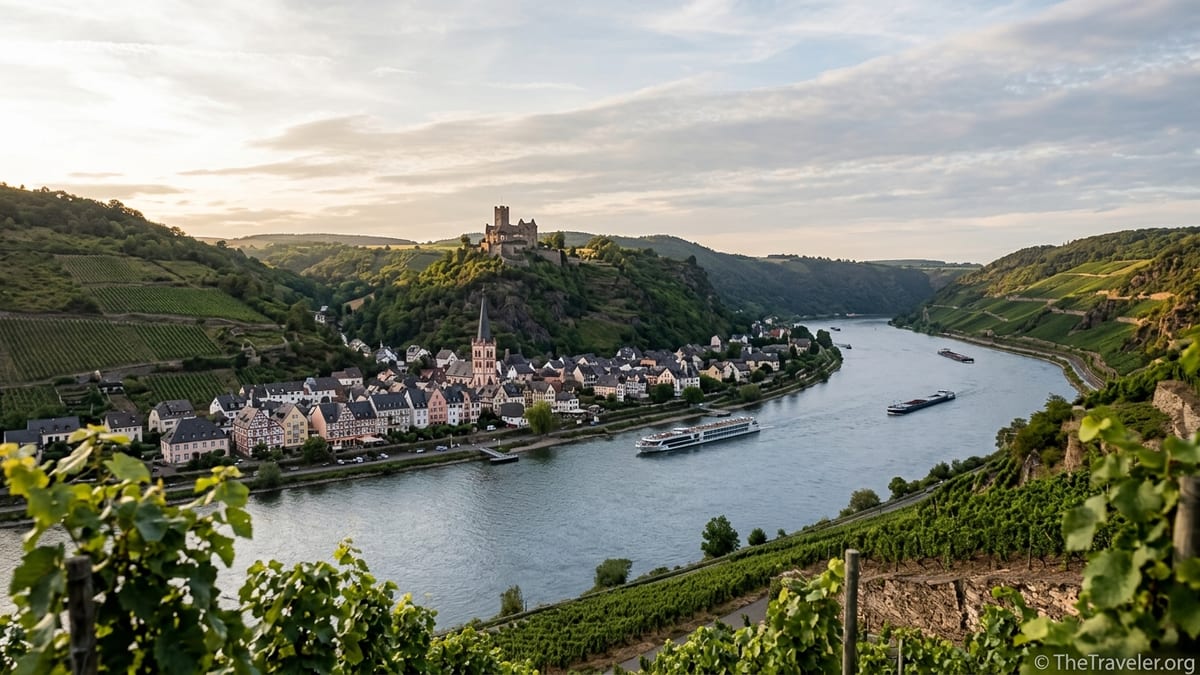
South of Bonn and Remagen, the Rhine cuts into a narrower valley between Koblenz and Bingen, officially called the Upper Middle Rhine Valley and recognized as a UNESCO World Heritage site. Here the river bends between steep slopes covered with vines, and almost every hilltop seems to carry a castle or ruined fortress. Towns such as Boppard, St. Goar and Bacharach cluster on the banks, with half-timbered houses, small squares and riverside walks. For many first-time visitors, this stretch is the quintessential German river landscape.
The most popular way to see the Rhine Valley is to combine trains and boats. Regional trains run every hour or better along both riverbanks, and scheduled boat services operate between Koblenz and Bingen or Rüdesheim. A common pattern is to take a morning train to a town such as Boppard, explore for an hour, then board a mid-morning boat drifting downstream past castles like Marksburg above Braubach, Maus Castle near St. Goarshausen and Rheinfels above St. Goar. Some boat companies sell combined tickets that include a panorama cruise plus the cable car in Koblenz up to Ehrenbreitstein Fortress, priced around 27 to 30 euros depending on the exact route.
Several castles in the valley can be visited inside. Marksburg, one of the few medieval castles on the Rhine never destroyed, stands above Braubach and is reached by a steep walk or a shuttle from the town. Burg Rheinfels above St. Goar offers extensive ruins and views of a wide bend in the river. Burg Stahleck towers over Bacharach and now operates largely as a youth hostel, giving overnight guests the experience of sleeping in a castle. At each of these sites, expect separate entrance fees, usually in the range of 8 to 12 euros for adults, with optional guided tours in German and sometimes English.
Lodging in Rhine towns is generally more affordable than in the big cities, especially outside peak festival weekends. In places like Boppard or Bacharach, traditional family-run hotels and guesthouses with river views often price double rooms around 90 to 140 euros including breakfast in shoulder seasons. Many travelers choose one town as a base for two or three nights and use trains or boats for day trips up and down the valley, visiting different castles and vineyards without having to move luggage every day.
Moselle Valley and Trier: Vineyards and Roman Stones
The Moselle Valley offers a softer, more intimate landscape than the Rhine. Between Koblenz and Trier the river loops in tight bends, with villages nestled against steep vineyards planted mostly with Riesling. Towns such as Cochem, Beilstein, Zell and Bernkastel-Kues have colorful, half-timbered houses around small market squares, with boats moored along the riverfront and walking paths up into the vines. It is an excellent region for slow travel: short drives or train hops between villages, long lunches on terraces overlooking the water and leisurely wine tastings in family wineries.
Cochem is one of the most visited Moselle towns, known for its hilltop castle that can be reached on foot or by shuttle bus. From Cochem, it is about an hour by regional train to Koblenz in one direction and about the same to Trier in the other. Bernkastel-Kues sits in the Middle Moselle, a short bus ride from Wittlich station. Here, and in neighboring villages like Wehlen and Zeltingen-Rachtig, many wineries offer tastings of their Rieslings. Some, such as well-known estates near Bernkastel, run formal tastings in vinotheques for a set fee per person, often around 15 to 25 euros for several wines, redeemable against purchases.
Alongside tastings, vineyard walks and short tours are common. In and around Bernkastel-Kues, local tour companies and wineries organize combined minibus drives through the vineyards, short guided walks explaining the slate soils and steep slopes, followed by a tasting in a winery or wine bar. These compact tours often take around two hours and may be advertised in local tourist offices, making them accessible even to spontaneous visitors. In smaller villages, it is still common to ring a bell or call a winery in advance and arrange a simple tasting directly in the cellar.
Trier, near the Luxembourg border, gives the region a different dimension. Known as one of the oldest cities in Germany, it preserves major Roman monuments, including the blackened Porta Nigra city gate, sections of an amphitheater, and imperial baths. The cathedral combines Roman remains with later medieval construction. Many visitors spend a full day here, combining Roman sites with time in the compact pedestrian center. Trier also makes a good base if you want a more urban feel while exploring the Moselle by day, with frequent buses and trains heading down the valley toward villages and wineries.
Castles, Wine Regions and Where to Stay
Castles are among western Germany’s biggest draws, but it is worth deciding early how many you realistically want to visit. In addition to the Rhine and Moselle castles, there are noteworthy sites slightly off the main rivers, such as Burg Eltz, hidden in a side valley above the Moselle. Reached by shuttle buses from nearby stations in season, Burg Eltz has a fairytale profile and intact medieval interiors. Visiting involves some walking on forest paths and timed guided tours inside. If you are traveling with children or have limited mobility, choose one or two major castles rather than trying to see every ruined tower on the skyline.
Wine lovers will find the Moselle and Middle Rhine particularly rewarding. Riesling dominates, with styles ranging from bone-dry to delicately sweet. Many wineries sell their bottles at noticeably lower cellar-door prices than you might see for the same labels abroad. In Moselle villages, it is still common to see simple tasting rooms attached to family homes, where a short flight of wines might cost around 10 to 15 euros and be waived if you buy a few bottles. Larger estates in high-profile vineyards around Bernkastel or Wehlen may charge slightly more and expect advance reservations, especially on weekends.
For accommodation, think in terms of city bases versus small-town stays. In cities such as Cologne or Düsseldorf, you will find everything from international chains to design hotels and hostels, making them convenient if you want nightlife, museums and varied restaurants. In contrast, Rhine and Moselle villages excel at small guesthouses, inns and apartments, often family-run. Expect a more limited set of dining options but quieter evenings and views of vineyards or the river. Apartment rentals in places like Cochem or Bacharach can be good value for couples or families staying several nights, with nightly rates often competitive with mid-range hotels and the bonus of a small kitchen for breakfasts and snacks.
If your priorities are castles and river scenery, a base such as Boppard or Bacharach on the Rhine or Cochem or Bernkastel-Kues on the Moselle can work well for three or four nights. From there, you can visit nearby castles, take a boat cruise and sample local wines without long transfers. If you prefer to mix city culture with a taste of the valleys, consider splitting your time between Cologne or Düsseldorf and one river town, rather than trying to sleep in a new place every night.
Trains, Driving and Getting Around
Public transport in western Germany is dense and generally reliable, making it realistic to plan a whole trip without renting a car. Trains on the main lines typically run at least hourly, and in commuter corridors even more frequently. Regional trains connect Cologne, Düsseldorf, Bonn, Koblenz, Mainz and Trier, while local trains and buses fill in the gaps along the rivers and into the hills. Timetables are integrated, so one journey plan often combines a regional train and a short bus ride on a single ticket.
For visitors staying several days, understanding ticket options saves money. In addition to the nationwide monthly flat-fare ticket for local and regional transport, there are regional day tickets valid across North Rhine-Westphalia that allow unlimited travel in a day on regional trains, trams and buses for a fixed price, with supplements for additional passengers. These are especially useful for day trips such as Cologne to Aachen and back, or Dusseldorf to Bonn via Cologne with stopovers. There are also nationwide day tickets for regional trains that let you travel across Germany in one day on non-high-speed services, which can be cost effective if you are linking western Germany with other regions without using Intercity Express trains.
Driving offers more flexibility in the Moselle side valleys and some castle approaches, but it is not essential. Roads along the Rhine and Moselle are generally two-lane and winding, with frequent roundabouts and traffic lights in villages. Parking in small towns is often in public riverfront lots or multi-story garages, with daily rates that are manageable but vary by town. If you are comfortable driving a manual transmission on narrow roads and want to stop spontaneously at viewpoints and wineries, a car can be enjoyable. If not, pairing trains with the occasional taxi or local shuttle bus to remote castles is a workable alternative.
Within cities, trams and buses are the easiest way to move around. Cologne, Düsseldorf and Bonn each have integrated networks where the same tickets are valid on trams, underground lines and many regional trains within the city limits. Ticket machines at stations typically offer English-language menus and accept cards as well as cash. In town centers, you will see many residents cycling; short-term bike rentals and app-based scooters are common in larger cities, but less so in small river towns.
Costs, Seasons and First-Time Planning Tips
Costs in western Germany are moderate by western European standards but can add up in peak periods. A reasonable mid-range daily budget for a first-time visitor might include 120 to 180 euros for a centrally located double room, 30 to 50 euros per person for meals if you mix simple lunches with a sit-down dinner, and 10 to 25 euros per person for admissions or activities such as castle visits, museum entries or boat cruises. Transport spending depends heavily on whether you are buying individual tickets, regional day tickets, or using a monthly flat-fare pass during a longer stay.
Season affects both prices and availability. High summer, especially during school holidays, brings more crowds on the rivers and in city centers, and river cruise boats may feel busy on sunny weekends. In contrast, November through early March can be quiet, with some smaller guesthouses and seasonal attractions in river towns closed or operating on reduced hours. Christmas markets in Cologne, Düsseldorf and Bonn in late November and December draw many visitors, so hotel rates rise again in those specific weeks. Spring and early autumn often strike the best balance for first-timers: lively enough that everything is open, but without peak-season pressures.
When sketching an itinerary, an efficient first-time plan might look like four nights in a city and three nights in a river town, with day trips added. For instance, you might spend three or four nights in Cologne, using one day for Düsseldorf and one for Bonn, then travel to Koblenz and continue to Boppard or Bacharach for three nights on the Rhine, or to Cochem or Bernkastel-Kues for three nights on the Moselle. Another pattern is to start in Düsseldorf, move to Cologne, then end in Trier, using Trier as a base for Moselle day trips before catching a train to Frankfurt or back to Cologne for your flight.
Booking ahead is advisable for stays in smaller river towns during major wine festivals or long weekends, and for popular city events such as Cologne Carnival in February. Flexible travelers who avoid these peak dates can often find last-minute rooms, but planning at least a few weeks in advance makes it easier to choose river-view rooms or specific neighborhoods. For wine tastings at well-known estates, check their websites or contact them by email before your trip; some accept walk-ins during posted hours, while others operate strictly by appointment, especially for in-depth tastings.
The Takeaway
Western Germany rewards travelers who slow down. Its highlights are close together, yet each river bend and city district has a distinct feel. Gothic spires in Cologne, riverfront promenades in Düsseldorf, Roman history in Trier, castle silhouettes above the Rhine, and vineyards descending to the Moselle all fit comfortably into a one or two week trip. With efficient trains, approachable price levels and a strong tourism infrastructure, it is a region where first-time visitors can quickly feel at ease.
By anchoring your plans around a couple of well-chosen bases, making use of regional rail passes or the monthly flat-fare ticket, and mixing better-known cities with smaller river towns, you can experience both the famous sights and quieter corners. Whether you are raising a glass of Riesling in a Moselle village, watching barges slide past from a Rhine terrace, or wandering cobbled lanes in Aachen or Bonn, western Germany offers a varied and accessible introduction to the country.
FAQ
Q1. How many days do I need for a first trip to western Germany?
Most first-time visitors are comfortable with seven to ten days, which allows three or four nights in a major city such as Cologne or Düsseldorf and three or four nights in a Rhine or Moselle town like Boppard, Bacharach, Cochem or Bernkastel-Kues, plus a night in Trier or Aachen if you are interested in Roman or early medieval history.
Q2. Is it better to stay in Cologne or Düsseldorf as a base?
Both work well. Cologne has a larger historic center, major sights like the cathedral and more traditional breweries, while Düsseldorf offers a slightly more polished riverfront, strong shopping on Königsallee and easy access to the airport. Trains between the two take around 30 minutes, so you can day-trip either way regardless of where you sleep.
Q3. Do I need a car to see the Rhine and Moselle valleys?
No, a car is optional rather than essential. Regional trains run along both rivers and connect with buses to many towns and castles. Boats operate between Koblenz and Bingen or Rüdesheim on the Rhine and between major Moselle towns in season. A rental car gives more flexibility for side valleys and less accessible castles but also requires dealing with narrow roads and parking in small villages.
Q4. When is the best time to visit the wine regions?
Late spring, summer and early autumn are best for vineyard scenery. May and June are usually green and relatively quiet, July and August are warmest and busiest, and late September and early October add grape harvest activity and wine festivals in some towns. In winter, many wineries shorten their opening hours, but you can still taste wine in larger estates and vinotheques.
Q5. How expensive are wine tastings in the Moselle Valley?
Prices vary by winery, but a simple tasting of several Rieslings in a family-run cellar often costs around 10 to 15 euros per person and may be offset against bottle purchases. More formal tastings at well-known estates with a broader range of wines typically cost more, often in the 15 to 25 euro range for a flight, sometimes by prior reservation.
Q6. Can I visit both the Rhine and Moselle valleys in one trip?
Yes, combining both valleys in a single itinerary is common. Koblenz sits at their junction, and regional trains link the Rhine and Moselle lines. A practical plan is to base on the Rhine first, perhaps in Boppard or Bacharach, then move by train through Koblenz to Cochem or onward toward Trier on the Moselle, or the other way around.
Q7. Are river cruises suitable for children?
Short river cruises of one to two hours on the Rhine or Moselle are usually family-friendly, with open decks, indoor seating and basic snacks or drinks on board. Children often enjoy spotting castles on the hillsides and watching other boats pass. For families, it is usually better to choose a shorter segment rather than a full-day cruise to avoid fatigue.
Q8. How should I budget for daily expenses?
As a rough guide, many visitors find that a mid-range day in western Germany excluding flights might involve 120 to 180 euros for a double room, 30 to 50 euros per person for food if you mix casual and sit-down meals, and around 10 to 25 euros per person for attractions or activities such as castle entries or boat rides, plus whatever you spend on transport or wine purchases.
Q9. Is English widely spoken in western Germany?
In cities like Cologne, Düsseldorf, Bonn and Trier, and in touristy river towns such as Cochem or Bacharach, staff in hotels, major attractions and many restaurants usually speak at least some English. In smaller villages and family-run wineries, English may be more limited, but basic transactions are still manageable with simple phrases, gestures and a translation app.
Q10. How far in advance should I book accommodation?
Outside major events and holiday weekends, booking a few weeks in advance is usually enough to secure good options in cities and river towns. During Cologne Carnival, big trade fairs, Christmas market season, or major wine festivals along the Rhine and Moselle, it is wise to reserve several months ahead, especially if you want river-view rooms or specific boutique hotels and guesthouses.