


Southern Germany is one of Europe’s great driving destinations, where Autobahn stretches meet mountain switchbacks, lakeside promenades and half-timbered towns. With a rental car and a flexible plan, you can link Bavaria, the Romantic Road, the German Alpine Road, Lake Constance and the Black Forest into a single loop, tailored to seven, ten or fourteen days. This guide focuses on the practicalities of driving, parking and route planning so you can spend more time enjoying beer gardens and castle views and less time wrestling with logistics.
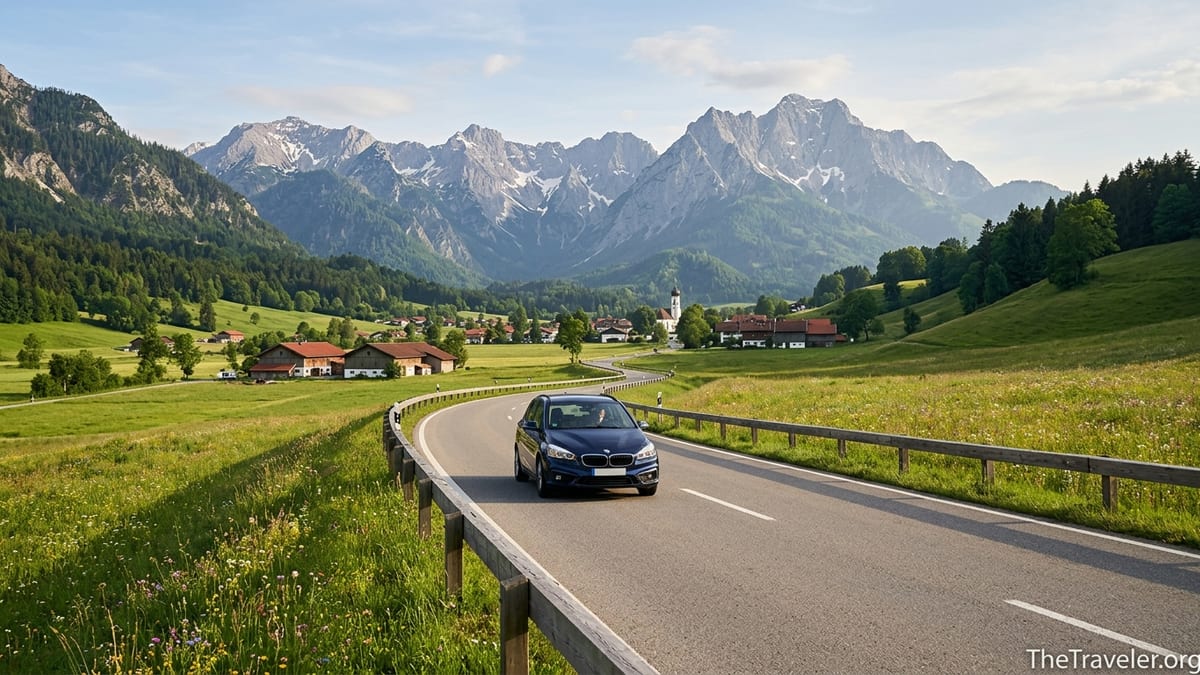
How to Plan a Southern Germany Road Trip
The classic Southern Germany loop usually starts and ends in Munich, which has one of Europe’s busiest airports and plenty of rental car options. From here, many travelers head west or north first along the Romantic Road, drop south into the Bavarian Alps and German Alpine Road, continue west to Lake Constance, and then arc north through the Black Forest before returning to Bavaria. Driven straight, this circuit covers roughly 1,000 to 1,400 kilometers depending on detours, which is comfortable over 10 to 14 days.
Your timing will shape the experience as much as the route. From late May to early October, most alpine roads are open, lakes are warm enough for boat trips, and outdoor terraces in places like Füssen, Garmisch-Partenkirchen and Lindau hum until late evening. July and August bring peak crowds and higher prices, but mountain areas can still feel uncrowded once you are a short walk from parking lots. Shoulder months such as late April, May, late September and early October often combine lighter traffic with lower hotel rates, though higher alpine side roads and some cable cars may be closed for maintenance.
Deciding how many bases to use keeps driving days enjoyable rather than exhausting. On a seven-day trip, you might focus on three to four hubs such as Rothenburg ob der Tauber, Füssen, Garmisch-Partenkirchen and Freiburg. With ten to fourteen days you can add overnights in smaller towns like Dinkelsbühl on the Romantic Road, Berchtesgaden on the eastern Alpine Road, or Triberg in the Black Forest. Each additional night in a single place cuts packing time and parking stress, and makes it easier to explore scenic side roads without worrying about check-in deadlines.
In practical terms, map out estimated driving times between stops rather than distances alone. For example, the 90 kilometer drive between Garmisch-Partenkirchen and Füssen along local roads can take two hours with slower traffic and photo stops, while the 180 kilometer Autobahn run from Munich to Rothenburg ob der Tauber often takes under three hours in normal conditions. Build at least one rest day with minimal driving into any itinerary longer than a week so that the trip feels like a holiday, not a delivery run.
Rental Cars, Costs and Essential Paperwork
Most travelers pick up their car at Munich Airport, where major brands like Sixt, Europcar, Hertz and Avis cluster in the central area between the terminals. Compact manual cars often price from around 50 to 80 euros per day in high season with unlimited mileage when booked well in advance, while automatic transmission models typically cost more. Prices climb sharply for last-minute bookings in summer, or for premium vehicles like BMW and Mercedes models that can easily run above 120 euros per day. Booking early and being flexible on car class and pickup time can reduce the bill substantially.
When comparing rentals, look closely at what is included. Many German rentals come with basic third-party liability coverage by default, but collision damage waivers and theft protection may carry an excess of several hundred to over a thousand euros. Upgrading to a lower-excess package adds to the daily rate but can make sense on a longer trip, particularly if you plan to park on-street in cities or on narrow village lanes. Factor in one-way drop fees if you consider starting in Munich and ending in Frankfurt or Zurich; these can add 100 to 300 euros or more, while round trips to the same location often avoid them.
For paperwork, U.S. and most non-EU travelers need a valid driver’s license from home, and many rental companies also recommend or require an International Driving Permit for licenses that are not in Roman script. Always carry your passport, rental contract, and proof of insurance in the car. If your itinerary briefly crosses into Austria or Switzerland, check cross-border rules before booking; some companies restrict certain vehicle categories from leaving Germany or charge a small cross-border fee. Ask specifically whether a vignette or toll device is needed if you plan any side-trips over the border.
Finally, consider practical extras. A built-in navigation system or smartphone with offline maps is almost essential on smaller Alpine and Black Forest roads where cellular coverage can drop. Child seats are mandatory for younger passengers and must usually be requested in advance. Roof boxes can be helpful if you are carrying hiking gear or ski equipment, but they increase fuel consumption, so only book one if truly necessary. For most couples or small families, a compact or midsize hatchback provides the best balance between luggage space and ease of parking in tight historic centers.
Driving the Autobahn and Navigating German Roads
Germany’s Autobahn network will likely form the backbone of your longer driving days, linking Munich to Würzburg, Ulm or Stuttgart and connecting Lake Constance with the Black Forest. Many stretches have variable speed limits, often 100 to 130 kilometers per hour, enforced by cameras, while some rural segments retain only an advisory limit. Traffic and weather can quickly slow what looks like a fast route on a map, so treat optimistic sat-nav arrival times as best-case estimates rather than guarantees, particularly around cities like Munich or Stuttgart during rush hour.
On the Autobahn, lane discipline is stricter than in many countries. The left lane is for overtaking only and fast-moving traffic can appear quickly in your mirrors, especially on sections with no fixed limit. Move back to the right lane after passing, signal clearly, and leave more distance than you might at home. You will see regular service areas every 40 to 60 kilometers, often with fuel, restrooms and a simple restaurant or bakery counter. Prices for fuel and food at these services are typically higher than in nearby towns, so topping up at a supermarket-adjacent station in places like Kaufbeuren or Garmisch-Partenkirchen can save money over a long trip.
Once you leave the Autobahn, the character of driving changes. Federal roads marked with a “B” prefix, such as the B17 section of the Romantic Road near Füssen or the B500 in the Black Forest, usually have good surfaces and frequent passing lanes. Narrower state and local roads often wind through forests and villages with frequent speed changes from 100 kilometers per hour down to 50 or 30 in built-up areas. Speed cameras are common at village entrances and near schools, particularly in smaller Bavarian towns, so it is wise to treat speed limits as firm rather than flexible suggestions.
Navigating through historic centers brings its own challenges. Many old-town cores, such as Rothenburg ob der Tauber or Füssen’s center, have restricted vehicle access zones, cobblestones and tight corners. In practice, the solution is almost always to follow signs to “Altstadt” or “Zentrum” parking, leave the car in a multi-story garage for a few euros, and explore on foot. Where your hotel sits inside a limited-traffic zone, it may provide a temporary access code or map so that you can unload luggage before parking elsewhere. Always ask at booking time so you are not surprised by barriers or local restrictions on arrival.
The Romantic Road: Castles, Walled Towns and Easy Driving
The Romantic Road runs roughly 350 kilometers between Würzburg and Füssen, and is one of Germany’s most popular themed routes. It links vineyard-clad Franconia with the Bavarian Alps, passing walled towns like Rothenburg ob der Tauber, Dinkelsbühl and Nördlingen, as well as countryside dotted with onion-domed churches. The driving itself is straightforward, mostly on standard rural roads and short Autobahn sections, making it a gentle introduction to German driving before you tackle mountain passes or forest ridges later in the trip.
In a seven-day circuit, many travelers choose two overnight stops along the Romantic Road: for example, Würzburg or nearby vineyards for a first night, then one or two nights in Rothenburg ob der Tauber before continuing south toward Füssen. In a ten-day plan you can add slower days with stops in Dinkelsbühl or Nördlingen, exploring medieval walls and climbing church towers for views over red roofs. Streets in these towns can be narrow and cobbled, so it often makes sense to park in a signed lot just outside the defensive walls and walk in, rather than threading a larger rental through the main gate.
At the southern end, Füssen serves as a practical base for visiting Neuschwanstein and Hohenschwangau castles. Parking lots at the castles near Hohenschwangau village are well signposted and charge a daily fee, and they can fill by late morning in peak season. Many visitors find it easier to park once in Füssen for the day, ride a local bus to the castle complex, and then return downtown for dinner in the evening. If you prefer to drive to the castles directly, plan early morning or late afternoon arrival to avoid tour bus waves.
For distance planning, driving from Würzburg to Rothenburg ob der Tauber takes around 90 minutes without stops, while Rothenburg to Füssen is closer to three and a half hours via country roads. In a 14-day itinerary, you might break that second stretch with a lunch stop in Augsburg or Landsberg am Lech, turning a long drive into a day of slow travel through small towns. Because the Romantic Road includes many low-speed sections through villages, daily averages of 150 to 200 kilometers feel comfortable if you want time for sightseeing along the way.
The German Alpine Road and Lake Constance
The German Alpine Road, or Deutsche Alpenstrasse, runs about 450 kilometers along the Bavarian foothills between Lake Constance in the west and the Berchtesgaden district in the east. It links resort towns like Lindau, Oberstaufen, Garmisch-Partenkirchen and Berchtesgaden with lakes such as Chiemsee and Königssee. The route is fully paved and well maintained but more sinuous than the Romantic Road, with frequent climbs, descents and sweeping curves that showcase views of jagged ridges and green meadows.
After leaving Füssen, many drivers head east on local roads that connect quickly with the Alpine Road segment near Garmisch-Partenkirchen. Here you can take a cable car up Germany’s highest peak, the Zugspitze, or walk partway around the emerald waters of Eibsee before continuing toward Mittenwald and the Austrian border. In good weather, a single day’s drive between Garmisch and Berchtesgaden can be completed in five to six hours of steady driving, but most travelers find it more rewarding to break this into two or three nights, perhaps staying in Ruhpolding, Inzell or near Lake Chiemsee to enjoy short hikes and local guesthouses.
On the western side, Lake Constance creates a different mood entirely. Lindau, with its harborfront lighthouse and lakeside promenade, makes a convenient stopover between the Bavarian Alps and the Black Forest. Parking garages sit close to the old town island, and lakeside hotels often provide their own small lots or underground spaces. Daytime drives around the German shore from Lindau to Meersburg or Konstanz take you past orchards, vineyards and lakefront bathing areas where locals swim on warm days. Traffic can be busy in July and August, so schedule Lake Constance either early or late in your circuit if you prefer quieter roads.
Driving times on this portion of the trip depend heavily on how many scenic detours you take. Lindau to Garmisch-Partenkirchen via the fastest route takes under three hours, but a slower, more scenic choice following the hills and smaller lakes can easily turn into a relaxed day with multiple photo stops. In a ten- or fourteen-day itinerary, consider dedicating three or four nights in total to the Alpine Road, splitting them between the Garmisch area and either Berchtesgaden or Lake Constance, so you are not packing the car every morning.
The Black Forest and the B500 High Road
The Black Forest spreads across southwestern Germany and is best known to drivers for the B500, often called the Black Forest High Road. This scenic federal highway runs along high ridges between Baden-Baden and Freudenstadt, offering sweeping views over dark fir forests, high moorlands and, on clear days, distant Vosges peaks. The road is well surfaced and not especially technical, with long curves and frequent lay-bys where you can pull off to take photos or walk to viewpoints and short trails.
From Lake Constance, you can reach the Black Forest by driving north through towns like Donaueschingen or Triberg, known for its waterfalls and woodcarving shops, before climbing onto the B500. Many travelers choose bases in Freiburg, Triberg or the spa town of Baden-Baden, depending on whether they prefer a lively university city, a small mountain town or classic spa atmosphere. Parking garages in Freiburg’s compact center are well signposted and make it easy to leave the car while you explore cobbled lanes and streams on foot, while smaller Black Forest villages often rely on simple roadside lots and hotel courtyards.
Along the B500 itself, you will find a mix of roadside viewpoints, trailheads and traditional inns. Short walks around lakes such as Mummelsee or through areas like the Lothar Path allow you to stretch your legs and experience the forest away from the road while still keeping driving days manageable. In summer, roadside parking areas can fill quickly around midday, particularly near lakefront cafés and toboggan runs, but turnover is constant as many visitors stop only briefly for photos before moving on.
For circuit planning, it is realistic to drive from Lake Constance to the northern Black Forest in three to four hours using a mix of highways and regional roads. From Baden-Baden or Freudenstadt, continuing northeast back toward Munich typically takes around four hours when traffic is reasonable. In a seven-day loop that also includes the Romantic Road and a taste of the Alps, you might restrict your Black Forest time to one or two nights. With ten or fourteen days, adding an extra night in a valley village or on the ridge itself gives you time for scenic detours without feeling rushed.
Parking, Scenic Stops and Sample 7, 10 and 14 Day Circuits
Parking across Southern Germany is generally straightforward if you know what to expect. Historic towns and cities favor large, well-marked underground garages at the edge of the old center, often charging hourly rates that cap after several hours. In Rothenburg ob der Tauber, for example, perimeter parking lots allow full days at reasonable prices, leaving you free to wander car-free lanes within the walls. In smaller Alpine villages, hotels frequently include on-site parking or a shared lot nearby, which can be worth a few extra euros per night when compared to hunting for a curbside space on a narrow lane.
In rural and mountain areas, trailhead and lakeside parking lots are common, sometimes charging a flat daily fee via ticket machines. Carry coins or a card that works with unattended machines, as not all accept foreign contactless payments. Around Lake Constance, for instance, smaller bathing beaches often have basic pay-and-display lots a short walk from the shore. In the Black Forest and along the Alpine Road, be prepared to park slightly away from the main viewpoints and walk a few minutes; doing so can turn a crowded overlook into a quiet picnic spot just beyond the main path.
For a compact seven-day circuit starting and ending in Munich, a workable pattern is two nights on the Romantic Road, two nights in the Bavarian Alps around Garmisch-Partenkirchen or Füssen, and two nights in the Black Forest, with the remaining night in Munich at the beginning or end. A ten-day plan might expand this by adding a night in Berchtesgaden on the eastern Alpine Road and one on Lake Constance, giving you more time on mountain and lakeside roads. With fourteen days, you can comfortably include both ends of the German Alpine Road, additional Romantic Road stops like Dinkelsbühl, and a slower loop through central Black Forest villages before returning to Munich.
Whichever length you choose, keep daily driving distances modest to preserve the pleasure of the road. On a week-long itinerary, aiming for driving days of 150 to 250 kilometers allows generous time for castles, lakes and coffee stops. In longer 10- and 14-day trips, you can sprinkle very short hops of under 100 kilometers between nearby bases such as Füssen and Garmisch-Partenkirchen or Freiburg and a ridge-top inn on the B500. Planning in this way turns the car from a necessary transfer tool into part of the holiday itself.
FAQ
Q1. Do I need an International Driving Permit to drive in Southern Germany?
Most visitors with licenses in Roman script, such as from the United States or Canada, can drive in Germany with their home license, but some rental companies prefer or request an International Driving Permit, especially if your license is not in English or German. It is inexpensive and easy to obtain before you travel, so carrying one is a sensible precaution.
Q2. How expensive is fuel in Southern Germany and how often will I need to fill up?
Fuel prices fluctuate, but expect petrol and diesel to be significantly higher than in North America. A compact car driven on a typical 1,200 kilometer loop might need two to three full tanks, depending on efficiency and how much mountain driving you do. Autobahn service stations are convenient but costlier than fuel stations in small towns.
Q3. Is it difficult to drive on the Autobahn as a visitor?
The Autobahn is well engineered and clearly signed, and most visitors adapt quickly if they respect lane discipline and speed limits. Staying in the right or middle lanes except when overtaking, watching mirrors carefully and avoiding sudden lane changes will keep the experience manageable even on faster sections.
Q4. When is the best time of year for a Southern Germany road trip?
Late spring to early autumn, roughly from May to early October, is ideal for combining the Romantic Road, Alpine Road, Lake Constance and the Black Forest. Summer offers long days and open mountain roads, while May, June, September and early October can bring fewer crowds and pleasant temperatures.
Q5. Can I drive these routes in winter?
Many sections of the Romantic Road and major highways remain open year-round, but snow and ice are common in the Alps and Black Forest. Some higher side roads and mountain passes may close temporarily, and winter tires or even snow chains can be necessary. Unless you are comfortable with winter driving, it is usually better to plan this trip for the milder months.
Q6. How much should I budget for tolls on this route?
Germany does not currently charge tolls for private cars on standard Autobahns and federal roads, so you will not pay tolls for the Romantic Road, German Alpine Road, Lake Constance shore or the B500 in the Black Forest. You may encounter tolls or vignettes only if you detour into neighboring countries such as Austria or Switzerland.
Q7. Is it safe to leave luggage in the car when sightseeing?
Petty theft from vehicles can occur anywhere, so avoid leaving valuables in sight. When you must leave luggage in the car between hotels, choose busy, well-lit parking lots, lock items in the trunk and avoid opening the trunk immediately after parking in a prominent area. Whenever possible, check in and drop bags at your accommodation before sightseeing.
Q8. Do I need to reserve hotels and guesthouses in advance?
In high season, especially June to September and around public holidays, it is wise to book key stops such as Rothenburg ob der Tauber, Füssen, Garmisch-Partenkirchen and popular Black Forest villages several weeks or more in advance. Outside peak times, you may find same-day availability in many towns, but booking at least a night ahead helps with parking arrangements and arrival planning.
Q9. Can I do this road trip without driving a manual transmission?
Yes. Automatic cars are widely available through major rental companies at airports and in large cities, although they tend to be more expensive and may sell out earlier in peak season. If you require an automatic, reserve as far ahead as practical and confirm the transmission type on your booking.
Q10. How many days do I realistically need to include Bavaria, the Romantic Road, Alpine Road, Lake Constance and the Black Forest?
You can sample each region in about seven days by limiting overnight stops, but ten days allows more relaxed pacing and fourteen days lets you spend full days hiking, boating and exploring smaller towns. Choosing a 10- to 14-day circuit reduces daily driving and makes the trip feel more like a holiday than a checklist.