


Western Germany is one of Europe’s easiest regions to explore by rail. Dense local networks radiate from Cologne and Düsseldorf along the Rhine and Moselle rivers, connecting Gothic cathedrals, winemaking villages and historic cities such as Bonn, Aachen, Koblenz and Trier. With a bit of planning, you can see much of this landscape on comfortable, frequent regional trains and only rent a car for the few stretches where wheels genuinely beat rails.
Understanding the Rail Network in Western Germany
Western Germany’s core rail arteries are the Rhine and Moselle valley lines, backed up by a lattice of regional routes around Cologne, Düsseldorf and the Ruhr. The West Rhine Railway follows the left bank of the Rhine from Cologne via Bonn and Koblenz down toward Mainz, passing castles, vineyards and medieval townscapes along the way. Passenger traffic is a blend of hourly or better Regional Express trains, slower stopping services and a layer of long-distance Intercity and ICE services on top, which you can largely ignore if you want to keep costs down and enjoy the scenery.
On the opposite bank, the East Rhine Railway runs via smaller towns and offers an equally scenic, slightly quieter alternative between Cologne and Koblenz. South of Koblenz, the Moselle line branches off toward Cochem and Trier, tracking one of Germany’s most graceful river landscapes. Regional trains like RE and RB services operate at least hourly between Koblenz and Trier, with more frequent segments around commuter hubs, making day trips from a Rhine base straightforward even for first-time rail travelers.
Cologne and Düsseldorf act as the main gateways for international arrivals, with direct trains from Amsterdam, Brussels, Frankfurt Airport and Paris. From either city, you can reach Bonn, Koblenz and Aachen in under 90 minutes on regional services. The practical effect is that almost any city pairing mentioned in this guide is feasible as a same-day round trip, allowing you to base yourself in one or two hubs and explore outward rather than packing and unpacking each night.
For planning, Deutsche Bahn’s national journey planner app remains the most comprehensive tool, covering both long-distance and regional services across Germany. Within North Rhine-Westphalia, local transport associations such as VRR and VRS publish schematic maps and pocket timetables for lines like the Rhein-Express between Düsseldorf and Koblenz or RB26 and RB27 services along the Rhine, which can be helpful for visualizing where you can hop on and off for photos or lunch stops.
Key City Hubs: Cologne, Düsseldorf, Bonn and Aachen
Cologne is the natural starting point for many itineraries. Its central station sits directly in front of the city’s vast Gothic cathedral, which you will likely spot the moment you step off the train. Regional services fan out to Bonn in around 25 to 30 minutes, to Koblenz in roughly 70 to 90 minutes depending on the stopping pattern, and to Düsseldorf in a similar time. Because Cologne Hauptbahnhof is so central, you can check into a nearby hotel and be on a train down the Rhine within an hour of arriving from another country.
Düsseldorf, a short hop north of Cologne, is more modern in feel and a good base if you also want to explore the Ruhr cities of Duisburg and Essen. Frequent regional trains link Düsseldorf Hauptbahnhof to Cologne in around 25 minutes, to Duisburg in under 15 minutes and to Bonn in under an hour. Travelers who prefer a business-hotel environment, international chains and easy airport access often choose Düsseldorf as their western Germany base before heading out on Rhine or Moselle day trips.
Bonn, the former West German capital, is smaller and quieter than Cologne but well linked by trains that follow the left bank of the Rhine. If your focus is the middle Rhine rather than the big cities, Bonn makes an excellent compromise between urban amenities and river scenery. A traveler could, for example, spend a morning at the Bonn Museum Mile, then catch an afternoon Regional Express south along the river to explore Remagen or Linz before returning for dinner in the Südstadt district.
Aachen, close to the Belgian and Dutch borders, is best known for its cathedral and Charlemagne heritage. It is easily reached by regional trains from Cologne in about an hour, or from Düsseldorf in roughly 90 minutes, making it straightforward to slot into a Western Germany rail itinerary. Aachen can be done as a day trip from Cologne with a mid-morning departure, two to three hours on the ground for the cathedral and old town, and a late-afternoon return, all on inexpensive regional tickets.
Rhine Valley by Train: Scenic Sections and Classic Stops
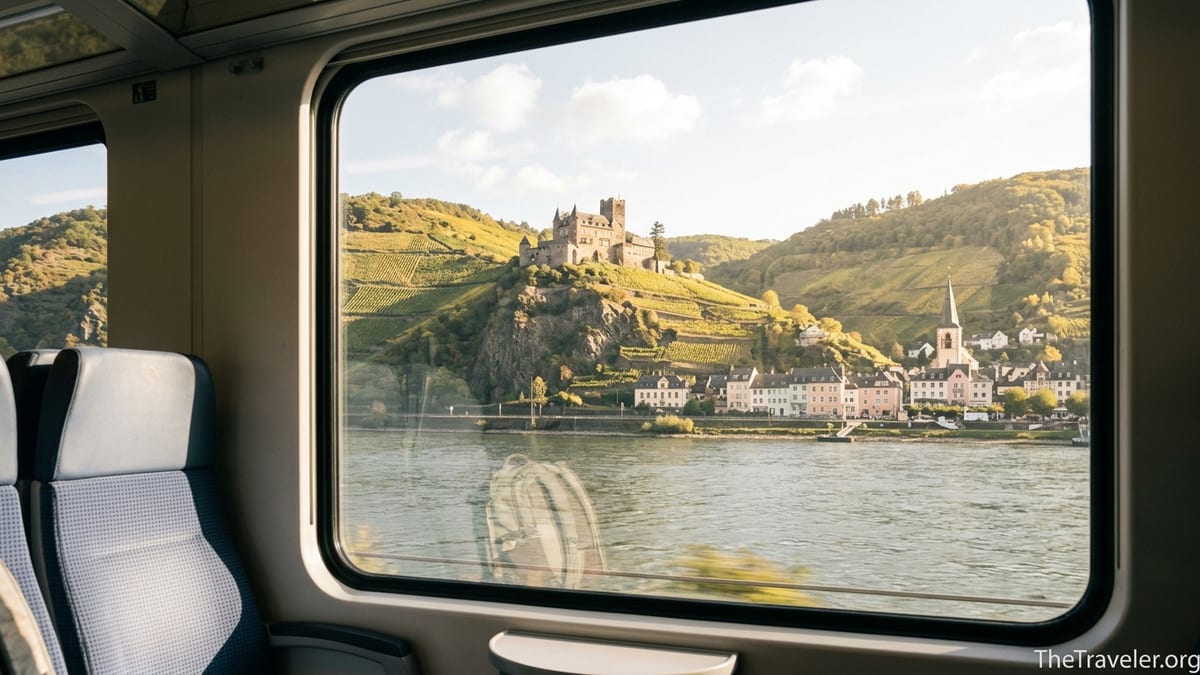
The most celebrated stretch of the Rhine for train travelers lies between Bonn and Koblenz, and further south toward Bingen and Mainz. Along this West Rhine route on the left bank, Regional Express trains such as the Rhein-Express typically run at least hourly and stop at riverside towns including Remagen, Andernach and Koblenz. The beauty of traveling this line is that your train often hugs the water, with castles crowning the opposite bank and terraced vineyards climbing the hillsides.
For pure scenery, many travelers focus on the section between Koblenz and Bingen, often described as the Middle Rhine. While this guide concentrates on Western Germany and the segment north to Cologne, it is worth noting that a day trip south from Koblenz toward Boppard, St. Goar or Oberwesel is easily arranged by regional trains. An example itinerary would be to leave Cologne mid-morning on a Regional Express, change at Koblenz onto a local train, break your journey in Boppard for lunch and a riverside walk, then continue one or two stops further before looping back to Cologne in the evening.
On the right bank, trains such as RB27 or other regional services serve towns like Königswinter and Linz, offering a complementary perspective. Many visitors will take the left bank line in one direction and the right bank on the way back, effectively turning the Rhine into a scenic loop. Since these are all classified as regional services, they are covered by regional day tickets and the nationwide monthly flat-fare ticket, which can significantly lower costs if you are traveling several days in a row.
Smaller stations along the Rhine often have basic facilities only, typically a platform, ticket machines and perhaps a kiosk. If you plan to stop off in smaller towns such as Remagen or Oberwesel, it is wise to use station lockers in major hubs like Cologne or Koblenz for larger bags, or to travel with luggage that you can comfortably roll across platforms and up short flights of stairs. Trains themselves are designed with wide doors and spaces for bikes and prams, which also accommodate suitcases reasonably well as long as you avoid the busiest commuter windows.
Moselle Valley by Train: Koblenz to Trier
The Moselle valley between Koblenz and Trier is one of the most scenic rail journeys in Germany, tracing long river bends, steep vineyards and half-timbered villages. Regional trains such as RE and RB services run along the left bank of the Moselle, stopping at Cochem, Bullay and other wine towns. Many travelers consider the stretch between Koblenz and Bullay particularly photogenic, with the railway sometimes threading directly between rock faces and water, and views of castles perched high above the river.
A practical example: from Koblenz, you can catch a mid-morning Regional Express towards Trier, hop off in Cochem after about 40 minutes, stash your lighter bags in a hotel or carry them into town for a riverside lunch, then continue later in the afternoon to Trier, arriving in time for an evening stroll around the Roman Porta Nigra. The same ticket usually remains valid for the entire regional journey if you do not backtrack or break the time limits, so you can treat the ride as a hop-on hop-off experience within your travel day.
Trier itself makes a strong base for exploring the upper Moselle and nearby Luxembourg by train or bus. The city is compact, with its station around a 10 to 15 minute walk from the Roman ruins and pedestrianized center. From Trier, local trains and buses follow the Moselle further south and west, though service is generally less frequent than on the Rhine. If your schedule is tight and you want maximum flexibility to stop at smaller vineyards and viewpoints, this is one of the first areas where a rental car begins to compete with the train.
In summer and early autumn, regional trains along the Moselle can be busy at weekends with cyclists and day trippers. If you are traveling with larger luggage, aim for midweek or mid-morning departures rather than early mornings or late afternoons. Boarding at terminus stations such as Koblenz or Trier rather than intermediate stops also increases your chances of finding luggage space and a window seat on the river side of the train.
Ticket Options: Deutschlandticket, Regional Day Passes and Seat Reservations
Germany’s rail ticketing has become simpler for regional travel thanks to the nationwide monthly ticket, widely known as the Deutschlandticket. Priced at around 63 euros per month in 2026, it allows unlimited travel in second class on almost all local and regional public transport across Germany, including RB, RE and S-Bahn trains as well as most city buses, trams and metros. For a traveler planning at least three or four substantial regional train days within a month, the math usually works in favor of this pass compared to buying separate day tickets.
For shorter visits focused solely on North Rhine-Westphalia, which includes Cologne, Düsseldorf, Bonn and Aachen, state-wide 24-hour tickets can be good value. A typical example is a 24-hour ticket valid across the region for one person, with a higher-priced version covering up to five travelers. These passes usually allow unlimited travel on regional trains plus local transport within the state for a calendar day or rolling 24-hour period. For instance, two friends based in Cologne could use a five-person 24-hour ticket to ride down the Rhine to Koblenz, continue to Bonn, and still use trams and buses in both cities without purchasing additional fares.
If your itinerary only requires a single intercity hop, such as Cologne to Koblenz and back, point-to-point regional fares can be sufficient. However, individual tickets can add up quickly once you start combining multiple segments in a day, like Cologne to Koblenz, Koblenz to Cochem and Trier, then local buses. In practice, most travelers who plan at least two day trips will find that some form of day or month pass provides both savings and peace of mind, since you can board almost any qualifying regional train without thinking about specific departure times.
Seat reservations are generally not available or necessary on regional trains in this part of Germany; they operate on a turn-up-and-go basis. Long-distance ICE and Intercity services do offer reservations and can be useful for speeding between hubs such as Cologne and Frankfurt Airport, but they are not essential for the Rhine and Moselle routes described here. If you are traveling at peak holiday times and prefer guaranteed seats, consider taking one long-distance train to reach your first base, then switching to regional services for the scenic segments.
Handling Luggage, Bikes and Day Packs on Regional Trains
Traveling this region by train works best when you pack with frequent boarding and alighting in mind. Most regional trains have level or near-level boarding, but you will still encounter short steps onto the carriage and occasional staircases within stations. A medium-sized rolling suitcase plus a backpack is much easier to manage than an oversized checked bag, especially in older stations such as Bonn or Trier where lifts might be busy or temporarily out of service.
Within the carriages, luggage space is usually informal rather than in dedicated racks. You will find open areas near the doors designed for bicycles, strollers and wheelchairs, as well as overhead shelves and spaces between back-to-back seat banks. Place heavier suitcases on the floor in these multipurpose areas and keep smaller bags either above your seat or on your lap. If you are traveling as a couple, you can often claim a pair of seats facing each other and slide your suitcase under the facing bench.
Bikes are a common sight on Rhine and Moselle trains, particularly on sunny weekends when locals head out for cycling excursions. Many regional services allow bicycles, sometimes requiring a modest extra ticket, and clearly mark doors with bike symbols. If you are carrying both a larger suitcase and a bike, consider traveling outside the busiest times to avoid congested doorways. For most short trips focused on towns and river walks, however, renting a bike locally at your destination is less stressful than bringing one onto the train.
For longer stopovers, station lockers are available at larger hubs such as Cologne, Düsseldorf, Koblenz and Trier. Prices vary by size, but a medium locker is often an economical way to store a suitcase for several hours while you explore without baggage. An example would be leaving your main case at Cologne Hauptbahnhof before an unplanned afternoon run down to Bonn and back, carrying only a small day pack with water, camera and an extra layer for breezy riverfront walks.
When a Rental Car Becomes More Useful
Despite the strengths of Western Germany’s rail network, there are situations where a rental car provides more flexibility than trains and buses. The Moselle above Cochem and the side valleys feeding into it, for example, are dotted with tiny wine villages and hilltop viewpoints that can be cumbersome to reach on public transport, especially in the evening when services thin out. If your ideal day involves hopping between three or four small wineries, lingering at a viewpoint for sunset and having dinner in a village without a late train connection, a car gives you the freedom to improvise.
Similarly, sections of the Eifel hills between Aachen and the Moselle, and the Hunsrück plateau south of the Moselle, are sparsely served by rail. You can reach gateway towns such as Gerolstein or Bullay by train, then pick up a rental car for a couple of days of rural exploration before returning it in a larger city. Many travelers will structure their trip so that the first half is rail-based along the Rhine and Moselle corridors, with a short car rental in the middle or end for countryside stays in farm guesthouses or spa towns off the main lines.
Parking in historic centers like Trier, Koblenz or central Cologne can be expensive and occasionally stressful, which is why it often makes sense to avoid a car while you are based in these cities. Instead, pick up the vehicle at a suburban office or near a smaller station when you are ready to leave the rail corridors behind. For example, after several nights in Cologne and a night in Koblenz, you might rent from a Koblenz office, spend three days exploring the quieter Moselle villages and Hunsrück hikes, then drop the car in Trier before continuing by train toward Luxembourg or back to Cologne.
Remember that renting a car in Germany usually requires a credit card and a driving license valid in the European Union, plus comfort with manual transmissions, as automatic vehicles can be more expensive and less common in smaller depots. If you are not confident about driving on winding river roads or navigating narrow village lanes, you may still prefer to rely on a mix of trains, local buses and the occasional taxi for hard-to-reach accommodation, even if it means planning your days slightly more rigidly around timetables.
Putting It All Together: Sample Rail Itineraries
A compact four-day rail-focused trip could start with two nights in Cologne, one night in Koblenz and one night in Trier. On day one, arrive in Cologne, explore the cathedral and old town and perhaps take an evening stroll over the Hohenzollern Bridge. On day two, use a North Rhine-Westphalia day ticket or the monthly nationwide pass to ride south along the Rhine, stopping in Bonn for a few hours before continuing to Remagen or Linz, then returning to Cologne for the night.
On day three, check out of your Cologne hotel and travel with luggage to Koblenz on a morning Regional Express. Leave your suitcase in a station locker or at your hotel, then ride a short regional train to Boppard or another nearby river town for lunch and a walk, coming back to Koblenz for the evening. Day four takes you from Koblenz to Trier along the Moselle, with an extended stop in Cochem. With a nationwide regional ticket or monthly pass, each of these days involves simply boarding the next regional train that fits your schedule without worrying about individual fares.
For a longer trip of a week to ten days, you might begin in Düsseldorf, move on to Cologne, then use Bonn or Koblenz as a base for two or three nights. Afterward, continue by train along the Moselle to Trier, where you could spend at least two nights exploring both the Roman sites and the surrounding wine villages. If you want a taste of driving, this is where you could add a short car rental to visit more remote vineyards and hill towns, keeping your rail segments to the main river corridors.
Whichever pattern you choose, try to cluster your heaviest travel days to maximize the value of any day or month passes you purchase. For example, if you activate a nationwide monthly regional ticket, plan your big movements, such as Cologne to Koblenz, Koblenz to Trier and day trips along the Rhine, within that calendar month. On quieter days when you stay mostly in one city, a local transit pass or even single metro tickets may be all you need.
FAQ
Q1. Is the Deutschlandticket worth it for a one-week trip in Western Germany?
The nationwide monthly regional ticket can be good value if you plan at least three or four full regional train days within the same calendar month. If your week is concentrated around Cologne, Düsseldorf and Bonn with multiple day trips to Koblenz, Aachen or the Rhine, it often pays off. For lighter rail use, state or local 24-hour tickets may be cheaper.
Q2. Do I need to reserve seats on trains in the Rhine and Moselle valleys?
No, reservations are generally not available or needed on regional trains in this area. Services run frequently, usually at least hourly, and operate on a first-come, first-served basis. Only long-distance ICE and Intercity trains offer reservations, and these are optional for most travelers on the routes described here.
Q3. Which side of the Rhine offers the best scenery by train, left or right bank?
Both sides are scenic but slightly different in character. The left bank between Bonn and Koblenz is busier, with more frequent Regional Express services and direct access to larger towns. The right bank feels quieter and more rural. Many travelers ride down one side and return on the other to experience both perspectives.
Q4. How much luggage can I bring on regional trains?
There is no strict checked baggage system on regional trains; you simply carry what you can manage yourself. A medium rolling suitcase plus a smaller backpack is usually comfortable. Space is limited near doors and in overhead racks, so extremely large suitcases can be awkward, especially at busy times.
Q5. Are station lockers available in smaller Rhine or Moselle towns?
Lockers are common in major hubs such as Cologne, Düsseldorf, Koblenz and Trier, but rare in smaller river towns like Cochem or Boppard. If you plan to stop off frequently, either store your main bag in a big-city locker and travel with a day pack, or choose accommodation near the station so you can drop bags quickly before exploring.
Q6. When does it make sense to rent a car instead of relying on trains?
A rental car becomes useful when you want to explore small villages and viewpoints off the main river lines, especially on the upper Moselle or in hill regions like the Eifel and Hunsrück. If your plans involve several remote wineries in a single day or late-evening dinners in villages with limited bus or train service, driving can be more practical than public transport.
Q7. Can I take a bicycle on Rhine and Moselle trains?
Yes, many regional trains on these routes allow bicycles, often for a small additional fee. Look for bike symbols on the carriage doors and use the designated multi-purpose areas. At busy times in summer, especially weekends, services can be crowded with bikes, so traveling earlier in the day can make boarding easier.
Q8. How far in advance do I need to buy regional tickets?
Regional day tickets and the nationwide monthly ticket can usually be purchased on the day of travel from ticket machines, staffed counters or official apps. There is no price advantage to buying far in advance for these products, unlike some long-distance fares, so you can keep your plans flexible and buy shortly before departure.
Q9. Is it better to base in Cologne or Koblenz for exploring the Rhine?
Cologne is ideal if you want a large city with extensive dining, museums and nightlife plus easy day trips to Bonn, Düsseldorf and Aachen. Koblenz is smaller and sits closer to the most scenic central stretch of the Rhine and the junction with the Moselle. Many travelers spend a few nights in Cologne, then shift to Koblenz for two or three days focused on river scenery.
Q10. Are trains in Western Germany usually on time?
Punctuality is generally good on regional services, though minor delays of a few minutes are not uncommon. When planning connections, allow a bit of buffer time, especially if you are catching a long-distance train or flight after a regional service. Using live departure boards in stations or official apps helps you adjust quickly if schedules shift slightly.