


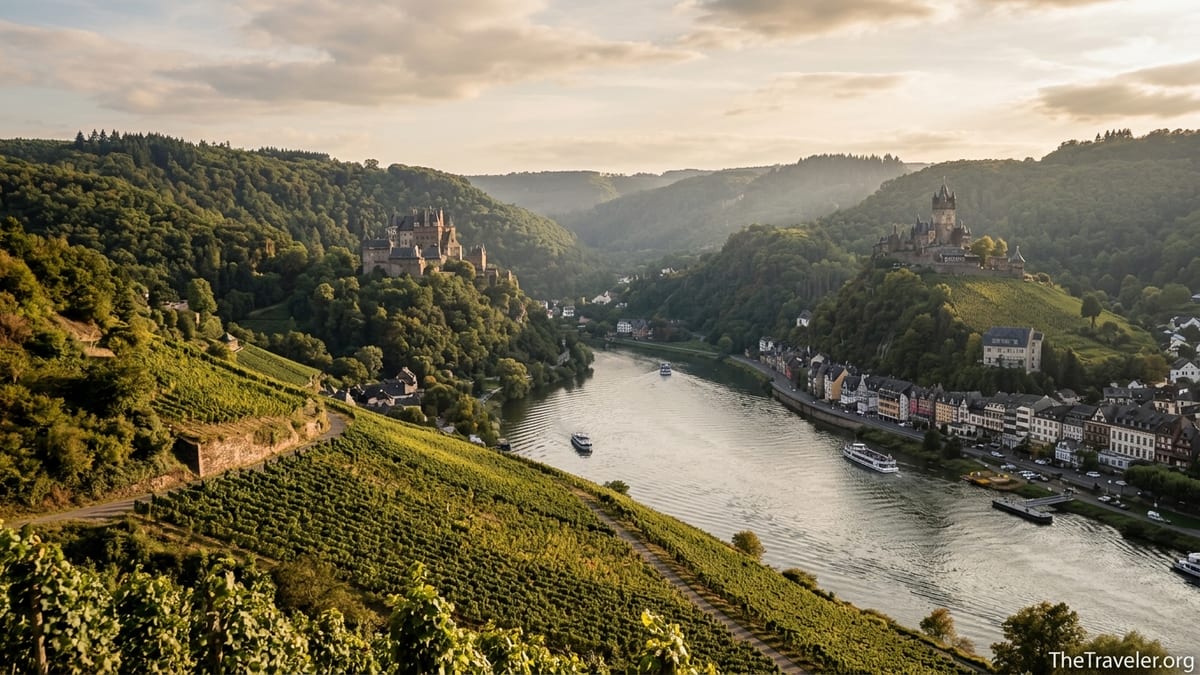
Western Germany’s Rhine and Moselle valleys are some of Europe’s richest landscapes for castle lovers, with fairytale fortresses perched above vineyards, half-timbered towns huddled by the water and riverboats gliding beneath medieval watchtowers. This guide explains how to plan a castle-focused trip built around the Rhine, Moselle, Eltz Castle and Reichsburg Cochem, comparing self-drive routes, classic river cruises, guided excursions and multi-castle itineraries that fit real-world travel budgets and schedules.
Understanding Western Germany’s Castle Country
The core castle region in western Germany runs roughly between Koblenz and Bingen / Rüdesheim on the Rhine and between Koblenz and Trier on the Moselle. Trains trace both riverbanks, roads wind through steep vineyards and day-cruise boats cover the most scenic stretches, so you can choose how active or relaxed you want your castle trip to be. Many travelers combine a base in Koblenz, Cochem or Rüdesheim with day trips rather than changing hotels every night.
The Rhine’s Upper Middle Rhine Valley is a UNESCO World Heritage area known for densely packed castles that once controlled river tolls. Between Koblenz and Bingen you pass well-known strongholds such as Marksburg above Braubach, the romantic ruins of Rheinfels near St. Goar and riverside fortresses like Pfalzgrafenstein on its own tiny island. On the Moselle, the scenery softens into epic vineyard slopes punctuated by castles such as Reichsburg Cochem, Burg Thurant near Alken and the hidden fairytale of Burg Eltz in the Eifel hills.
For a first trip, most visitors focus on a three to five day loop that links the Rhine and Moselle. A typical pattern is to arrive via Frankfurt or Cologne, travel by train to Koblenz and then fan out to day trips by boat, car or regional trains. Others rent a car directly at the airport and drive a loop from Frankfurt through the Rhine, Moselle and Eifel region before returning. Both approaches work; the right choice depends on how confident you feel about driving winding rural roads, how many castles you plan to tour inside and your overall budget.
Castle access is an important planning detail. Some fortresses, such as Eltz Castle and Reichsburg Cochem, can only be visited on guided tours at set times, which affects how many you can realistically see in one day. Others, like the ruins of Rheinfels or the fortifications of Ehrenbreitstein above Koblenz, can be explored more freely with a general admission ticket. Building your itinerary around a mix of structured guided visits and more flexible ruins helps keep the trip enjoyable instead of rushed.
Rhine River Castles: Cruises, Trains and Car Routes
The classic way to experience Rhine castles is on a day cruise through the Upper Middle Rhine Valley. A common option is to take a scheduled passenger ship between Koblenz and Bingen or Rüdesheim, a journey of roughly four to five hours depending on stops and direction of travel. Boats run more frequently from late spring through early autumn, with a reduced schedule outside peak months. Many travelers sail one way and return by regional train, which takes about one hour and lets you adjust your timing if you decide to linger in a riverside village.
Prices for these regular Rhine day cruises are typically in the rough range of 30 to 60 euros per adult one way, depending on distance, class of seating and whether you take advantage of promotional passes or regional transport tickets. Families often find it cost-effective to combine a river cruise with a discounted regional train pass that covers the return journey. Some boats, including historic paddle steamers on certain routes, offer restaurant service on board, making it easy to combine sightseeing with lunch while you glide past castles like Katz, Maus and Schönburg.
If you prefer maximum flexibility, hiring a car and driving the Rhine is straightforward for most visitors comfortable with European roads. The B9 road along the left bank and the B42 on the right bank lead through riverside towns such as Boppard, St. Goar and Bacharach, with frequent pullouts or parking areas for viewpoints. Parking in small towns is usually metered but reasonably priced; you might pay a few euros for a couple of hours near the waterfront or in village lots. A realistic self-drive day could involve leaving Koblenz after breakfast, stopping at Marksburg Castle for a late-morning tour, continuing to St. Goar for lunch and a visit to Rheinfels, then looping back via the opposite bank in the evening.
Travelers who do not want to drive can still explore Rhine castles efficiently by train and short taxi rides. Regional trains run at least hourly between Koblenz and Bingen, stopping in most major villages. From Braubach station it is a steep walk or a short taxi ride up to Marksburg, and from St. Goar station you can walk to the Rheinfels shuttle or footpath. Pre-booked small-group excursions from cities like Frankfurt or Cologne often bundle transport, a Rhine cruise segment and one or two castle visits into a single day, which is especially appealing for time-pressed visitors who want logistics handled for them.
Moselle Valley & Reichsburg Cochem
The Moselle between Trier and Koblenz offers a softer, more intimate feel than the Rhine, with looping bends, vertiginous vineyards and compact wine villages such as Beilstein, Bernkastel-Kues and Traben-Trarbach. Cochem, roughly one hour by regional train from Koblenz, makes a popular base thanks to its charming old town and the picture-book silhouette of Reichsburg Cochem rising above the river. Many visitors split their time between a day or two based in Cochem and additional nights in Trier or Koblenz to broaden their range of excursions.
Reichsburg Cochem is a highlight for many castle enthusiasts. Access starts in town, where you walk uphill for 15 to 30 minutes depending on your pace, or take a local shuttle taxi service when operating. Inside, entry is by guided tour only, with standard adult tickets generally in the low double-digit euro range at the time of writing. English-language tours typically run about once an hour in the busier months, though exact frequency can vary day to day. The tour leads through furnished rooms, from knight’s halls to richly decorated chambers, giving a vivid impression of 19th-century romantic restoration layered onto medieval foundations.
It is easy to combine a visit to Reichsburg Cochem with other Moselle experiences in the same day. Travelers with a rental car might drive on to the hilltop ruins of Burg Metternich above Beilstein for sweeping river views, then continue to the vineyards near Bremm, home to one of Germany’s steepest wine slopes. Those using public transport can rely on regional trains along the river and local buses to reach smaller villages, or simply spend extra time in Cochem itself, riding the riverside promenade, tasting local Riesling in a wine tavern and taking the chairlift up to the Pinnerkreuz viewpoint for a panoramic shot of the castle and town.
River cruises on the Moselle tend to be shorter and more localized than the big Rhine day trips, often lasting one to three hours and focusing on specific sections like the loop around Cochem or the stretch between Traben-Trarbach and Bernkastel-Kues. These smaller cruises, typically priced in the ballpark of 15 to 30 euros, are a relaxing way to see the castles and vineyards from water level. They are especially pleasant in the evening light when the slopes glow golden and some castles are illuminated.
Eltz Castle: Fairytale Fortress in the Forest
Eltz Castle lies in the hills between the Moselle and the Eifel region, technically away from the main riverbanks but easily combined with Moselle or Rhine itineraries. Drivers typically approach via the village of Wierschem and park in the designated lot above the castle, where a small parking fee is charged. From there it is about a 15 to 20 minute downhill walk through the forest to the iconic viewpoint above the castle bridge. In peak season a shuttle bus usually operates for a modest charge on the return uphill stretch, which many visitors appreciate after touring the interiors.
Like Reichsburg Cochem, Eltz Castle can only be visited with a guided tour. Adult tickets are typically in the low to mid-teens in euros, with reduced prices for children. Tours run frequently during the main opening period, with English-language departures scheduled several times per day, especially in summer. Inside, you walk through richly decorated rooms with original furnishings, from armories and treasury chambers to bedchambers and wood-paneled halls. Photography rules may restrict taking pictures in some rooms, so visitors keen on interior shots should check current guidelines at the entrance.
Because of its popularity, timing is crucial for Eltz Castle. On busy weekends or during school holidays, the parking areas can fill late in the morning and the approach paths become crowded. If possible, aim to arrive close to opening time, especially if you are driving from Koblenz or Cochem. An alternative is to visit later in the afternoon once day-trip crowds thin out, though you should keep an eye on the last tour times to avoid disappointment. Travelers relying on public transport can combine a regional train to nearby towns with a seasonal bus service or taxi to the parking lot, but should build in extra buffer time for connections.
Many travelers pair Eltz Castle with other nearby sites for a full day. A realistic plan from Koblenz, for example, might start with an early-morning drive to Burg Eltz, a late-morning tour and picnic lunch on the forest trails above the castle, followed by an afternoon in Cochem for a stroll through the old town and a riverside dinner. Those staying in Trier might stop at Eltz en route to or from Koblenz, using it as a scenic midpoint on the Moselle drive. In both cases, packing comfortable walking shoes is essential, as forest paths and castle courtyards are often uneven.
Self-Drive Castle Routes: Flexibility and Scenic Roads
For travelers comfortable behind the wheel, a self-drive trip offers the greatest freedom to string together multiple castles and river viewpoints in a single day. Rental cars are easily arranged at airports such as Frankfurt and Cologne Bonn or at major stations like Koblenz, and compact models are usually sufficient. Fuel, parking and occasional toll-free highways keep driving costs manageable, especially if you are sharing expenses within a couple or family group.
A popular three-day loop might look like this in practice. Day one, pick up a car in Frankfurt and drive to Rüdesheim, then follow the Rhine north toward Koblenz, stopping at villages like Bacharach and castles such as Rheinfels above St. Goar for a tour. Overnight in Koblenz or Boppard. Day two, cross to the Moselle and follow the river to Cochem, visiting Reichsburg and perhaps Burg Thurant or another hillside fortress. Day three, detour to Eltz Castle on your way back toward Frankfurt or onwards to Trier. Driving distances each day are under three hours, leaving ample time for castle visits and vineyard walks.
On the Moselle, the drive between Trier and Koblenz is considered one of Germany’s most scenic, with repeated bends offering new views every few kilometers. Self-drivers can stop at smaller, less touristed sites such as the twin ruins near Treis-Karden or hilltop viewpoints above Zell and Bremm that are harder to reach on public transport. Many roadside wineries sell bottles directly from their cellars, and a common strategy is to buy a couple of bottles to enjoy later at your accommodation, since drink-driving laws are enforced and it is safest to keep tastings modest if you are continuing to drive.
Navigation is generally straightforward, as most routes simply follow the river and are well signposted. However, castle access roads can be narrow, steep and occasionally one-way. It is wise to check in advance whether a castle has its own parking, requires shuttle access or restricts private vehicles during busy times. For example, the approach to Eltz Castle directs drivers to the main lot rather than the castle gate itself, while some smaller ruins may only have a few roadside parking spaces that fill quickly on sunny weekends.
Costs for self-drive itineraries vary with fuel prices and rental rates, but a rough benchmark for a compact car might be in the range of 50 to 80 euros per day including basic insurance, plus fuel and parking. When spread across two or more travelers, this can compare favorably with multiple individual train or tour tickets, especially if you plan to visit out-of-the-way castles that would otherwise require taxis or complex bus connections.
River Cruises and Guided Excursions: Relaxed Alternatives
Not everyone wants to navigate foreign roads or decipher rail timetables while on vacation. River cruises and guided excursions offer a more relaxed way to see western Germany’s castles, with transport, some meals and selected entry tickets bundled into one package. Options range from short day cruises on local companies to multi-day itineraries on international river cruise lines that sail the Rhine and Moselle.
For independent travelers, a practical middle ground is to base in a river town and book individual excursions. From Koblenz, for example, you might purchase a day ticket on a Rhine boat that allows you to hop on and off at different villages, combining this with a discounted regional rail ticket to return at your own pace. Travel agencies and local tourist offices also promote themed coach tours, such as “Rhine Castle & Loreley” days from Frankfurt or Cologne, which often include a river cruise segment, lunch and a visit to a major castle like Marksburg.
Multi-day river cruises on larger ships, offered by well-known companies specializing in European waterways, typically bundle accommodations, most meals and shore excursions into a per-night price. While these trips can be more expensive on a nightly basis than self-planned travel, they appeal to travelers who value unpacking once and waking to new views each day. Itineraries frequently include sections of both the Rhine and Moselle, with guided visits to castles such as Reichsburg Cochem, tours of wine villages and optional hikes to viewpoints above the river.
When comparing guided excursions with do-it-yourself options, consider both cost and how you like to travel. A day tour from Frankfurt that includes a Rhine cruise, lunch and one castle entry might run in the rough range of 100 to 150 euros per person, while arranging the same day independently using regional trains, a scheduled boat and individual tickets could come in lower but require more planning. Guided tours often move at a set pace, which is convenient but may feel rushed if you like to linger in one village or at a particular castle museum.
Planning Multi-Castle Itineraries: Sample Days & Bases
Designing a satisfying multi-castle itinerary in western Germany means balancing ambition with realism. Most travelers find that two interior castle tours per day, plus some time for a boat ride or town walk, is the upper limit before fatigue sets in. It can be more rewarding to fully experience a couple of castles and a village than to race past four or five without context. Building in slower mornings, long lunches or an afternoon at a spa hotel or riverside beer garden helps keep energy levels up.
One practical two-day plan using public transport might be to base in Koblenz. On day one, take a morning boat or train to Braubach, visit Marksburg Castle on a guided tour and then continue to St. Goar for lunch and an afternoon exploring the Rheinfels ruins before returning by train. On day two, ride the Moselle train to Cochem, tour Reichsburg Cochem and, if time allows, take a short Moselle cruise or the chairlift to the Pinnerkreuz viewpoint before heading back to Koblenz in the evening.
For travelers with three to four days and a rental car, combining Rhine, Moselle and Eltz is straightforward. A three-night itinerary might involve one night in Rüdesheim or Bacharach, one in Koblenz or Boppard and one in Cochem. Over these days you could visit at least four major castles inside, plus additional ruins for views and short hikes. Ending your trip in Trier or Cologne gives you easy onward connections by train or plane while still allowing a final day visiting Roman ruins or cathedral precincts instead of squeezing in yet another fortress.
Seasonality is another important factor. Late spring through early autumn offers the most reliable combination of cruise schedules, extended opening hours and pleasant walking conditions. In July and August, crowds peak and daytime temperatures can rise significantly in the river valleys, making early starts and siesta-style afternoons attractive. Shoulder months such as May, June, September and early October often provide a sweet spot of active cruise timetables and more moderate visitor numbers, with vineyards turning golden in autumn and festivals celebrating the grape harvest in many villages.
The Takeaway
Exploring castles in western Germany’s Rhine and Moselle valleys can be as relaxed or as adventurous as you choose. Whether you glide past watchtowers on a historic paddle steamer, wind along vineyard roads in a rental car, hike through forest paths to Burg Eltz or join a guided excursion that bundles transport and tickets, the region rewards every style of traveler with dramatic scenery and layered history. Anchoring your plans around a few key bases like Koblenz, Cochem and Rüdesheim, and limiting yourself to a realistic number of castle interiors each day, ensures your trip feels immersive instead of exhausting.
By comparing self-drive, river cruise, guided and hybrid itineraries, and by timing visits to major sites such as Reichsburg Cochem and Eltz Castle to avoid peak crowds, you can stitch together a castle-focused journey that fits both time and budget. With thoughtful planning and a willingness to slow down on the riverbanks, western Germany’s fortresses, vineyards and storybook towns will feel less like items on a checklist and more like chapters in a memorable travel story.
FAQ
Q1. How many days do I need for a Rhine and Moselle castle trip?
Most travelers find three to five days ideal for combining Rhine, Moselle, Eltz Castle and a couple of major fortress interiors without rushing. With three days you can focus on highlights like a Rhine cruise, Reichsburg Cochem and one or two additional castles, while five days allow time for slower town walks, vineyard visits and extra ruins.
Q2. Is it better to rent a car or rely on trains and boats?
Both options work well. A rental car offers maximum flexibility, especially for reaching Eltz Castle and smaller Moselle villages, and can be cost-effective for two or more travelers. Trains and boats are comfortable and scenic, and suit those who prefer not to drive. Many visitors combine public transport with the occasional taxi or guided excursion rather than committing to one mode only.
Q3. When is the best time of year to visit these castles?
The most popular period is late spring to early autumn, roughly May through early October, when river cruises run frequent schedules and most castles offer extended opening hours. July and August are busiest and warmest, while May, June and September often balance good weather with slightly lighter crowds. Some castles and cruise routes operate on reduced hours or close entirely in winter, so always check current schedules if visiting in the off-season.
Q4. Can I visit Eltz Castle and Reichsburg Cochem in one day?
It is possible but works best with a rental car and an early start. A typical day might include driving first to Eltz Castle for a morning tour, then continuing to Cochem for a late lunch and an afternoon visit to Reichsburg. Using public transport, the combination is more challenging in one day because of connections and walking times, so many travelers spread the two castles over separate days when relying on trains and buses.
Q5. Do I need to book castle tours and river cruises in advance?
For peak summer weekends and public holidays, advance booking is advisable for popular river cruises and for guided day tours from major cities. Individual castle tickets on site are generally available on the day, but timed guided tours can fill, especially in English. Booking ahead online where possible reduces waiting and helps you plan your daily schedule more precisely.
Q6. Are these castle trips suitable for children?
Yes, with some planning. Many castles, including Reichsburg Cochem and Eltz Castle, fascinate children with towers, courtyards and stories of knights, but guided tours can be long for younger kids. Choosing family-friendly times, mixing in free-exploration ruins and allowing breaks for playgrounds or ice cream stops in river towns helps keep the experience enjoyable. Strollers may struggle with steep, cobbled paths, so carriers or sturdy footwear are useful.
Q7. How expensive are castle-focused trips in western Germany?
Costs vary, but a mid-range traveler might budget for accommodation in small hotels or guesthouses, daily restaurant meals, a couple of paid castle entries per day and one or two river cruises. Interior castle tickets are typically in the low to mid-teens in euros per adult, while short cruises may run from the mid-teens upward depending on duration. Using regional rail passes, sharing rental car costs and choosing self-catering apartments can all help manage expenses.
Q8. Which town makes the best base: Koblenz, Cochem or Rüdesheim?
Koblenz is the most practical hub for combining Rhine and Moselle, with strong train links and easy access to both rivers. Cochem is ideal if you want a smaller town atmosphere and plan to focus on the Moselle and Reichsburg Cochem, while Rüdesheim suits travelers prioritizing the southern Rhine and wine village ambiance. Some visitors split their stay between two bases to experience different atmospheres while keeping travel days short.
Q9. Do I need travel insurance or special coverage for castle hikes and walks?
Standard travel insurance that includes medical coverage and trip interruption is strongly recommended, as with any international trip. Most castle visits and riverside walks are considered standard tourist activities and do not require special adventure coverage, but if you plan more serious hiking in surrounding hills, check that your policy covers those activities. Good footwear and attention to weather forecasts are just as important, since paths and stone steps can be slippery when wet.
Q10. Are English-language tours and information widely available?
Yes, in most major castles and tourist centers. Sites like Eltz Castle, Reichsburg Cochem and Marksburg typically offer regular English-language tours, though frequency can depend on season and visitor demand. Tourist offices in Koblenz, Cochem and Rüdesheim usually provide English-language brochures and staff assistance. In smaller villages, signage may be primarily in German, but key visitor information is often available in English as well.