


Western Germany is made for road trips. Distances are short, roads are smooth, and between Cologne and Trier you can link cathedral cities, vineyard-clad valleys and storybook castles in a single, flexible circuit. This guide walks you through a practical self-drive route that connects Cologne, Aachen, the Rhine Gorge, Koblenz, Cochem, the Moselle wine villages and Trier, with clear advice on rental cars, parking, scenic roads and suggested 5-, 7- and 10-day itineraries.
Planning Your Western Germany Road Trip
Most travelers start this circuit at Cologne Bonn Airport or in central Cologne, where several international rental brands operate in and around the terminal and Hauptbahnhof area. As a rule of thumb, compact cars typically start around the equivalent of 25 to 45 US dollars per day when booked in advance outside peak times, with higher prices during summer and major trade fairs. A small hatchback is usually the best choice for narrow old-town streets and tight parking garages along the Rhine and Moselle.
Driving in this part of Germany is straightforward for confident drivers, but planning pays off. Much of your route follows the A4, A3, A61 and A1 motorways, which are fast but can be busy near Cologne and Koblenz on Friday afternoons and Sunday evenings. Where possible, combine motorways for long hops with slower riverside roads along the Middle Rhine and Moselle, where speeds are lower but the scenery is the reason you came.
For most visitors, a valid US, UK or EU driving license is accepted at the rental desk. Many agencies also want the main driver to have held a license for at least one year and to present a credit card in their own name. An International Driving Permit is not usually demanded for Americans or Britons, but can speed up check-in and is inexpensive to arrange before your trip.
Fuel is widely available on both motorways and in small towns, but prices at highway service stations are often noticeably higher than in villages. On a typical loop from Cologne to Trier and back via the Moselle you may cover roughly 600 to 900 kilometers, depending on side trips. A modern compact car can usually complete this on two to three tanks of fuel, which helps you estimate your running costs before you leave.
Picking Up a Rental Car and Understanding Local Rules
At Cologne Bonn Airport, rental counters are grouped in a dedicated car hire center easily reached from Terminal 1. Well-known international brands sit alongside local companies, giving you a good choice of vehicle categories, from modest city cars ideal for parking in Cochem’s steep lanes to larger SUVs for families carrying child seats and luggage. If you prefer to avoid driving in the city, you can also pick up a car from suburban branches in areas like Porz or Gremberghoven after using the S-Bahn into town.
Automatic transmission vehicles are available but limited compared with manual models, and they can cost significantly more. If you are not comfortable with a manual gearbox, reserve an automatic well ahead of time and reconfirm your booking a few days before arrival. In summer and during school holidays, last-minute upgrades are not guaranteed, particularly for compact automatics.
Before leaving the car park, take a few minutes to familiarize yourself with German road rules. On the Autobahn, some stretches have no fixed speed limit, but many sections in North Rhine-Westphalia and Rhineland-Palatinate have posted limits, often 120 or 130 kilometers per hour, or lower near construction zones. On rural roads the default is usually 100 kilometers per hour and in towns 50 kilometers per hour unless signs state otherwise. Fixed speed cameras are common at the entrances to villages and on bridges.
Environmental zones are important in larger cities. Cologne has a low-emission zone that affects certain central districts. The vast majority of modern rental cars carry the correct emissions sticker, but if you plan to park overnight near Cologne’s Altstadt or close to Aachen’s inner center, it is worth confirming with your rental agency that the vehicle complies, so you avoid fines.
From Cologne and Aachen to the Rhine Castles
Cologne makes a natural first stop, even if you only linger one night. Many travelers choose city hotels with underground parking near the ring road or on the right bank of the Rhine around Deutz, where access from the Autobahn is simpler. Once parked, you can explore Cologne Cathedral, the riverside promenade and the Belgian Quarter on foot or by tram, then retrieve the car the following morning to avoid city-center congestion.
From Cologne to Aachen it is roughly 75 kilometers, usually about one hour via the A4, though morning and evening peak traffic can add extra time. Aachen offers paid car parks within walking distance of the cathedral and old town. A practical strategy is to use one of the multi-storey garages around the inner ring road, then spend half a day seeing the cathedral, town hall and thermal baths before heading south toward the Rhine in the late afternoon.
To reach the Rhine castles, many drivers cut across toward Koblenz using the A44 and A61, then drop down to the river at Boppard, Braubach or St Goar. From these towns you can follow the narrower B9 or B42 highways that track the riverbanks. This is where the scenery becomes especially impressive, with vineyards stepping up the hillsides and freight barges pushing against the current below cliff-top castles like Marksburg above Braubach and the ruins of Rheinfels at St Goar.
Parking for the castles varies. At Marksburg, the access road winds steeply up the hill to a small car park just below the ramparts; during busy holiday weekends it can fill quickly, so arriving in the morning is wise. At Pfalzgrafenstein near Kaub you park on the riverside and take a small boat across to the toll castle perched on its island. Around St Goar there are paid riverfront spaces and small lots near the hillside hotels, from which it is a moderately steep walk up to Rheinfels or a short shuttle ride in season.
Koblenz, Cochem and the Moselle Wine Villages
Koblenz sits at the confluence of the Rhine and Moselle and works well as a base for a night or two. Many hotels on the Moselle side offer guest parking, but if you are visiting for only a few hours, the large car parks near the Deutsches Eck monument and the cable car to Fortress Ehrenbreitstein are convenient. From these you can explore the old town on foot, ride the cable car over the river, then be back on the road toward Cochem in the same afternoon.
The drive from Koblenz to Cochem along the Moselle follows the B49 and takes roughly 45 to 60 minutes, depending on how often you stop to photograph vineyards and half-timbered houses. For a more scenic, slower route, you can stay close to the river on local roads that pass through wine villages like Winningen, Alken, Löf and Treis-Karden. These villages often have riverside parking areas signed as “Parkplatz” where you can pause for a glass of local Riesling or a walk among the lanes.
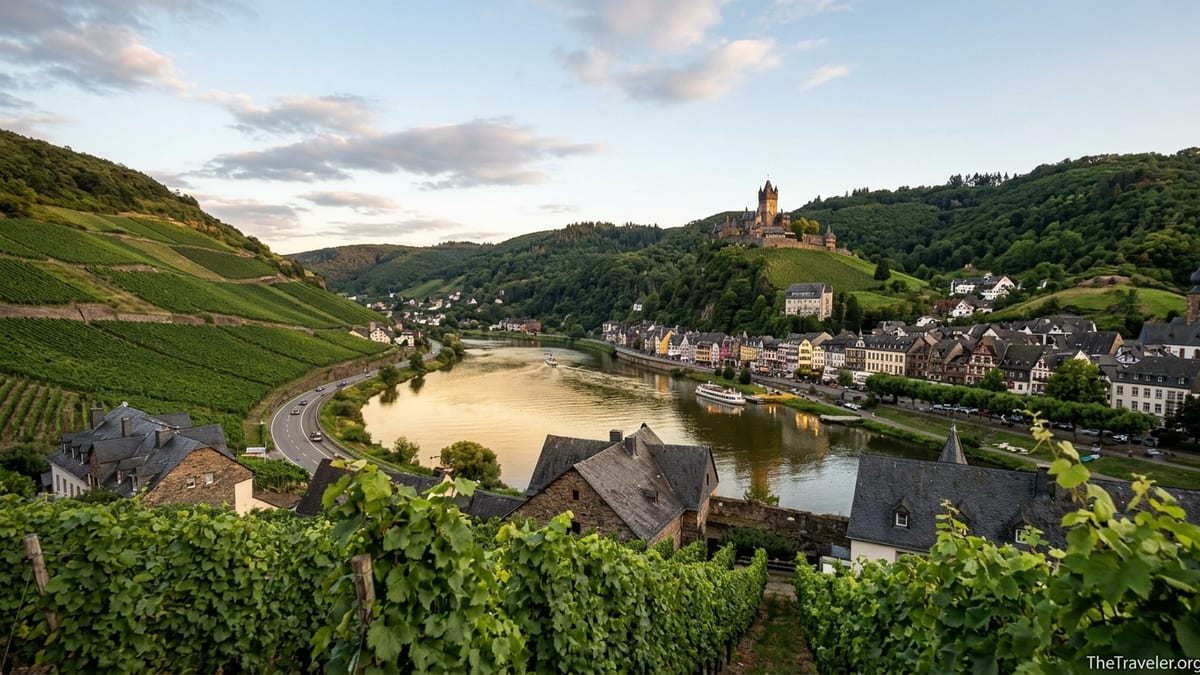
Parking in Cochem itself can be tight in high season, but the town has several designated options. Larger outdoor parking areas sit along the Moselle promenade, while a main parking garage on Endertstrasse and a city parking area at Pinnerstrasse are commonly used by visitors planning to walk up to Reichsburg Cochem. From these car parks the climb to the castle usually takes 15 to 30 minutes on foot, depending on your pace and the exact starting point.
During the main visitor season, typically from spring into autumn, a shuttle bus runs between Cochem’s central area and near the castle entrance. This is particularly useful for travelers with mobility issues or families visiting with small children. Even if you take the shuttle up, the walk back down into town through the vineyards and narrow stairways gives some of the best views over the river loops and slate roofs below.
Historic Trier and Scenic Moselle Side Trips
From Cochem to Trier, you remain largely on the Moselle, giving this leg a relaxed and scenic character. The distance is roughly 110 to 130 kilometers depending on whether you choose the faster inland route via the A1 or the slower but prettier riverside drive through villages like Beilstein, Zell, Traben-Trarbach and Bernkastel-Kues. Many travelers split this journey into a full day, stopping for lunch at a winery restaurant or riverside café in one of these small towns.
Beilstein is compact and almost theatrical in its preserved old streets, but parking is limited; it is sensible to arrive early or choose a weekday shoulder season visit. Zell has more extensive riverside parking and a relaxed promenade ideal for a short walk. In Bernkastel-Kues, most visitors use the signed parking areas just outside the medieval core, then stroll over cobblestones to the timbered market square and up to viewpoints above the vineyards.
Arriving in Trier, Germany’s oldest city, you should plan your parking strategy in advance. The city is larger and busier than Cochem or Bernkastel, with several multi-storey car parks and surface lots around the center. Options near the Porta Nigra gate and along the banks of the Moselle allow you to leave the car and see the major Roman sites on foot, including the amphitheatre, imperial baths and basilica, typically in one long day of sightseeing.
If you have an extra day in the Trier area, consider a loop into the nearby Saar valley or the forested Hunsrück uplands. These regions are less crowded than the main Moselle corridor and offer gently winding roads, reservoirs and smaller wine villages. Many family-run guesthouses in these side valleys provide free on-site parking, making them a cost-effective base if central Trier hotels are busy.
Suggested 5-, 7- and 10-Day Road Trip Circuits
For travelers with limited time, a 5-day circuit captures the highlights without rushing. One workable plan is to spend the first night in Cologne, allowing a late arrival and an evening stroll around the cathedral once you have parked at your hotel. On day two, drive to Aachen for a half day of sightseeing before continuing to a Rhine-side town such as Boppard or St Goar for the night, with time for a castle visit on the way.
Day three of this shorter loop can take you from the Rhine to Koblenz and along the Moselle to Cochem, where you stay two nights. This gives you a full day to explore Reichsburg Cochem, join a short boat trip on the Moselle or drive to nearby wine villages. On day five, you return directly to Cologne from Cochem, which usually takes around two and a half to three hours once you rejoin the Autobahn network.
With 7 days, you can extend your circuit from Cochem downriver to Trier. A common pattern is to spend night one in Cologne, night two near the Rhine castles, night three in Koblenz and night four and five split between Cochem and a Moselle wine village such as Bernkastel-Kues. You then spend night six in Trier before driving back to Cologne on day seven, either via the faster A1 or by rejoining the Moselle above Cochem for a final scenic stretch.
A 10-day itinerary lets you slow the pace and add side trips. You might stay two nights in Cologne to recover from your flight, then dedicate two nights to the Rhine area, moving once between, for example, Boppard and Bacharach. After a further night in Koblenz and two in Cochem, you could spend two in Trier and your final night back near Cologne Bonn Airport for an easy morning departure. With this much time, detours into the Eifel region’s volcanic lakes or extra winery visits on both the Rhine and Moselle become comfortable additions.
Driving, Parking and Seasonal Tips
Parking charges are a realistic part of your budget along this route. In mid-sized towns such as Koblenz, Cochem and Trier, hourly rates in central garages are commonly a handful of euros, with day tickets slightly more. Smaller riverside parking areas in wine villages may use pay-and-display machines that require coins or local parking apps. Keeping a small supply of euro coins in the car is still useful, even as contactless payments become more common.
In summer and during festival weekends, many of these towns close central streets to through traffic or impose restrictions, especially during wine festivals and Christmas markets. If you are visiting in late September for harvest events or in December for Christmas markets, it is smart to book a hotel that includes on-site parking so you can leave the car and explore on foot. This is particularly relevant in Cochem and Bernkastel-Kues, where market stalls and temporary stages occupy central squares that double as parking at quieter times of year.
Weather influences driving comfort as well. Spring and autumn often provide clear views and lighter traffic, but fog can linger in the river valleys on cool mornings, especially along the Moselle. In winter, road crews clear snow efficiently on main routes, but steep approach roads to castles such as Marksburg or to hilltop viewpoints above Cochem can be slippery after snow or frost. A rental car with seasonally appropriate tires is standard practice in Germany, and your rental contract should specify this.
Finally, remember that alcohol limits are strict, and this is a celebrated wine region. If you plan to sample Riesling or local sect in winery tasting rooms, designate a driver who stays within legal limits or consider leaving the car at your accommodation and using local trains, buses or taxis for an evening out. Many Moselle villages are linked by regional rail lines and riverboats, allowing mixed travel days that combine driving, walking and public transport.
FAQ
Q1. Is it better to start this road trip in Cologne or Trier?
Both work, but most international travelers find Cologne easier due to its airport and major rail links, then loop south and west toward Trier before returning.
Q2. Do I need an International Driving Permit to rent a car in Western Germany?
Most visitors from the United States, Canada, the United Kingdom and EU countries can rent with their regular license, though an International Driving Permit can be a useful supplement.
Q3. How stressful is driving on the Autobahn for first-time visitors?
The main challenge is speed differences in the fast lane. Stay in the right-hand lanes, follow posted limits and build confidence before overtaking.
Q4. Can I do this route using only automatic transmission cars?
Yes, but automatic cars are fewer and usually more expensive than manuals, so reserve early and be flexible about vehicle category to secure one.
Q5. Is parking available close to the Rhine castles?
Most major castles such as Marksburg, Rheinfels and Pfalzgrafenstein have dedicated car parks or nearby parking areas, though spaces can be limited at peak times.
Q6. How many days do I really need for Cologne, the Rhine, Cochem and Trier?
A compact version works in 5 days, but many travelers prefer 7 days for a more relaxed pace and 10 days if they enjoy wine villages and side trips.
Q7. Are the Moselle villages suitable for travelers with a rental car?
Yes, most wine villages are very car friendly, with signed parking at the village edge and compact centers that are best explored on foot once you have parked.
Q8. Is it easy to find fuel along the Rhine and Moselle?
Fuel stations are common on main roads and at town edges, though prices on the Autobahn are usually higher than in villages and smaller highways.
Q9. Can I visit both Cochem and Trier as day trips from one base?
It is possible but not ideal; driving times mean you would spend many hours in the car, so most visitors choose at least one overnight stay in or near each city.
Q10. What is the best season for this Western Germany road trip?
Late spring and early autumn often balance pleasant weather, open attractions and manageable crowds, though summer offers the liveliest festival atmosphere along the rivers.